Any renovation project, large or small, can be all-consuming in terms of your energy and money. Here are six loan types that can help you with the latter.

Considering transforming your home from ‘blah’ to ‘brilliant’, but lacking the funds to support your major makeover? Never fear, we’ve rounded up a few different home renovation loans to help you turn your dream into a reality.

Whether you want to make a few finishing touches to your home with the help of a paint job or completely turn your home into something magical, there’s an option to suit your needs.

1 Home equity loan

This is probably the most common way people borrow money when they want to renovate. It involves borrowing against the current value of your home, before any value-adding renovations. You won’t be able to borrow the full value of your home but, without mortgage insurance, you can usually borrow up to 80 per cent of its value if you own it outright. One potential problem is that the cost of your renovations may actually be higher than the equity you have available.

2 Construction loan

This is similar to a home equity loan, except the lender will take into account the final value of your home after the renovation. You won’t be given the full loan amount upfront, but in staggered amounts over a period of time.

3 Line of credit

This may be ideal for ongoing or long-term renovations. When you apply, you can establish a revolving credit line that you can access whenever you want up to your approved limit. You only pay interest on the funds you use and, as you pay off your balance, you can re-borrow the unused funds without reapplying. However, care must be taken not to get in over your head in terms of serviceability – make sure you can make repayments on the line of credit that will reduce the principle. Read more about Line of credit here.

4 Homeowner mortgage

If you’re planning to completely transform your home and undergo a major makeover, this may be a good option as you can spread the cost over a long period of time. You could even possibly borrow up to 90 per cent of the value of your home and take advantage of mortgage rates, which are often lower than credit card and personal loan rates.

5 Personal loan

If you’re only making minor renovations – personal loans are usually capped at around $30,000 – this might be suitable, but interest rates on personal loans are higher than on home equity loans.

6 Credit cards

This option is only if you want to undertake really small renovation projects. The interest rates are usually much higher than on mortgages, but for a very small project that extra interest might actually total less than loan establishment fees.

One thing you must do

There are very few exceptions to the rule that your renovations should add more value to your home than they will cost to carry out. Think about how the money you spend on a renovation will increase the value of your property. For example, consider making changes that would appeal to the majority of potential buyers to help you sell your house faster and at a higher price.

If you would like to discuss, please call us on Phone: 07 5641 4134 or email martin@wtfp.com.au


Source:

Reproduced with the permission of the Mortgage and Finance Association of Australia (MFAA) 

Important: 

This provides general information and hasn’t taken your circumstances into account. It’s important to consider your particular circumstances before deciding what’s right for you. Although the information is from sources considered reliable, we do not guarantee that it is accurate or complete. You should not rely upon it and should seek qualified advice before making any investment decision. Except where liability under any statute cannot be excluded, we do not accept any liability (whether under contract, tort or otherwise) for any resulting loss or damage of the reader or any other person.

Any information provided by the author detailed above is separate and external to our business and our Licensee. Neither our business, nor our Licensee take any responsibility for their action or any service they provide.

What is the equity risk premium?

To compensate for their greater short-term volatility and risk of loss, shares should provide a return differential over a ‘risk free’ asset like government bonds over the long term. This return differential is referred to as the equity risk premium (ERP) and used to be thought of as being around 5% pa or more as this is what it had been for much of the post World War Two war period. But thanks largely to the 2007-09 global financial crisis (GFC), global shares have underperformed global bonds by around 1% pa over the last decade and Australian shares have underperformed Australian bonds by around 2.1% pa. Does this mean the equity risk premium concept is meaningless and that shares are a dud? The answer is no.

As the ERP concept relates to the very long term, the last decade or so proves nothing about its merits. Unfortunately, much confusion and disagreement surrounds the ERP. This is largely because it can refer to three different things: the historically realised return gap between equities and bonds; the gap required by investors to attract them to invest in equities; and the prospective (or likely) long-term gap based on current valuations. A key issue is not what equities have done relative to bonds in the past but what their potential is going forward. These concepts can move in opposite directions.

The historical (or ex post) equity risk premium

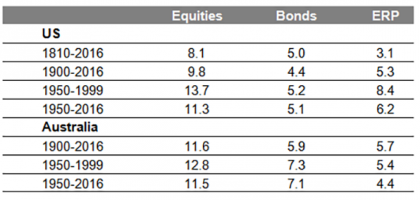
Many analysts tend to focus on historical data as a guide to what sort of return premium investors require for shares over bonds and to what it will be in future. However, while a useful starting point, this approach has limitations. Firstly, the historically realised return differential between equities and bonds varies significantly over time. As can be seen in the next table, between 1950 and 1999 the ERP was 8.4% pa in the US. But if the period is extended to 2016, the ERP falls to 6.2% pa. Similarly the realised ERP for Australian shares was 5.4% pa over the 50 years from 1950, but if the period is extended to 2016 it drops to 4.4% pa.

Nominal returns, % pa

instability of the realised ERP
Source: Global Financial Database, Thomson Financial, AMP Capital

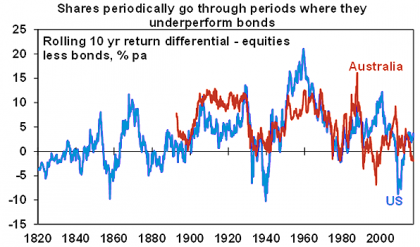
The instability of the realised ERP is highlighted below. Over rolling 10-year periods, the excess return from shares over bonds has varied from around -10% to +20% pa in the US and from around -7% to +17% pa in Australia. So the negative or low equity risk premium experienced in recent times is not unusual in an historic context. There is also a degree of mean reversion in the chart, with periods of low excess returns from shares being followed by periods of high excess returns, and vice versa. So the poor performance of shares versus bonds over the last decade globally and in Australia suggests there is a good chance of shares outperforming bonds over the decade ahead (just as the US share market has already shown).

Nominal returns, % pa
Source: Global Financial Data, Thomson Reuters, AMP Capital

Obviously, the starting and end point valuation for markets for any period can heavily affect the size of the realised risk premium, even over long periods. For example, over the 50 years from 1950, equity returns were boosted by the fact that shares were depressed relative to earnings in 1950 (in the aftermath of the Great Depression and WWII) and so generated strong capital gains over the next 50 years as share prices rose relative to earnings. As a result, over the 1950 to 1999 period shares outperformed bonds by a very wide margin. However, by changing the end point to the end of 2016, the return from shares has been reduced thanks to the tech wreck and GFC. The point is that even when measuring over long periods the starting point and end point have a big impact on the measured equity risk premium.

Secondly, to the extent valuation changes (rising price to earnings multiples) boosted the realised ERP over the post-war period, this would have not been expected by investors and hence the measured ERP over that period is not a good guide to what they would have required to invest in shares.

Thirdly, in any case it is difficult to justify why investors would have demanded such a large premium (ie, 8.4% pa in the US and 5.4% pa in Australia over the 50 years from 1950). This would imply an implausibly high degree of risk aversion. It’s interesting to note that if we go way back to 1810, the US equity risk premium is just 3.1% pa.

Finally, historical equity data for countries like the US and Australia suffers from a survival bias. An investor who bought into German and Japanese shares in 1900 would have been wiped out along the way.

For these reasons, while an analysis of the past is a good starting point it does not provide a definitive guide as to what the equity risk premium should be or will be.

The required equity risk premium

We have already noted the historically realised ERP is not a good guide as to what investors actually require to invest in shares. The 5% plus ERP achieved in much of the post-war period was in large part due to a windfall gain to equity investors they were not expecting or requiring. Several considerations suggest that the required ERP has fallen and is now well below this, including:

  • improved regulatory and legal protection for investors, which means less risk from investing in shares;

  • lower trading costs in equities, greater scope to spread risk via diversification and improved market liquidity making it much easier to get out when desired;

  • increased demand for shares from pension funds helped by tax concessions on retirement savings;

  • the fall in inflation from the 1970s and 1980s, which has likely resulted in a higher quality of earnings;

  • this and less regular recessions should have reduced economic uncertainty – although this may have been partly reversed following the GFC and the constrained and fragile growth profile seen since then;

  • a greater feeling of global political security with no major wars since the end of WW2 and the end of the Cold War – although again this may have been partly reversed following the rise of terrorism and populist/nationalist politics.

While the GFC, the rise of terrorism and populism and a more risk-averse older population may have partly offset some of these favourable factors, the broad trend is still positive and suggests investors should demand a lower risk premium than, say, 50 or 100 years ago. Our assessment is that the appropriate equity risk premium going forward for US and global equities is somewhere around 3%. For Australian shares, fewer opportunities for diversification justify a slightly higher premium of around 3.5%, and for Asian shares greater economic and market volatility suggest a required ERP of around 4%. However, what will actually be delivered going forward is a different matter.

The prospective (or ex ante) equity risk premium

A simple way to think of the prospective (or likely) ERP for the next five to 10 years at any point in time is as follows:

Likely ERP = Dividend Yld plus Growth Rate less Bond Yld

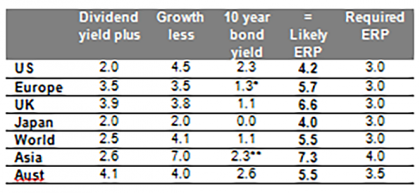
The Growth Rate is the growth rate in share prices and this is assumed to equal the long run growth rate in listed company earnings. This in turn is assumed to equal long-term nominal growth in the economy (with some adjustments). This approach makes sense as the return on shares equals dividend income plus capital growth. The table below provides current figures for each of these, the prospective ERP in the second last column and our estimate of the required ERP in the final column.

The prospective ERP over the next 5 to 10 years, % pa
* Average of Germany, France, Italy & Spain. ** US bond yield. Source: Bloomberg, AMP Capital

This suggests that likely ERPs for shares are above what we think is required. This is particularly so for Europe, Asia and Australia but less so for the US (which has outperformed in recent years) and Japan (thanks to poor growth prospects). Of course, this calculation of the prospective risk premium assumes that bond yields are unchanged. The risk over the next few years is that bond yields rise towards more normal levels as central banks raise interest rates and inflation picks up. This will result in capital losses on government bond investments and hence a potentially higher excess return from shares over bonds. Of course if bond yields rise rapidly this could negatively impact share markets but this is unlikely given still low underlying inflation pressures globally and only a gradual removal of still easy monetary conditions. And the positive gap between the prospective and required equity risk premiums indicates shares have a bit of a buffer on this front.

Concluding comments

  • The historical record does not provide a definitive guide as to the risk premium that shares should or will offer over bonds. Just as the recent negative excess return from global and Australian shares over the last decade understates the return from shares over bonds, longer-term perceptions of a 5% plus return excess based on history exaggerate it;

  • A range of factors suggests the required ERP is somewhere around 3-4% pa;

  • Current estimates suggest the prospective ERP is above this, particularly for European, Asian and Australian shares.

While stocks are vulnerable to a correction after their sharp gains since February last year, their attractive risk premium compared to bonds along with the favourable outlook for growth and profits suggests that any short-term pullback in shares will simply be a correction in a still rising trend.


Source: AMP Capital 3 May 2017

About the Author

Dr Shane Oliver, Head of Investment Strategy and Economics and Chief Economist at AMP Capital is responsible for AMP Capital’s diversified investment funds. He also provides economic forecasts and analysis of key variables and issues affecting, or likely to affect, all asset markets.

Important note: While every care has been taken in the preparation of this article, AMP Capital Investors Limited (ABN 59 001 777 591, AFSL 232497) and AMP Capital Funds Management Limited (ABN 15 159 557 721, AFSL 426455) makes no representations or warranties as to the accuracy or completeness of any statement in it including, without limitation, any forecasts. Past performance is not a reliable indicator of future performance. This article has been prepared for the purpose of providing general information, without taking account of any particular investor’s objectives, financial situation or needs. An investor should, before making any investment decisions, consider the appropriateness of the information in this article, and seek professional advice, having regard to the investor’s objectives, financial situation and needs. This article is solely for the use of the party to whom it is provided.

One of the underlying attributes of Australia’s superannuation system is that it starts young adults saving for retirement as soon as they join the workforce.

Without compulsory super contributions, many millennials – aged in their twenties to thirties and also known as members of Generation Y – may have second thoughts about saving for retirement early in their working lives.

Any reluctance to begin saving for retirement at a relatively early age is understandable given that their post-working days might be 40 years away or so.

A challenge, of course, is to convince millennials that saving for the really long-term is worthwhile. And part of that challenge is to persuade millennials about the value of adding to their superannuation guarantee (SG) contributions in such ways as making salary-sacrificed contributions.

A recent New York Times personal finance feature – For millennials, it’s never too early to save for retirement – comments that it is “perennially true” that most young adults don’t make retirement savings a priority.

However, its author tellingly adds, “millennials are in an ideal position to get started” because their perhaps seemingly modest regular savings have the opportunity to grow substantially over time.

The article is largely based on interviews with five people aged 28 to 32 about their attitudes towards savings and investing. The interviews produced some surprising and not-so-surprising responses.

For instance, a 28-year-old accountant interviewed has been saving for retirement since she was 17 and arranges with her husband for one of their salaries be saved each pay day. However, several of those interviewed recognise the need to properly save for retirement yet have never quite got around to it.

High in the reasons why young adults should begin saving and investing as early as possible is to reap the rewards of what is sometimes called “the magic of compounding”.

Compounding occurs when investors earn investment returns on past investment returns as well as on their original capital. And the compounding returns can really mount (or compound) over the long term – particularly the extremely long term.

Ways to get the most out of compounding include:

  • Start to save and invest as early as possible in your working life with as much as possible. Compounding needs plenty of time to produce its best results.

  • Invest regularly to keep building your investment capital and to accelerate the benefits of compounding.

  • Adhere to an appropriate long-term asset allocation for your portfolio – with enough exposure to growth assets.

A perhaps overlooked attribute of compounding is that disciplined investors who reinvest their earnings are less likely to be distracted from their long-term course by the latest market noise such as a bout of higher market volatility. Meanwhile, there returns keep compounding.

Current retirees who had recognised the value of compounding at the beginning of their working lives should now be enjoying its rewards.

If you would like to discuss, please call us on Phone: 07 5641 4134 or email martin@wtfp.com.au.


Source:

Written by Robin Bowerman, Head of Market Strategy and Communications at Vanguard.

Reproduced with permission of Vanguard Investments Australia Ltd

Vanguard Investments Australia Ltd (ABN 72 072 881 086 / AFS Licence 227263) is the product issuer. We have not taken yours and your clients’ circumstances into account when preparing this material so it may not be applicable to the particular situation you are considering. You should consider your circumstances and our Product Disclosure Statement (PDS) or Prospectus before making any investment decision. You can access our PDS or Prospectus online or by calling us. This material was prepared in good faith and we accept no liability for any errors or omissions. Past performance is not an indication of future performance.

© 2017 Vanguard Investments Australia Ltd. All rights reserved. 

Important:

Any information provided by the author detailed above is separate and external to our business and our Licensee. Neither our business, nor our Licensee take any responsibility for their action or any service they provide.

Despite numerous geopolitical threats (Eurozone elections, tensions between the US and China, North Korea, etc.), worries about the demise of the so-called “Trump trade” and shares being overbought and due for a correction at the start of the year, share markets have proved to be remarkably resilient with only a minor pull back into their recent lows. This despite a more significant fall back in bond yields. Partly this is because the geopolitical threats have not proven to be major problems (at least so far) and Trump remains focussed on his pro-business policy agenda (he has already embarked on deregulation and his tax reform proposals – while lacking in details – indicate that tax reform remains a key objective). More fundamentally though, markets have been underpinned by an improvement in global growth. This is likely to continue.

Global economy best in years

Numerous indicators point to a stronger global economy.

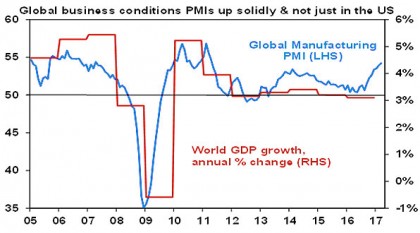
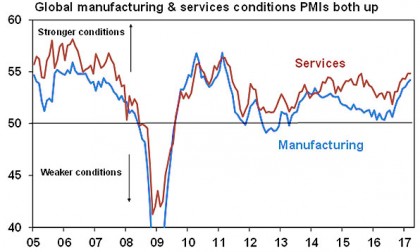
  • Business condition indicators – commonly called purchasing managers’ indexes or PMIs – have moved up to their highest since the post GFC bounce.


Source: Bloomberg, AMP Capital

This is the case for manufacturing and services sectors and for advanced and emerging countries. This generally points to stronger growth ahead. Believe it or not the Eurozone currently looks to be the star performer on this front.


Source: Bloomberg, AMP Capital

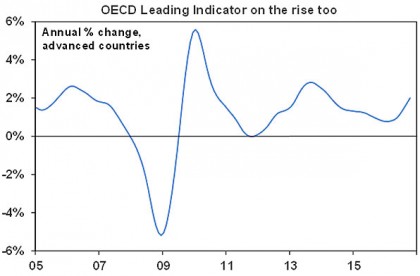
  • The OECD’s leading economic indicators (basically a combination of economic indicators that lead economic growth) have turned up decisively.


Source: OECD, Bloomberg, AMP Capital

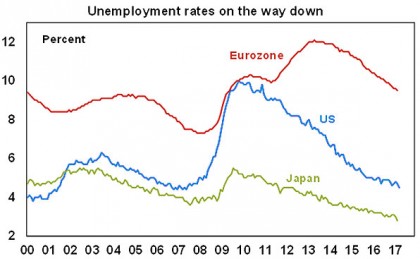
  • Consistent with improving global economic conditions, measures of unemployment are heading down in the major advanced countries (albeit they still have further to go in Europe).


Source: Bloomberg, AMP Capital

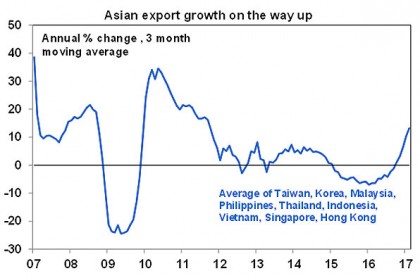
  • Asian economies which are always a good barometer of the health of the global economy are seeing a solid rebound in export growth. So much for all the talk that world trade and globalisation had peaked!


Source: Bloomberg, AMP Capital

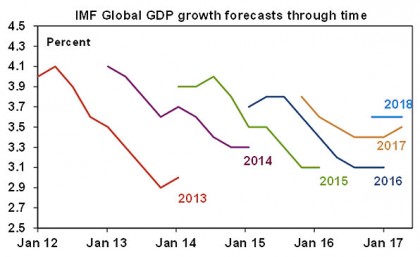
  • Reflecting the improvement in global growth, for the first time in years the IMF’s latest World Economic Outlook update revised up its global growth forecast for the current year (2017) to 3.5% from 3.4% rather than revised it down as had become the norm.


Source: IMF, AMP Capital

Of course, there is one qualification to all these positive signs (there is always something!) and that is that the US economy looks to have seen a soft start to the year as measured by GDP growth. However, March quarters in the US seem to regularly come in on the soft side initially only to get revised up later and be followed by a bounce back in growth suggesting a seasonal adjustment problem. US unemployment claims running around their lowest since the early 1970s – no mean feat given that the US economy and population are much bigger today – tell us that the US economy remains strong despite a soft March quarter.

So why the turn for the better in global growth?

There are a bunch of factors driving healthier global growth including:

  • Years of ultra-easy monetary policy – zero and even negative rates and money printing – have finally got traction.

  • Fiscal austerity has largely come to an end.

  • Memories of the global financial crisis (GFC) and hence fears of another re-run are gradually receding – after all it is now 9-10 years ago (shares peaked in 2007!) – and so the negative impact on confidence is gradually receding too.

  • Deleveraging (or the desire to reduce debt ratios) post the GFC – to the extent that it occurred – has arguably run its course.

Investment implications

The pick-up in global growth is not so strong as to tell us that we are near the peak of the cycle. Spare capacity remains in labour markets, factories are still not running at full capacity, wages growth remains relatively weak (albeit it’s trending up a bit in the US) and core inflation remains low (just 0.7% year on year in the Eurozone, 0.1% in Japan, 1.8% in the US and 2.3% in China). Out of interest the US Leading Economic Indicator has only just surpassed its pre GFC high and historically it’s then taken six years on average for the next recession to start.

In other words we are a long way from boom times that then give way to a bust. Nevertheless, the implications of the healthier global economy are likely to be:

  • Ongoing support for share markets – as stronger growth underpins further gains in profits – which should mean reasonable returns from shares.

  • Support for commodity prices – although it’s doubtful they will take off given the lagged impact of rising supply but it should mean we have seen the lows.

  • A bottoming in the global interest rate cycle. The Fed will continue its gradual tightening in monetary policy in the US with two more rate hikes likely this year and a start to reversing quantitative easing later this year via a phased reduction in the Fed rolling over its bond holdings as they mature. China is likely to continue tightening gradually as well. Other countries will eventually follow (albeit very slowly in Europe and then in Japan – but that could be years away).

  • A resumption of the rising trend in government bond yields – after the pause seen since December – which is likely to mean low returns from government bonds.

  • A rising trend in bond yields – albeit a gradual one – will weigh on bond proxies such as global real estate investment trusts and listed infrastructure assets constraining their returns relative to the double digit gains they have seen over the last five years in response to the prior plunge in bond yields.

For Australia, the stronger global growth back drop is a positive in supporting export demand and confidence which in turn should help support Australian economic growth pick up towards 3%. Which in turn adds to confidence that the official cash rate has bottomed. However, with downside risks to growth remaining as mining investment is still falling, underemployment remaining very high, wages growth still ultra-weak, the $A remaining relatively strong and core inflation remaining below target we remain of the view that an RBA rate hike is unlikely until the second half of 2018.

Source: AMP Capital 27 April 2017

Author

Dr Shane Oliver, Head of Investment Strategy and Economics and Chief Economist at AMP Capital is responsible for AMP Capital’s diversified investment funds. He also provides economic forecasts and analysis of key variables and issues affecting, or likely to affect, all asset markets.

Important note: While every care has been taken in the preparation of this article, AMP Capital Investors Limited (ABN 59 001 777 591, AFSL 232497) and AMP Capital Funds Management Limited (ABN 15 159 557 721, AFSL 426455) makes no representations or warranties as to the accuracy or completeness of any statement in it including, without limitation, any forecasts. Past performance is not a reliable indicator of future performance. This article has been prepared for the purpose of providing general information, without taking account of any particular investor’s objectives, financial situation or needs. An investor should, before making any investment decisions, consider the appropriateness of the information in this article, and seek professional advice, having regard to the investor’s objectives, financial situation and needs. This article is solely for the use of the party to whom it is provided.

If you’re an American, you’re much more likely to rent your home or apartment today than you were ten to twenty years ago. If Seinfeld were filmed today, Jerry would still be renting his apartment on the Upper West Side of Manhattan, rather than owning it.

A slump in home ownership in the United States is a trend that investors of all sizes can tap into and benefit from.

A larger pool of renters is good news for companies that specialise in owning and leasing apartments. There is a group of high-quality US apartment REITs that benefit from the renting trend, and provide a good opportunity for Australian investors to gain exposure to the growth in US rentals, to generate income streams, and to achieve offshore diversification in their property portfolio.

The influence of Millennials

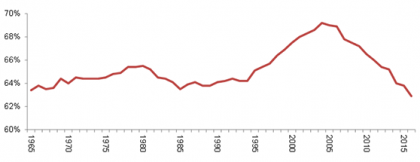
As shown in Figure 1 below, US homeownership has fallen steadily since the Global Financial Crisis (GFC) to a level not seen since Lyndon B. Johnson occupied the White House 50 years ago.

Figure 1: US homeownership rate (1965 to 2016)

US homeownership rate (1965 to 2016)

Source: US Census Bureau

During the GFC, home ownership in the US fell as many Americans struggled to service their home loans. 

As the economy improved, you may have expected this trend to revert – however, the slump in home ownership has continued. One explanation is that the tarnished credit records suffered during the GFC still haunt some borrowers who remain locked out of the mortgage market. Banks – under greater regulatory scrutiny – have also tightened loan requirements.

But there is another explanation for the sustained drop in home ownership: the preferences of Millennials (those born between 1980 and 2004).

Millennials now make up the largest share of the American workforce, a proportion which is set to rise to 75 per cent by 2025. As the largest source of new demand for housing, be it home sales or rentals, this cohort wields significant influence over the residential real estate market.

Millennials want to rent. This should come as no surprise. After all, this is the generation that pioneered and embraced the “sharing economy”, a collaborative approach to consumption that draws heavily on the notion of renting.

Millennials are marrying later in life; prefer proximity to nightlife and the workplace; seek flexibility as they switch jobs readily; and are struggling to save for down payments. These factors combined contribute to a greater tendency to rent.

As a result, there has been an increase in demand for rented apartments, particularly in what is dubbed the ‘urban core’: areas of high density in and around city centres.

The impact on the apartment business

With renting being both more acceptable and common, there are meaningful implications for real estate assets. Clearly, the movement of the prime renter demographic into the city centre will have an impact on apartment values.

A bigger pool of renters means a more stable business. An increasingly older tenant base (Millennials rent later into life) should also allow for healthier rent increases. 

Lastly, because of land and development constraints in dense, urban areas – which will become increasingly more onerous over time – existing high quality, core product will be at an advantage.

Exposure through US apartment REITs

Broadly, this change in American dwelling habits is a positive for residential landlords. Investors can gain exposure to that upside potential through the listed institutional apartment operators.

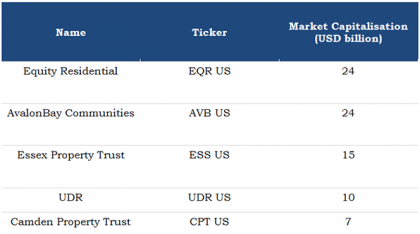
These apartment (Real Estate Investment Trusts) REITs are generally of high quality and have seen significant consolidation in recent times – five such REITs have been acquired or have merged during the past three years alone – leaving an investible set of large, well-capitalised companies with seasoned management teams, as shown in Figure 2.
 
Figure 2: Largest US Apartment REITs by Market Capitalisation

Largest US Apartment REITs by Market Capitalisation

Source: Bloomberg, as at December 2016

The listed apartment REITs’ assets are predominantly located in the urban core, where renting is most common and where further development is increasingly difficult. A greater focus on public transportation links should further benefit the high-quality apartment names.

As always, expertise counts when identifying those companies with best-of-breed management teams and asset portfolios in order to deliver an attractive, long-term real estate return. 

Investors should therefore consider dedicated listed real estate managers with on-the-ground coverage and the ability to tap into local market insight, to deliver a conviction portfolio of liquid, high-quality real estate.

A more attractive through-cycle investment

The emergence of the Millennials as the single largest demographic in the United States, accounting for an ever-growing proportion of the American workforce, has brought with it a shift in the value paradigm driving residential real estate consumption.

Affordability challenges and demographic change have resulted in a larger share of the population living and renting in the city centre. Over the property cycle, the US apartment REITs should therefore be in a stronger position to push rents, given the larger demand base. Quality management teams with insight into the needs of Millennials will be best placed to deliver value for investors. 

This is not to say that the US apartment REITs will always outperform. Indeed, there will be times when better opportunities present themselves, particularly if investing across the global listed real estate universe.

However, we believe that this subsector is a more attractive through-cycle investment because of the structural tailwinds described above.

This article was based on the ‘Generation Rent: The symbiosis of apartment REITs and Millennials’ whitepaper which can be downloaded here.


Source: AMP Capital 12 April 2017

Author
Christopher Deves
Client Portfolio Manager, Global Listed Real Estate at AMP Capital

Important note: While every care has been taken in the preparation of this document, AMP Capital Investors Limited (ABN 59 001 777 591, AFSL 232497) and AMP Capital Funds Management Limited (ABN 15 159 557 721, AFSL 426455) make no representations or warranties as to the accuracy or completeness of any statement in it including, without limitation, any forecasts. Past performance is not a reliable indicator of future performance. This document has been prepared for the purpose of providing general information, without taking account of any particular investor’s objectives, financial situation or needs. An investor should, before making any investment decisions, consider the appropriateness of the information in this document, and seek professional advice, having regard to the investor’s objectives, financial situation and needs. This document is solely for the use of the party to whom it is provided.

After the election of Donald Trump in November 2016, a surge in global yields triggered a sharp sell-off in global listed infrastructure. Global listed infrastructure fell 4 per cent that month and underperformed global equities by 12 per cent – the second worst monthly relative performance since 2002.

With the threat of further yield rises looming, it’s understandable advisers and their clients would be concerned about the outlook. 


Nonetheless, investors shouldn’t give up on this important investment class. There are strong reasons advisers should remain faithful, and focus not on short-term market movements, but on the resilience of global listed infrastructures’ underlying assets and their ability to generate visible and growing cash flows.

Bond proxies

It’s not surprising that global listed infrastructure as an asset class is sensitive to rate rises in the short term.

Infrastructure companies provide owners with stable and reliable streams of cash flow, often paid out as regular dividends. That risk/reward profile is usually compared to those of other lower-risk investments such as fixed income, thus receiving the term ‘bond proxies’ from time to time. 

The tools used to value infrastructure assets are rate sensitive, as are regulatory frameworks and contracts that are based on allowed rates of return. Infrastructure assets often have higher leverage, and higher rates can impact financing costs and ultimately cash-flow streams themselves.

Surprising resilience

What is surprising is the asset class’ ability to weather rate rises over time.

November was not the first time in recent history that yields have risen, causing global listed infrastructure to underperform global equities in the short term.

We have seen four distinct periods of sizeable and protracted increases (at least 75 basis points lasting for more than 100 days) in long-term interest rates since the end of the Global Financial Crisis (GFC), which marks the beginning of the current business cycle.

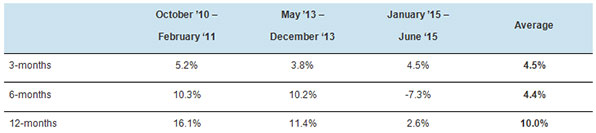
As shown in the table below, each of these periods, including the Taper Tantrum in 2013, exhibited similar dynamics: increasing nominal and real (above inflation) sovereign yields, strong performance of global equities, and relative underperformance of global listed infrastructure. 

Table 1. Absolute performance during periods of rising yields

Absolute performance during periods of rising yields

Past performance is not a reliable indicator of future performance.

However, as you can see in the next table, global listed infrastructure recovered all the relative underperformance to global equities in the 12 months following these periods of increases in nominal yields.

Table 2.  Relative performance following periods of rising yields – Global Listed Infrastructure vs. Global Equities

 Relative performance following periods of rising yields – Global Listed Infrastructure vs. Global Equities

Past performance is not a reliable indicator of future performance.

One key reason for the absolute and relative recovery in performance (besides a normalization of interest rates) is the recognition of the asset class’s long-term stability of cash flows. 

It is important to differentiate between the short-term volatility of equity prices and the long-term stability of cash flows, which, in our view, explains the strong correlation between the long-term performance of the asset class and its cash flow growth. 

Sector diversification

If investors are unconvinced and still concerned, but would like ongoing exposure to global listed infrastructure, an understanding of specific characteristics of regions and sectors within the asset class can help them position investments to mitigate some interest rate risk.

The drivers of cash flows of a communication tower company in Italy are very different from those of an electric utility company in the US, or an airport in Australia; regulatory frameworks and contract structures vary greatly from sector to sector and from region to region.

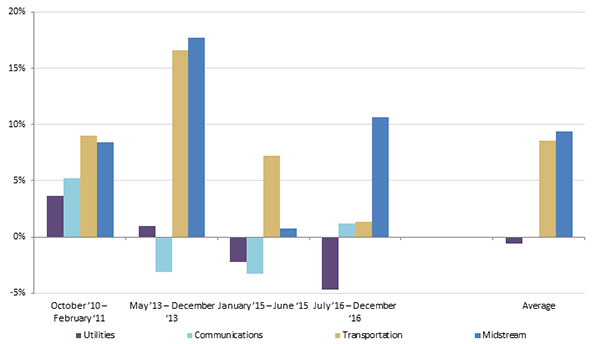
  • Utilities are perhaps the companies with the highest sensitivity to changes in interest rates, given their long duration, above-average financial leverage, and highly regulated activities with very limited exposure (if any) to economic growth.

  • Communication infrastructure companies also have a relatively long duration and above-average financial leverage, which makes them highly sensitive to changes in interest rates as well. However, exposure to secular growth thematics (such as mobile data traffic) partially offsets the impact of rising rates.    

  • Transportation companies generally are the least sensitive to changes in interest rates, given they have the greatest exposure to economic growth. Having said that, interest rates tend to impact the sector in different magnitudes because of the diverse regulatory frameworks of assets, the length of concessions and financial leverage. 

  • The Oil & Gas Storage and Transportation sector’s sensitivity to changes in interest rates is also relatively lower. The long duration of the life of the assets and above-average financial leverage are offset by higher exposure to economic growth and, more importantly, region and/or sector-specific growth dynamics, which may be more affected by changes in commodity prices. Given these unique drivers, the sector is also relatively de-correlated from the broader asset class. 

With the different duration, regulatory frameworks and exposure to economic growth, it is not surprising that, as seen in the chart below, global listed infrastructure’s sectors have performed quite differently during those periods of rising sovereign yields.

Performance of Global Listed Infrastructure sectors

Performance of Global Listed Infrastructure sectors

Source: AMP Capital, Dow Jones, Bloomberg, December 2016
Past performance is not a reliable indicator of future performance.

An opportunity in underperformance

Income-generating assets play a crucial role in clients’ ability to fund their goals and dreams, particularly retirees and there is no doubt the prospect of future rate rises is creating a challenging period for advisers.

With its strong cash flow characteristics, global listed infrastructure is an important asset class in any adviser’s toolkit. 

It would be a shame to panic in the face of short-term relative underperformance and either ignore the asset class completely, or sell out.

Indeed, we believe that the volatility of listed infrastructure equities triggered by short-term increases in interest rates actually presents an opportunity for investment managers like ourselves, as well as advisers, to capitalize on the dislocation of value and price.

By investing in a truly diversified portfolio of companies within global listed infrastructure, we believe that advisers can mitigate a lot of the risk arising from macro factors, such as interest rates. 

This article was based on the Global Listed Infrastructure: Not just a bond proxy whitepaper. Click here to read the full paper.
 

Source: AMP Capital 12 April 2017

Important note: While every care has been taken in the preparation of this document, AMP Capital Investors Limited (ABN 59 001 777 591, AFSL 232497) and AMP Capital Funds Management Limited (ABN 15 159 557 721, AFSL 426455) make no representations or warranties as to the accuracy or completeness of any statement in it including, without limitation, any forecasts. Past performance is not a reliable indicator of future performance. This document has been prepared for the purpose of providing general information, without taking account of any particular investor’s objectives, financial situation or needs. An investor should, before making any investment decisions, consider the appropriateness of the information in this document, and seek professional advice, having regard to the investor’s objectives, financial situation and needs. This document is solely for the use of the party to whom it is provided.

In this article, we share the long-term investment trends that we expect to be prominent in 2017.

These include:

  • Sugar and obesity
  • Disruption
  • Climate change
  • Corporate governance
  • Social license to operate
  • Supply chain scrutiny
  • Factory farming

Sugar and obesity: a risk to earnings

Sugar is emerging as one of the most prominent investment risks for the global food and beverage industry. Science has linked high sugar consumption to obesity and Type 2 diabetes at a time when obesity rates are rising and healthcare costs for governments are growing. A long-term trend toward health and wellness is already limiting the growth profile of companies manufacturing and selling products with high sugar content.

Disruption: technology with the potential to upend mature industries

In 2017, we expect the next generation of disruptive technologies to deliver the first waves of impact. A few industries in particular will see technology change the way they do business, namely manufacturing (automated vehicles/driverless cars), finance (Blockchain) and retail (online retail moving offline).

Climate change: momentum on renewables will continue.

The private sector is proactively preparing for a renewables-centric and climate change-resilient world. The continued focus on renewables and energy security will ensure that electricity prices and energy will remain heated discussions globally in 2017. This is likely to add to short term uncertainty for investors as well as utility and fossil fuel companies in the medium term.

Corporate governance: CEO pay and persistence of bonuses

The spotlight on executive pay is firmly on bonuses and long-term incentives as fixed pay appears to have receded to pre-Global Financial Crisis levels but bonuses at some companies appear consistently high. With increased investor focus on the components of executive pay and whether or not the hurdles that determine vesting reward stretch performance, executive pay will be a key issue for investors in 2017.

Social licence to operate

Key in 2017 will be the remuneration structures financial services firms have in place for front-line sales staff. If there are sales incentives for those who sell to customers, the structure of these incentives will be scrutinised as well as the presence of safeguards to ensure that customers are sold products that are in their best interests, irrespective of internal sales targets. Investors now recognise that sales targets alone may deliver growth in the short term but the flipside is a risk to earnings and reputation in the medium to long term, if sales targets are not checked with measures to ensure that those sales are in customers’ best interests.

Supply chain scrutiny broadens beyond the garment sector (electronics, food and agriculture sectors)

Globally, some of the largest retailers and manufacturers are only just starting to audit their lengthy supply chains in response to growing scrutiny that is unlikely to abate. For instance, the Modern Slavery Act in the UK will increase attention on human rights across all sectors and all supply chains. Ultimately, a lack of control over a supply chain raises the risk of business interruption and reputational damage and investor awareness of this issue is important.

Food and agriculture: human resistance to antibiotics

Recent scientific studies have linked human resistance to some types of antibiotics to their use in meat production. As consumers become more educated about the potential health risks, they are likely to demand antibiotic-free meat. Reduced use of antibiotics by factory farmers will change cost structures and may lead to price rises for consumers. Consumption patterns may therefore also change, affecting the growth and profitability of listed food and agricultural companies globally.

Final thoughts

As long-term investors, understanding the way the world is changing is crucial. At any point in time, a complex web of trends is shaping industries, creating headwinds and fuelling tailwinds.

Source: AMP Capital 12 April 2017

Author
Kristen Le Mesurier
Senior ESG Analyst, Investment Research, AMP Capital

Important note: While every care has been taken in the preparation of this article, AMP Capital Investors Limited (ABN 59 001 777 591, AFSL 232497) makes no representations or warranties as to the accuracy or completeness of any statement in it including, without limitation, any forecasts. Past performance is not a reliable indicator of future performance. This article has been prepared for the purpose of providing general information, without taking account of any particular investor’s objectives, financial situation or needs. An investor should, before making any investment decisions, consider the appropriateness of the information in this article, and seek professional advice, having regard to the investor’s objectives, financial situation and needs. This article is solely for the use of the party to whom it is provided and must not be provided to any other person without the express written consent of AMP Capital. © 2017 AMP Capital Investors Limited.

No-one wants to think about death in the prime of life. But it’s important to decide what will happen to your assets when you die. Find out how you can give instructions to your family about your legal and medical preferences should you fall ill or lose the capacity to make those decisions yourself.

Estate plans

An estate plan includes your will as well as any other directions on how you want your assets distributed after your death. It includes documents that govern how you will be cared for, medically and financially, if you become unable to make your own decisions in the future.

You must be over 18 and mentally competent when you draw up the legal agreements that form your estate plan. Key documents might include:

  • Will

  • Superannuation death nominations

  • Testamentary trust

  • Powers of attorney

  • Power of guardianship

  • Anticipatory direction

If you have made a binding nomination in your super or insurance policies, the beneficiaries named in those policies will override anyone mentioned in your will. If you have a family trust, the trust continues and its assets will also be distributed according to the trust deed, no matter what is written in your will.

You should ask a legal professional to check your estate plan. A good estate plan should minimise the tax paid by your heirs, and help avoid any family squabbles.

Wills

A will takes effect when you die. It can cover things like how your assets will be shared, who will look after your children if they are still young, what trusts you want established, how much money you’d like donated to charities and even instructions about your funeral.

Your will can be written and updated by private trustees and solicitors, who usually charge a fee. Some Public Trustees will not charge to prepare or update your will, but only if they act as the executor of your will. Other Public Trustees may only exempt you from charges if you are a pensioner or aged over 60. Check with the Public Trustee in your state or territory.

  • ACT – Public Trustee and Guardian for the ACT
  • NSW – NSW Trustee and Guardian

  • Northern Territory – Office of the Public Trustee

  • Queensland – The Public Trustee of Queensland

  • South Australia – Public Trustee South Australia

  • Tasmania – Public Trustee Tasmania

  • Victoria – State Trustees Victoria

  • Western Australia – Public Trustee Western Australia

You can buy will kits online but it’s a good idea to ask a solicitor to review your will to make sure everything is in order. If a will isn’t signed and witnessed properly, it will be invalid.

Keep your will valid and up to date as your legal rights change, specifically if you marry, divorce or separate; have children or grandchildren; if your spouse or beneficiaries die; or if you have a significant change in financial circumstances.

If you die intestate or your will is invalid, an administrator appointed by the court pays your bills and taxes from your assets, then distributes the remainder, based on a pre-determined formula, which may not be how you intended your assets to be distributed.

If you die intestate and don’t have any living relatives, your estate is paid to the state government.

Testamentary trusts

A testamentary trust is a trust set out in a will that only takes effect when the person who has created the will, dies. Testamentary trusts are usually set up to protect assets.

Here are some reasons why you would create a testamentary trust:

  • The beneficiaries are minors (under 18 – 21 years old)

  • The beneficiaries have diminished mental capacity

  • You do not trust the beneficiary to use their inheritance wisely

  • You do not want family assets split as part of a divorce settlement

  • You do not want family assets to become part of bankruptcy proceedings

A trust will be administered by a trustee who is usually appointed in the will. 

A trustee must look after the assets for the benefit of the beneficiaries until the trust expires. 

The expiry date of a trust will be a specific date such as when a minor reaches a certain age or a beneficiary achieves a certain goal or milestone, like getting married or attaining a specific qualification.

Powers of attorney

Appointing someone as your power of attorney gives them the legal authority to look after your affairs on your behalf.

Powers of attorney depend on which state or territory you are in: they can refer to just financial powers, or they might include broader guardianship powers. You will need to check with your local Public Trustee.

Generally speaking, there are different types of power of attorney:

  • A general power of attorney is where you appoint someone to make financial and legal decisions for you, usually for a specified period of time, for example if you’re overseas and unable to manage your legal affairs at home. This person’s appointment becomes invalid if you lose the capacity to make decisions for yourself.

  • An enduring power of attorney is where you appoint a person to make financial and legal decisions for you if you lose the capacity to make your own decisions.

  • A medical power of attorney can make only medical decisions on your behalf if you become unable to do so yourself.

You can prepare a few other documents to help your legal appointees and family as you grow older, including:

  • An enduring power of guardianship that gives a person the right to choose where you live and make decisions about your medical care and other lifestyle choices, if you lose the capacity to make your own decisions.

  • An anticipatory direction records your wishes about medical treatment in the future, in case you become unable to express those wishes yourself.

  • An advance healthcare directive (or living will) documents how you would like your body to be dealt with if you lose the capacity to make those decisions yourself.

The documents you choose to draw up will depend on your situation, and the responsibilities you are happy to entrust to others. Get legal advice if you are not sure.

Choosing your powers of attorney

Nominate people that you know are trustworthy, if possible financially astute, and likely to be around when you need them.

Your legal and financial housekeeping

Once your paperwork is in order, it will help your executor and family if you list the legal documents you have and where they are kept.  

Keeping a record of your personal information and notes on how your legal documents, assets and investments are arranged can also help you.

Here is a list of key documents to keep:

  • Birth certificate

  • Marriage certificate

  • Will

  • Enduring power of attorney

  • Advance healthcare directive (also called a living will)

  • Personal insurance policies

  • House deeds

  • Home and contents insurance

  • Deeds and insurance policies for any other real estate you own

  • Bank account details

  • Superannuation papers

  • Investment documents (securities, share certificates, bonds)

  • Medicare card

  • Medical insurance details

  • Pensioner concession card

  • Any pre-payments of funeral investments

A good will and estate plan can help make sure your wishes are carried out after you die, or if you are no longer able to make your own decisions.

If you would like to discuss, please call us on Phone: 07 5641 4134 or email martin@wtfp.com.au.


Source:

Reproduced with the permission of ASIC’s MoneySmart Team. This article was originally published at www.moneysmart.gov.au

Important:

This provides general information and hasn’t taken your circumstances into account.  It’s important to consider your particular circumstances before deciding what’s right for you. Although the information is from sources considered reliable, we do not guarantee that it is accurate or complete. You should not rely upon it and should seek qualified advice before making any investment decision. Except where liability under any statute cannot be excluded, we do not accept any liability (whether under contract, tort or otherwise) for any resulting loss or damage of the reader or any other person.  

Any information provided by the author detailed above is separate and external to our business and our Licensee. Neither our business, nor our Licensee take any responsibility for their action or any service they provide.

The RBA provided no surprises following its April board meeting leaving the official cash rate on hold at 1.5%.The RBA remains more confident regarding global growth, sees Australian economic growth as moderate, regards the labour market as being mixed, sees a gradual rise in underlying inflation and continues to see conditions in the housing market as varying considerably across the country, but sees recent regulatory measures as reducing the risks associated with high and rising household debt. This note looks at the outlook for the cash rate, the impact of bank rate hikes and the implications for investors.

RBA likely on hold well into 2018

Our assessment is the cash rate has probably hit bottom after falling from 4.75% in 2011 to a record low of 1.5% last year and that the next move will be a rate hike but not until second half 2018. Another rate cut looks unlikely because:

  • economic growth is okay – having bounced back in the December quarter after a temporary slump;

  • national income is up from its lows thanks to higher commodity prices;

  • the RBA expects underlying inflation will gradually rise; and

  • the Sydney and Melbourne residential property markets are uncomfortably hot with prices up 19% and 16% respectively over the last year and 75% and 50% respectively over the last five years posing financial stability risks if prices and household debt continue to rise.

By the same token it’s too early to be thinking about hikes as:

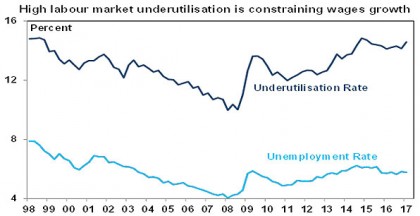
  • unemployment and underemployment (ie. labour underutilisation) at over 14% are way too high;

  • this is maintaining downwards pressure on wages growth which is at record low of 1.9% year on year (in terms of the historical record for the Wage Price Index);

High labout market underutilisation
Source: ABS, Bloomberg

  • the $A remains too high and is up from January last year;

  • underlying inflation risks staying below target for longer – reflecting low wages, the rise in the $A and competition;

  • there are risks around economic growth as the contribution to growth from home building is likely to slow this year and retail sales growth is weak at a time when mining investment is still falling; and

  • bank “out of cycle” mortgage rate hikes have delivered a (“modest”) de facto monetary tightening any way.

The RBA has to set interest rates for the average of Australia so raising interest rates just to slow the hot Sydney and Melbourne property markets would be complete madness at a time when overall growth is still fragile, underlying inflation is well below target and property price growth elsewhere is benign or weak. The best way to deal with the hot Sydney and Melbourne property markets and excessive growth in property investor lending into those markets is through tightening lending standards, which APRA has just moved again to do.

By the second half of 2018 the drag on growth from falling mining investment is likely to have ended, stronger global growth should have started to help Australian growth and stronger employment growth should have started to benefit full time jobs and wages and the threat around below target underlying inflation should have subsided. All of which should allow the RBA to start raising interest rates. But on current indications it’s hard to justify RBA rate hikes before then.

But what about bank out of cycle rate hikes?

The banks have recently raised rates for property investors and on interest only loans by around 0.25% and for principal and interest owner occupier loans by around 0.03%. The stated drivers were higher funding costs (presumably following the back up in global bond yields over the last six months) and regulatory pressure to slow lending to investors and higher risk borrowers. More moves may lie ahead if global borrowing costs rise further but again would be focussed on investors & interest only mortgages and in the absence of RBA rate hikes are likely to be small as only 20-30% of bank funding is sourced globally. But it’s worth putting “out of cycle” moves in context:

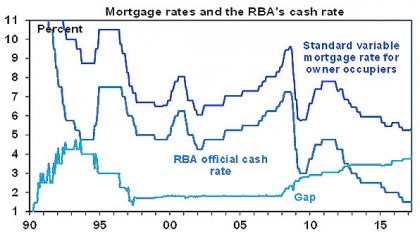
  • The RBA is still in control. “Out of cycle” bank moves have been a regular occurrence since the GFC and yet this did not stop mortgage rates falling to record lows in response to RBA rate cuts. As can be seen in the chart below the virtually fixed 1.8% gap between the standard variable mortgage rate and the cash rate only applied from 1997 to 2007, prior to that the relationship was far less stable so “out of cycle” moves are nothing new. The chart shows that changes in the cash rate remain the main driver of mortgage rates. If the RBA wants to lower mortgage rates again it can just cut the cash rate till it gets the mortgage rates it wants.

Mortgage rates and the RBA's cash rate
Source: RBA, AMP Capital

  • So far the changes in owner occupier rates are unlikely to have much economic impact because 3 basis points is trivial compared to the 200 basis point rise in mortgage rates that occurred in the 2009-10 monetary tightening cycle. So don’t expect much impact on consumer spending albeit there is negative psychological impact.

  • Changes in investor rates have less impact on spending in the economy because they are tax deductible and investors are less sensitive to rate moves. That said investor rates have gone up by around 0.52% compared to owner occupier rates since 2015 and this will eventually have some dampening impact on investor demand.

House prices

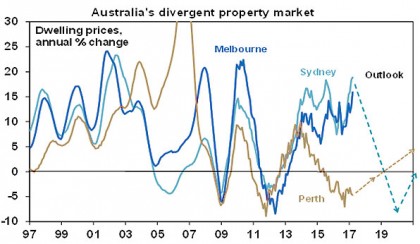
While strong population growth means that underlying property demand remains strong, the threats to the hot Sydney and Melbourne property markets are building: more macro-prudential measures to slow lending to investors and to more risky borrowers have been announced; the banks are raising rates out of cycle particularly for investors; the May budget is likely to see a reduction in the capital gains tax discount; all at a time when the supply of units is surging; and home prices are ridiculous. Taken together these moves are likely to result in a significant dampening impact on home price growth.

Australia's divergent prperty market
Source: CoreLogic, AMP Capital

We continue to expect a significant cooling in price growth in Sydney and Melbourne this year followed by 5-10% price falls commencing sometime in 2018 after the RBA starts to hike rates. By contrast Perth and Darwin are getting close to bottoming (as the mining investment slumps nears its low) and other capital cities are likely to see continued moderate growth. Unit prices are most at risk given the increasing supply of units.

Will rate hikes crash the economy?

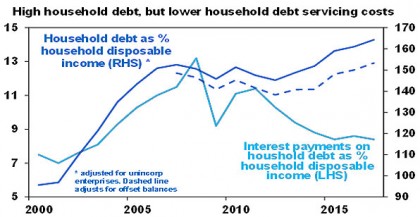
There seems to be a view that household debt is now so high that any hike in interest rates will cause mass defaults and crash the economy. This is nonsense. Yes household debt is up but not dramatically since the GFC and interest payments as a share of household disposable income are at their lowest since 2003. Mortgage rates would need to rise by nearly 2% to get the interest servicing ratio back to its most recent 2011 high – which slowed but did not crash the economy. And most Australians are ahead on their debt payments.

High household debt
Source: RBA, AMP Capital

Finally, the RBA will move gradually when it does start to raise rates and knows households are now more sensitive to rate moves and so it probably won’t have to hike rates as much as in the past to cool any overheating in the economy.

Implications for investors

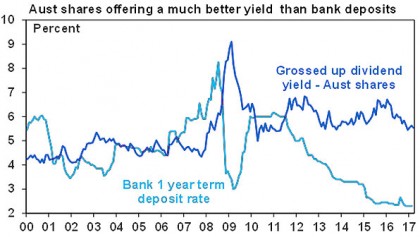
There are several implications for investors. First, bank term deposit rates are set to remain very low. As a result, there is an ongoing need to consider alternative sources of income. Second, be cautious of the Sydney and Melbourne property markets, particularly units. Third, remain a little bit wary of the $A as an on hold RBA at a time when the Fed is likely to hike rates another two or three times this year could put downwards pressure on the $A. So retain some exposure to unhedged global shares. Finally, with low interest rates growth assets providing decent yields will remain attractive. This includes unlisted commercial property and infrastructure but also Australian shares which continue to offer much higher income yields relative to bank term deposits.

Aust shares offering a much better yield
Source: RBA, Bloomberg, AMP Capital


Source: AMP Capital 4 April 2017

Author

Dr Shane Oliver, Head of Investment Strategy and Economics and Chief Economist at AMP Capital is responsible for AMP Capital’s diversified investment funds. He also provides economic forecasts and analysis of key variables and issues affecting, or likely to affect, all asset markets.

Important note: While every care has been taken in the preparation of this article, AMP Capital Investors Limited (ABN 59 001 777 591, AFSL 232497) and AMP Capital Funds Management Limited (ABN 15 159 557 721, AFSL 426455) makes no representations or warranties as to the accuracy or completeness of any statement in it including, without limitation, any forecasts. Past performance is not a reliable indicator of future performance. This article has been prepared for the purpose of providing general information, without taking account of any particular investor’s objectives, financial situation or needs. An investor should, before making any investment decisions, consider the appropriateness of the information in this article, and seek professional advice, having regard to the investor’s objectives, financial situation and needs. This article is solely for the use of the party to whom it is provided.

The basics of successful investing are timeless and some investors (often the best) have a knack of encapsulating these into a sentence or two that brings them to life in a way that’s easy to understand. Over the last few years I have written two insights on investment quotes I find useful (see “21 great investment quotes”, Oliver’s Insights, April 2014 and “Another 21 great investment quotes”, Oliver’s Insights, February 2015). Here are some more. Just considering them helps bring us back to the basics of investing which is critical at a time when we are being increasingly bombarded by noise around the next best thing or the next disaster about to hit investment markets.

Having a goal

“If you don’t know where you’re going any road will take you there.” Lewis Carroll paraphrased, George Harrison song “Any road”

The first thing to do when embarking on investing is to work out what your financial goals are, how much risk you are prepared to take, your desire for income versus capital growth, how active you want to be in managing your investments, etc. This may entail seeking advice. But if you don’t work out these things you will be vulnerable to all sorts of distractions which will take you a long way from your goals.

“Saving is a great habit, but without investing and tracking it just sleeps.” Manoj Arora

There is a big difference between saving and investing with the former often implying putting money aside in a bank deposit. This may be fine for short term spending requirements and rainy days but it won’t grow your wealth for which the more deliberate and considered process of investing is required.

The market

“Investing is the intersection of economics and psychology.” Seth Klarman

The point is that asset prices rarely reflect some rational fundamental value. Instead, the influence of various behavioural biases on thousands and millions of investors will often act to push prices well away from fundamentally justified levels.

“Sometimes [Mr Market’s] idea of value appears plausible and justified by business developments and prospects as you know them. Often, on the other hand, Mr Market lets his enthusiasm or his fears run away with him, and the value he proposes seems to you a little short of silly.” Benjamin Graham

In other words, the market can be like a manic depressive. Several insights flow from the Mr Market metaphor for financial markets. First, avoid getting sucked in during good times and spat out during bad. Second, it’s the manic swings that create opportunities. Third, make sure that you respect the market as the silly prices it throws up can sometimes linger longer than you can remain solvent (to borrow from John Maynard Keynes).

Contrarian investing

“Nearly every time I have strayed from the herd, I’ve made a lot of money. Wandering away from the action is the way to find the new action.” Jim Rogers

In the roller coaster of investor emotion that characterises investor psychology through a share market cycle the best financial opportunities are found after a period of sharp falls when shares have become undervalued and under loved by the investing crowd, ie, when investors are depressed. And vice versa for when shares are overvalued and investors euphoric.

The roller coaster of investor emotion
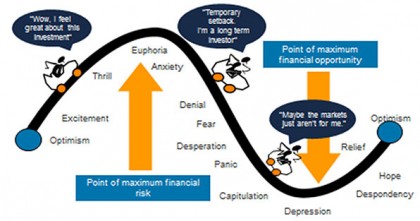
The roller coaster of investor emotion
Source: Russell Investments, AMP Capital

“Generally the greater the stigma or revulsion, the better the bargain.” Seth Klarman

The more an asset has fallen out of favour to the point where no one will touch it with a barge poll is usually the point its value and return potential is probably the greatest.

“Cash combined with courage in a time of crisis is priceless.” Warren Buffett

To take advantage of the buying opportunities thrown up by a sharp fall in markets requires not only spare cash but a lot of courage because this is invariably the time when the news flow is at its worst – with talk of economic crisis, falling profits, high unemployment, etc – but also when the crowd around you is convinced that it’s a crazy time to invest.

Pessimism

“Pessimistic visions about anything usually strike the public as more erudite than optimistic ones.” Joseph Schumpeter

The evolution of the human brain through the Pleistocene era when the key was to avoid being eaten by a sabre tooth tiger or squashed by a woolly mammoth has left us hard wired to be on the lookout for risks. So bad news sells and a financial loss is felt more distastefully than the beneficial impact of the same sized gain. Consequently, prognosticators of doom are more likely to be revered as deep thinkers than optimists. Therefore, we seem to be perpetually bombarded with warnings about the next disaster to hit investment markets. But when it comes to investing, giving too much attention to pessimists doesn’t pay. Historically, since 1900 shares have had positive returns seven years out of 10 in the US and eight years out of 10 in Australia.

Process

“Investing is simple. It’s the financial industry that works hard to make it complex!” Robert Rolih

Unfortunately, there is an element of truth in this, although in the industry’s’ defence often the complexity arises from the desire to protect against a particular risk (eg, options) or make it easier to gain access to a certain exposure and remove others (eg, hedging currency risk from global exposures). But frequently this leads to unnecessary complexity and at times the industry itself has not properly understood what it has created (eg, the risks around sub-prime debt in the US prior to the GFC). Maybe it’s just human nature to want to make the simple complex. But the bottom line is: don’t overcomplicate your investments. Avoid investments you don’t understand and keep your investment process relatively simple and commensurate with the amount of effort you want to put in.

“Trying to pick the stocks that outperform the average is like trying to find a needle in a haystack.” Robert Rolih

Jack Bogle (the founder of Vanguard) says just buy the haystack. The point is that trying to pick stocks that will outperform the market is not easy and requires a lot of effort. The key to growing wealth over time is to get a broad exposure to the market and let compound interest do its job.

“If you are shopping for common stocks, choose them the way you would buy groceries, not the way you would buy perfume.” Benjamin Graham

If you are trying to pick stocks to outperform the market the key is to look for value rather than glamour.

“The individual investor should act consistently as an investor and not as a speculator. This means,,,that she should be able to justify every purchase she makes and each price she pays by impersonal, objective reasoning that satisfies that she is getting more than her money’s worth for her purchase.” Benjamin Graham

In other words you need a process that filters stocks & enables you to assemble a portfolio as opposed to just taking a punt.

“Good investing is boring.” George Soros

Successful investing can take discipline and time and sometimes it can take years to pay off. This can be boring. If you want bright lights, excitement and instant riches (or more likely, losses) the casino is the place to go.

“It is remarkable how much long term advantage people like us have gotten by trying to be consistently not stupid, instead of trying to be very intelligent.” Charlie Munger

This is very important. You don’t need a super high IQ to be a successful investor. In fact, Charles Ellis wisely related investing to a “losers game” like amateur tennis or boxing after several rounds where you win by not trying to be smart but by not making stupid mistakes. In other words you win by not losing.

Knowledge, wisdom and noise

“Information is not knowledge, knowledge is not wisdom.” Frank Zappa (and maybe some others)

The information revolution and particularly the explosion of social media has made available to us a wealth of information and opinion around investments. But we need to recognise that much of this is ill-informed and that there is a big difference between information and wisdom when it comes to investing.

“An investment in knowledge pays the best interest.” Benjamin Franklin

There is not much to add to this. You have to do research and analysis before making investment making decisions. And with knowledge will come the wisdom to be able to screen out what doesn’t matter from the noise that surrounds us.

“When an investor focuses on short term investments, he or she is observing the variability of the portfolio, not the returns – in short being fooled by randomness.” Nassim Nicholas Taleb

Focussing on short term fluctuations in investment markets can be very distracting and risks blowing you off course from your strategy. Much of it is just random noise. On a day to day basis its pretty much a coin toss as to whether you will get good news or bad from share markets but the longer the time horizon you take the greater the probability of a positive return. On a calendar year basis its around 70-80% and on a decade by decade basis its actually 100% for Australian shares. In other words, time is on your side and the more you have of it the better. So turn down the day to day noise and avoid looking at your investments too frequently to avoid being disappointed.
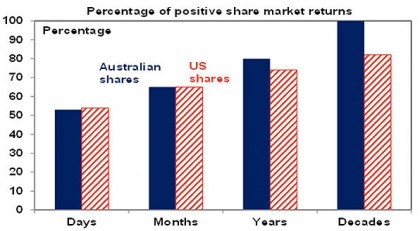
Daily and monthly data from 1995
Daily and monthly data from 1995, data for years and decades from 1900. Source: Global Financial Data, AMP Capital

Right mindset

“It ain’t what you don’t know that gets you into trouble. It’s what you know for sure that just ain’t so.” Mark Twain

If you want to be a successful investor you have to check your ego at the door and be humble.

Another perspective

“Always borrow money from a pessimist – she doesn’t expect to be paid back.” Anon

Or just make sure you don’t take on too much debt such that you lose control over your investments just at the wrong time.

“Money is not the most important thing in the world. Love is. Fortunately, I love money.” Jackie Mason

The Beatles wisely realised that “money can’t buy me love” and in the end the love you take is equal to the love you make.

“Money, if it does not bring you happiness, will at least help you be miserable in comfort.” Helen Gurley Brown

Well I guess that’s a good second best!


Source: AMP Capital 29 March 2017

Author

Dr Shane Oliver, Head of Investment Strategy and Economics and Chief Economist at AMP Capital is responsible for AMP Capital’s diversified investment funds. He also provides economic forecasts and analysis of key variables and issues affecting, or likely to affect, all asset markets.

Important note: While every care has been taken in the preparation of this article, AMP Capital Investors Limited (ABN 59 001 777 591, AFSL 232497) and AMP Capital Funds Management Limited (ABN 15 159 557 721, AFSL 426455) makes no representations or warranties as to the accuracy or completeness of any statement in it including, without limitation, any forecasts. Past performance is not a reliable indicator of future performance. This article has been prepared for the purpose of providing general information, without taking account of any particular investor’s objectives, financial situation or needs. An investor should, before making any investment decisions, consider the appropriateness of the information in this article, and seek professional advice, having regard to the investor’s objectives, financial situation and needs. This article is solely for the use of the party to whom it is provided.