Passive investment funds used to be a relatively obscure part of the market. But with their popularity soaring in recent years, many investors might now be sceptical about paying for active investment.

Market performance over recent years would reinforce that scepticism. Holding a passive mix of mainstream assets has performed very well over the last 5 years.

For example, an investor who suffers a permanent 25% loss of capital at age 30 is expected to have a 0.8% reduction in their retirement balance at age 67 as a result. Even at age 50, a 25% drawdown is only expected to reduce the saver’s balance at retirement by 7%. However, at age 60, the loss more than doubles, shrinking the balance at retirement by 17%. At the point of retirement, age 67, a person’s retirement balance reduces by 25%.

Advisers should now be questioning the ability of passive investing to deliver each client’s goals, and carefully analysing whether active management is more suited to a client’s life stage and goals.

Riding the tailwinds

Adherents of passive investing have had a strong story to tell in recent years. They’ve popularised research that shows passive investing has outperformed active investment over certain periods. And there has been a growing emphasis on the impact of management fees on long-term investment performance.

But the investment environment has also been favourable to passive investment in recent times. Passive investors have had to merely sit back and ride the strong, clear trends.

From 2012 to now, a post-GFC cyclical rally saw the major asset classes deliver strong returns as economic growth and US earnings strengthened. US shares, which make up around half the MSCI world index, particularly outperformed, driven by a low US dollar and a surge in earnings.

Bonds delivered one of the largest rallies in history as Central Banks pushed interest rates close to zero, and in some cases below.

That strong period for bonds also gave investors an incentive to seek higher returns in shares and, more broadly, risk assets. Shares and bonds, which normally zigged when the other zagged, were highly correlated this time and both provided strong returns for investors at the same time.

What’s more, the falling Australian dollar from pre-GFC highs boosted the returns of unhedged index funds.

From tailwinds to headwinds

But we believe those very tailwinds that drove outperformance in recent years could likely become headwinds.

We are particularly concerned about US equity markets. We think the region could significantly underperform as monetary policy tightens and the rising US dollar restricts growth. US Equity markets are at very high levels on many measures, despite the pullback and subsequent bounce in early February. With US inflation and Fed expectations still moving higher and Trump adding to the inflationary pressure in the US with tariff hikes, share markets are likely to remain volatile in the short-term with a high risk of seeing a re-test of February share market lows.

We are also concerned about ‘duration risk’ and the impact of rising interest rates on bonds. The longer the duration, the bigger the falls when interest rates rise. Unfortunately, the duration of fixed-income indices has lengthened at potentially the worst point in the cycle. (The duration of the Australian fixed-income index (Bloomberg AusBond Composite) is now 5.24 years, up from 3.5 years before the GFC.)

Investors passively invested in global bonds could be exposed to capital losses if yields rise from their record low levels. Those risks, relative to expected returns, are at all-time highs.

Big losses from passive investments

Many investors are focused on the low cost of passive investing, which over time can make a significant difference to returns.

Advisers need to remind clients that active management, particularly at the asset allocation level but also at more granular levels, is most effective in periods of greatest turmoil.

Controlling losses is important. A portfolio that has shed one-third of its value requires a significantly larger gain – 49 per cent – just to recover prior losses. If those large losses can be avoided or reduced, then an investor’s wealth accumulation will be significantly enhanced.

A closer match with investors’ life-stage and goals

Investors with longer-term horizons, such as younger people in their early accumulation phase, are better able to weather large losses. Markets do recover and they can simply choose to ignore the market fluctuations and ride out the market cycle.

But those losses can have a significant impact on investors with a shorter-term horizon, and particularly those close to, or at, retirement. Passive investing, particularly, removes the potential for those losses to be managed and increases an investor’s exposure to sequencing risk – the risk of a large loss just before or after someone retires, which can lead to a significant cut in standard of living.

In this environment we believe advisers need to more closely match an investor’s life-stage and goals. Younger investors often have less requirement for active management of portfolio risks and can have a greater allocation to passive investing; but investors close to, or in, retirement, advisers need to consider more actively managed solutions that have are designed to effectively manage risk and in particular are focused on managing the impact of large losses.

An active reconsideration

We believe reconsideration of active investment to navigate market risks and to protect capital.

The new environment will be characterised not just by low returns, but by greater volatility. Investment cycles are shorter and sharper, and risk flares look to be a more regular occurrence.

Active management allows investors to negotiate the ups and downs of the market cycle. Assets that aren’t expected to provide reasonable total returns, or that have excessive downside risks can be reduced or avoided. It also allows investors to exploit opportunities that volatility throws up with fewer restraints than passive investing.

Passive investing, for the time being, is restricted to traditional asset classes like shares and bonds. We think that in the current environment portfolios also require more alternative sources of risk to help compensate for the low returns on offer from bonds. Strategies that focus on generating returns regardless of market direction or come from the ownership and management of specific assets such as Infrastructure are essential components of portfolios expected to navigate what’s ahead of us, and these strategies are only available within actively managed funds.

Source: AMP Capital 8 March 2018

Important note: While every care has been taken in the preparation of this article, AMP Capital Investors Limited (ABN 59 001 777 591, AFSL 232497) and AMP Capital Funds Management Limited (ABN 15 159 557 721, AFSL 426455) makes no representations or warranties as to the accuracy or completeness of any statement in it including, without limitation, any forecasts. Past performance is not a reliable indicator of future performance. This article has been prepared for the purpose of providing general information, without taking account of any particular investor’s objectives, financial situation or needs. An investor should, before making any investment decisions, consider the appropriateness of the information in this article, and seek professional advice, having regard to the investor’s objectives, financial situation and needs. This article is solely for the use of the party to whom it is provided.

Geopolitical events like Brexit and Donald Trump’s election in the US “surprised” investors in 2016 but had no lasting negative impact on global financial markets. By last year investors were well focussed on geopolitical risks – Trump taking over as US President, Eurozone elections, the Communist Party Congress in China and rising risks around North Korea – but again they did not have much lasting negative market impact. In fact, in most cases it turned out to be a positive impact.
Now in 2018 it’s already clear that geopolitical events remain significant, for example with Trump’s tariffs and the messy Italian election result. Despite their benign financial market impact over the last two years they are worth keeping an eye on. This note takes a look at why geopolitics is more important for investors these days and what to look out for this year.

Why geopolitics is more important now

While not to deny the influence of various geopolitical events in the 1980s and 1990s the broad trend was reasonably positive with the embrace of free market/economic rationalist solutions (after the failure of widespread government intervention in the 1970s), the collapse of communism and the associated surge in global trade and the peace dividend and the dominance of the US as the global cop. However, while the last 2 years highlight the importance of not getting too distracted by geopolitical events, in recent times geopolitical risks have arguably become more elevated. There are several reasons for this:

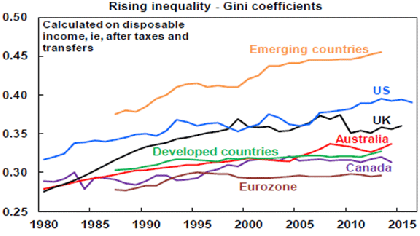
First, the slow post global financial crisis recovery, rising inequality (see the next chart which shows the Gini coefficient – a measure of income distribution) and stress around immigration have all led to a backlash against establishment politics and economic rationalist policies. This is showing up in support for re-regulation, nationalisation, increased taxes and protectionism and other populist responses, which could slow growth and share markets. While aspirational politics ruled in the 1980s & 1990s it’s since been replaced with scepticism about trickle-down economics.


Source: OECD, Standardised World Income Inequality Database, AMP Capital

The swing of the political pendulum to the left is most acute in Anglo Saxon countries as it was here that the pendulum swung most towards free markets in the 1980s and 1990s. It’s messy in the US as while Trump has tapped into popular discontent and is more protectionist, his policies around de-regulation and tax cuts go in the opposite direction – for now, as this could just set the scene for a more left-wing president in 2020. And Macron in France is going in a fundamentally more pro-business direction, which is very positive for French assets.

Second, the relative decline of US economic and military power is shifting us away from the unipolar world that dominated after the Cold War when the US was the global cop and most countries were moving to become free market democracies. Now we are seeing the rise of China, Russia revisiting its Soviet past and efforts by other countries to fill the gap left by the US in parts of the world, all creating tensions.

Third, social media is allowing us to make our own reality. The danger is that, as politicians pander to this, economic policy making will be less rational and more populist.
Finally, with the mid-term elections in November, Trump is back in campaign mode. And he is not your normal politician.

Global geopolitical issues to keep an eye on 2018

President Trump – Trump faces two big challenges this year. First, the mid-term Congressional elections in November risk the Republicans losing control of the House and also the Mueller inquiry is closing in. These in turn put pressure on Trump to create distractions and return to focussing on his base after the pro-business focus of last year. The tariffs, dealing with North Korea and maybe Iran fit into this.

Tariffs – much has been written about Trump’s steel and aluminium tariffs, but a full-on global trade war is unlikely. First the steel and aluminium tariffs are trivial amounting to less than 2% of US imports. They are nothing compared to the tariff hikes of 1930 and 1971 that covered most US imports. Second, there is more to go on trade with NAFTA renegotiations, a review of China’s alleged theft of US intellectual property likely to result in broad tariffs on US imports from China and restrictions on Chinese investment in the US and possible tariffs on vehicles, shipbuilding, aircraft and semi-conductors are also possible. Finally, Trump is trying to appeal to his base ahead of the mid-terms, but a full-blown global trade war is unlikely. There are few political constraints on Trump imposing tariffs and his Republican base tends to support it. However: the exemptions to his steel and aluminium tariffs suggest he has listened to criticism of his initial plan including around the threat it poses to US alliances; his approach on this issue smacks a bit of The Art of the Deal – go in hard, then back down to something that sounds more acceptable and the same is likely in relation to China with initial harsh measures likely designed for use as a bargaining chip; Trump won’t want to go too far on tariffs as the resultant price increases won’t go down well with his supporters; a plunging stock market in the face of a trade war will also constrain Trump (as he likes to take credit for it going up); and other countries are likely to be cautious in retaliating and China may want to come across as the “good guy” on trade. Of course, this issue could roll on all year, and Australia is vulnerable via its exposure to China. But a full-on global trade war is unlikely – but there may not be much peace on the trade front either. And a US-China trade war is the main risk.

The Mueller inquiry – this is getting closer to Trump. However, our view remains that while the Democrats may find something to impeach Trump on if they get control of the House of Representatives, in the meantime the Republicans are unlikely to impeach him. And even if the Democrats do impeach him post the mid-terms it’s doubtful they will find the 70 votes in the Senate to remove him from office. And even if Trump is removed from office, VP Pence will not mean a big change in economic policy (just less tweets!). In the meantime most of the big market friendly policies Trump has to offer have been done.

The US mid-term elections – these will be watched closely as a guide to whether US politics is swinging back towards the Democrats taking the Presidency in 2020. If the GOP loses the House, it will leave Trump as a lame duck president. On the one hand most of his big market friendly policies have already been done so no great impact on domestic policy until post 2020. But being a lame duck could encourage him to seek relevance globally (more tariffs or action on Iran?).

US shutdown risk – by March 23 funding will again have to be renewed for the Government to avoid a shutdown. But neither side wants to be blamed for a shutdown so expect funding to be granted, another extension or any shutdown to be brief.

North Korea – news that Trump will meet Kim Jong Un before May and that NK is open to denuclearisation is welcome. Whether it comes to anything though remains to be seen given numerous false thaws with NK over the decades. Or maybe Kim John Un read The Art of the Deal and its development of nuclear weapons was all just a negotiating ploy, so this is really a very big deal. At least it will be “quiet” on this front for a while.

Iran – the US deadline to remain compliant with the Iran nuclear deal expires in May. It will probably be renewed but if it’s not and sanctions on Iran return it potentially means a sharp reduction in Iranian oil supply which could put upwards pressure on oil prices. Meanwhile, tensions and proxy wars between Iran and Saudi Arabia will continue with occasional flare ups but open warfare between the two is unlikely.

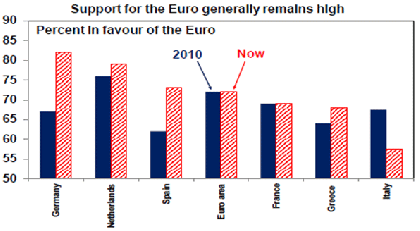
Italy and Europe – the messy Italian election outcome is not great for Italy, but it’s unlikely to threaten the Euro. There are now three major blocs in the Italian lower house. None of these blocs are near a majority and it may require a new election (not that most parties want that). Barring a worst-case coalition between the Five Star Movement and the far-right Northern League, which given their huge political differences is unlikely, it will be the Democratic Party that will decide who forms government and given its pro-Euro and left of centre bias it’s more likely to lean to 5SM but only if it remains supportive of Italy remaining in the Euro. But it may take months to get to this point. This is not great for Italy, but there is unlikely to be a short-term threat to the Euro. In any case support for the Euro remains strong across the rest of the Eurozone so even if Italy does leave, a contagion across Europe looks very unlikely. This and the German Social Democrat Party’s solid support for a coalition with Angela Merkel all leaves Germany on track to work with France on strengthening the Eurozone.

Support of Euro
Source: Eurobarometer, AMP Capital

Terrorism – The impact of terrorism on investment markets has been declining since the 9/11 attacks to the point where attacks in recent years have had little impact. Economies and markets seem to have become desensitised to them to a degree.

China – The Chinese Government’s focus on its reform agenda – shifting towards less investment intensive growth, reducing pollution, reforming state-owned enterprises and reducing financial risk – has long run hot and cold, speeding up in good times only to slow down if growth slowed. However, the reform agenda now looks likely to see another step up posing a short-term threat to growth (albeit with a long-term benefit) and with President Xi Jinping’s status enhanced in October’s National Communist Party Congress and leadership term limits now abolished it’s likely that the leadership’s tolerance to a slowdown in growth may be greater than in the past. So the growth/reform nexus bears watching in terms of the outlook for global growth, commodity prices, etc.  

Australia – the main risk in Australia is an early election and the adoption of less business-friendly policies (higher taxes, more regulation) under a Labor Government which may be taken badly by financial markets. The May budget is likely to promise income tax cuts but in the absence of better polling it’s hard to see the Government calling an early election.

Implications for investors

These geopolitical issues have the potential to keep volatility high this year and so are worth keeping an eye on. However, there are several key points for investors to bear in mind. First, turn down the noise. Geopolitical issues create much interest, but as we seen in recent years (with eg Brexit, North Korea and Catalonia) they won’t necessarily have significant negative impacts on investment markets. Second, it’s hard to quantify geopolitical risks. You have to understand each issue separately. Finally, given the difficulties in trying to predict geopolitical shocks and their impact it often makes more sense for investors to focus on the opportunities they throw up, rather than taking long term shelter from them in low returning cash.
 

Important note: While every care has been taken in the preparation of this article, AMP Capital Investors Limited (ABN 59 001 777 591, AFSL 232497) and AMP Capital Funds Management Limited (ABN 15 159 557 721, AFSL 426455) makes no representations or warranties as to the accuracy or completeness of any statement in it including, without limitation, any forecasts. Past performance is not a reliable indicator of future performance. This article has been prepared for the purpose of providing general information, without taking account of any particular investor’s objectives, financial situation or needs. An investor should, before making any investment decisions, consider the appropriateness of the information in this article, and seek professional advice, having regard to the investor’s objectives, financial situation and needs. This article is solely for the use of the party to whom it is provided.
f you’re a home owner who falls into the “asset rich, cash poor” category, a reverse mortgage could hold appeal in retirement.

Over the next 40 years an estimated seven million Australians are expected to start living off their super savings, but many simply won’t have enough to enjoy a comfortable lifestyle. The benefit of a reverse mortgage is that you can access money to live on without having to sell your home.


No ongoing repayments

A reverse mortgage is a loan that lets you draw down the equity in your home. It’s a product that is typically available once you reach age 60, and while no monthly repayments are required, full loan repayment generally falls due when you sell your home or pass away.

Limits do apply to the amount you can borrow with a reverse mortgage. You won’t be able to borrow the full value of your home – but rather a percentage, and the older you are, the more you can borrow. As a guide, a 60-year old can often borrow 15-20% of the value of their home. An 80-year-old may be able to borrow 35% of their home equity.

Understand the drawbacks

Turning to the family home to supplement your retirement income can make financial sense though it pays to speak with your financial adviser to be sure this is the case for you.

The payments from a reverse mortgage can be taken as a lump sum (though this can impact Age Pension entitlements) or as a series of regular payments or a line of credit, providing extra money to live on.

On the downside, loan interest is charged from day one and the mounting cost can outpace the growth in your home’s value.

By law, you can’t end up with “negative equity”- where you owe more than your home is worth. Nonetheless, for many Australians, a key stumbling block of reverse mortgages can be the impact on your estate. No, you won’t be able to bequeath the full value of your home to your adult children or other family members.

However, I’m sure your loved ones wouldn’t want you to live a lean retirement just so that you can provide a generous legacy.

How to maximise value

The key to managing a reverse mortgage is not to over-borrow. This type of product works best when you draw down small annual amounts, and a few thousand dollars extra each year in the kitty can make for a much better lifestyle.

I still believe super is a great way to save for retirement, but if you’re a home owner, the availability of reverse mortgages means you shouldn’t have to live a meagre existence once you exit the workforce.

Good advice is essential

Talk to your solicitor about the possible implications of using a reverse mortgage. And be sure to discuss your decision with your family. Tapping into home equity should generally be a last resort. Once you’ve exhausted this option there may be few choices left to fund your retirement – and looking ahead, your aged care needs.

Please contact  us on Phone: 07 5641 4134 we can ensure every strategy is considered before you rely on the roof over your head to enjoy a fulfilling retirement. 

Paul Clitheroe is a founding director of financial planning firm ipac, Chairman of the Australian Government Financial Literacy Board and chief commentator for Money Magazine.

Source : AMP 23 February 2108  

Important 

This article provides general information and hasn’t taken your circumstances into account. It’s important to consider your particular circumstances before deciding what’s right for you. Although the information is from sources considered reliable, we do not guarantee that it is accurate or complete. You should not rely upon it and should seek qualified advice before making any investment decision. Except where liability under any statute cannot be excluded, we do not accept any liability (whether under contract, tort or otherwise) for any resulting loss or damage of the reader or any other person.


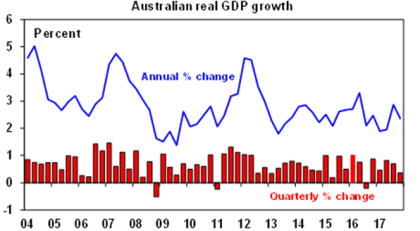
Growth just muddling along

For the last few years the Australian economy has been meandering between 2-3% growth. This remained the case through last year with December quarter GDP up just 0.4%, and annual growth of 2.4% as a bounce a year ago dropped out. In the quarter growth was helped by consumer spending and public investment but soft housing and business investment and a large detraction from net exports weighed on growth.

Source: ABS, AMP Capital

Australia continues to defy recession calls. Against this, economic growth is well below potential, with per capita growth running at just 0.8% year on year, which is below that in most major countries.

The usual worry list

Global threats aside, Australia’s worry list is well known:

  • The solid contribution to growth from housing construction seen over 2013-16 has faded and building approvals are off their highs.

  • Average house prices have started to edge down, with fears of a deeper crash. But in the absence of a stronger supply surge, the Reserve Bank of Australia (RBA) making a mistake and raising rates too high and/or unemployment surging, our view remains that price declines in Sydney and Melbourne will be limited to 5-10% and other cities face a more positive outlook.

  • The outlook for consumer spending is constrained and uncertain given record low wages growth, high levels of underemployment and slowing wealth gains. Consumers have been running down their savings rate helped by rising wealth (to now just 2.7%), but this is unlikely to continue as property prices in Sydney and Melbourne slow.

  • Mining investment is still falling with investment plans pointing to roughly 15% falls this financial year and next.

  • The Australian dollar at around $US0.78 is up 12% from its 2015 low and risks threatening growth in trade-exposed sectors like tourism, agriculture and manufacturing.  

  • Underlying inflation is too low with a fall in inflationary expectations, making it harder to get wages growth up and with the stronger $A not helping.

  • Our political leaders seem collectively unable to undertake productivity-enhancing economic reforms. And it’s unlikely this will change any time soon which is a concern with productivity falling 0.8% through 2017.

Five reasons why growth will be okay

These drags are nothing new. We continue to see five reasons why recession will be avoided, and growth will be okay:

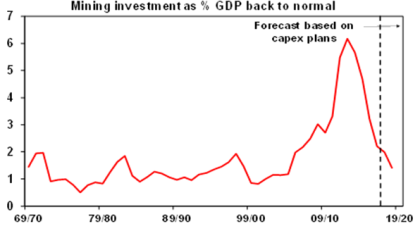
  • First, the drag from falling mining investment is nearly over. Mining investment peaked at nearly 7% of GDP five years ago and has since been falling, knocking around 1.5% pa from GDP growth. At around 2% of GDP now, its growth drag has fallen to around 0.3% pa and it’s near the bottom.


Source: ABS, AMP Capital
 

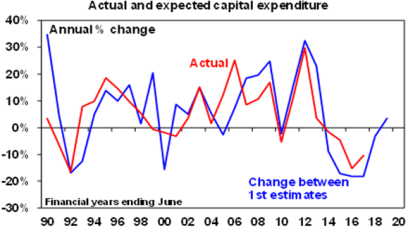
  • Second, non-mining investment is now rising. Comparing corporate investment plans for this financial year with those made a year ago points to a decline in business investment this year of around 3% (see next chart) and a similar sized rise in 2018-19. But this is the best it’s been since 2013 & once mining investment is excluded this turns into an 8% gain for non-mining investment in both years.


Source: ABS, AMP Capital
 

  • Third, public investment is rising strongly, reflecting state infrastructure spending.

  • Fourth, net exports are likely to add to growth as the completion of resources projects and strong global demand boosts resources export volumes and services sectors like tourism and higher education remain strong.

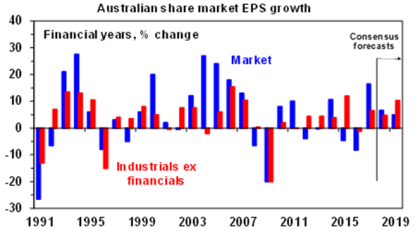
  • Finally, profits for listed companies are rising. This is a positive for investment.


Source: ABS, AMP Capital

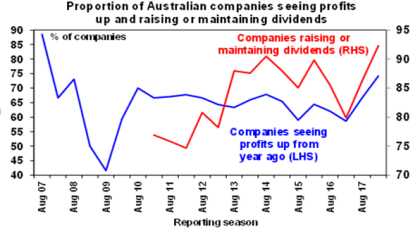
While profit growth has slowed from 16% in 2016-17 to around 7% now as the 2016-17 surge in commodity prices dropped out, more companies (74%) are seeing profit gains than at any time since before the GFC. 92% of Australian companies either raised or maintained their dividends in the most recent reporting season indicating a high degree of confidence in the earnings and growth outlook.


Source: ABS, AMP Capital

So while housing is slowing and consumer spending is constrained (with January retail sales data suggesting consumer spending this year is off to a weak start), a lessening drag from mining investment and stronger non-mining investment (both public and private) along with solid export growth are likely to keep the economy growing and see a pick-up in growth to between 2.5% and 3%. However, growth is likely to remain below Reserve Bank of Australia expectations for a pick up to 3.25% this year and next. As a result, and with wages growth and inflation likely to remain low for a while yet we have pushed out the expected timing for the first RBA rate hike from late this year into February next year.

Implications for investors

There are several implications for Australian investors.

First, continuing growth should provide a reasonable backdrop for Australian growth assets. Australian shares are vulnerable to the concerns impacting global markets – particularly US inflation and Fed fears and worries about a trade war – but we remain of the view that the ASX 200 will be higher by year end.

Second, bank deposits are likely to provide poor returns for investors for a while yet. The issue for investors in bank deposits is to think about what they are really after. If it’s peace of mind regarding the capital value of their investment, then maybe stay put. But if it’s a decent income yield then there are plenty of alternatives providing superior yield. The yield gap between Australian shares and bank deposits remains wide.

Third, while Australian shares are great for income, global shares are likely to remain outperformers for capital growth. Global shares have been outperforming Australian shares since October 2009 and over the last five years have outperformed in local currency terms by nearly 4% pa and by 9% pa in Australian dollar terms. This reflects relatively tighter monetary policy in Australia, the commodity slump, the lagged impact of the rise in the $A above parity in 2010, and a mean reversion of the 2000 to 2009 outperformance by Australian shares. While earnings growth in Australia is around 7%, it’s double this globally, suggesting the relative underperformance of Australian shares in terms of capital growth may go for a while yet. Which all argues for a continuing decent exposure to global shares.

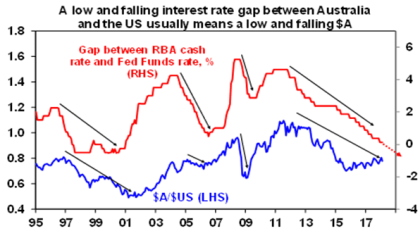
Finally, the risks remain on the downside for the $A. With the RBA comfortably on hold and the Fed set to raise rates later this month with four hikes this year in total, the interest rate gap between Australia and the US will go negative and keep falling this year. Historically this has been associated with falls in the value of the Australian dollar. Fears of a global trade war may add to this risk given Australia’s relatively high trade exposure. All of which is another reason to maintain a continuing decent exposure to global shares but on an unhedged basis.


Source: Bloomberg, AMP Capital

Source: AMP Capital 8 March 2018

Important note: While every care has been taken in the preparation of this article, AMP Capital Investors Limited (ABN 59 001 777 591, AFSL 232497) and AMP Capital Funds Management Limited (ABN 15 159 557 721, AFSL 426455) makes no representations or warranties as to the accuracy or completeness of any statement in it including, without limitation, any forecasts. Past performance is not a reliable indicator of future performance. This article has been prepared for the purpose of providing general information, without taking account of any particular investor’s objectives, financial situation or needs. An investor should, before making any investment decisions, consider the appropriateness of the information in this article, and seek professional advice, having regard to the investor’s objectives, financial situation and needs. This article is solely for the use of the party to whom it is provided.

Take your product home, pay for it within the specified timeframe, get charged 0% interest. What could go wrong?

Branded the modern-day layby, ‘buy now, pay later’ services essentially offer the same thing, except you get the product up front—the outfit, the watch, even certain domestic flights within Australia.

If you haven’t heard of buy now, pay later services, or are keen to know more, we explain what they are, how they work and when it’s possible you could run into financial strife if you’re not careful.

What are buy now, pay later services?

Buy now, pay later services, such as Afterpay, Openpay and zipPay, are offered by approved retailers and provide another form of payment option when you’re shopping online and sometimes instore1.

They allow you to buy a product, take it home and pay for it in instalments over a set period of time via an online buy now, pay later account, which deducts your preferred debit or credit card.

While payments are withdrawn automatically (for instance, over four fortnightly instalments if you’re using Afterpay2), generally you can make repayments before they are due as well.

Purchase limits do apply though and depending on the provider will typically vary according to things like how long you’ve been using the service and your payment track record to date.

How do they charge?

Many buy now, pay later services are interest and fee free (if you pay on time that is!). If a payment is scheduled to be deducted and you don’t have the money in your account, and haven’t attempted to pay what is owed via other means, you’ll typically be charged a late fee.

For that reason, it’s important you have the right amount of money in your account when each instalment is due, and that you’re across any other charges that might be payable before signing up.

According to buy now, pay later services, such as Afterpay, late fees are not a primary revenue driver, with the group saying 80% of its revenue is derived from merchant fees paid by retailers3.

Another thing to consider, if you’re using your credit card, is while the buy now, pay later provider might not charge interest on your purchase, you may still have to pay interest to your credit card provider if you don’t pay the full amount owing on your credit card by the due date.

Key considerations

Spending what you don’t have

While buy now, pay later services can be very handy if you have available funds and can pay on time, if you don’t, little debts stemming from things like late fees can quickly snowball into bigger debts, which can have a variety of repercussions. For this reason, it’s a good idea to have a budget in place when it comes to spending, so you don’t get in over your head.

How your credit rating could be affected

Many buy now, pay later services don’t check your ability to make repayments, so if you’re already in the red, further debt could mean bad news and possibly debt collectors at your door. On top of that, while these services might not check your history, they’re still able to report black marks against you to credit reporting agencies, which could make it hard to borrow money in future.

If you have a customer complaint

Because you’re not going direct to the retailer when using a buy now, pay later service, you might also want to check out the provider’s dispute resolution policy so that there are no surprises if something you purchased doesn’t turn up, or you want to refund or return something that wasn’t quite right.

More information

It’s important to check the terms and conditions before you sign up to any new service provider to ensure you’re across things like fees and various other policies so you don’t get caught out.

Please contact us on Phone: 07 5641 4134 we can help you work out your combined financial goals, budget better and develop a plan to help you grow your wealth so that you can achieve your goals.

ASIC MoneySmart – Buy now, pay later services – info page
2, 3 Afterpay Fact Sheet p2, p8

Source : AMP 21 February  2018 

Important 

This article provides general information and hasn’t taken your circumstances into account. It’s important to consider your particular circumstances before deciding what’s right for you. Although the information is from sources considered reliable, we do not guarantee that it is accurate or complete. You should not rely upon it and should seek qualified advice before making any investment decision. Except where liability under any statute cannot be excluded, we do not accept any liability (whether under contract, tort or otherwise) for any resulting loss or damage of the reader or any other person.


At its meeting today, the Board decided to leave the cash rate unchanged at 1.50 per cent.

The global economy has strengthened over the past year. A number of advanced economies are growing at an above-trend rate and unemployment rates are low. Growth picked up in the Asian economies in 2017, partly supported by increased international trade. The Chinese economy continues to grow solidly, with the authorities paying increased attention to the risks in the financial sector and the sustainability of growth.

The pick-up in the global economy has contributed to a rise in oil and other commodity prices over the past year. Even so, Australia’s terms of trade are expected to decline over the next few years, but remain at a relatively high level.

Globally, inflation remains low, although higher commodity prices and tight labour markets are likely to see inflation increase over the next couple of years. Long-term bond yields have risen but are still low. Market volatility has increased from the very low levels of last year. As conditions have improved in the global economy, a number of central banks have withdrawn some monetary stimulus. Financial conditions remain expansionary, with credit spreads narrow.

The Bank’s central forecast is for the Australian economy to grow faster in 2018 than it did in 2017. Business conditions are positive and non-mining business investment is increasing. Higher levels of public infrastructure investment are also supporting the economy. Further growth in exports is expected after temporary weakness at the end of 2017. One continuing source of uncertainty is the outlook for household consumption. Household incomes are growing slowly and debt levels are high.

Employment grew strongly over the past year and the unemployment rate declined. Employment has been rising in all states and has been accompanied by a significant rise in labour force participation. The various forward-looking indicators continue to point to solid growth in employment over the period ahead, with a further gradual reduction in the unemployment rate expected. Notwithstanding the improving labour market, wage growth remains low. This is likely to continue for a while yet, although the stronger economy should see some lift in wage growth over time. Consistent with this, the rate of wage growth appears to have troughed and there are reports that some employers are finding it more difficult to hire workers with the necessary skills.

Inflation remains low, with both CPI and underlying inflation running a little below 2 per cent. Inflation is likely to remain low for some time, reflecting low growth in labour costs and strong competition in retailing. A gradual pick-up in inflation is, however, expected as the economy strengthens. The central forecast is for CPI inflation to be a bit above 2 per cent in 2018.

On a trade-weighted basis, the Australian dollar remains within the range that it has been in over the past two years. An appreciating exchange rate would be expected to result in a slower pick-up in economic activity and inflation than currently forecast.

The housing markets in Sydney and Melbourne have slowed. Nationwide measures of housing prices are little changed over the past six months, with prices having recorded falls in some areas. In the eastern capital cities, a considerable additional supply of apartments is scheduled to come on stream over the next couple of years. APRA’s supervisory measures and tighter credit standards have been helpful in containing the build-up of risk in household balance sheets, although the level of household debt remains high.

The low level of interest rates is continuing to support the Australian economy. Further progress in reducing unemployment and having inflation return to target is expected, although this progress is likely to be gradual. Taking account of the available information, the Board judged that holding the stance of monetary policy unchanged at this meeting would be consistent with sustainable growth in the economy and achieving the inflation target over time.


Source: Reserve Bank of Australia, March 6th, 2018

Enquiries

Media and Communications
Secretary’s Department
Reserve Bank of Australia
SYDNEY

Phone: +61 2 9551 9720
Fax: +61 2 9551 8033

The best of times can also be the most worrying of times for investors.

As we head off on the journey that is destined to become 2018, investment markets have been both kind and – until this week at least – relatively benign.

Suddenly headlines are screaming at us about the billions lost off market values and record one-day drops in the US index.

The motional tide of markets can turn rapidly so let’s take a moment to remind ourselves of the returns delivered across the major asset classes (as measured by the Vanguard suite of index funds) in 2017 along with the returns for the past five years to December 2017.

Asset class

1 year return%*

5 year return%*

Australian shares

12

10.1

International shares

13.6

18.7

International shares (currency hedged)

20.2

15.7

Australian fixed interest

3.7

4.2

Australian listed property

6.8

13.5

International listed property

0.7

14.1

International listed property (hedged)

6.85

10.7

Emerging markets

27.2

10.6

Cash

1.8

2.3

* To December 31, 2017

Without doubt there are investors – particularly those who have SMSFs in pension mode – who would have been happier if the returns on cash/fixed interest had been higher, but overall the past five years has been good for investors.

But after markets have had such a strong run it is reasonable for people to start questioning whether the good times will end any time soon. Forecasting the future performance of markets is a fraught business. The only certainty is that markets do move through economic cycles so at some point there will be market shocks and downturns that we will all have to deal with on our investing journey.

There is no question that sharemarket valuations – particularly in the US – are stretched given the run up in prices. This is all grist to the mill of media commentators speculating on when or what may cause the run to end or spark the next sell-off.

The real challenge for investors is deciding what action – if any – they should take.

You can – as some commentators have suggested – sit around monitoring brokerage screens with one finger poised over the sell button…

That sounds stressful and captive to the market’s emotional swings. The reality is that no-one sends you an email alert or rings a bell when the market has just peaked – or at least not one guaranteed to be correct. And while you are sitting at home on your screen it is worth remembering there is an army of professional investors out there – including 150,000 Certified Financial Analysts globally – who are doing the same thing, but with all the resources that financial services organisation can provide to support and inform their work.

Which brings us back to the basic question of what investors can do.

First port of call is to talk to your financial adviser – if you have one.

Not everyone does but one of the undervalued benefits of having an adviser is the coaching and portfolio review they can provide through periods like this. That does not mean they have any magical answers but they can provide a professional, unemotional review of your portfolio. As investors we can often get emotionally invested in what is in the portfolio so an impartial opinion can be instructive.

While you may not have an adviser you should still have a written financial plan that sets out the reasons you are investing, long-term goals and appetite for risk.

Too many investors focus on return projections – which are notoriously unreliable – and do not spend enough time thinking through what level of risk or loss they can bear.

For example, your age is a key input into these type of considerations simply because people approaching or in retirement typically are much more sensitive to significant market drops and potential capital losses.

All of which feeds into your portfolio’s asset allocation levels which are one of the most important decisions you make as an investor.

The simple act of reviewing and rebalancing your portfolio is a practical step you can take at times of market uncertainty. After five years of strong markets it is likely that some of the allocations will have moved outside the target allocations if rebalancing has not been done regularly.

This is a great discipline for investors but be warned, it can present an emotional challenge. Essentially if one part of your portfolio has performed strongly – hedged international shares for example – it is likely to now be above your target asset allocation level. So the disciplined act is to sell some of it down and invest the proceeds in the part of the portfolio that needs topping up.

In raw terms that means selling winners and buying losers – which is why some people intuitively find the notion of rebalancing hard to act on.

Tax consequences can also play a role here if you cannot use additional cashflow to rebalance the portfolio so again getting advice is an important input.

Part of the value of rebalancing is that it is a reason to revisit the basic reasons you are investing in the first place, your long term goals and whether or not you are on track. Staying within your target asset allocation means that you are managing the risk/return tradeoff within the portfolio to what you are comfortable with.

When combined with broad diversification across the asset classes the discipline of rebalancing can help keep investors on course to meeting their long-term goals and avoid the temptation of reacting to short-term market volatility and emotive headlines.

If you seek further assistance please contact us on Phone: 07 5641 4134 .

Written by Robin Bowerman, Head of Market Strategy and Communications at Vanguard.

Source : Vanguard 6 February 2108

 
Reproduced with permission of Vanguard Investments Australia Ltd

Vanguard Investments Australia Ltd (ABN 72 072 881 086 / AFS Licence 227263) is the product issuer. We have not taken yours and your clients’ circumstances into account when preparing this material so it may not be applicable to the particular situation you are considering. You should consider your circumstances and our Product Disclosure Statement (PDS) or Prospectus before making any investment decision. You can access our PDS or Prospectus online or by calling us. This material was prepared in good faith and we accept no liability for any errors or omissions. Past performance is not an indication of future performance.

© 2018 Vanguard Investments Australia Ltd. All rights reserved. 

Important:
Any information provided by the author detailed above is separate and external to our business and our Licensee. Neither our business, nor our Licensee take any responsibility for any action or any service provided by the author.

Any links have been provided with permission for information purposes only and will take you to external websites, which are not connected to our company in any way. Note: Our company does not endorse and is not responsible for the accuracy of the contents/information contained within the linked site(s) accessible from this page.


A lot has been said and written about Australia’s household debt levels and possible implications on the banking system and the economy more broadly. But could Australian households be even more constrained than the headline numbers are suggesting?

Michele Bullock, the Reserve Bank of Australia’s Assistant Governor, highlights the stresses households will likely be facing well before any rise official interest rate materialises in this speech. Bullock points to the large proportion of interest-only loans set to expire between 2018 and 2022 as of particular concern, when more financially constrained borrowers will be required step up to onerous principal and interest repayments.  

AMP Capital’s chief economist Dr Shane Oliver weighs in on the topic in a recent note, noting Australia’s household debt is the highest in the world based on a percentage of disposable income – and still continues to rise.

Oliver says Australians’ growing love affair with debt makes the local economy vulnerable to changing economic conditions, but his overarching view is that things might not be as bad as they seem at first blush.

Rising wealth in Australia means debt burdens are serviceable, Oliver notes. Furthermore, the high debt levels actually gives the Reserve Bank of Australia better leverage to keep inflation in check in the future, he says.

But could there be more to the conversation around the financial constraints of households than meets the eye?

New research by AMP Capital’s Fixed Income team raises the possibility that further assessment of borrowers’ living expenses and disposable income at the end of the day – in addition to banks’ traditional income assessment – provides a fuller picture of the financial vulnerabilities of Australian households to changing conditions. 

The research, led by Andrea Jaehne, a Senior Credit Analyst, and Manroop Singh, a Portfolio Analyst, both within AMP Capital’s Global Fixed Income team, uses the Australian Bureau of Statistics latest Census data to map out where households are potentially at their most vulnerable. 

Considering distribution of monthly household income alongside mortgage repayments gives new insight into bands where households are at their most constrained, Singh notes.

The Insight Paper, available to download here, also considers what if mortgagees in Australia were held to the same loan approval process as in some European countries, where a maximum loan amount is limited to a fixed percentage of the borrower’s disposable income – known as the “serviceability ratio” – typically around 33 per cent.
  
The paper finds serviceability ratios in Sydney’s western suburbs in particular are above the European benchmark on average and elevated amongst the more leveraged households elsewhere in Australia. 

“Households are vulnerable at a time when mortgage rates are at record lows . Consider also that the nature of mortgages in Australia is variable and any increases in rates will only weaken the picture further,” Jaehne highlights. 

While the paper concludes that Australia’s major banks are well positioned to handle the shocks associated with a possible unravelling associated with households in vulnerable positions, it notes that issues relating to vulnerable households could ultimately land on the shoulders of financial institutions outside of the regulated banking system.

The ability for financial institutions to measure household expenses – not just income – to get a better understanding relating to how much households have at the end of the day after paying fixed costs is limited, Jaehne highlights.

Incorporating expenditures into borrowing assessment capacity can give a more representative measure of serviceability and the strain households are likely facing beyond the headline debt ratios rolled out by the RBA and in the media, she says. 

Source : AMP Capital 21 February 

Important note: While every care has been taken in the preparation of this article, AMP Capital Investors Limited (ABN 59 001 777 591, AFSL 232497) and AMP Capital Funds Management Limited (ABN 15 159 557 721, AFSL 426455) makes no representations or warranties as to the accuracy or completeness of any statement in it including, without limitation, any forecasts. Past performance is not a reliable indicator of future performance. This article has been prepared for the purpose of providing general information, without taking account of any particular investor’s objectives, financial situation or needs. An investor should, before making any investment decisions, consider the appropriateness of the information in this article, and seek professional advice, having regard to the investor’s objectives, financial situation and needs. This article is solely for the use of the party to whom it is provided.
If you can’t decide between a fixed or variable rate, a split rate home loan could provide the best of both worlds.

If you’re about to take out a home loan and are looking for some protection against interest rate rises, a fixed rate home loan may sound like the loan for you.

On the other hand, if you don’t want to miss out on the benefits of a potential interest rate cut, and/or you’re looking for additional flexibility, a variable rate home loan could also have its advantages.

If you’re tossing up between the two, but can’t decide, the good news is you also have the option of a split rate, where you can fix part of your home loan, while leaving the rest variable.

If you’re keen to know more, we explain how a split home loan works, and look at some of the pros and cons worth taking into consideration.

What is a split rate home loan?

A split rate home loan effectively allows you to split your home loan into different loan accounts that charge different interest rates—with people typically opting for part fixed and part variable.

Before we explain further, here’s a quick refresh of how fixed rate and variable rate home loans differ.

What’s a fixed rate home loan?

A fixed rate home loan allows you to fix your interest rate for a specified period (typically one to five years), after which time the loan will generally switch back to your lender’s standard variable rate.

Any interest rate rises that happen within that timeframe won’t affect you, so you’ll know exactly what you have to pay each month, as your repayments will stay the same.

This could make budgeting easier, but the downside is you won’t benefit from a potential drop in interest rates if your fixed rate is more than the variable rate your lender is charging.

On top of that, there are often restrictions around making extra repayments when opting for a fixed rate home loan, and redraw and offset facilities mightn’t be available.

Meanwhile, if you want to change lenders, or pay off your loan within the fixed period, you might also have to pay break fees.

What’s a variable rate home loan?

A variable rate home loan doesn’t protect you from interest rate rises, which means your repayments could go up or down depending on whether your lender adjusts its rates, which could make it harder to budget for the future.

On the upside, variable rate loans often provide extra flexibility, so generally there aren’t restrictions or penalties for making additional repayments, so you could pay off your home loan sooner.

You’ll typically have access to more features too, such as an offset account which could reduce what you pay in interest, or unlimited redraws on any additional repayments you make.

It also may be easier to switch loans if you find a better deal as you’re not locked in the same ways as you are when you have a fixed rate home loan.

How do the two come together?

When it comes to a split rate, you can split your home loan into two accounts, fixing the interest rate on one portion while leaving the other portion variable to potentially get the best of both worlds.

For example, if you have a $600,000 loan, you could opt for $400,000 to be fixed and $200,000 to be variable, allowing you to manage the risk of interest rate movements with the fixed portion, while taking advantage of possible interest rate cuts on the variable portion.

In the meantime, you’ll have the ability to make some extra repayments when it comes to the variable portion, however this won’t be applicable to the fixed portion where penalties will generally still apply.

Depending on your lender, you might also still have access to some redraw and offset features.

Before you make a decision, you should consider your situation and the potential advantages and disadvantages that different types of loans may offer and where features, flexibility and fees could make a big difference.

For further asssistance and information please contact us on Phone: 07 5641 4134 

Source : AMP 14 February 2018  

This article provides general information and hasn’t taken your circumstances into account. It’s important to consider your particular circumstances before deciding what’s right for you. Although the information is from sources considered reliable, we do not guarantee that it is accurate or complete. You should not rely upon it and should seek qualified advice before making any investment decision. Except where liability under any statute cannot be excluded, we do not accept any liability (whether under contract, tort or otherwise) for any resulting loss or damage of the reader or any other person.


The period since the Global Financial Crisis (GFC) has seemed unusual in the sense that periodic crises and post GFC caution prevented the global economy from overheating and excesses building, in turn preventing the return of the conventional economic cycle. Many of course concluded this was permanent and that inflation would never rise again (with talk of structural stagnation, the Amazon effect, etc). However, it’s becoming increasingly clear the global economy is moving out of its post GFC funk – with growth picking up and signs that inflation will too (led by the US) – and arguably returning to a more normal investment cycle. The pullback in shares and surge in volatility seen this month likely indicates an adjustment in investor expectations to reflect this. This note looks at what to watch.

The long and strong US bull market 

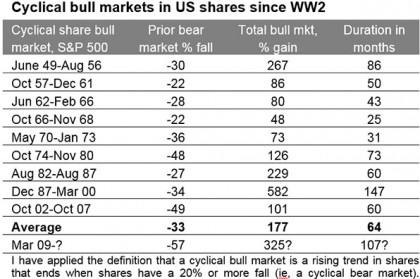
Next month, the cyclical bull market in US shares that started in March 2009 will be nine years old. See the next table.


Source: Bloomberg, AMP Capital. 

This makes it the second longest since World War Two and the second strongest in terms of gain. And according to the US National Bureau of Economic Research the current US economic expansion is now 104 months old and compares to an average expansion of 58 months since 1945. This naturally begs the question whether recession is around the corner leaving the US and hence global shares vulnerable to a major bear market? 

The investment cycle is maturing

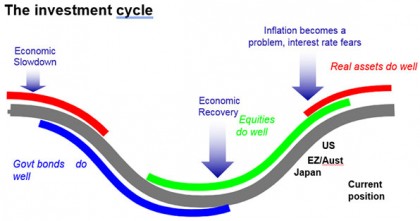
The next chart is a stylised version of the investment cycle – the thick grey line is the economic cycle.


Source: AMP Capital

A typical cyclical bull market in shares has three phases: scepticism – when economic conditions are weak and confidence is poor, but smart investors see value in shares helped by ultra-easy monetary conditions; optimism or the “sweet spot” – when profits and growth strengthen and investor scepticism gives way to optimism while monetary policy is still easy; euphoria – when investors become euphoric on strong economic and profit conditions, which pushes shares into clear overvalued territory and excesses appear, forcing  central banks to become tight triggering an economic downturn, which combines with overvaluation and investors being fully invested to drive a new bear market.

Typically, the bull phase lasts five years. However, “bull markets do not die of old age but of exhaustion” – their length depends on how quickly recovery proceeds, excess builds up, inflation rises and extremes of overvaluation and investor euphoria appear. 

This process has taken longer than normal following the GFC because periodic crises or aftershocks from the GFC – eg, the 2010-2012 Eurozone sovereign debt crisis and the 2015-16 global growth scare both of which were associated with mini bear markets globally and 19% and 14% falls in US shares respectively. This combined with post GFC consumer and business caution have prevented the global economy from overheating and excesses building and share markets going into euphoria, that then sets the scene for the next major bear market.

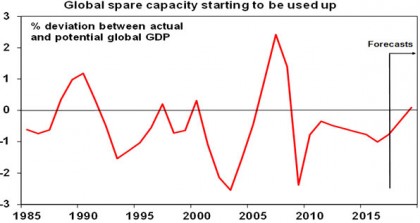
However, this is starting to change. Global growth forecasts have stopped being revised down and are now being revised up. Global growth this year and next will likely be around 3.9% which is above potential. So global spare capacity is starting to be used up.


Source: IMF, AMP Capital

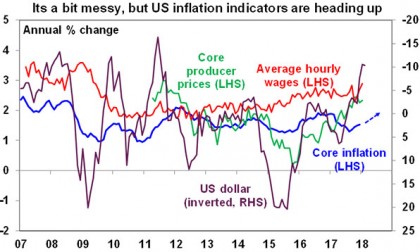
Fiscal austerity has given way to fiscal stimulus – at least in the US (with tax cuts and the removal of spending caps) – which with a lag will further boost growth. Inflationary pressures are building in the US – which is further advanced in the economic cycle than Europe, Australia and Japan (see the first chart) –  with a tight labour market, rising wages growth and accelerating import prices (flowing from the falling $US) and producer price inflation.


Source: Bloomberg, AMP Capital

Not at the top yet

But it’s unlikely we are at the top just yet.  Historically 10% or so share market pull backs (like the one two weeks ago) are normal. But whether the US is about to enter recession is critical to whether the US (and hence global) bull market in shares is about to end. Looking at all 10% or greater falls in US shares since the 1970s (see the table in Correction time for shares?) share market falls associated with recession tend to be longer lasting with an average duration of 16 months as opposed to 9 months for all 10% plus falls and deeper with an average decline of 36% compared to an average of 17% for all 10% plus falls.
 
So whether a recession is imminent or not in the US is critically important in terms of whether we will see a major bear market or not. In fact, the same applies to Australian shares.
 
Our assessment is that a recession is not imminent in the US or globally (or in Australia – a separate issue).  First, the post-GFC hangover has only just faded with high levels of confidence helping drive stronger investment and consumer spending. 
 
Second, as a result we are yet to see the sort of excesses that normally come with such confidence and precede recessions: 
  • overall private sector debt growth is modest in most countries (except for corporate debt in the US and China);

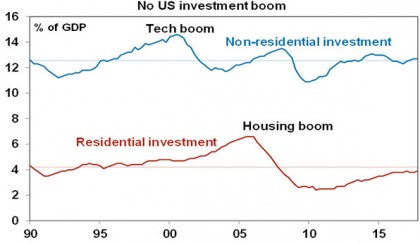
  • while investment is starting to pick up globally, there is no sign of overinvestment. While the US is further advanced, even here business investment (excesses in which preceded the tech wreck) and residential property investment (excesses in which preceded the GFC) are around their long-term averages relative to GDP.


Source: Bloomberg, AMP Capital

  • capacity utilisation is rising and inflationary pressures are building in the US but inflation is not a problem yet and it’s not an issue in other major countries. Core inflation in major countries ranges between 0.3% in Japan to 1.5% in the US.


Third, while tax cuts and additional public spending following the relaxation of spending caps will boost US growth they will take time to flow through and cause the economy to overheat.
 
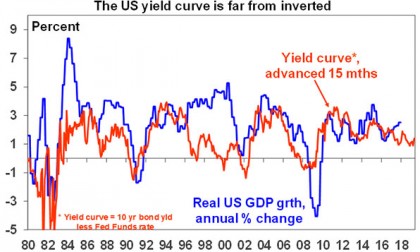
Fourth, monetary policy is not tight globally, even in the US where the Fed has been tightening for two years: the Fed Funds rate is below nominal GDP growth – which is a sign of lose monetary policy; and the yield curve (or the gap between long term bond yields and short-term interest rates), which has always gone negative ahead of past recessions, is still positive.


Source: Bloomberg, AMP Capital

Given this our judgement is that a recession is still some time away as it will take time for excesses to build and US monetary policy to become tight such that it threatens growth. Our best guess is that it’s a late 2019/2020 risk. In the interim share market volatility is likely to increase as inflation risks and other excesses gradually build, but the bull market still has some way to go. 

What to watch?

The key to watch for the next big bear market is for signs of excess – eg, overinvestment in key areas, rapidly-rising inflation over and above central bank targets, tight monetary policy, clear overvaluation and investor euphoria. This would then set the scene for the next economic downswing and hence a more severe bear market (as opposed to a correction or short-term bear market like we saw in 2015-16).

Investment implications

More volatility should be anticipated, and the fickleness of investor confidence means we can’t rule out another crash like in 1987. But despite this we still appear to be a fair way from the peak in the investment cycle so the trend in share markets likely remains up. Non-US shares and economies are less advanced in their cycles and provide opportunities for investors.


Source: AMP Capital 21 Feb 2018

Important note: While every care has been taken in the preparation of this article, AMP Capital Investors Limited (ABN 59 001 777 591, AFSL 232497) and AMP Capital Funds Management Limited (ABN 15 159 557 721, AFSL 426455) makes no representations or warranties as to the accuracy or completeness of any statement in it including, without limitation, any forecasts. Past performance is not a reliable indicator of future performance. This article has been prepared for the purpose of providing general information, without taking account of any particular investor’s objectives, financial situation or needs. An investor should, before making any investment decisions, consider the appropriateness of the information in this article, and seek professional advice, having regard to the investor’s objectives, financial situation and needs. This article is solely for the use of the party to whom it is provided.