If you don’t think you size up in the managing-money department, check out these 11 tips for when financial opposites attract.

You and your other half may be on the verge of moving in together, adopting a couple of fur-babies, having kids, opening a joint account, or buying a property.

If your partner is on point when it comes to managing their money, whereas you don’t have the faintest idea (do you even know how much cash is in your account right now?), it’s a conversation that mightn’t end well, particularly if you’re not even sure what you earn, owe, and spend.

If the thought had crossed your mind (after all, one third of couples cite financial stress as a key negative influence on their relationship1), but you have no idea where to start, here are some simple ways you can demonstrate to that special someone, you don’t need “financial babysitting” no more.

How to flex your financial muscle

Know exactly what money is coming in and going out

If you’re wondering why some people seem to have more money than you do, while it often comes down to salary, sometimes it comes down to smarts – and creating a budget will often play a big part.

It doesn’t have to be too hard of a task either. Simply start by writing down what money you’ve got coming in (from your job and/or elsewhere), what cash you need for the mandatory stuff (don’t forget any repayments owing), and what dough you’d like to have left over for the fun stuff.

Once you’ve done that, you’ll more easily be able to identify where you could cut back and where money might be saved.

Stop borrowing cash from mates and loved ones

When you’re in a bind, while you may be tempted to ask for a hand-out, it can put strain on relationships, particularly if it becomes a regular occurrence and you don’t pay things back on time.

The person you’ve borrowed from might need the money back before you can repay it, start to judge your spending habits, or even end the relationship, because they’re over you asking for cash.

Reduce your debts or you may have problems borrowing later on

Average household debt in Australia is around four times what it was about three decades ago2, which is why reducing debt is high on many people’s to-do lists.

Not only that but did you know that late payments can impact your credit rating, which means next time you go to borrow money, you might not actually be able to?

Here are some ways you can tackle mounting debt:

  • Consider setting up alerts or direct debit payments to help you stay on schedule

  • Try to pay the full amount owing, or you’ll generally still incur interest on the balance leftover

  • Look at whether you can afford to make extra repayments

  • Consider rolling your debts into a single loan with a lower interest rate.

Don’t pay more than what you have to

Research shows Aussie households could save up to $1,086 on their electricity bill every year by switching from the highest priced plan to the most competitive on the market3.

Now apply that thinking to your phone, wi-fi, credit card and other providers, and you might be pleasantly surprised by the savings you could make annually (c’mon, it’s worth a few phone calls).

If you want help, comparison sites, such as Compare the MarketCanstar and Mozo, can do a lot of the legwork for you.

Kick the bad habits or at least try to cut down

Aussies spent $10.7 billion on smokes, $6.7 billion on gambling and lotteries, and $5.8 billion on drinks at the bar last year alone4, so cutting back where you can might be worth a thought and reduce people in your life nagging you about it.

Easier said than done? Sure, but if you consider the other things you could put your money toward (an overseas trip might be nice) and that findings reveal those who persist in these areas could save more than $20,000 a year5, healthier choices might not sound like too bad of an alternative.

Cut out the secret spending

Nearly one third of Aussies in relationships spend money they don’t tell their other half about6. And, with about 85% of respondents in a survey by Relationships Australia indicating that financial problems were likely to push couples apart7, honesty and planning together might be a game changer.

Show you care about the future

If you’ve put thinking about super on the backburner, you might want to think again, particularly depending on how you and your partner hope to spend your years after you finish working.

With almost $18 billion worth of super waiting to be claimed by Aussies right across the country8(you may have changed jobs and opened new super funds along the way that you’ve lost track of), you might discover super you didn’t know you had. If you’re with AMP, we can even help locate it for you.

Meanwhile, you might also be interested to know that over a 12-month period $2.85 billion dollars in super wasn’t paid to employees by their employers9, so it’s worth taking a moment to also check you’re getting what you are owed.

In short, if you get paid over $450 a month, no less than 9.5% of your before-tax salary should be going into your super, so check your payslip and if something doesn’t look right, speak to your boss or contact the ATO.

Have an emergency stash for the unexpected stuff

An emergency fund can give you (and your partner) peace of mind, as you’ve got a bit of savings up your sleeve to pay for unexpected bills in the event of a financial dilemma – broken phone screen, car troubles, chipped tooth, parking fine – you get the gist.

It also reduces the need to rely on friends and family, and high interest borrowing options, such as credit cards or payday loans, which could see you pay back a lot more than what you borrowed.

Check you have the right insurance for you

Having personal insurance (whether you take it out through super or via an insurance company, broker or adviser) may help you to still meet your financial commitments if life throws you a curve ball.

With approximately one in five Australian families to suffer an unforeseen event that will leave someone incapable of working10, checking you have the right cover and enough of it, is important.

Keep in mind you can still have fun on a budget

If you’re thinking this all sounds great, but you’re social life could take a bit of a blow, the good news is there are a number of inexpensive ways to have fun.

One simple one might be to go where the specials are at and look out for two-for-one offers and other cheap deals. TheHappiestHour can give you some ideas, and you may even find some new venues in different suburbs you haven’t tried along the way.

Prioritise the things you want to do in life

While getting your financial affairs in order and learning how to consistently manage your money isn’t something that’s typically done in a day, the good news is, once you’ve nutted out some of the above points, prioritising your short, long-term and shared goals might seem more achievable.

If you’re interested, the top three savings goals for Australians is currently saving for a holiday, putting money toward an emergency fund, and buying or renovating a home11.

Regardless of your life stage, contact us on Phone: 07 5641 4134 about laying foundations to enjoy a rewarding future.


1. 7 Relationships Australia – Impact of financial problems on relationships paragraph 2, 8
AMP.NATSEM 38 – Buy now, pay later: Household debt in Australia page 3
Mozo – Sick of high energy bills? Aussies willing to change providers could be saving over $1,000 a year paragraph 2
Mozo – Australians eating away savings, spending a whopping $4 billion on food and drink per month table 1
Mozo – The 2018 New Year’s Resolutions that could help Aussies save $30,000
Finder – Out of sight, out of mind: One in three Aussies spend secretly
ATO media release – Almost $18 billion of super waiting to be claimed paragraph 2
ATO media release – ATO releases Super Guarantee gap estimates paragraph 2
10 Finder – Underinsurance in Australia paragraph 8
11 ASIC MoneySmart – How Australians save money table 1 

Source : AMP 13 April 2018 

Important 

This article provides general information and hasn’t taken your circumstances into account. It’s important to consider your particular circumstances before deciding what’s right for you. Although the information is from sources considered reliable, we do not guarantee that it is accurate or complete. You should not rely upon it and should seek qualified advice before making any investment decision. Except where liability under any statute cannot be excluded, we do not accept any liability (whether under contract, tort or otherwise) for any resulting loss or damage of the reader or any other person.


How do you go about choosing a restaurant, a new car or, or a dishwasher? Chances are you begin by looking online at consumer ratings and asking friends for their opinions.

Understandably, we look for shortcuts when making decisions and a common shortcut is to assume that past performance will continue in the future.

Certainly, it makes sense when buying a new vacuum cleaner to place weight on rankings for past reliability and the past experiences of other consumers.

Because the decision-making shortcut of relying heavily on past performance works well in most areas of our everyday lives, it is understandable that many investors would apply the same shortcut to buying and selling investments.

A Vanguard research paper, Reframing investor choices: Right mindset, wrong market, emphasises that the decision-making shortcut of relying too much on past performance “often falls short when it comes to making investment decisions”.

While past performance can have some predictive value with non-financial decisions, the link between past and future investment performance is “tenuous at best”, the paper emphasises.

To highlight the trap of relying on past performance when making investment decisions, other updated Vanguard research looks at performance of actively-managed Australian share funds over two consecutive five-year periods.

The majority of once top-performing funds for the first five years (ending December 2012) did not remain in the first quintile for the second five years (ending December 2017). However, if past performance was a reliable guide to future performance, most of the once first quintile funds could be expected to remain top performers.

Flows of capital in and out of investments suggest that a high proportion of investment cash flow is driven by past performance. “Momentum investors”, as they have been called, buy investments when prices are rising and sell when prices are falling. In other words, they are driven by past performance.

Further, the top-performing asset classes often do not remain the top performers in the next year.

How can you try to avoid basing your investment decisions on past performance?

“First and foremost, one must recognise and understand that the decision process that serves well in most areas of decision-making does not work in investing,” Vanguard’s paper on reframing investment decisions comments.

It suggests that investors shift their focus from past performance by relying on a straightforward, four-part decision-making process.

These steps are: develop a long-term financial plan to reach clear and appropriate goals, create a broadly-diversified portfolio across asset classes, minimise investment costs and periodically rebalance your portfolio.

Rebalancing a portfolio keeps it in line with its strategic asset allocation and is a disciplined way to respond to changing market prices.

Investors often assume that an investment that has outperformed in the recent past will continue to do well. And they often assume that an investment that has underperformed in the recent past will continue to underperform. Both assumptions are unreliable.

Please contact us on Phone: 07 5641 4134 for further assistance .

Written by Robin Bowerman, Head of Corporate Affairs at Vanguard.

Source : Vanguard August 2018  

Reproduced with permission of Vanguard Investments Australia Ltd

Vanguard Investments Australia Ltd (ABN 72 072 881 086 / AFS Licence 227263) is the product issuer. We have not taken yours and your clients’ circumstances into account when preparing this material so it may not be applicable to the particular situation you are considering. You should consider your circumstances and our Product Disclosure Statement (PDS) or Prospectus before making any investment decision. You can access our PDS or Prospectus online or by calling us. This material was prepared in good faith and we accept no liability for any errors or omissions. Past performance is not an indication of future performance.

© 2018 Vanguard Investments Australia Ltd. All rights reserved. 

Important:
Any information provided by the author detailed above is separate and external to our business and our Licensee. Neither our business, nor our Licensee take any responsibility for any action or any service provided by the author.

Any links have been provided with permission for information purposes only and will take you to external websites, which are not connected to our company in any way. Note: Our company does not endorse and is not responsible for the accuracy of the contents/information contained within the linked site(s) accessible from this page.


By Laurentine Ten Bosch, Food Matters

We live in a world of plastic. Plastic cups, bottles, plates, packaging – our plastic society is putting the world’s ecosystem at risk, but there are some simple steps we can take to change our wasteful habits. 

We wrote an article late last year “Are you still using plastic bags?”, and thankfully, many supermarket chains across the world have banned single use plastic bags.  Even just recently in Queensland, Australia.  This change is a massive step in the right direction for the health of our environment.

Although the popularity of single-use plastic bags is slowly declining, plastic bags and plastic packaging are still being used to package fresh, frozen, and dry foods. One problem has been solved but there’s more to go. Unnecessary plastic is making its way into our homes, and often through the kitchen. So, we’ve looked at a number of ways to reduce, reuse, and recycle in the kitchen.

What does our waste look like? 

Australia alone produces almost 3 million tons of plastic per year and of that, up to130,000 tons will end up in the ocean. That’s an incredible amount for a population that is just short of 25 million. 

The Clean Water Action organisation explains that food containers and packaging are the largest component of the municipal solid waste stream at 80 million tons or 31.7%, and together with plastic bags, represent the largest component of marine debris.

But why should we care?

There are many detrimental effects caused by plastic in our environment:

  • Marine plastic pollution has impacted at least 267 species worldwide, including 86% of all sea turtle species, 44% of all seabird species, and 43% of all marine mammal species through ingestion, starvation, suffocation, infection, drowning, and entanglement.  As our sea creatures consume this plastic waste, this means, with people consuming an average seafood diet, they are likely to ingest an approximate 11,000 pieces of plastic per year.

  • On land, plastic littler can block drains, trap birds, and kill livestock. It can cause blockages in the stormwater system, leading to flooding, costing councils thousands to repair.It has been estimated that it costs governments, businesses, and community groups over $4 million a year to clean up littered plastic.

  • Even the process of creating plastic causes problems – crude materials such as gas, oil, and coal are used to produce plastic, emitting dangerous greenhouse gases that can have numerous adverse reactions.   

What can we do to help?

Start with the kitchen, as this is the biggest source of plastic in most homes. Look at ways you can reduce the amount of plastic that comes into your kitchen and swap current plastic-based habits with more sustainable options. You may also find during this process that you reduce your food wastage as well!  

Changing our wasteful habits can be as easy as these 9 steps:

1. Beeswax wraps

2. Glass and metal storage containers

Forget the plastic tupperware, get yourself some reusable jars and containers. You can even save your jars from other foods to reuse. Many natural food stores will allow you to bring your own jars to refill on the staples like coconut oil, peanut butter, and your dry goods. You can also use them when you get a take-away meal, avoiding the wasteful packaging that is typically provided. These containers are fine for the pantry, fridge, and freezer – just check your liquid quantities when freezing and allow for expansion…  you don’t want bone broth exploding throughout your freezer!

3. Keep Cups!

Grabbing a bottle of water from your local convenience store or a take-away coffee from your favorite barista may seem harmless, however, these single use products are key ingredients in the pollution problem. An alternative way to combat this, without forgoing your caffeine fix, is by using a keep cup or reusable water bottle! And to keep your juices fresh, try our Food Matter Juice Jar – the perfect way to enjoy your Superfoods, smoothie, or fresh green juice on the go!

4. Compost

Take note green thumbs! A great way to avoid food waste and plastic bin bag waste is to build an at-home compost bin. Food scraps and yard waste currently make up 30% of what we throw away and can be used to create nutrient-rich fertiliser instead. The best part is, building your own compost is easy and great for your garden! 

5.  Reusable bags

With the recent ban on single use plastic bags in many locations, you’re going to need to make an investment in some reusable bags. TIP: keep them in your car so you’re never without! The NEW Food Matters big brown jute is the perfect plastic bag alternative for the farmers’ markets, beach, or day-to-day bag. Made with 100% natural jute materials, we have crafted our bags to be both beautiful and made with as minimal toxic load as possible.

6. Buying in bulk

Buying in bulk can help reduce your plastic consumption whilst helping out your wallet as well. Think about buying long-life items in bulk (brown rice and quinoa we’re looking at you!) and cut out the amount of times you go to the grocery store – the rest is history.  Check out our favorite online whole food suppliers, here.

7. Shop at farmers markets

Generally, when you shop at a farmers market, you avoid all the unnecessary plastic packaging that you see in chain supermarkets, plus, the quality and freshness of the produce is incomparable. You can simply use your reusable bags or cardboard boxes to carry your haul of fresh produce and other goodies.

8. Make more meals from scratch

You can dramatically reduce the amount of plastic entering your home by meal prepping at the start of the week and making meals from scratch. Use individual ingredients from markets and health food stores, collected in your reusable storage items (jars, cloth bags etc). Think about how much packaging goes into a store-bought salad with dressing, compared to a home-made version with fresh ingredients from the market! Yes, this takes planning, but make it a fun weekend outing to the market and then throw on your favorite tunes as you spend a Sunday afternoon preparing your meals for the week. It makes your week easier too!

9. Mindful party planning

Avoid a plastic overload at your next event by excluding plastic plates, cups, and cutlery. Try serving finger food so you don’t need these plastic accessories, or if utensils are a must, look out for bamboo alternatives.  


Following these tips, you will be amazed at just how little you need to take out to the curb come next ‘trash day’

Author  LAURENTINE TEN BOSCH 

Source : Foodmatters July 2018 

Reproduced with the permission of the Food Matters team. This article by  LAURENTINE TEN BOSCH was originally published at www.foodmatters.com/article/zero-waste-kitchen-swaps

Important:
This provides general information and hasn’t taken your circumstances into account.  It’s important to consider your particular circumstances before deciding what’s right for you. Although the information is from sources considered reliable, we do not guarantee that it is accurate or complete. You should not rely upon it and should seek qualified advice before making any investment decision. Except where liability under any statute cannot be excluded, we do not accept any liability (whether under contract, tort or otherwise) for any resulting loss or damage of the reader or any other person.  

Any information provided by the author detailed above is separate and external to our business and our Licensee. Neither our business, nor our Licensee take any responsibility for any action or any service provided by the author.

Any links have been provided with permission for information purposes only and will take you to external websites, which are not connected to our company in any way. Note: Our company does not endorse and is not responsible for the accuracy of the contents/information contained within the linked site(s) accessible from this page.


Are you among the investors holding a growing proportion of your investments outside super?

Changes to the super system – particularly the lowering of contribution caps and the introduction of the $1.6 million pension transfer cap* – are inevitably focusing more of investor’s attention on non-super assets.

Shortly before the arrival of the pension transfer cap in July 2017, the total value of non-super personal investments had overtaken the total value of super assets.

The Personal Investments Market Projections 2017 report, published earlier this year by consultants Rice Warner, calculates that the value of non-super personal investments overtook super assets during 2016-17.

Rice Warner expects personal non-super investments to become more important to higher-income super fund members still making contributions together with members, including retirees, who have already accumulated large super balances.

Further, the Vanguard/Investment Trends 2018 SMSF Report found that a third of SMSF trustees are making, or intending to make, investments outside super.

Yet regardless of wealth, a high proportion of investors have, of course, both super and non-super savings.

It is critical for investors to co-ordinate their super and non-super investment portfolios. This includes for their retirement and investment strategies, strategic asset allocations, periodic rebalancing of portfolios, tax planning, estate planning and their day-to-day finances.

When assessing the adequacy of your retirement savings, all of your investments, inside and outside super, should be included in your calculations.

Exchange traded funds (ETFs) are likely to receive an increasing share of the savings that would have otherwise flowed into super. This is because of their low cost, ease of trading and ability to immediately create widely-diversified portfolios. 

By contrast, low interest rates continue to discourage many investors from holding more of their non-super money in term deposits and cash.

A key difference between super and non-super investments is obviously tax treatment. Investors with more of their assets outside concessionally-taxed super have an added motivation to make their portfolios as tax efficient as possible.

*The indexed $1.6 million pension transfer cap is the maximum transferrable from an accumulation to a pension super account from July 1, 2017. Also, members with total super balances (in accumulation and pension accounts) greater or equal to the transfer cap can no longer make non-concessional (after-tax) contributions without exceeding the contributions cap. 

Please contact us on Phone: 07 5641 4134 if we can be of assistance .

Written by Robin Bowerman, Head of Corporate Affairs at Vanguard 

Source : Vanguard July 2018 

Reproduced with permission of Vanguard Investments Australia Ltd

Vanguard Investments Australia Ltd (ABN 72 072 881 086 / AFS Licence 227263) is the product issuer. We have not taken yours and your clients’ circumstances into account when preparing this material so it may not be applicable to the particular situation you are considering. You should consider your circumstances and our Product Disclosure Statement (PDS) or Prospectus before making any investment decision. You can access our PDS or Prospectus online or by calling us. This material was prepared in good faith and we accept no liability for any errors or omissions. Past performance is not an indication of future performance.

© 2018 Vanguard Investments Australia Ltd. All rights reserved.

Important:
Any information provided by the author detailed above is separate and external to our business and our Licensee. Neither our business, nor our Licensee take any responsibility for any action or any service provided by the author.

Any links have been provided with permission for information purposes only and will take you to external websites, which are not connected to our company in any way. Note: Our company does not endorse and is not responsible for the accuracy of the contents/information contained within the linked site(s) accessible from this page

For the last two calendar years the Australian dollar has defied our expectations for weakness. But after hitting $US0.81 in January it’s been trending down as US interest rates fell below the Australian cash rate, the threat of a US-driven trade war increased and it recently broke below a short-term range around $US0.74 and fell as low as $US0.72 on fears of contagion to global growth from a crisis in Turkey. This note looks at outlook for the $A and why it makes sense for Australian-based investors to hold a decent exposure to foreign exchange.

What are the fundamental drivers of the $A?

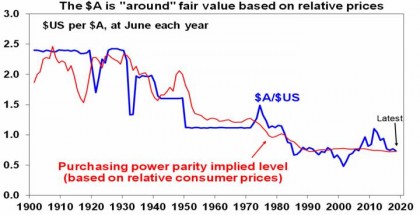
The Australian dollar tends to move in line with relative price differentials over the long term. This is the theory of purchasing power parity (PPP) according to which exchange rates should equilibrate the price of a basket of goods and services across countries – see the next chart.


Source: RBA, ABS, AMP Capital

If over time Australian inflation and costs rise relative to the US, then the value of the $A should fall relative to the $US to maintain its real purchasing power and competitiveness. But in the short to medium term, swings in the $A are largely driven by swings in the prices of Australia’s key commodity exports and the terms of trade (when they go up the $A tends to rise and vice versa) and relative interest rates such that a rise in US rates relative to Australian rates makes it more attractive to park money in the US and hence pushes the $A down.

Why the $A is likely to fall further 

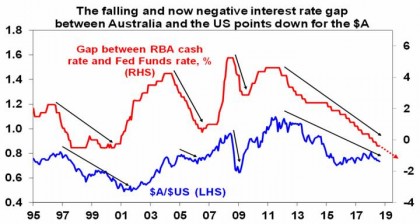
At current levels, the Australian dollar at around $US0.7350 is around where it should be on a long-term purchasing power parity basis – see the first chart. But the $A rarely spends much time at the purchasing power parity level and tends to be pushed to extremes above and below it. Our view remains that the downtrend in the $A that started in 2011 when the iron ore price peaked at over $US190/tonne has further to go. The main reason is the interest rate differential in favour of the $A is likely to go further into negative territory as the Fed continues to hike rates and the RBA remains on hold. This is making it relatively less attractive to park money in Australia putting downwards pressure on the $A. The Fed is on track to hike rates again next month as the US economy has continued to strengthen highlighted by a very tight jobs market. This will take the Fed Funds rate to a range of 2-2.25%. If the RBA leaves rates on hold at 1.5%, as is almost certain, then the gap between Australian and US official interest rates will fall to -0.5-0.75%, from a whopping +4.5% in 2011. Periods of a low and falling official interest rate differential between Australia and the US usually see a low and falling $A.


Source: Bloomberg, AMP Capital

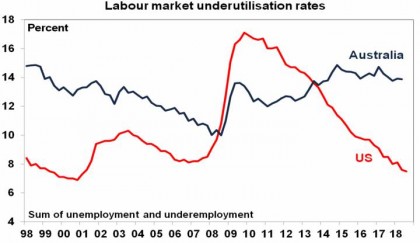
While some think that the RBA just follows the Fed there has often been significant divergences. This has notably been the case lately with the RBA hiking in 2009 (as the mining boom returned) and the Fed holding and the RBA continuing to cut in 2016 even though the Fed had commenced a tightening cycle. While US growth is running well above potential and has largely used up spare capacity, Australian growth has been running below potential and there is plenty of spare capacity. This is evident in the combination of unemployment and underemployment in the US running about as low as it ever gets whereas in Australia it’s about as high as it ever gets.


Source: Bloomberg, AMP capital

While there are some positive signs in Australia with investment picking up, strong export volumes and strong employment growth, uncertainty remains high around the housing sector and consumer spending. Wages growth and inflation also remain very low so the RBA is likely to be on hold for a long while yet as the Fed continues to hike. Given falling home prices in Sydney and Melbourne a rate cut cannot be ruled out if it threatens overall growth and inflation.

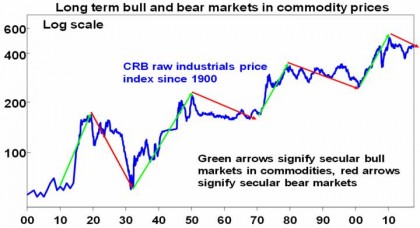
Our base case is that solid global growth will support commodity prices – particularly iron ore and coal – and that this will provide a floor for the $A in the high $US0.60s. However, history suggests we are still in a commodity price bear market after last decade’s surge in prices, the recent 20% or so plunge in metal prices is a warning of weakness and there are threats to emerging world growth from a rising $US, a potential contagion from Turkey, slower growth in China and from US trade policy.


Source: Global Financial Data, Bloomberg, AMP Capital

In the very short term the Australian dollar is oversold and this along with speculative short positions warns of a bounce higher. However, beyond this our assessment is that the $A has further to fall and will likely reach $US0.70 by year end.

What does it mean for investors?

With the risks skewed towards more downside in the value of the $A, there are several implications for investors.

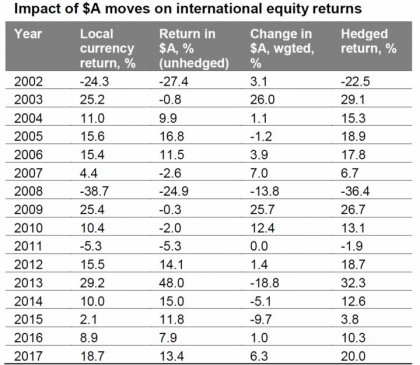
First, there remains a strong case to maintain a decent exposure to offshore assets that are not hedged back to Australian dollars. A decline in the value of the $A boosts the value of an investment in offshore assets denominated in foreign currency by one for one. This can be seen in relation to international equity returns in the next table. The first column shows the return from global shares in local currency terms; the second shows the return in Australian dollars (if foreign currency exposures are not hedged back to Australian dollars); the third column shows the difference, which is the change in the $A on a weighted basis; and the final column shows the return to global shares if hedged back to Australian dollars.


Source: Thomson Reuters, AMP Capital Investors

When the $A rises as it did last year it reduces returns from international shares for an unhedged investor. But when the $A falls as was the case in 2005, 2008, 2013, 2014 and 2015 it boosts the value of global assets and hence the return from global shares for an unhedged investor.

Furthermore, when Australian interest rates are above global rates, investors are “paid” to hedge their foreign currency exposure back to Australian dollars. As can be seen in the last column the return from global shares when hedged back to Australian dollars has been higher than the local currency return because hedging investors receive the difference between Australian and foreign rates. However, with Australian rates falling versus global rates the incentive to hedge is falling.

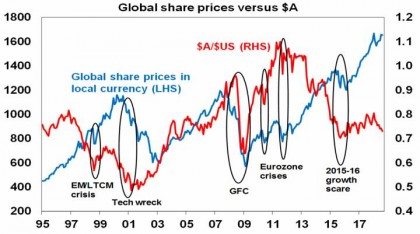
Second, if the global outlook turns sour, having an exposure to foreign currency provides protection for Australian investors as the $A usually falls in response to threats to global growth. As can be seen in the next chart there is a rough positive correlation between changes in global shares in local currency terms and the $A. Major falls in global shares associated with the emerging market/LTCM crisis in 1998, the tech wreck into 2001, the GFC, the Eurozone crises and the 2015-16 global growth scare saw sharp falls in the $A. This has been evident this year with worries about a trade war and Turkey weighing on the $A. So being short the $A and long foreign exchange provides good protection against threats to the global outlook.


Source: Bloomberg, AMP Capital

Finally, continuing weakness in the $A will be positive for Australian sectors that compete internationally like tourism, higher education, manufacturing, agriculture and mining.


Source: AMP Capital 21 August 2018

Important notes: While every care has been taken in the preparation of this article, AMP Capital Investors Limited (ABN 59 001 777 591, AFSL 232497) and AMP Capital Funds Management Limited (ABN 15 159 557 721, AFSL 426455) makes no representations or warranties as to the accuracy or completeness of any statement in it including, without limitation, any forecasts. Past performance is not a reliable indicator of future performance. This article has been prepared for the purpose of providing general information, without taking account of any particular investor’s objectives, financial situation or needs. An investor should, before making any investment decisions, consider the appropriateness of the information in this article, and seek professional advice, having regard to the investor’s objectives, financial situation and needs. This article is solely for the use of the party to whom it is provided.

The potential for financial technology (fintech) and bank collaboration is endless. Emerging technologies and innovations such as crypto currencies, voice-activated banking and the application of artificial intelligence to financial services are likely to transform banking in the future.

This was a key message from Henri Arslanian, founder of the fintech Moven, who addressed AMP’s recent Amplify event.

There is enormous work being done within banks and also within fintechs right now to develop new tools and technologies. The superannuation and investments platform space is a great example of Australian firms driving innovation in fintech, with Netwealth and HUB24 capturing significant share in the local market.

Robo advice is an emerging trend which has the potential to be adopted by the financial advice industry in the future. This software is currently able to deliver simple and broad based financial advice, but over time sophistication levels will increase and cater to more individual needs. The main hurdle to adoption is the consumer and regulator gaining comfort with the technology, given most people require individual advice suited to their unique circumstances.

Voice-activated banking is another evolving area, facilitated though devices such as Amazon Alexa. This device operates as a virtual assistant and can respond to simple queries. But there are substantial risks that also need to be addressed before tools such as Alexa become widely adopted for banking purposes.

It’s already possible to ask Alexa about the price of a share, for instance. But this becomes trickier when it comes to private banking information. For instance, asking Alexa or other similar devices such as Apple’s Siri function to perform transactions such as transferring funds is fraught with risk.

Banks must be certain the person performing the transaction is the person who owns the account. This will be difficult to resolve without putting the user through an additional layer of security checks which potentially negate the time saving benefit of using voice technology in the first place! It may be that a middle ground is found, whereby voice-activated technologies can be used for low-value transactions in the same way payWave technology is used now.

Distributed ledger technologies, or blockchain, are already being adopted in financial services. For instance, the Australian Securities Exchange (ASX) is planning to use blockchain-based technologies to replace its CHESS transaction settlements system. This is a huge project spanning many years, but the potential to increase efficiency and reduce errors makes it a worthwhile endeavour. While many associate blockchain with crypto currencies, investors should focus less on crypto and more on the technology that enables it.

There’s much for investors to absorb and understand about many of these new and largely unproven technologies. Many fintechs are still at a very nascent stage and investing in them carries substantial risk. This was evidenced recently when small business lender Prospa postponed its ASX listing after queries from the regulator. There are also a very limited number of fintech companies in Australia of a meaningful size that have made it onto the ASX. Examples include Netwealth, HUB24, OFX Group and EML Payments.

It’s important for most investors to understand early stage ventures such as fintechs carry more risk than proven businesses. While some will do exceptionally well, many will fail, and there is usually a long runway between a fintech starting up and profitability. It is however, still an area for investors to keep watch over to understand emerging technologies and how they are likely to contribute to the financial services sector over time.


Source: AMP Capital 16 August 2018

Author: Matt Griffin, Co-portfolio Manager, Small Caps

Important notes: While every care has been taken in the preparation of this article, AMP Capital Investors Limited (ABN 59 001 777 591, AFSL 232497) and AMP Capital Funds Management Limited (ABN 15 159 557 721, AFSL 426455) makes no representations or warranties as to the accuracy or completeness of any statement in it including, without limitation, any forecasts. Past performance is not a reliable indicator of future performance. This article has been prepared for the purpose of providing general information, without taking account of any particular investor’s objectives, financial situation or needs. An investor should, before making any investment decisions, consider the appropriateness of the information in this article, and seek professional advice, having regard to the investor’s objectives, financial situation and needs. This article is solely for the use of the party to whom it is provided.

Investor uncertainty and market volatility appear to be increasing as the economy continues to strengthen, leading to higher bond yields and eventual interest rate rises.

Australian equity investors trying to navigate the choppy waters that lie ahead should ignore the day-to-day ‘noise’ of the markets and instead focus on seven key questions. The answers to these will help investors better understand the approaching dangers and opportunities.

Will Aussie banks keep paying out big dividends?

Banking has been the principle beneficiary of the 25-year bull market in residential mortgages that has followed in the wake of Australia’s housing boom.

Bank share prices have powered ahead over recent years, fueled by the sustained and predictable earnings that strong mortgage lending delivered. Retail investors in particular have been drawn to the strong growth in (franking credit-enhanced) bank dividends.

Banks have been able to capture generous mortgage lending margins because the regulatory environment has prioritised banking solvency. The banks’ balance sheets further benefitted from the 30-year decline in bond yields.

However, regulatory focus may now shift from institutional stability towards promoting customer interests, following the Royal Commission.

Meanwhile, global bond markets are now moving into a period of rising yields, even if Australian interest rates are unlikely to increase for some time yet. These trends will not be positive for bank valuations.

Moreover, personal debt in Australia has reached historically high levels, leaving many recent homebuyers looking vulnerable. The most highly indebted are now worryingly exposed to a downside shock.

Credit conditions for borrowers are continuing to tighten, as maximum earnings multiples fall and living expenses are considered more cautiously by loan officers. Buy-to-let investors and first-time buyers with modest deposits appear to be withdrawing from the market now that home prices are falling in Sydney and Melbourne.

Why are Aussie consumers looking so glum?

The high level of indebtedness is having a significant impact on consumer spending in Australia. Under-employment remains high and wage growth for large parts of the labour force remains fairly stagnant.

Families who bought their home more recently at elevated price levels and now face increasing mortgage payments are especially impacted.

This is leading many families to look much more closely at their weekly spending, especially those seeking to pay down debt.

The retail sector is seeing shoppers switch their spending to market challengers such as Aldi, where private labels are priced at a significant discount to the major grocery stores, which is forcing down pricing on the majors’ own goods.

Investing in price cutting is not expected to be sustainable over the long-term and could detract from the major supermarkets’ earnings.

A wider range of businesses that depend on such price-sensitive shoppers will struggle to grow earnings as real wage growth remains subdued and debt servicing costs rise.

When will the next capex boom ride to the economy’s rescue?

The end of the mining investment boom led to resources companies taking an extended capex holiday that has been a major drag on the Australian economy. However the depletion of older mines is now leading to investment in new facilities.

Meanwhile Federal and State governments are continuing to support infrastructure investment, often as part of asset recycling programs in an attempt to grow productivity levels.

Australia’s growing population faces energy supply limitations as many base load power generation assets need upgrading or replacement and renewable energy targets loom large. This will require a capital investment uplift in power generation and transmission assets.

Finally Australia’s LNG market is moving from a period of oversupply during which capex was highly restricted, to one of undersupply. This is leading to a renewed surge of investments in brownfield sites.

This is likely to present the opportunity for well-positioned developers and contractors to grow earnings over the next phase of the capex cycle.

How can Australia make beautiful returns from a Beautiful China?

President Xi recently announced the intention to build a “Beautiful China” that would reduce the country’s toxic levels of air, water and soil pollution.

Older polluting coal power stations are likely to be shut. However, while the country is expected to continue importing high volumes of Australian coal, cleaner fuels such as LNG may grow in relative importance. Australian companies are expected to continue to benefit throughout this shift as they begin to invest in new LNG projects again.

In addition to ongoing demand for high-grade seaborne commodities, Australian companies exposed to China’s growing demand for clean energy, electric vehicles and batteries have the opportunity to grow earnings.

How will regulatory change impact companies?

The Federal Government in Canberra is now intervening much more actively across a number of areas of the economy. This is motivated by a desire to bring down those costs to voters and companies that threaten the economic recovery and the government’s political fortunes.

This is especially impacting regulated infrastructure companies, where some have been assigned especially low rates of return by regulators. Consequently, the less attractive earnings outlook may start to be reflected in companies’ market valuations.

Therefore, investors should be cautious about the wider regulated utility market, especially transmission assets facing government pricing decisions. The implementation of the National Energy Guarantee by the end of 2018 is likely to influence the returns and valuations of a range of energy businesses.

Meanwhile, gaming reform that impacts margin bets, advertising and taxation poses a potential threat to companies in the sector.

However media deregulation may well permit increased consolidation in the industry, which will potentially be supportive of earnings and valuations.

Which companies will be bitten by rising bond yields?

Rising global bond yields have been signaling the start of the return to more normal levels of interest rates for some time now. The rate-hiking cycle is well advanced in the US and has now started in the UK and some other markets.

Such an environment is generally considered to be negative for the market valuations of companies whose earnings are relatively stable and predictable. These include those in the infrastructure, listed real estate and telecommunications sectors. This is because as bond yields rise, investors apply a higher discount rate to their expected earnings, which reduces the implied valuation levels.

Therefore a cautious approach to these sectors is likely to be appropriate during the next phase of the business cycle.

However, certain companies in these markets are nonetheless able to grow earnings independently of the business cycle. These include real estate companies exposed to the growth of data centres and e-commerce, which are poised to outperform the market even during a period of rising interest rates.

Should I be investing in growth or income companies?

Australian growth companies have strongly outperformed value/income stocks since the last round of Chinese economic stimulus. This is to be expected during a stage of the economic cycle when earnings growth is generally positive and interest rates remain at historically low levels

However, the valuations of growth companies are now notably high, trading at large premiums to their 10-year average price/earnings ratio and relative to the wider Australian equity market.

Such lofty valuation levels require very strong and sustained earnings growth in order to justify the present market premiums. Therefore many growth companies appear to be highly vulnerable to any events that slow the upward path of corporate earnings.

Hence investors may now find more attractive opportunities in companies that are characterised by sustainable dividend payouts and/or more attractive valuation levels.


Source: AMP Capital 16 August 2018

Author: Dermot Ryan is a co-PM for AMP Capital’s Australian equity income-focused strategies and covers mining and energy sectors.

Important notes: While every care has been taken in the preparation of this article, AMP Capital Investors Limited (ABN 59 001 777 591, AFSL 232497) and AMP Capital Funds Management Limited (ABN 15 159 557 721, AFSL 426455) makes no representations or warranties as to the accuracy or completeness of any statement in it including, without limitation, any forecasts. Past performance is not a reliable indicator of future performance. This article has been prepared for the purpose of providing general information, without taking account of any particular investor’s objectives, financial situation or needs. An investor should, before making any investment decisions, consider the appropriateness of the information in this article, and seek professional advice, having regard to the investor’s objectives, financial situation and needs. This article is solely for the use of the party to whom it is provided.

At AMP’s recent Amplify event, Mark Moore, Uber’s engineering director of aviation and Nick Earle from Hyperloop One, spoke about how innovation is likely to change the face of public transport. Emerging public transport systems are poised to free up road and rail systems, leading to less congestion and better use of infrastructure.

As an example, Uber’s vision for the future of commuting involves a self-driving electric car picking up a passenger and taking them to a nearby teleport, from which an unmanned air taxi would take them to their destination teleport, where another Uber car would pick them up and take them to their final destination.

Hyperloop One’s vision is different but likely to be complementary. They envisage ‘packetised transportation’ that can carry both passengers and cargo in a pod which travels at high speed through a tube using magnetic levitation. It’s energy agnostic and has the ability to draw power from various sources including renewable sources such as solar. The target speed is just below the speed of sound, so a Sydney to Melbourne trip could take just 60 minutes.

Both visions will slash trip times and take cars off the road, and also provide new infrastructure investment opportunities.

The future of infrastructure

Any reduction in the number of vehicles on roads will have further flow on effects to related infrastructure and this is a major trend of which infrastructure investors need to be aware. For instance, there will be less need for big CBD parking stations, which may be able to be repurposed, for example as logistics hubs or as electric vehicle charging stations.

These changes may also impact the nature of our cities. They may allow for even larger cities, possibly incorporating several centralised hubs, and larger population densities.

Given competition will be fierce among technology providers, one strategy for infrastructure investors may be to back the facilities and systems needed to support new transport modes.

For example, an electric-vehicle future may require an amplification of renewable generation and distribution capacity. This will require construction of many battery charging or swap stations in major built up areas. This is an opportunity for investors.

Ultimately, it will take time, new regulations and substantial public education to switch to a new model for public transport. While it’s impossible to predict the future, given how gridlocked Australia’s road and rail networks are, it’s only a matter of time before new approaches make practical and economic sense.


Source: AMP Capital 16 August 2018

Author: John Julian has over 22 years financial sector and investment experience in both legal and commercial roles. John joined AMP Capital Infrastructure as an Investment Specialist in 2008, and since then has worked closely with the Global Infrastructure Team across all aspects of AMP


Important notes: While every care has been taken in the preparation of this article, AMP Capital Investors Limited (ABN 59 001 777 591, AFSL 232497) and AMP Capital Funds Management Limited (ABN 15 159 557 721, AFSL 426455) makes no representations or warranties as to the accuracy or completeness of any statement in it including, without limitation, any forecasts. Past performance is not a reliable indicator of future performance. This article has been prepared for the purpose of providing general information, without taking account of any particular investor’s objectives, financial situation or needs. An investor should, before making any investment decisions, consider the appropriateness of the information in this article, and seek professional advice, having regard to the investor’s objectives, financial situation and needs. This article is solely for the use of the party to whom it is provided.

Earlier this year the big fear was that inflation was going to surge led by the US and that this was going to drive aggressive interest rate hikes by the US Federal Reserve and much higher bond yields, which in turn would pressure other asset classes. Such fears saw a significant correction in global share markets with US shares falling 10%, global shares falling 9% and Australian shares falling 6%. Since then, inflation fears seem to have taken a back seat. While in most major countries 10-year bond yields are well up from their 2016 multi decade lows, US bond yields have struggled to stay above 3%, German bond yields are around 0.3%, Japanese bond yields are around 0.09% and Australian bond yields are around 2.58%, with most well below their highs seen earlier this year. So, what happened? Should we still worry about inflation?

What happened? 

A whole bunch of things have helped bond yields remain low and kept investors focused elsewhere:

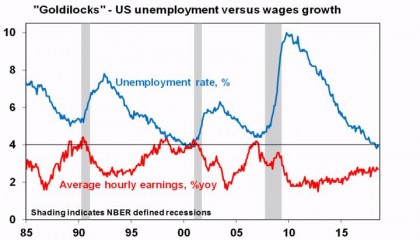
  • First, although US inflation has moved up it remains relatively benign with the core private final consumption deflator around 2% year on year which is the Fed’s inflation target. It seems every US jobs report has seen the same “Goldilocks” (not too hot/not too cold) combination of strong jobs growth and falling (now sub-4%) unemployment but low wages growth of around 2.7-2.8% year on year implying low inflation pressures. See the next chart.


Source: Bloomberg, AMP Capital

  • While the Fed has continued its drip feed of rate hikes consistent with strong economic conditions, the lack of any inflation break-out has meant that they have been able to remain gradual, with one hike every three months and monetary policy remains very easy.

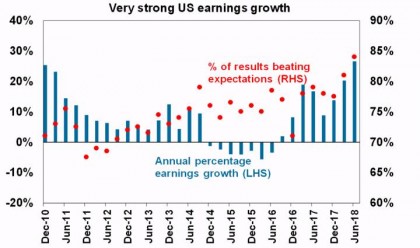
  • Strong US earnings growth has helped distract share market investors. June quarter earnings results have seen 84% of companies surprise on the upside regarding earnings and 71% beat revenue expectations, both of which are above normal levels. Reflecting this, June quarter earnings growth has come in around 27% on a year ago, up from expectations for 20% earnings growth in early July.


Source: Bloomberg, AMP Capital

  • The trade war threat has tended to dominate, leading to fears of a hit to global (and US) growth and safe haven demand for assets like bonds (which has helped keep their yields down).

  • Worries about Italy’s new populist government blowing out its budget deficit and already high level of public debt, or worse still threatening to leave the Euro resulting in bond holders taking a hit on their investment in Italian bonds, have boosted demand for German bonds depressing their yields and helped extend expectations of easier for longer European Central Bank monetary policy.

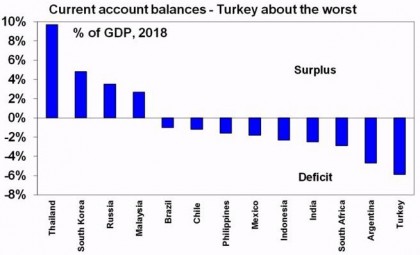
  • Other geopolitical events like the crisis in Turkey have kept investors on edge for deflationary shocks. The latest worries about contagion from Turkey as its currency plunged anew are likely overdone. Yes, there will be some impact on Eurozone banks that are exposed to Turkish debt (which will keep the ECB cautious), but it’s unlikely to be economically significant. More fundamentally, Turkey is not indicative of the bulk of emerging countries. Its currency has crashed 40% or so this year because of current account and budget deficit blowouts, surging inflation, political interference in its central bank and populist economic mismanagement generally. In addition, political tensions with the US following the imprisonment of an American pastor resulting in US sanctions on Turkey including tariff hikes on steel and aluminium have made things even worse. The crisis is now being intensified by Turkish PM Erdogan’s rejection of higher interest rates and an international bailout. While Brazil, Argentina and South Africa also have particular problems, most of the rest of the emerging world is in far better shape. That said, emerging markets will remain vulnerable until the US dollar stops rising (as a rising $US boosts US dollar denominated debt servicing costs for emerging countries that have high foreign debt), the global trade threat ends and uncertainty regarding Chinese growth fades. And upwards pressure on the US dollar is likely to continue as the Fed is unlikely to stop its process of gradual rate hikes anytime soon.


Source: IMF, AMP Capital

  • Finally, while growth in the US has accelerated this year, in other major countries it looks to have slowed. So, while there was talk of the Bank of Japan, the European Central Bank and even the Reserve Bank of Australia following the US into tightening this has been pushed out further. Similarly, some signs of a softening in growth in China and the tariff threat have seen the PBOC (China’s central bank) move towards monetary easing.

Implications – another extension to the cycle?

These considerations have combined to help fade the inflation/Fed tightening fears of earlier this year with the result that bond yields have been contained and most share markets have been able to recover from their February inflation-scare lows. In some ways it’s more of the same because the whole post global financial crisis (GFC) experience has been one of two or three steps forward towards stronger global growth followed by one or two steps back (with eg the Eurozone debt crisis, the 2015 growth scare and various deflation fears along the way). What we have seen this year is effectively a continuation of that.

By delaying or slowing monetary tightening this has all helped extend the economic and investment cycle. The implications have been:

  • A continuation of low returns from cash and low bank deposit rates.

  • Yield-sensitive share market listed investments like real estate investment trusts have been able to rebound.

  • Unlisted assets like infrastructure and commercial property have continued to benefit from a search for yield by investors.

With global monetary conditions remaining easy and US recession warning indicators still not flashing red (although the yield curve is worth keeping an eye on) our assessment remains that the investment cycle has more upside and that a US recession remains a way off yet. However, the main risks around this relate to the threat of a global trade war should the tariff threat from the US continue to escalate.

But should we still worry about inflation?

However, while the investment cycle has been extended it would be wrong for investors to dismiss the inflation threat – particularly in relation to the US:

  • First, while it has taken a long time to get there resulting in numerous deflation scares along the way, spare capacity in the US economy has been mostly used up.

  • Second, numerous indicators point to a very tight labour market in the US – with more vacancies than there are unemployed, very high hiring and quits rates, companies nominating finding suitable labour as a bigger problem than weak demand – suggesting that sooner or later wages growth will start to pick up more significantly.

  • Third, inflation is well known to be a lagging indicator and it often appears as a problem after the pace of economic growth has peaked.

  • Finally, from a longer-term perspective there is a risk that the lessons of the break out in inflation from the late 1960s into the 1970s are being forgotten and that populist politicians will seek to weaken the institution of an independent central bank targeting low inflation. President Trump’s tweets critical of the Fed raising interest rates are concerning in this regard. 

As a result, we remain of the view that (absent a full-blown global trade war) the drip feed of Fed rates hikes will continue well into next year, that the 35 year bull market in bonds that began in the early 1980s is over and that the risks to US and by implication global bond yields into next year are still on the upside. This suggests investors need to be a little more wary of yield-sensitive globally-exposed investments that don’t offer inflation protection (like inflation-linked bonds do and the potential for rising rents do in the case of commercial property and infrastructure) than was the case a few years ago when there was still plenty of spare capacity in the US. Ongoing Fed rate hikes also point to ongoing upwards pressure on the US dollar which in turn suggests that investors should remain cautious in relation to emerging market shares.

The upside risks for bond yields is less in Australia given much higher unemployment and underemployment and that the RBA is likely to remain well behind the US in raising interest rates. With the Fed hiking and the RBA holding, this is all consistent with ongoing downwards pressure on the Australian dollar which we still see falling to around $US0.70, having recently broken below $US0.73.


Source: AMP Capital 14 August 2018

Important notes: While every care has been taken in the preparation of this article, AMP Capital Investors Limited (ABN 59 001 777 591, AFSL 232497) and AMP Capital Funds Management Limited (ABN 15 159 557 721, AFSL 426455) makes no representations or warranties as to the accuracy or completeness of any statement in it including, without limitation, any forecasts. Past performance is not a reliable indicator of future performance. This article has been prepared for the purpose of providing general information, without taking account of any particular investor’s objectives, financial situation or needs. An investor should, before making any investment decisions, consider the appropriateness of the information in this article, and seek professional advice, having regard to the investor’s objectives, financial situation and needs. This article is solely for the use of the party to whom it is provided.

Role models are important in many stages of life. Be it school years, on the sporting field or in your career, having a positive role model, someone to compare yourself to and measure your progress against, can be a powerful and positive influence.

But what about your financial position? Do you have someone that you compare your financial well-being against?

If so, are you ahead or behind?

For people approaching retirement a sense of financial security is important not just in monetary terms but also in terms of their overall sense of happiness and well-being.

Stepping off the employment treadmill can be both liberating and a recipe for heightened levels of anxiety.

At Morningstar’s annual adviser conference in Chicago this month, Sarah Newcomb, their senior behaviour scientist, gave a presentation on what she terms “the comparison trap” and looked at research that shows where people believe they rank relative to others has a greater effect on happiness than their absolute level of income.

Interestingly, she also pointed to research that people who spend a lot of time on social media sites can have lower levels of well-being and life satisfaction.

The glib answer to this is to stop comparing ourselves to others – and perhaps cut down the social media time – but the counter to that is a body of research that identifies what Newcomb says is an innate need as humans. To assess our social and personal worth when there is no objective means to do so, we look to people similar to us to inform an assessment.

In common parlance we know that phenomenon as “keeping up with the Joneses”.

What is interesting about this discussion is that it is not simply about the dollars. There is a significant emotional component involved when we are discussing financial well-being. Newcomb says we all probably know someone who is financially well off but not as happy or content with their lot as you would expect.

Rather than saying stop to the natural human trait of comparison, what the Morningstar research has tried to do is look at ways investors – and their advisers – can reframe the mindset to make it a more positive process. Because our tendency is to compare ourselves to people who have more, in Newcomb’s words most of us appear to be actively making ourselves feel bad about our own financial circumstances by always looking up at people who have more.

While the concept of a role model/mentor is something that is positive overall, what the Morningstar research is pointing to is the need to thoughtfully pick the person you are going to measure yourself against.

As Newcomb says, by changing the target and direction of our social comparisons, we can create more positive emotions with our finances. “This might not change your economic reality, but it could improve your quality of life. And feeling more secure with your financial well-being could have beneficial long-term effects by eliminating fear-based behaviours, such as performance-chasing and panic selling, which could put you in a better position to achieve long-term investing success.”

PLease contact us on Phone: 07 5641 4134 if you require further assistance . 

Written by Robin Bowerman, Head of Market Strategy and Communications at Vanguard.

Source : Vanguard June 2018

Reproduced with permission of Vanguard Investments Australia Ltd

Vanguard Investments Australia Ltd (ABN 72 072 881 086 / AFS Licence 227263) is the product issuer. We have not taken yours and your clients’ circumstances into account when preparing this material so it may not be applicable to the particular situation you are considering. You should consider your circumstances and our Product Disclosure Statement (PDS) or Prospectus before making any investment decision. You can access our PDS or Prospectus online or by calling us. This material was prepared in good faith and we accept no liability for any errors or omissions. Past performance is not an indication of future performance.

© 2018 Vanguard Investments Australia Ltd. All rights reserved.

Important:
Any information provided by the author detailed above is separate and external to our business and our Licensee. Neither our business, nor our Licensee take any responsibility for any action or any service provided by the author.

Any links have been provided with permission for information purposes only and will take you to external websites, which are not connected to our company in any way. Note: Our company does not endorse and is not responsible for the accuracy of the contents/information contained within the linked site(s) accessible from this page.