Creating good saving habits takes practice and willpower – especially when there are so many ways to spend your money. But these strategies can help you (or your kids) become a successful saver and reach your goals sooner.

Set up your savings plan in five simple steps

1. Look at what’s coming in, and what’s going out

To set a realistic budget, first, figure out how much money you have coming in. Then take a close look at how much you’re spending – right down to the smallest purchase. This will help you decide how much you can afford to put away each month. Check out Budgeting 101 and Budgeting 102 for more helpful tips on how to start a budget and stick to it.

2. Have a goal in mind

What are you saving for? Maybe it’s a short-term goal, like a holiday. Or perhaps you’re saving for something significant, like your first home. Regardless of how big or small your dream purchase is, having a goal in mind will make it easier to stick to your savings plan.

Check out our savings calculator to see how soon you could reach your savings goal.

3. Help to plan and track

No matter what your goal is, there are budgeting and savings tools to help. Set up a savings plan and track your progress. If you don’t have internet banking, a budget planner can still get you started.

4. Choose a savings account with bonus interest

A savings account usually offers a higher interest rate than an everyday account. When selecting a savings account, check to see if it offers bonus interest. If it does, try not to make any withdrawals, as the bonus may not be paid out if you do. You can learn more about how bonus interest works by reading our tips on successful saving.

Alternatively, you might also want to consider exploring a term deposit as an option to reach your savings goal.

5. Set up a direct credit

Setting up a direct credit from your salary to your savings account each payday can be a big help. It will mean some of your money will be ‘out of sight, out of mind’ so that it will be easier for you to save. You can use internet banking to set up a weekly, fortnightly or monthly direct credit. Simply choose a day or date you want the money transferred so that it lines up with your payday. Remember to check your balances regularly to make sure that there are enough funds to transfer your direct credit.

How to save money: a beginner’s guide

New to saving? Here are some simple saving tips to help you reach your goal.

Save up those lump sums

Treat any unexpected windfalls or lump sums – such as work bonuses, tax returns or cash gifts – like forced savings, and put them in your pot immediately. They can really add up in the long run.

Think before you buy

‘Mindful consumption’ is a good habit to get into. Not only will it help you save in the short term, it will help you budget for larger financial responsibilities down the road too. Avoiding temptation can be tricky, however. The next time you’re tempted to make an impulse purchase, walk away and give yourself time to think it over, even if just for an hour. Chances are you’ll realise you really don’t need it after all.

Sell unwanted goods

Cleaning out your cupboards and getting rid of things you don’t use doesn’t just free up space, it can lead to some extra savings too. Try selling your unwanted items on eBay, Gumtree, or at a good-old fashioned garage sale. There’s a nationwide garage sale trail every October, which is ideal for first-time sellers.

Cut back on those little luxuries

More often than not it’s the smaller, everyday purchases that start eating into your budget. Do you buy your lunch and coffees every day? Make your own and save as much as $100 a week. Swap takeaways for homemade dinners and lunches. And instead of going out for dinner at the weekends, why not take turns with friends to host a casual dinner at home, or have a movie or games night?

Even the savings from simple changes – like taking public transport or car-pooling to save on petrol, or swapping your magazine subscription for an online one instead – can really add up. Remember, the short-term pain of giving up what you love will be worth it when you’ve saved for your first home deposit or that overseas trip.

Shop around

Doing a little research on price comparison websites and tools can help save you money on both everyday purchases and big spends. Why not:

  • compare shopping on sites like MyShoppingShopbot and GetPrice

  • compare insurance and other contracts online to find the best deal

  • compare the cost of your gym membership with group personal training sessions.

Ask your family for advice

Your parents and grandparents had to start saving at some stage too. They might’ve had to be thrifty to save up for their home or raise a family. So why not learn from their experiences? They could have some great cost-cutting tips you hadn’t even thought of. You can also read plenty more successful saving tips to help with your savings goals. If you’re thinking about getting your first bank account and not sure where to start,  you can find out more at our youth banking page.

Don’t kick your savings habit

Being a good budgeter and saver has plenty of advantages well beyond any short-term financial goals you might reach to begin with.

It can be the difference between keeping your head above water during difficult financial times and being in financial hardship. It’s also a wonderful habit to teach your kids, so the next generation can have the same great opportunities you’ve had.

Source: NAB 

Reproduced with permission of National Australia Bank (‘NAB’). This article was original published at https://www.nab.com.au/personal/life-moments/manage-money/budget-saving/simple-saving-habits

National Australia Bank Limited. ABN 12 004 044 937 AFSL and Australian Credit Licence 230686. The information contained in this article is intended to be of a general nature only. Any advice contained in this article has been prepared without taking into account your objectives, financial situation or needs. Before acting on any advice on this website, NAB recommends that you consider whether it is appropriate for your circumstances.

© 2021 National Australia Bank Limited (“NAB”). All rights reserved.

Important:
Any information provided by the author detailed above is separate and external to our business and our Licensee. Neither our business nor our Licensee takes any responsibility for any action or any service provided by the author. Any links have been provided with permission for information purposes only and will take you to external websites, which are not connected to our company in any way. Note: Our company does not endorse and is not responsible for the accuracy of the contents/information contained within the linked site(s) accessible from this page.


 

Key points:

  • Assessment teams will help you find the rights services to suit your care needs or basic help you require at home

  • The Commonwealth Home Support Programme (CHSP) may be your best option if you need basic help around the home

  • A Home Care Package (HCP) is ideal if you require care services but don’t wish to enter aged care

Sometimes simple tasks, like taking a shower or getting dressed, can become a major ordeal, and if you no longer have a driver’s licence, getting to appointments can be hard.

With the right support, you can receive help to make your life easier, and this will enable you to continue living in your own home.

Depending on your needs, you can receive support in many areas including:

  • Help with domestic tasks such as laundry, cleaning or meal preparation

  • Transport to appointments, shopping

  • Assistance with personal care such as showering and dressing

  • Gardening and home maintenance

  • Medication management

  • Counselling and support

  • Fitness and rehabilitation

  • Allied health support such as podiatry or occupational therapy

  • After hospital care

  • Goods and equipment such as mobility aids

  • Social support and other activities

  • Nursing care such as changing dressings on wounds

  • End of life care at home

Types of home care

If you want to stay in your own home but need assistance to continue living independently, you can get support from the Government. You can access home care support through the Commonwealth Home Support Programme (CHSP) or the Home Care Packages (HCP) program.

Entry level support is offered through the CHSP, if you only need basic assistance to continue living independently at home.

If your needs exceed the level of assistance offered through CHSP, then the HCP program can offer higher intensity support to help you stay at home.

How to access Government funded home care services

In Australia, there are a wide variety of organisations and businesses offering different home support services to help you at home.

The Australian Government provides funding for home care packages, and these are offered via providers using the ‘Consumer Directed Care’ principles of service. This means you can choose the type of home support you receive, when you receive it and who you receive it from.

If you are accessing Government funded aged care services for the first time, you will need to be assessed to determine your level of care needs. Contact My Aged Care via its website or call the My Aged Care contact centre on 1800 200 422.

Types of assessment

When you contact My Aged Care, a representative will discuss your needs by asking questions about:

  • Any support you are currently receiving

  • If you have any health concerns

  • How you are managing with activities around the home

  • Some questions relating to your safety in the home.

The outcome of this conversation depends on your needs. You will either be referred to services, need a face-to-face home support assessment through the Regional Assessment Service (RAS), or if you have more complex needs, a more comprehensive assessment conducted by an existing Aged Care Assessment Team (ACAT) or (or ACAS in Victoria) may be required.

The more comprehensive assessment may also be organised if you are leaving hospital or you are in need of respite care.

Choosing your home care provider

Under the consumer directed care, you can choose whoever you want to provide your services. If you are eligible for several services, you may choose one provider for your domestic tasks and another one to assist with your medication management.

If you already know which provider or providers you would like to deliver your home care services, ask My Aged Care to arrange for them to contact you.

Alternatively, you can ask My Aged Care for a referral code, and when you decide on which provider you would like to receive help from, contact it direct with the referral code.

Financial contribution

The Australian Government provides subsidies for home care services through its Commonwealth Home Support Programme and Home Care Packages. 

However Government funding does not always cover the entire cost of the services needed and, depending on your income, you may have to contribute towards the cost of your home services.

The amount you contribute is on a means tested basis.

Always discuss with your provider the financial aspects of your home care service before you receive the relevant service.

Other home care services

Local organisations

Some councils and charities offer some services such as transport, social support and help with home and garden maintenance. Many of these services are free or require a minimum payment.

Private home care

You can pay entirely for your home support services through a private home care provider. Private home care providers offer the full range of services including 24-hour Registered Nurses for complex care needs, physiotherapists and drivers, and carers to assist with shopping and personal care. There is no limit to the number of hours of care provided.

There is no need for Government assessments. The provider will talk with you and tailor a package according to your needs and wishes.

As private home care services are arranged directly between you and the private home care company, be sure to ask for a full breakdown of what you will be receiving and paying for, and where there may be any additional costs.

Source: This article was originally published on https://www.agedcareguide.com.au/information/home-care-introduction. Reproduced with permission of DPS Publishing.


Important:
This provides general information and hasn’t taken your circumstances into account.  It’s important to consider your particular circumstances before deciding what’s right for you. Although the information is from sources considered reliable, we do not guarantee that it is accurate or complete. You should not rely upon it and should seek qualified advice before making any investment decision. Except where liability under any statute cannot be excluded, we do not accept any liability (whether under contract, tort or otherwise) for any resulting loss or damage of the reader or any other person. 

Any information provided by the author detailed above is separate and external to our business and our Licensee. Neither our business nor our Licensee takes any responsibility for any action or any service provided by the author. Any links have been provided with permission for information purposes only and will take you to external websites, which are not connected to our company in any way. Note: Our company does not endorse and is not responsible for the accuracy of the contents/information contained within the linked site(s) accessible from this page.

How much tax you pay on your super contributions and withdrawals depends on:

  • your total super amount

  • your age

  • the type of contribution or withdrawal you make

If you inherit someone’s super after they die, the person’s super fund pays you a super death benefit. You may have to pay tax on some of this benefit.

Because everyone’s situation is different, it’s always best to get advice about tax matters. Contact the Australian Taxation Office (ATO) or a us Phone: 07 5641 4134.

How super contributions are taxed

Money paid into your super account by your employer is taxed at 15%. So are salary-sacrificed contributions, also known as consessional contributions.

There are some exceptions to this rule:

  • If you earn $37,000 or less, the tax is paid back into your super account through the low-income super tax offset (LISTO).

  • If your income and super contributions combined are more than $250,000, you pay Division 293 tax an extra 15%.

If you make contributions from your after-tax income — known as non-concessional contributions — you don’t pay any contributions tax.

See tax on contributions on the ATO website for more information about how much tax you’ll pay on super contributions.

Smart Tip:

To avoid paying extra tax on your super, make sure you give your super fund your Tax File Number.

How super investment earnings are taxed

Earnings on investments within your super fund are taxed at 15%. This includes interest and dividends, less any tax deductions or credits.

See super investment options to find out more.

How super withdrawals are taxed

The amount of tax you pay depends on whether you withdraw your super as:

  • a super income stream, or

  • a lump sum

Everyone’s financial situation is unique, especially when it comes to tax. Make an informed decision. We recommend you get financial advice before you decide to withdraw your super.

Super income stream

A super income stream is when you withdraw your money as small regular payments over a long period of time.

If you’re aged 60 or over, this income is usually tax-free.

If you’re under 60, you may pay tax on your super income stream.

See retirement income tax.

Lump sum withdrawals

If you’re aged 60 or over and withdraw a lump sum:

  • You don’t pay any tax when you withdraw from a taxed super fund.

  • You may pay tax if you withdraw from an untaxed super fund, such as a public sector fund.

If you’re under age 60 and withdraw a lump sum:

  • You don’t pay tax if you withdraw up to the ‘low rate threshold’, currently $225,000.

  • If you withdraw an amount above the low rate threshold, you pay 17% tax (including the Medicare levy) or your marginal tax rate, whichever is lower.

If you have not yet reached your preservation age:

  • You pay 22% (including the Medicare levy) or your marginal tax rate, whichever is lower.

See the super lump sum tax table on the ATO website for more detailed information.

When someone dies

When someone dies, their super is usually paid to their beneficiary. This is called a super death benefit.

If you’re a beneficiary, the amount of tax you pay on a death benefit depends on:

  • the tax-free and taxable components of the super

  • whether you’re a dependent for tax purposes

  • whether you take the benefit as an income stream or a lump sum

See super death benefits on the ATO website or call us on Phone: 07 5641 4134 for detailed information.

Source: Moneysmart.gov.au
Reproduced with the permission of ASIC’s MoneySmart Team. This article was originally published at https://moneysmart.gov.au/how-super-works/tax-and-super

Important note: This provides general information and hasn’t taken your circumstances into account.  It’s important to consider your particular circumstances before deciding what’s right for you. Although the information is from sources considered reliable, we do not guarantee that it is accurate or complete. You should not rely upon it and should seek qualified advice before making any investment decision. Except where liability under any statute cannot be excluded, we do not accept any liability (whether under contract, tort or otherwise) for any resulting loss or damage of the reader or any other person.  Past performance is not a reliable guide to future returns.

Important
Any information provided by the author detailed above is separate and external to our business and our Licensee. Neither our business nor our Licensee takes any responsibility for any action or any service provided by the author. Any links have been provided with permission for information purposes only and will take you to external websites, which are not connected to our company in any way. Note: Our company does not endorse and is not responsible for the accuracy of the contents/information contained within the linked site(s) accessible from this page.

In today’s fast-moving property market, it is particularly important that you’re as organised as possible before you start seriously looking for your next home. While it’s easy to get caught up in the house hunting process, you’ll need to know your budget and more importantly, how much lenders will be comfortable lending you, when the time comes to put in an offer.

A mortgage pre-approval does all of this, and yet a recent survey shows a whopping 54 per cent of buyers missed out on a property because they didn’t have their pre-approval in place.i Here’s how to ensure you’ve got your pre-approval lined up, so you are ready to pounce when that perfect property comes along.

What is pre-approval and why is it so important?

A pre-approval is generally your first step in the home loan application process. Having a mortgage pre-approval lets you focus your house hunting on the properties you can afford and also shows real estate agents that you’re a serious buyer who has started the loan process with a specific lender.

It is not a guarantee that your application will be approved but it does tell you how much you can borrow and what your repayments would be. It also reassures sellers that your finance will likely be approved sooner rather than later.

Conditional pre-approvals and your credit score

Conditional pre-approvals are a common type of pre-approval that can be done online by you or your mortgage broker, usually without the lender charging a fee. A conditional pre-approval can often be granted within a few hours. However, because your credit report and financial documents have not been fully assessed, it does come with conditions.

A conditional pre-approval doesn’t register as a request for a loan on your credit score. After you have made an offer on a property, the lender will do a full credit check that does leave a loan request on your file. Having multiple requests in quick succession with multiple lenders can be interpreted as financial instability, lowering your credit rating. This is why it’s so important to choose your lender carefully. We can help select a lender and loan that best suit your circumstances.

Know your pre-approval conditions

Understanding how your pre-approval works means you won’t be caught out by having an out-of-date, or invalid loan application. This can leave you scrambling around for a new mortgage, harming your credit rating and missing out on that home you had your heart set on. Here are the conditions you need to keep in mind:

Expiry date

For most lenders, pre-approvals are valid for three to six months. It’s important to be aware of your lender’s time frame and what will happen if you don’t find a property within it. Speak to us if the house hunting process is taking longer than expected and we may be able to negotiate an extension for you.

Property assessment

One pre-approval condition often included is a satisfactory valuation, which confirms the property is valued correctly and has no major defects.

Certain types of properties may not be acceptable to a lender. These can include very small apartments, properties in poor repair, specific apartment blocks, certain suburbs with fluctuating property prices, flood or fire insurance risks or properties with large power lines close by.

Changes to your circumstances

If your personal or financial situation changes after you’re pre-approved, the lender will reassess your application. The most common changes are to your work situation, any new or undisclosed expenses, a reduction in your deposit, changes to government incentives or regulations and having a child.

A change in your circumstances doesn’t automatically mean your pre-approval is cancelled. However, you still want to be as up front with your lender as soon as possible. It’s always better to fix these things in pre-approval stage rather than later on.

Showing sellers that you have a lender waiting to proceed to full approval could give you a big advantage against other buyers. It allows you to quickly make an offer or bid at auction with confidence.

Speak to us today on Phone: 07 5641 4134 to get the ball rolling, so you can start house hunting with confidence!

i Property Possibilities: Buyers’ Outlook Report, Aussie and Lonergan Research
https://www.aussie.com.au/content/dam/aussie/documents/news/aussie-property-buyers-report-may-2021.pdf

By Tony Kaye, Senior Personal Finance Writer, Vanguard Australia

In early 2020, over just a few weeks, global share markets tumbled more than 35 per cent.

Sparked by investor panic over the rapid spread of the COVID-19 virus, it was one of the biggest-ever market downturns.

Yet, by the end of last year, markets had recovered most of their lost ground. What’s more, they were once again trading near record highs.

It’s only when you take a long-term view of the performance of share markets over time that you get to see the bigger investment picture.

And it shows that while markets do experience volatility and can sometimes fall quite sharply over short periods, they consistently rise over longer time frames.

Investors who stay the course, rather than trying to time when to buy and sell, tend to be more successful in the long run.

If you invest in products such as managed funds and exchange traded funds that provide broad exposures to markets, you essentially capture the rising returns from those markets over time.

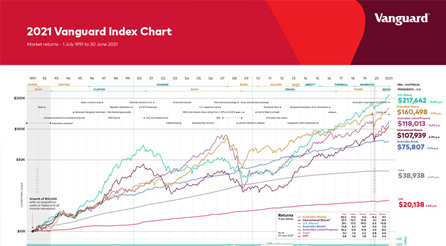
The 2021 Vanguard Index Chart below shows the performance of six different asset types over the last 30 years since 30 June 1991.

These assets are Australian shares, United States shares, international shares, Australian bonds, listed property, and cash.

As well as mapping the performance of these assets, the chart shows how a starting investment of $10,000 would have grown over 30 years. The total numbers don’t include any buying costs or taxes and assume all the income received along the way was reinvested back into the same assets.

You can clearly see how investment markets have risen and fallen over time. As well, you can see the shorter-term impacts of major events including the Global Financial Crisis in 2008 and last year’s COVID-19 crash.

How different assets have performed

A $10,000 investment in mid-1991 into the U.S. share market would have grown to $217,642 by 30 June 2021 if all income received had been reinvested back into U.S. shares. That’s based on the 10.8 per cent average annual return from the broad U.S. market over 30 years.

The Vanguard chart also shows how someone who had invested $10,000 back then would have ended up by investing in other asset types.

The same amount invested into Australian shares would have grown to $160,498 based on the 9.7 per cent per annum return from the Australian share market since the start of the 1991-92 financial year.

Left in listed property, which has returned 8.6 per cent per annum, a $10,000 investment would have increased more than 10 times to $118,013. The same goes for international shares, although its 8.3 per cent per annum return delivered a slightly lower outcome and would have turned $10,000 into $107,939.

In Australian bonds, which have returned 7 per cent per annum over 30 years, a $10,000 starting investment would have been worth $75,807 at 30 June this year.

The lowest long-term return over three decades has been from cash.

If you’d left your money in cash it would have earned 4.6 per cent per annum and grown to $38,938. It’s a much lower return than from other asset types. But it’s still almost four times the original amount invested.

The importance of diversification

The returns from the different assets tracked in the Vanguard Index Chart over the last 30 years demonstrates a few key points.

Some assets are more prone to volatility than others. You can see that by comparing how different types of shares have performed over time against the more stable returns of lower-risk assets such as bonds and cash.

During times of uncertainty, shares are likely to be much more volatile than fixed income assets such as bonds. Cash returns, which closely reflect official interest rates, are largely unaffected by what happens on share markets.

You can also see that the returns from different assets vary from year to year. The best-performing assets in some years can be the worst-performing in others.

In the 2020-21 financial year listed property achieved a positive return of 33.2 per cent, which compared with a negative return of 21.3 per cent the year before.

Lastly, the best way to smooth out intermittent volatility and to achieve more consistent returns is to spread your holdings over a range of assets.

The power of compounding returns

The overall financial returns shown in the Vanguard Index Chart are based on an investor having reinvested any income received from their investments back into the same asset type.

By following a strategy of reinvesting investment distributions such as dividends, and by making additional contributions over a long period of time, the combination of market growth and compounding returns will likely deliver strong results.

It’s why famous scientist Albert Einstein famously described compound interest as “the eighth wonder of the world”.

Even a low initial balance will grow substantially over time when combined with compounding investment returns.

If you would like to discuss your current investment portfolio or would like more information about long-term investing, call us on Phone: 07 5641 4134.

Source: Vanguard August 2021

Reproduced with permission of Vanguard Investments Australia Ltd

Vanguard Investments Australia Ltd (ABN 72 072 881 086 / AFS Licence 227263) is the product issuer. We have not taken yours and your clients’ circumstances into account when preparing this material so it may not be applicable to the particular situation you are considering. You should consider your circumstances and our Product Disclosure Statement (PDS) or Prospectus before making any investment decision. You can access our PDS or Prospectus online or by calling us. This material was prepared in good faith and we accept no liability for any errors or omissions. Past performance is not an indication of future performance.

© 2021 Vanguard Investments Australia Ltd. All rights reserved.

Important:
Any information provided by the author detailed above is separate and external to our business and our Licensee. Neither our business nor our Licensee takes any responsibility for any action or any service provided by the author. Any links have been provided with permission for information purposes only and will take you to external websites, which are not connected to our company in any way. Note: Our company does not endorse and is not responsible for the accuracy of the contents/information contained within the linked site(s) accessible from this page.
Many investors concentrate on building their nest egg during their working lives to pay or help pay for their retirement but fail to give enough attention to planning for a retirement that may last 25 years or longer.

A lack of retirement planning makes retirees more financially vulnerable than necessary in numerous ways including the possibility of outliving your retirement savings, overreacting to market volatility, not planning for unexpected costs and holding a portfolio that isn’t properly diversified.

Some retirees who have not properly planned for retirement may have underestimated the amount required to finance their anticipated lifestyles, while others may be living too frugally given their financial needs.

By following a practical approach for creating a retirement plan that aligns with retirees’ often-unique goals while mitigating risk, retirees may gain greater confidence that savings will match with your future financial needs.

Step 1: Determine your retirement goals

These goals typically include having enough income to pay for basic living expenses, a contingency reserve (such as for medical treatment, home repairs and aged care) and discretionary spending (such as eating out and holidays). And you may plan to leave an inheritance. Once your goals are listed, you can prioritise their importance.

Step 2: Understand your risks

These include market risk, health risk, longevity and mortality risk, event risk (again such as medical treatment, home repairs and aged care), and tax and policy risk (changes to government policies and health care coverage). The research suggests that these risks should be addressed in the context of their impact on achieving their retirement goals.

Step 3: Assess your available financial resources

This will help ensure that your capital is used as efficiently as possible. Financial resources include super and non-super savings, age pension if eligible, annuities, insurance, housing wealth, insurance, and any additional income if planning to work in retirement.

Step 4: Develop a plan to achieve your goals and mitigate your risks

This is a matter of bringing together the various elements of your retirement planning. The right mix of resources should be tailored to your individual circumstances. It should take into account the relative importance of competing goals and the risks that a retiree may be susceptible or sensitive to.

The ultimate retirement goal

In the end, peace of mind may be the ultimate retirement goal bearing in mind this phase of life may represent at least a quarter of our lives.

If you would like to find out more about planning for your retirement, call us on Phone: 07 5641 4134.

You can read more about planning for retirement in Vanguard’s Roadmap to Financial Security: A Framework to Decision Making in Retirement.

Source: Vanguard July 2021

Reproduced with permission of Vanguard Investments Australia Ltd

Vanguard Investments Australia Ltd (ABN 72 072 881 086 / AFS Licence 227263) is the product issuer. We have not taken yours and your clients’ circumstances into account when preparing this material so it may not be applicable to the particular situation you are considering. You should consider your circumstances and our Product Disclosure Statement (PDS) or Prospectus before making any investment decision. You can access our PDS or Prospectus online or by calling us. This material was prepared in good faith and we accept no liability for any errors or omissions. Past performance is not an indication of future performance.

© 2021 Vanguard Investments Australia Ltd. All rights reserved.

Important:
Any information provided by the author detailed above is separate and external to our business and our Licensee. Neither our business nor our Licensee takes any responsibility for any action or any service provided by the author. Any links have been provided with permission for information purposes only and will take you to external websites, which are not connected to our company in any way. Note: Our company does not endorse and is not responsible for the accuracy of the contents/information contained within the linked site(s) accessible from this page.

From time to time, investors become irrationally enthusiastic. The important thing to note about these manic moments is that the investment theme underpinning them makes perfect sense. The narratives are rational; it is the market excess surrounding them that is not.

In the early 1970s investors became transfixed by a group of seemingly bullet-proof stocks, collectively known as the Nifty 50, that came to be viewed as ‘one decision’ stocks. The likes of Kodak, IBM and Xerox were ‘buy and hold’ shares for which no price was deemed too high. History subsequently showed that it could be.

There aren’t many investors who remember that period. There are plenty, however, who experienced the late 1990s moment of over-exuberance. Twenty years ago, as we know, it was all about the emerging internet, with sky-high and ultimately unrealistic growth expectations for which investors were prepared to pay an irrational price. Investors who were lured into tech stocks ended up as disappointed as followers of the Nifty mantra had been 30 years before.

Today’s hot investment story is sustainability. As with the largely consumer story of the Nifty 50 and the digital revolution of the 1990s, the story underlying today’s ESG narrative is completely plausible. The environmental strand reflects the most important challenge facing the world today, climate change. Neither the social nor governance themes are fads either. They mirror unstoppable changes in what is considered acceptable corporate behaviour.

That ESG should have started to be talked about as a potential stock market bubble is disappointing. I report it through gritted teeth because I defer to no-one in my desire for a world in which companies manage themselves honestly and prudently, are concerned for the health of the planet, and look out for the well-being of their employees, suppliers and customers. I think that what we do with our money matters.

But as with the two previous episodes, the underlying narrative is only part of the story from an investor’s perspective. There are plenty of good reasons to consider environmental, social and governance factors when we decide where to invest our money. But unless you place yourself firmly at the philanthropic end of the investment spectrum, none of them are reasons to disregard the fundamental factors that drive returns. The stories that underpinned the Nifty 50 and the tech bubble were not wrong, although they were maybe exaggerated or premature. Today’s enthusiasm for ESG is likewise wholly reasonable. But none of them were enough by themselves to overcome the stock market’s law of gravity.

A share price is ultimately a reflection of a handful of measurable factors. It is determined firstly by expectations about future earnings growth and secondly by the price that investors are prepared to pay to participate in that growth. That sounds simple. It is complicated, however, both by the fact that the future is inherently uncertain, so we are always guessing what that future growth will be and when it will arrive, and by the ever-shifting calculus about what constitutes a reasonable valuation.

Those two variables multiplied together would be enough by themselves to make financial markets volatile and prone to bouts of over-exuberance. Add in a third key factor – the sheer weight of investment money, which in the short run can disguise the fundamentals – and it is hardly surprising that prices spend almost no time at the ‘right’ price but move widely either side of it.

Of these three drivers, growth is where the ESG story is on firmest foundations. Even before the pandemic, the need to combat global heating, even out the inequalities highlighted by the financial crisis and its aftermath, and align corporate governance with changing social mores, was creating an abundance of investment opportunities. Covid has merely accelerated the desire to build back better.

The problem then is not a lack of potential growth. It is rather that many investments are being wrongly identified as growth opportunities. Just as adding dotcom to the name of a company did not make it a good investment in 1999, labelling a business as sustainable will not change anything of substance in 2021. As I said last week, there is a burning need to rationalise how we describe these investments. Looking at ESG factors may help us identify better, faster-growing, more sustainable companies but we better get it right.

The second driver, price, is where ESG is on shakier ground. One of the key arguments for investing in sustainable companies is that directing capital towards them makes the world a better place. It does this by lowering the cost of capital for well-behaved businesses. More good things happen because companies find it more profitable to engage in green or socially responsible activities. And bad companies are effectively priced out of existence. On one level that’s clearly a good thing, but the flip side of a low cost of capital for good companies is a low expected return for the investors who provide it. The more you pay for a given cash return the lower its effective yield to you.

The third driver, the weight of money chasing returns in this area, is perhaps the most dangerous of all. This is because the wall of cash going into ESG investments disguises what is really going on with the other two drivers, growth and price. It drives prices higher in the short term thanks to the simple arithmetic of supply and demand. ESG-focused assets have now reached US$40trn and the pace of accumulation has accelerated during the pandemic. Inflows of US$46bn to ESG funds in the first quarter of this year compared with outflows of US$385bn in the broader fund universe, according to Morningstar. The performance is self-fulfilling for now.

This matters because ESG matters. When the Nifty 50 blew up it was not the end of the world. Even the bursting of the tech bubble merely set things back a few years. The ESG stakes are higher. A little less exuberance now might not be a bad thing in the longer run.

Source: Fidelity June 2021
Reproduced with permission of Fidelity Australia. This article was originally published at https://www.fidelity.com.au/insights/investment-articles/esg-fad-or-future/

This document has been prepared without taking into account your objectives, financial situation or needs. You should consider these matters before acting on the information. You should also consider the relevant Product Disclosure Statements (“PDS”) for any Fidelity Australia product mentioned in this document before making any decision about whether to acquire the product. The PDS can be obtained by contacting Fidelity Australia on 1800 119 270 or by downloading it from our website at www.fidelity.com.au. This document may include general commentary on market activity, sector trends or other broad-based economic or political conditions that should not be taken as investment advice. Information stated herein about specific securities is subject to change. Any reference to specific securities should not be taken as a recommendation to buy, sell or hold these securities. While the information contained in this document has been prepared with reasonable care, no responsibility or liability is accepted for any errors or omissions or misstatements however caused. This document is intended as general information only. The document may not be reproduced or transmitted without prior written permission of Fidelity Australia. The issuer of Fidelity Australia’s managed investment schemes is FIL Responsible Entity (Australia) Limited ABN 33 148 059 009. Reference to ($) are in Australian dollars unless stated otherwise.
© 2021. FIL Responsible Entity (Australia) Limited.

Important:
This provides general information and hasn’t taken your circumstances into account. It’s important to consider your particular circumstances before deciding what’s right for you. Any information provided by the author detailed above is separate and external to our business and our Licensee. Neither our business nor our Licensee takes any responsibility for any action or any service provided by the author. Any links have been provided with permission for information purposes only and will take you to external websites, which are not connected to our company in any way. Note: Our company does not endorse and is not responsible for the accuracy of the contents/information contained within the linked site(s) accessible from this page.

JobKeeper payments are taxable, so you need to include them in your tax return.

If you’re a sole trader, partnership, company or trust that’s received JobKeeper payments, we’ll contact you or your registered tax agent by early July to let you know:

  • the total amount of JobKeeper payments your entity received since 1 July 2020, or where you can find out

  • where to report JobKeeper payments in your tax return.

From early July, sole traders who’ve received JobKeeper payments for themselves and any eligible employees will also be able to find the total amount of JobKeeper payments they’ve received through Online services for business and myTax. Their registered tax agent will also get this information.

The amount will be provided as ‘information only’ and will not be mapped to a label.

Here are some important points about including JobKeeper payments in your return:

  • You don’t need to include any JobKeeper payments that you’ve already repaid (or are repaying to us) in your return.

  • You should review and cross-check the payment amounts against your own records to make sure they’re accurate.

We can help you with your tax, call us on Phone: 07 5641 4134 today. 

Source: ATO June 2021
Reproduced with the permission of the Australian Tax Office. This article was originally published on https://www.ato.gov.au/Newsroom/smallbusiness/General/Did-you-receive-JobKeeper-this-financial-year-/.

Important:
This provides general information and hasn’t taken your circumstances into account.  It’s important to consider your particular circumstances before deciding what’s right for you. Although the information is from sources considered reliable, we do not guarantee that it is accurate or complete. You should not rely upon it and should seek qualified advice before making any investment decision. Except where liability under any statute cannot be excluded, we do not accept any liability (whether under contract, tort or otherwise) for any resulting loss or damage of the reader or any other person. 

Any information provided by the author detailed above is separate and external to our business and our Licensee. Neither our business nor our Licensee takes any responsibility for any action or any service provided by the author. Any links have been provided with permission for information purposes only and will take you to external websites, which are not connected to our company in any way. Note: Our company does not endorse and is not responsible for the accuracy of the contents/information contained within the linked site(s) accessible from this page.

 

If you’re aged 60 or over, own your home and need to access money, releasing equity from your home may be an option.

There is risk involved and a long-term financial impact. Get independent financial or legal advice before you go ahead.

How home equity release works

‘Equity’ is the value of your home, less any money you owe on it (on your mortgage).

‘Home equity release’ lets you access some of your equity, while you continue to live in your home. For example, you may want money for home modifications, medical expenses or to help with living costs.

Ways to access equity in your home include:

  • reverse mortgage

  • home reversion

  • equity release agreement

  • the Government’s Pension Loans Scheme

The amount of money you can get depends on:

  • your age

  • the value of your home

  • the type of equity release

Your decision could affect your partner, family and anyone you live with. So take your time to talk it through, get independent advice and make sure you understand what you’re signing up for.

Get independent advice

Before making the decision to apply for any home equity release, consider how it will affect:

  • your eligibility for the Age Pension

  • your ability to afford aged care

  • your ability to pay for future living expenses, medical bills and home maintenance

  • what you leave for others when you die

  • if someone lives with you, whether they will be able to stay in your home when you move out or die

If you are borrowing to invest, it puts your whole home at risk — not just the portion you are investing.

Ask the Services Australia Financial Information Service how it will affect your pension or government benefits.

Reverse mortgage

A reverse mortgage allows you to borrow money using the equity in your home as security.

If you’re aged 60, the most you can borrow is likely to be 15–20% of the value of your home. As a guide, add 1% for each year over 60. So, at 65, the most you can borrow will be about 20–25%. The minimum you can borrow varies, but is typically about $10,000.

Depending on your age and lender policy, you can take the amount you borrow as a:

  • regular income stream

  • line of credit

  • lump sum, or

  • combination of these

How a reverse mortgage works

You stay in your home and don’t have to make repayments while living there. Interest charged on the loan compounds over time, so it gets bigger and adds to the amount you borrow. The interest rate is likely to be higher than on a standard home loan.

You repay the loan in full, including interest and fees, when you or your deceased estate sell your home.

You may be able to make voluntary repayments earlier, if you wish. You may also be able to protect a portion of your home equity from being eroded by the loan. For example, to ensure you have enough money left to pay for aged care.

What a reverse mortgage costs

The cost of the loan depends on:

  • how much you borrow

  • how you take the amount you borrow (for example, a lump sum will cost more due to compounding interest)

  • the interest rate and fees (for example, loan establishment, ongoing fees, valuation)

  • how long you have the loan

Over time, your debt will grow and your equity will decrease (see our case study below).

Your lender or broker must go through reverse mortgage projections with you, showing the impact on your home equity over time. Get a copy of this to take away, and discuss it with your adviser. Ask questions if there’s anything you’re not sure about.

Negative equity protection

Reverse mortgages taken out from 18 September 2012 have negative equity protection. This means you can’t end up owing the lender more than your home is worth (market value or equity).

If you took out a reverse mortgage before this date, check your contract. If it doesn’t include negative equity protection, talk to your lender or get independent advice on what to do.

Home reversion

Home reversion allows you to sell a proportion (a ‘share’ or ‘transfer’) of the future value of your home while you live there. You get a lump sum, and keep the remaining proportion of your home equity.

How home reversion works

The home reversion provider pays you a reduced (‘discounted’) amount for the share you sell. Depending on your age, this may be 25% or more of the current value of the share.

Terms and conditions vary. The provider may offer a ‘rebate’ feature. This means you (or your estate) get some money back if you sell your home (or die) earlier than expected. You may also have the option to buy back the sold share later, if you wish.

For example, suppose your home is currently worth $500,000 and you sell a 20% ($100,000) share of the future value. The provider may only offer you $25,000 to $40,000 to buy that share. When you sell your home, you pay the provider their share of the proceeds. So, if in 20 years time you sell your home for $800,000, the provider gets 20% of that amount: $160,000.

What home reversion costs

It’s not a loan, so you don’t pay interest. You pay a fee for the transaction and to get your home valued (as a guide, around $2,000). You may also have to pay other property transaction costs.

Home reversion costs you the difference between:

  • what you get for the share of your home you sell now, and

  • what it’s worth in the future (minus any early sale rebate)

The more your home goes up in value, the more you’ll pay the provider when you sell it.

Get the provider to go through projections with you, showing the impact over time. Get a copy of this to take away, and discuss it with your adviser. Ask questions if there’s anything you’re not sure about.

Equity release agreement

An equity release agreement allows you to sell a portion of the value of your home. You get a lump sum or instalment payments in return. You live in your home and pay fees for the portion you’ve sold. A bit like paying rent on it. Your proportion of equity reduces over time, to cover the fees you pay.

How an equity release agreement works

One option is for one or more investors to buy portions of your home’s equity through a property investment fund. You pay fees which are periodically deducted from the remaining equity in your home. The investor’s share of your home’s equity goes up over time, and yours goes down.

For example, suppose your home is currently worth $500,000. You sell 20% of your home’s equity in return for a lump sum of $100,000. The fee charged by the fund may vary, depending on your circumstances and the agreement. If the fund charges an initial fee of $30,000, it may take $130,000 of your equity to cover both the lump sum and periodic fee.

Additional amounts of equity are deducted each time the periodic fee falls due (such as every 5 years). The fee is a set percentage of the fund’s equity in your home. So, as the fund’s share of equity increases, the fee goes up.

When the equity release agreement ends, and your home is sold, the fund gets their share of the proceeds. That is, the proportion of your home’s equity they have accrued. You or your deceased estate get the remainder of the proceeds, if any.

The proportion of home equity you keep will reduce over time, and could even go down to zero.

Check your agreement to see what happens if your equity goes down to zero. Make sure you can continue living in your home, until sold by you or your deceased estate.

What an equity release agreement costs

It’s not a loan, so you don’t pay interest. Instead, you pay fees such as:

  • an application fee

  • periodic service fees, potentially deducted in advance from your home’s equity

  • a fee to end the agreement

Get the fund to go through projections with you, showing the impact on your home equity over time. Get a copy of this to take away, and discuss it with your adviser. Ask questions if there’s anything you’re not sure about.

Pension Loans Scheme

The Pension Loans Scheme is provided by Services Australia and the Department of Veterans’ Affairs. It lets eligible older Australians get a voluntary non-taxable fortnightly loan from the Government. You and your partner may use this to supplement your retirement income.

You can choose the amount of loan you get paid fortnightly. Your combined pension and loan payments cannot exceed 1.5 times the maximum fortnightly pension rate.

The loan is secured against real estate you, or your partner, own in Australia. You can choose how much you offer as security.

There is a maximum amount of loan you can borrow over time. This is based on your (or your partner’s) age and how much you offer as security for the loan. The Pension Loans Scheme is not paid as a lump sum.

You must repay the loan and all costs and accrued interest to the Government. You can make repayments or stop your loan payments at any time.

For more information about the Pension Loans Scheme, visit Services Australia or the Department of Veterans’ Affairs.

Consider other options

If you need money, other options to consider include:

Case Study 

Lorenzo and Sophia consider getting a reverse mortgage

Lorenzo is 70, Sophia is 65 and their home is worth $500,000. They want to renovate, but don’t have enough savings.

They use the reverse mortgage calculator to explore what a loan might cost. Based on Sophia’s age, the most they can borrow is 25% of the value of their home: $125,000. They want a lump sum to pay for the renovations.

They allow $1,000 for loan set-up fees and use the default interest rate of 7%.

In 15 years, if their property goes up in value 3% each year, it will be worth $779,984. They will own 54% of their home ($420,016), and owe the lender 46% ($358,967).

They decide to get financial advice and consider borrowing a smaller amount.

Call us on Phone: 07 5641 4134 if you would like more information on reverse mortgages. 

Source: moneysmart.gov.au
Reproduced with the permission of ASIC’s MoneySmart Team. This article was originally published at https://moneysmart.gov.au/retirement-income/reverse-mortgage-and-home-equity-release

Important note: This provides general information and hasn’t taken your circumstances into account.  It’s important to consider your particular circumstances before deciding what’s right for you. Although the information is from sources considered reliable, we do not guarantee that it is accurate or complete. You should not rely upon it and should seek qualified advice before making any investment decision. Except where liability under any statute cannot be excluded, we do not accept any liability (whether under contract, tort or otherwise) for any resulting loss or damage of the reader or any other person.  Past performance is not a reliable guide to future returns.

Important
Any information provided by the author detailed above is separate and external to our business and our Licensee. Neither our business nor our Licensee takes any responsibility for any action or any service provided by the author. Any links have been provided with permission for information purposes only and will take you to external websites, which are not connected to our company in any way. Note: Our company does not endorse and is not responsible for the accuracy of the contents/information contained within the linked site(s) accessible from this page.

Take advantage of shifting global dynamics

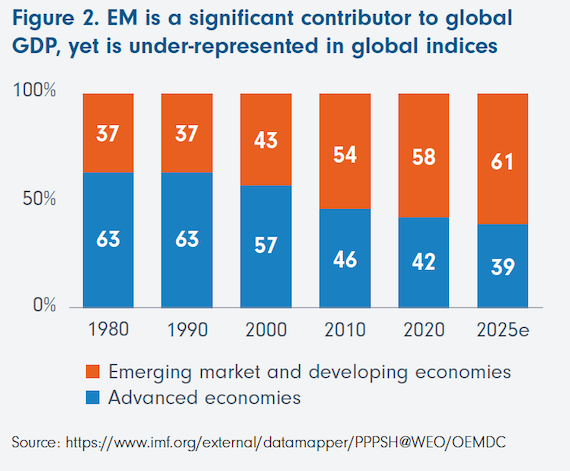
Emerging markets (EM) have been growing rapidly in recent years. In fact, they now contribute over 50% of global growth and are expected to contribute over 60% by 2025.1 Once dominated by agriculture and cheap manufacturing, EM countries are today home to some of the world’s fastest-growing economies and most innovative companies.

Emerging markets poised to benefit from accelerating trends

The rise of the internet and persistent technological advancement have been increasingly important drivers of emerging markets. China, which was traditionally the powerhouse of global manufacturing for decades, today rides the wave of digital innovation with the success of the BAT tech giants – Baidu, Ali Baba and Tencent. Some of the largest e-commerce, gaming, social media and hardware manufacturers reside in emerging markets and the changing nature of the index shows just how much this changed over a decade.

What is an emerging market?

An emerging market economy is simply one transitioning from low-to-middle income to high income. However, unlike a frontier economy, an emerging market economy already shares some of the characteristics of a developed market. This includes a functioning stock exchange where shares can be easily traded, access to debt and some form of predictable government regulation – all of which help smooth its path to development.

EM economies include growing powerhouses such as India, Indonesia, Brazil and China, as well as smaller, more nimble economies like Morocco, the Philippines and Thailand.

A more broad-based index composition

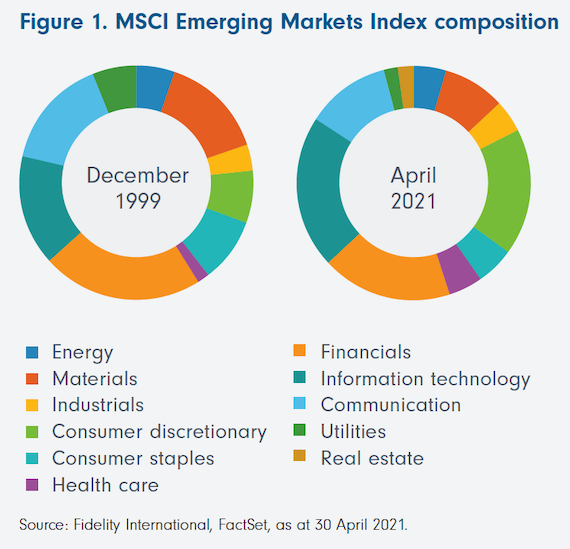
Since 1999, we have seen a reduction in energy and materials, in favour of tech, consumer and healthcare names. This translates in a less cyclical earning stream.


Disruptive forces accelerate growth

In 2020, the COVID-19 pandemic lockdown has accelerated demand for a variety of services and has broadly benefited companies in emerging markets with solid online propositions.

In China, for example, working from home has boosted the need for Cloud services which is in its infancy and ripe for expansion; mobile phone time surged to over five hours per day and time spent gaming on Tencent titles – Honour of Kings and Game for Peace – surged to two to three times the prior monthly run-rate.

With social distancing a feature in many countries for some time to come, this is likely to further accelerate these trends.

Other changes in society and consumer habits will emerge from the pandemic, some semi-permanent and some permanent, such as a greater focus on health, lifestyle choices and financial planning.

Emerging markets, home to large domestic consumer bases, are well positioned to benefit from growth in these themes.

Emerging markets are the growth powerhouse globally

With the changing landscape and growth of emerging markets, emerging market economies are beginning to account for a much higher percentage of global GDP. The IMF World Economic Outlook Database showed that in 1980 these nations had a combined GDP of less than half that of advance economies. By 2010, the two were close to level.

However, by 2025, it’s estimated that emerging economies will have an output that is larger than the developed world (Figure 2). In other words, in the space of 45 years, emerging markets will have gone from a peripheral position in the world economy to a central one. Despite this, they still account for just a fraction of most Australian investment portfolios.

A demographic shift

If you’re wondering why emerging markets are experiencing such solid growth, you’ve hit upon the second part of the emerging markets equation – many emerging markets are undergoing a profound demographic shift.

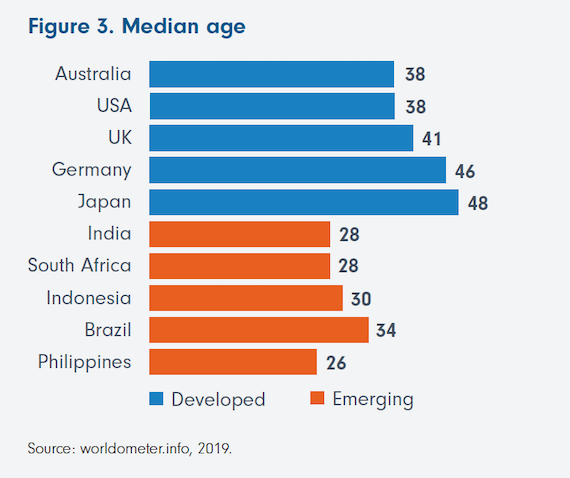
While much of the developed world struggles to come to terms with the cost of supporting an ageing population, developing economies typically don’t have this problem, as much of their population is still young. For example, India’s population has a median age of 27.1 years, compared to the EU’s median of 41.7, which means there are still plenty of productive workers to keep the economy running and fewer retirement-age workers to support.2


As more of these young populations find meaningful work, they also tend to have more disposable income, giving rise to a new middle class in emerging market economies. Between 2009 and 2030, China alone is expected to add 1.2 billion people to its middle class, taking it from < 10% to 73% of its population.3 With this increased affluence comes more consumption – not just of consumer goods such as cars, technology and electrical goods, but of more sophisticated products and services. China’s healthcare industry, for example, grew four-fold between 2006 and 2016.4

From global to regional

With disruption of supply chains during the COVID-19 pandemic, along with geopolitics driving a more regional approach to trade, emerging market economies with large domestic consumption are expected to benefit. We expect to see the rise of regional economic centres, where growing demand from a large economy like China or India, fuels growth in other developing countries nearby. Put this together with strong domestic consumption driven by a rising middle class and the evolution towards growth industries, and we can see a compelling case for exposure to emerging market economies.

The importance of active management

While the case for emerging markets for investors seeking growth and diversification remains strong, selectivity is paramount. Not all emerging markets will emerge on an equal footing from the COVID-19 crisis and regional dislocation is already evident.

North Asia, led by China, has staged a sharp rebound vis-à-vis South Asia whilst in Latin America many countries are still behind the curve in controlling the outbreak and government capacity is limited to compensate for the economic impact.

The recent crisis highlights the importance of investing in high-quality names, characterised by sound balance sheet structures that enable them to weather more challenging environments and come out stronger from the volatility than their peers. Solid corporate governance and underlying incentive structures are also paramount, to ensure businesses treat capital prudently and try to grow shareholder value over time.

An active investment approach offers crucial advantages for investors as it allows our investment team to select opportunities from a much broader universe than those available in the Index. The advantage to investors is twofold: greater diversification across countries, sectors and companies, and importantly enables us to choose our investments selectively taking into account the varying impact of the crisis on emerging market economies, the sectors and the companies themselves.

Access our best ideas in emerging markets

Amit Goel, the Lead Portfolio Manager and Punam Sharma, the Co-Portfolio Manager for the Fidelity Global Emerging Markets Fund are backed by a 400-strong team of investment professionals worldwide.

They carefully select 30 to 50 companies they believe are well positioned to generate returns through market cycles and which have demonstrated a track record of strong corporate governance.

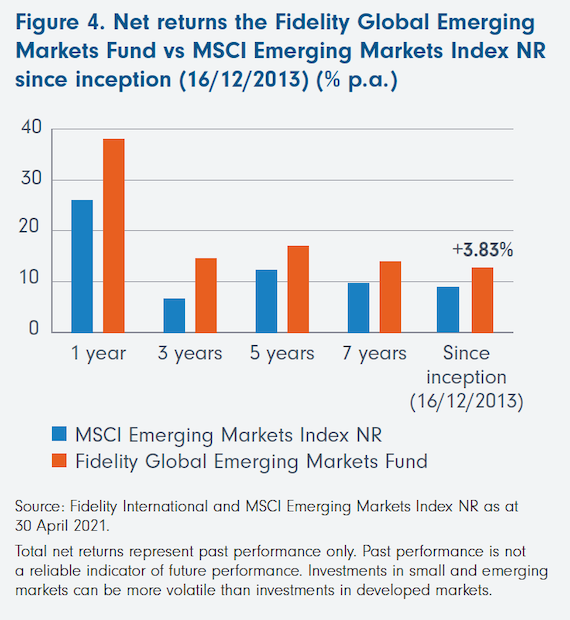
Delivering returns to investors for nearly a decade

 1. IMF, World Economic Outlook Database October 2017. 2. S&P Global Market Intelligence. 3. The World factbook. 4. www.mckinsey.com.

Source: Fidelity June 2021
Reproduced with permission of Fidelity Australia. This article was originally published at https://www.fidelity.com.au/insights/investment-articles/the-case-for-emerging-markets2/

This document has been prepared without taking into account your objectives, financial situation or needs. You should consider these matters before acting on the information. You should also consider the relevant Product Disclosure Statements (“PDS”) for any Fidelity Australia product mentioned in this document before making any decision about whether to acquire the product. The PDS can be obtained by contacting Fidelity Australia on 1800 119 270 or by downloading it from our website at www.fidelity.com.au. This document may include general commentary on market activity, sector trends or other broad-based economic or political conditions that should not be taken as investment advice. Information stated herein about specific securities is subject to change. Any reference to specific securities should not be taken as a recommendation to buy, sell or hold these securities. While the information contained in this document has been prepared with reasonable care, no responsibility or liability is accepted for any errors or omissions or misstatements however caused. This document is intended as general information only. The document may not be reproduced or transmitted without prior written permission of Fidelity Australia. The issuer of Fidelity Australia’s managed investment schemes is FIL Responsible Entity (Australia) Limited ABN 33 148 059 009. Reference to ($) are in Australian dollars unless stated otherwise.
© 2021. FIL Responsible Entity (Australia) Limited.

Important:
This provides general information and hasn’t taken your circumstances into account. It’s important to consider your particular circumstances before deciding what’s right for you. Any information provided by the author detailed above is separate and external to our business and our Licensee. Neither our business nor our Licensee takes any responsibility for any action or any service provided by the author. Any links have been provided with permission for information purposes only and will take you to external websites, which are not connected to our company in any way. Note: Our company does not endorse and is not responsible for the accuracy of the contents/information contained within the linked site(s) accessible from this page.