Planning is the key to successful investing. Creating a plan will help you find investments that fit your investing time frame and risk tolerance, to help you reach your financial goals sooner.

1. Review your finances

Before you invest, review your financial situation.

Write down what you owe (your debts) and what you own (your assets). For your assets include your:

  • super

  • home

  • savings

  • other investments

This net worth calculator can help you record this. Writing down what you own and what you owe will help you see what savings you can invest. It will also help you see how you can diversify.

Then write down your income and expenses. This budget planner can help you track what money is coming in and going out. This will help you see how much you can put toward investing regularly.

2. Set your financial goals

Write down your financial goals. For each goal include how much you’ll need and how long you have to reach it. For example, taking a $10,000 holiday in one year, or reaching $500,000 in superannuation before you retire.

Then divide your goals into:

  • short term (0 to 2 years)

  • medium term (3 to 5 years)

  • long term (5 years or more)

Setting and defining your financial goals will help you pick the right investment to reach each goal.

3. Understand investment risks

Investment risk is the likelihood that you’ll lose some or all the money you’ve invested. This can be due to your investment falling in value or not performing how you expected. All assets carry investment risks — some are riskier than others. 

Risks that can affect the value of your investment include:

Interest rate risk

Interest rate changes reduce your returns or cause you to lose money. This is a key risk for fixed interest investments.

Market risk

An investment falls in value because of economic changes or other events that affect the entire market.

Sector risk

An investment falls in value because of events that affect a specific industry sector.  

Currency risk

Currency movements impact your investment and returns. This is a key risk for overseas investments, Australian companies with overseas operations and investments that have foreign currency in them.

Liquidity risk

You can’t sell your investment and get your money when you need to without impacting the price in the market.

Credit risk

A company or government you lend to will default on the debt and be unable to make the repayments.

Concentration risk

If your investments aren’t diversified, poor performance in one investment or asset class can significantly affect your portfolio.

Inflation risk

The value of your investments doesn’t keep pace with inflation. 

Timing risk

The timing of your investment decisions expose you to lower returns or loss of capital.

Gearing risk

Using borrowed money to invest can magnify your losses. Your investments may fall in value but you still have to pay the remaining loan balance and interest.

Risk and return

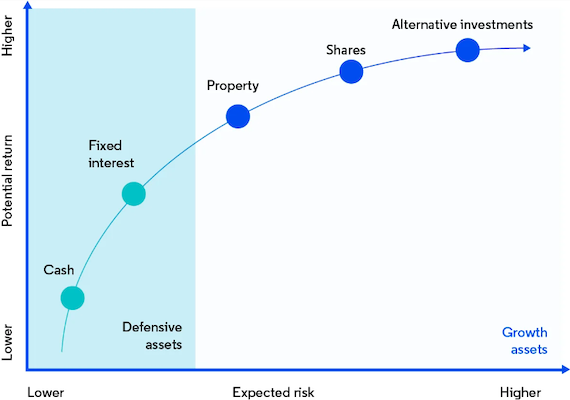
As a general rule, the higher the expected return on an investment, the higher the risk of the investment. The lower the expected return, the lower the risk. Lower risk means the returns are more stable and there is a lower chance you could lose money.

For example, a government bond is a low risk investment. It pays interest, and the value of the investment doesn’t change too much in the short term. Shares are a higher risk investment. The price of a share can move up and down a lot over a short amount of time.

The graph below shows the risk and return relationship for different asset classes.
 

Important: There are no shortcuts to investing success. The combination of high returns and low risk doesn’t exist.

Know your risk tolerance

Your risk tolerence depends on your ability to cope with falls in the value of your investment. Your age, capacity to recover from financial loss, financial goals and your health are some of the factors that may influence your risk tolerance. 

Ask yourself: how would I feel if I woke up tomorrow and found the value of my investments had dropped 20%?

If this drop would cause you to worry and withdraw your money, high-risk investments are not for you.

Each investor’s risk tolerance is different and for different financial goals that have different investment time frames, you may be willing to accept different levels of risk.

It’s important to understand your risk tolerance and find investments that are aligned to it.

4. Research your investment options

To find the right investments, you need to think about:

  • Return — what is the expected return on the investment? Does it come from income or capital growth?

  • Time frame — how long do you need to invest to get the expected return?

  • Risk — what types of risk does the investment involve? Are you comfortable to take on these risks?

  • Access to cash (liquidity) — how long will it take to sell the investment and get your cash out?

  • Cost to buy and sell — how much will it cost to buy and sell the investment?

  • Tax — how much tax will you pay on earnings (income and capital gains) from the investment?

See choose your investments for an overview of different types of investments.

Important: Make sure the expected returns are realistic. If the returns look too good to be true, it could be an investment scam.

5. Build your portfolio

The way you structure your portfolio will depend on your financial goals, investing time frame and risk tolerance.

For short-term goals, lower-risk investment options are better. Consider investments like a savings accountterm deposit or government bonds. These investments are lower risk as they’re less likely to fall in value and you can access your money.

For longer-term goals, investments with higher returns such as shares and property, can be better. These investments are higher risk but you’re investing long term, so you can ride out any short-term falls in value.

It’s important to make sure you diversify your portfolio across different asset classes and within each asset class. This protects you against losing too much if the value of one investment falls. See diversification for how this strategy can help you.

If you need help with investing

We can help you work out your risk tolerance, set goals and choose the right investments. Call us today on Phone: 07 5641 4134.

6. Monitor your investments

It’s important to review your investments regularly to make sure they’re performing as expected. And check whether you’re on track to reach your financial goals. See keep track of your investments.

Source:
Reproduced with the permission of ASIC’s MoneySmart Team. This article was originally published at https://moneysmart.gov.au/how-to-invest/develop-an-investing-plan

Important note: This provides general information and hasn’t taken your circumstances into account.  It’s important to consider your particular circumstances before deciding what’s right for you. Although the information is from sources considered reliable, we do not guarantee that it is accurate or complete. You should not rely upon it and should seek qualified advice before making any investment decision. Except where liability under any statute cannot be excluded, we do not accept any liability (whether under contract, tort or otherwise) for any resulting loss or damage of the reader or any other person.  Past performance is not a reliable guide to future returns.

Important
Any information provided by the author detailed above is separate and external to our business and our Licensee. Neither our business nor our Licensee takes any responsibility for any action or any service provided by the author. Any links have been provided with permission for information purposes only and will take you to external websites, which are not connected to our company in any way. Note: Our company does not endorse and is not responsible for the accuracy of the contents/information contained within the linked site(s) accessible from this page.


Budgeting for a holiday or saving for a deposit? Even the best budget can unravel if the right tools are not in place. In this article, we look beyond the basics and focus more on what it takes to stick to your budget.

Here are five tips to help you stick to your budget.

1. Stocktake. Spending more than you earn?

Subtract your total weekly expenses from your total weekly income. How’s it looking? Ideally, you’ll have more coming in than going out. Over time you’ll be able to save and build up your reserves.

First, you want a buffer in case things go wrong. Financial advisers used to talk of having six month’s spare cash in the bank. When this seemed out of reach for most, they talked instead of having three months in reserve—but many people struggle to even have one.

Living month to month is stressful enough; living week to week even more so. Getting your finances into a stable and sustainable place is the goal. Properly accounting for income and outgoings is the first step.

2. Cut costs

Realistically, the quickest way to improve your personal bottom line is to cut costs – to curb unnecessary spending.

Go through your expenditure. You’ll find there are fixed costs (e.g. rent or mortgage payments) you can do little about, and other areas where you could cut but it’d be unwise to do so (e.g. insurance).

Unfortunately, the areas where you can make the greatest savings (your discretionary spending) are often the things that are most fun – like going to the movies, or big Friday nights out.

Once more, the crucial consideration is ‘balance’. You can draft an extreme austerity plan, but you’d be unlikely to stick to it.

Be realistic. Don’t introduce cuts across the board or take $20 off food without knowing what you can (and will) give up or change.

3. Have a plan

It’s easier to keep to a budget if you have a goal you’re working towards. It might be something humble like a pair of shoes or cast-iron wok.

It could be bigger ticket items like a car, an overseas trip, or your first home deposit. Perhaps you’ve just got debts you want to pay off.

Whatever it is, having a plan is the best way to keep focused and ensure spend-ups and blowouts don’t happen too often.

4. Sort your day-to-day money management

Set up a system that makes saving automatic—and limits your ability to spend more than you’ve budgeted. It’s a good idea to set up several bank accounts, with direct debits into (or out) of each.

For instance, you might have a general account where your wages are paid into. Each week, money is diverted from here into a designated ‘House’ savings account (for your home deposit).

Don’t touch this. You might have another couple of accounts—a smaller one where you trickle money in for that trip to New Zealand, another to fund big, occasional bills (e.g. vehicle maintenance).

Your goal? Each month your overall financial position should be stronger than the month before.

You may also want to consider a Term Deposit to help you reach your savings goal.

5. Track your progress

Check your finances each month to see if your savings and spending plans are on track. If you’re extra organised, fill out your own Statement of Financial Position in Excel.

Don’t just look at the bottom line. Where are you over? Where are you under? What little fixes could bring things back into line? Are your targets realistic?

Remember, the best budgets are regularly reviewed and refined – and evolve over time.

Need a hand? Call us to work out how much you’re saving on Phone: 07 5641 4134.

Source: NAB

Reproduced with permission of National Australia Bank (‘NAB’). This article was originally published at https://www.nab.com.au/personal/life-moments/manage-money/budget-saving/stick-to-budget

National Australia Bank Limited. ABN 12 004 044 937 AFSL and Australian Credit Licence 230686. The information contained in this article is intended to be of a general nature only. Any advice contained in this article has been prepared without taking into account your objectives, financial situation or needs. Before acting on any advice on this website, NAB recommends that you consider whether it is appropriate for your circumstances.

© 2022 National Australia Bank Limited (“NAB”). All rights reserved.

Important:
Any information provided by the author detailed above is separate and external to our business and our Licensee. Neither our business nor our Licensee takes any responsibility for any action or any service provided by the author. Any links have been provided with permission for information purposes only and will take you to external websites, which are not connected to our company in any way. Note: Our company does not endorse and is not responsible for the accuracy of the contents/information contained within the linked site(s) accessible from this page.

Mustering a deposit to buy property can be an intimidating exercise and joining forces with a partner, family, or friends could make it a lot more accessible than flying solo. However, it’s a big financial commitment which has the potential to cause tension or even conflict if not carefully handled.

One of the most important things you can do if you are contemplating taking that step is to think carefully about the relationship you have with your potential co-owner.

While things are a little more straightforward if you are buying as part of a couple, it’s increasingly common for people to enter into purchases in a wide range of contexts. In fact, a quarter of Australians have considered buying property with a ‘non-traditional’ partner.i This can include buying with a sibling or a parent or parents who are happy to help their children get a foot in the door. Another option is choosing to take the step with a friend or even a consortium of like-minded individuals.

With any of these scenarios there are a few things you need to discuss together and decide upon.

Getting on the same page

Buying with another or others can be tricky, as there are a lot of decisions to be made about the purchase and it’s essential to make sure you agree on the fundamentals or at least are able to reach a compromise.

It’s a good idea to start by looking at what drives each of you as it’s important to make sure your property goals are compatible.

Why do you want to buy property?

Your motivations for the purchase underpin a lot of decisions and while it’s quite natural for both parties to have different reasons for the purchase your goals must be somewhat aligned.

Things to consider: Is it a forever home or a foot in the door to enter the property market? How does the purchase fit into your future plans? Is it a home for you to live in or an investment property for you to rent out? Does this represent a tree or sea change or downsizing?

What do you want in a home?

The next step is to think about what you are looking for and make some mutual decisions. It’s unlikely you will always see eye-to-eye on every detail so be prepared for discussion and compromise.

Things to consider: The location, the size of the property, available amenities, the age, and condition of the property. What are your respective ‘must haves’ as opposed to your ‘nice to haves’?

The financial considerations

Buying a property is one of the biggest financial commitments you can take on so it’s important to be upfront and honest about your respective financial situations as well as comfort with taking on debt and ability to manage all of the outgoings associated with the property.

Things to consider: Are you able to play an equal role in raising or saving for a deposit or will one party take on a greater share? What will your budget be? How will you manage the repayments, as well as bills and upkeep of the property? Once you have reached an agreement it is prudent to outline the details of the arrangement in a signed, formal document.

Options for the ownership structure

There are two main forms of co-ownership agreement: Tenancy in Common and Joint Tenancy.

Tenancy in Common allows you to split your ownership according to the percentage of your respective contributions (such as 50:50 or 60:40) and enables each person to sell, lease or deal with their share of the property as they see fit. Purchasing as joint tenants means that you both own the property, each with equal rights and obligations.

It’s also possible to buy property as a company or even as a trust asset. Each structure has benefits and disadvantages as well as tax considerations, so it’s important to get the appropriate legal, financial and tax advice to ensure you are aware of all the considerations.

Thinking ahead

Circumstances change and it’s important to think about what the exit strategy might be, well in advance of when that time comes. This would include discussions about the circumstances you would sell the property and how you would value the property i.e. what happens if one party wants to sell the property or rent it out, or even move into a previously rented property.

There are many ways of making joint ownership work for all parties involved but open communication is critical, so get those conversations going. Please reach out to us on Phone: 07 5641 4134 if we can be of assistance.

i https://www.commbank.com.au/articles/newsroom/2021/11/Aussies-consider-alternate-property-pathways.html

If you’d invested $10,000 into the whole Australian share market back in 2002, your initial investment amount would have grown to almost $50,000 by 30 June 2022.

It’s a huge gain. Around 385 per cent to be precise. And, to achieve it, all that you would have needed to do is reinvest all the Australian company dividends you’d received over the last 20 years back into the Australian share market.

You could have achieved similar returns by investing through a managed fund or an exchange traded fund (ETF) that tracks the broad Australian share market.

Yet, as good as that all sounds, you could have done much better if you had added to your initial $10,000 investment by making regular monthly investment contributions.

How much better? Just by adding $250 per month your Australian share market investment would have surged to more than $180,000.

In other words, for $60,000 in total additional contributions over 20 years, your end investment would have been worth over $130,000 more than if you had made no extra contributions.

The numbers, which assume you incurred no investment management fees, indirect costs, or buy/sell spreads, obviously get larger if you had made higher regular monthly contributions.

By adding $500 per month to the initial $10,000 amount your investment would have grown to more than $317,000.

That’s a $130,000 total investment ($10,000 plus $120,000 in other contributions) over 20 years to achieve an investment worth $270,000 more than if you had just left your initial investment to grow on its own.

This growth reflects the additional capital contributed together with the market returns on the higher investment balance.

Here’s how those numbers would have looked based on the actual performance of the All Ordinaries Accumulation Index (which measures the Australian share market) from 1 July 2002 to 30 June 2022.

The benefits of regular contributions

Date

No extra contributions*

$250 per month

$500 per month

1 July 2002

$10,000

$10,000

$10,000

30 June 2007

$24,432

$52,047

$79,661

30 June 2012

$19,832

$57,104

$94,378

30 June 2017

$34,329

$117,332

$200,335

30 June 2022

$48,503

$182,931

$317,359

Source: Vanguard. *Assumes the reinvestment of income distributions and does not take into consideration investment management fees, indirect costs, and buy/sell spreads. Past performance information is given for illustrative purposes only and should not be relied upon as, and is not, an indication of future performance.

It’s only when you compare the results side by side that the full picture becomes much clearer.

An initial contribution amount combined with a regular investment savings strategy and the reinvestment of distributions over time will deliver much higher long-term results.

In the example used above, there would have already been a significant gap after just five years (in 2007) between investors who had not made additional contributions versus those that had.

And you can see that gap would have kept on widening over time. After 20 years, any investors who had followed a $250 per month regular contributions plan would have ended up with more than three times the amount of money than investors who had made no additional contributions.

A $500 per month contributions plan would have increased the differential to more than six times.

Understanding dollar-cost averaging

There’s another major advantage in making regular investment contributions, which brings into play a well-known portfolio strategy called dollar-cost averaging.

You may not realise it, but you’re probably already undertaking this strategy (indirectly) if you’re a member of a super fund.

Here’s how dollar-cost averaging works. Every time your employer makes a contribution into your super fund account it’s automatically invested by your fund according to the default investment strategy that you’ve chosen.

Maybe you’ve selected a “high-growth” super option, a “balanced” option, or a “conservative” option.

Behind the scenes your super money is most likely being directed into different managed funds, which invest into shares, bonds, cash, and other types of assets.

While the amount of super your employer pays doesn’t change, your investment purchasing power does change every time you receive a new super contribution.

That’s because the prices of the managed fund units your super fund is investing into does change every day.

If those managed fund unit prices have risen since your last contribution, then your super fund will be purchasing fewer units than last time.

Likewise, if the managed fund unit prices have fallen in value, your super fund will be purchasing more units than last time.

This strategy works in exactly the same way if you make regular contributions at set intervals outside of your super to buy units directly in other managed funds and ETFs.

You’ll automatically buy more units when market prices are lower and fewer units when prices are higher.

Over the total period that you keep investing, your average entry cost into specific assets will potentially be lower than if you’d try to guess the best time to buy in.

As your unit balance grows over time, your corresponding distributions via company dividends and other payments will also keep on growing. That’s the magic of compounding investment returns.

Just like your super contributions, it’s all really about sticking to a disciplined, non-emotional approach to investing that’s not affected by what’s happening on financial markets at any point in time.

Making regular contributions, and taking advantage of dollar-cost averaging, really adds up.

They’re a powerful combination in helping you to focus on achieving your investment goals, ideally through an appropriately diversified portfolio, to give you the best chance of investment success over the long term.

Having a diversified investment strategy can help you reach your financial goals sooner. Call us on Phone: 07 5641 4134 if you’d like to discuss your investment portfolio.

Source: Vanguard

Reproduced with permission of Vanguard Investments Australia Ltd

Vanguard Investments Australia Ltd (ABN 72 072 881 086 / AFS Licence 227263) is the product issuer. We have not taken yours and your clients’ circumstances into account when preparing this material so it may not be applicable to the particular situation you are considering. You should consider your circumstances and our Product Disclosure Statement (PDS) or Prospectus before making any investment decision. You can access our PDS or Prospectus online or by calling us. This material was prepared in good faith and we accept no liability for any errors or omissions. Past performance is not an indication of future performance.

© 2022 Vanguard Investments Australia Ltd. All rights reserved.

Important:
Any information provided by the author detailed above is separate and external to our business and our Licensee. Neither our business nor our Licensee takes any responsibility for any action or any service provided by the author. Any links have been provided with permission for information purposes only and will take you to external websites, which are not connected to our company in any way. Note: Our company does not endorse and is not responsible for the accuracy of the contents/information contained within the linked site(s) accessible from this page.

Salary sacrifice is an arrangement with your employer to forego part of your salary or wages in return for your employer providing benefits of a similar value.

One example of a salary sacrifice arrangement is to have some of your salary or wages paid into your super fund instead of to you.

If your employer makes super contributions for you through a salary sacrifice agreement you should be aware how these contributions will affect your super balance.

From 1 January 2020, salary sacrificed super contributions will not:

  • reduce the ordinary time earnings that your employer is required to calculate your super entitlement on

  • count towards the amount of super guarantee contributions that your employer is required to make in order for them to avoid the super guarantee charge.

Salary sacrificed super contributions are classified as employer super contributions, rather than employee contributions. If you make super contributions through a salary sacrifice agreement, these contributions are taxed in the super fund at a maximum rate of 15%. Generally, this tax rate is less than your marginal tax rate.

The sacrificed component of your total salary package is not counted as assessable income for tax purposes. This means that it is not subject to pay as you go (PAYG) withholding tax.

If salary sacrificed super contributions are made to a complying super fund, the sacrificed amount is not considered a fringe benefit.

If you are deciding whether you should salary sacrifice some of your income into your super, or if you are already salary sacrificing, you can get more information or check your entitlements under the Fair Work Act 2009.

The Fair Work Commission regulates employment agreements and conditions. To check your conditions contact Fair Work Commission.

The Fair Work Ombudsman has information on deducting pay & overpaymentsExternal Link. You can phone the Fair Work Ombudsman on 13 13 94.

Salary sacrifice limitations

Unless there are limitations specified in the terms of your employment, there is no limit to the amount you can salary sacrifice into super. However, you should also consider whether the amount you wish to salary sacrifice:

  • will cause you to exceed your concessional (before-tax) contributions cap and attract additional tax – this concessional contributions cap limits the amounts that can be contributed to your super fund and still receive the concessional tax rate of 15%

  • will attract Division 293 tax – this occurs when your income (including concessional super contributions and other components) is more than:

    • $300,000 in one year, before 1 July 2017

    • $250,000 in one year, from 1 July 2017.

Once you have used up your concessional contributions cap, you can still make after-tax contributions. The annual limit for these contributions is $110,000 but you can potentially contribute up to $330,000 using the bring-forward rule. These rules can be complex, especially if you already have a relatively high super balance.

For more superannuation information, contact us today on Phone: 07 5641 4134. We can help you understand what contributions you can make to your super whilst staying within the limitations. 

Source: ato.gov.au
Reproduced with the permission of the Australian Tax Office. This article was originally published on https://www.ato.gov.au/individuals/super/growing-your-super/adding-to-your-super/salary-sacrificing-super/
.

Important:
This provides general information and hasn’t taken your circumstances into account.  It’s important to consider your particular circumstances before deciding what’s right for you. Although the information is from sources considered reliable, we do not guarantee that it is accurate or complete. You should not rely upon it and should seek qualified advice before making any investment decision. Except where liability under any statute cannot be excluded, we do not accept any liability (whether under contract, tort or otherwise) for any resulting loss or damage of the reader or any other person. 

Any information provided by the author detailed above is separate and external to our business and our Licensee. Neither our business nor our Licensee takes any responsibility for any action or any service provided by the author. Any links have been provided with permission for information purposes only and will take you to external websites, which are not connected to our company in any way. Note: Our company does not endorse and is not responsible for the accuracy of the contents/information contained within the linked site(s) accessible from this page.

You use passwords to access your bank accounts, social media, email and more every day.

Passwords are the keys to our online identity. That’s why protecting them is so important.

Creating a strong password is the first step to protecting yourself online. This helps reduce the risk of unauthorised access by those willing to put in a bit of guesswork.

To help stay safe online, follow these password tips.

1. Make your passwords strong

Short and simple passwords might be easy for you to remember, but unfortunately they’re also easier for cyber criminals to crack.

Strong passwords have a minimum of 10 characters and a use mix of:

  • uppercase and lowercase letters

  • numbers

  • special characters like !, &, and *.

Use passphrases

You may like to consider using a passphrase instead of a traditional password.

Passphrases are considered more secure than regular passwords, and easier to remember too.

A passphrase is used in the same way as a password, but is a longer collection of words that is meaningful to you, but not to someone else.

For example, the passphrase ‘CloudHandWashJump7’ is 17 characters long and contains a range of different characters. This is more complex than the average password.

Having complex passwords is important to deter ‘brute force’ attacks, in which a computer program cycles through every possible combination of characters to guess a password. These automated attempts at guessing passwords are not slowed down by numbers or capital letters, but depend on how long a password is.

Depending on the systems you access, you may be limited to a defined number of characters.

2. Make passwords hard to guess

Could someone who knows you guess your passwords? For this reason, it’s best to avoid using personal information such as your children, partner or pets name, favourite football team or date of birth as your password.

When trying to hack into an online account, cyber criminals start with commonly found words and number combinations.

So it’s best to avoid using:

  • dictionary words

  • a keyboard pattern like qwerty

  • repeated characters like zzzz

  • personal information like your date of birth or pet’s name.

Security companies publish lists each year of the most common passwords exposed in data breaches. Read the list from 2020. Make sure you’re not using them, because it’s likely criminals will try these passwords first.

3. Create new, unique passwords

If you need to reset a password, don’t just change one part of it.

Instead of changing a number at the beginning or end, create something completely new you’ve never used before.

If your original exposed password had a ‘1’ at the end, an attacker would likely try ‘2’ next. That’s why it’s important to change the whole password.

Get into the practice of changing your password often, ideally every few months.

4. Don’t share passwords, ever.

Never share your password with someone, not even with someone you trust.

What about family and friends?

Regardless of whom you share it with, once you share your passwords you lose control of how it’s stored or how and when it’s used.

What if a business or company I know asks for my password?

Reputable companies won’t ask you to give them your password over the phone or via emails or SMS messages. This might be a warning sign of phishing or a scam.

You may not be covered for fraud

One of your responsibilities as a savings account owner and user of internet banking is to protect your password. Sharing your passwords or PINs may affect a claim for any money lost due to fraud.

5. Use different passwords for each of your online accounts

Using different passwords means that if one of your accounts is breached, criminals won’t have access to other accounts that use the same password.

Make each of your passwords for online logins unique. This will help protect you from attacks like ‘credential stuffing’.

Credential stuffing

Credential stuffing is an automated technique used by criminals. They test a user’s known username and password combinations across multiple online accounts.

As many people use the same credentials for multiple sites, it can give criminals easy access to multiple accounts.

This gives criminals an opportunity to gather more information about you, which they might use to impersonate you online to access accounts under your name.

For example, it’s not a good idea to use the same password for an online pizza delivery website and your business email. If the pizza delivery site is compromised, you don’t want someone to also have access to your business email account.

6. Store passwords safely

Writing passwords down is never recommended. You could lose them, or someone else could see them and use them.

Password management tools

There are programs and apps known as password managers that will store all your passwords in a secure vault.

A password manager only needs one strong password to access it and has extremely strong protection to make sure that only you can access it.

This means you only need to remember one password to have access to all your passwords.

Password safes can even generate and store new, complex passwords for you when you create new online accounts.

Don’t allow web browsers to store your password

Some web browsers may display a pop-up message, asking whether you want the browser to remember your login details.

For more information, check out the Australian Cyber Security Centre’s guide on creating secure passphrases.

Source: NAB

Reproduced with permission of National Australia Bank (‘NAB’). This article was originally published at https://www.nab.com.au/about-us/security/online-safety-tips/protect-your-passwords

National Australia Bank Limited. ABN 12 004 044 937 AFSL and Australian Credit Licence 230686. The information contained in this article is intended to be of a general nature only. Any advice contained in this article has been prepared without taking into account your objectives, financial situation or needs. Before acting on any advice on this website, NAB recommends that you consider whether it is appropriate for your circumstances.

© 2022 National Australia Bank Limited (“NAB”). All rights reserved.

Important:
Any information provided by the author detailed above is separate and external to our business and our Licensee. Neither our business nor our Licensee takes any responsibility for any action or any service provided by the author. Any links have been provided with permission for information purposes only and will take you to external websites, which are not connected to our company in any way. Note: Our company does not endorse and is not responsible for the accuracy of the contents/information contained within the linked site(s) accessible from this page.

Be suspicious of anyone offering you easy money. Scammers are skilled at convincing you that the investment is real, the returns are high and the risks are low. There’s always a catch.

How investment scams work

There are three main types of investment scams:

  • The investment offer is completely fake.

  • The investment exists, but the money you give the scammer doesn’t go towards that investment.

  • The scammer says they represent a well-known company – but they’re lying.

In any case, the money you ‘invest’ goes straight into the scammer’s bank account and not towards any real investment. It is extremely hard to recover your money if it goes to a scammer based overseas.

Anyone can be scammed and every scam is different. Scams are often very hard to spot and can feel legitimate in the moment. Scammers can use professional-looking websites and apps, and impersonate legitimate companies.

Scammers are promoting fake green bonds from well-known companies through social media or on websites.

Green bonds are bonds that are used to finance new and existing projects that offer climate change and environmental benefits. These bonds are not available to the general public or retail investors. The only way to invest in any green bond investment is through a managed investment scheme.


How scammers get you to invest

1. The set up

Scammers can come from anywhere. The most common approaches are:

  • Unexpected contact – they may contact you by phone, social media, email or text message. They might pretend to be someone you know, such as your fund manager, financial adviser, bank, or even a friend. They’ll offer guaranteed or unrealistic high returns on an investment.

  • Fake investment trading – they use real investment trading platforms to set up fake accounts. Then they offer to trade on your behalf. Once you deposit your money it’s gone for good.

  • Fake investment comparison websites – scammers will get you to enter your personal information into their fake website, then contact you to sell their scam investment.

  • Websites with fake ASIC endorsements – slick websites with fake investing information and performance figures. They may claim to be endorsed or approved by ASIC by showing the ASIC logo.

  • Dating apps – using romance to form a relationship with you, then offering you an investment opportunity.

  • Paid advertising – scammers often pay big money for advertisements, to appear high in online search results. They also advertise through social media. Advertising a scam is illegal.

  • Fake news articles – scammers will promote fake articles on social media, impersonating other news outlets and linking to their scam websites.

2. The offer

A scammer may tell you they’re offering:

  • guaranteed, quick and easy investment returns and sometimes tax-free benefits

  • investments in shares, cryptocurrency, mortgage, real estate or virtual investments, all with ‘high returns’

  • options trading or foreign currency trading

  • commissions for building their client base and getting others to invest

  • an opportunity with no risk or low risk, because you will:

    • be able to sell anytime

    • get a refund for non-performance

    • have insured or ‘guaranteed’ transactions

    • be able to swap one investment for another

  • inside information on initial public offerings or discounts for early bird investors, often falsely impersonating real companies to pitch their offer

3. The hook

Scammers will look at the latest investment trends for opportunities. They often use well-known company names, platforms, and terms (such as ‘crypto’) to lure investors in and appear credible.

This may include fake:

    • crypto-asset (virtual currency) investments

    • trading companies, getting you to invest with them through real apps and trading platforms

    • offers of inside information on public company floats, often naming ones that have been hyped in the media or on social media

    • offers to get your money back from a sharemarket fall, often using losses resulting from the COVID-19 pandemic as bait

Important : Beware of scammers offering investments or asking for payment using crypto-assets. Crypto-assets (for example, cryptocurrency) are largely unregulated in Australia and are high-risk, volatile investments. Payments using crypto are very difficult to trace and recover. See Cryptocurrencies.

How to spot an investment scam

The investment offer may be a scam if the person:

  • does not have an Australian financial services (AFS) licence or says they don’t need one

  • constantly contacts you (phone calls or emails) and pressures you to make a quick decision

  • uses the name of a reputable organisation to gain credibility (for example, NASDAQ, Bloomberg)

  • has an investment prospectus that isn’t registered with ASIC

  • offers you very high investment returns

If you spot any of these signs, hang up the phone or delete the email. If you manage to record any of the scammer’s details, report them to the Australian Securities and Investments Commission (ASIC).

Other tactics used by investment scammers

Operate from overseas

Overseas-based scammers target Australians because ASIC does not have international jurisdiction to prosecute them and they are very difficult to track down. They may ask you to deposit into different bank accounts every time you make a payment.

Investing in overseas companies can be risky. If you invest and something goes wrong, you won’t be able to get help from ASIC.

Convincing you not to pull out of the investment

They may try to swap your current investment for another one, convincing you the value will increase, or threaten you with legal action or fees. A common tactic is to ask for ‘insurance’ or ‘taxes’ before funds invested can be released. This is just another method to extract more money out of victims.

‘Pump and dump’ scams

Scammers use social media and online forums to create fake news and excitement in listed stocks to increase (or ‘pump’) the share price. Then they sell (or ‘dump’) their shares and take a profit, leaving the share price to fall. Any other investors are left with low value shares and will lose money.

How to check an investment is real

1. Ask questions and request information

Check the legitimacy of the person offering the investment by asking them:

  • What is your name and what company do you represent?

  • Who owns your company?

  • Does your company have an AFS licence and what is the licence number?

  • What is your address?

  • Is your investing prospectus registered with ASIC?

If they try to avoid answering these questions, their investment offer is probably a scam. Hang up the phone, do not respond to the email. Stop dealing with the person or delete and block them if it’s through social media.

But, even if they can answer these questions, it doesn’t always mean the investment is legitimate.

2. Do your own research on the company

Don’t rely only on the information the person gives you to make your decision — always verify what they tell you from independent sources. Don’t be pressured to make a quick decision you could regret later.

Follow these steps to do your own research — check:

Reduce the risk of investment scams

Protect yourself

  • Do your own checks on any investment opportunity to make sure it’s real.

  • Take simple steps to protect yourself from identity theft

  • Make sure your privacy settings are up to date on your social media accounts.

Be cautious

  • Be wary of unexpected contact, particularly if you have replied to something on a website or social media platform.

  • Don’t trust any offer to invest if approached through social media. You don’t know who you are dealing with.

  • Always get independent financial advice before you invest.

If you think you’ve been scammed

Source:
Reproduced with the permission of ASIC’s MoneySmart Team. This article was originally published at https://moneysmart.gov.au/investment-warnings/investment-scams

Important note: This provides general information and hasn’t taken your circumstances into account.  It’s important to consider your particular circumstances before deciding what’s right for you. Although the information is from sources considered reliable, we do not guarantee that it is accurate or complete. You should not rely upon it and should seek qualified advice before making any investment decision. Except where liability under any statute cannot be excluded, we do not accept any liability (whether under contract, tort or otherwise) for any resulting loss or damage of the reader or any other person.  Past performance is not a reliable guide to future returns.

Important
Any information provided by the author detailed above is separate and external to our business and our Licensee. Neither our business nor our Licensee takes any responsibility for any action or any service provided by the author. Any links have been provided with permission for information purposes only and will take you to external websites, which are not connected to our company in any way. Note: Our company does not endorse and is not responsible for the accuracy of the contents/information contained within the linked site(s) accessible from this page.

When I retire, will I have enough money to enjoy the retirement lifestyle I envision? It’s a question many of us will need to ponder at one point.

It’s a question most of us will need to ponder at some stage in our lives.

When I retire, will I have enough money built up in superannuation and other savings to enjoy the sort of retirement lifestyle I want to have?

Working out how much superannuation you’ll have by the time you reach your intended retirement age is fairly easy.

There are lots of online retirement calculators that will do that for you once you enter in some basic personal information.

But these calculators have obvious limitations. They can’t accurately predict how much of your superannuation money you’re going to spend when you do retire, or how much income your accumulated savings will deliver.

New retirement savings research

That’s where some research released this month by Super Consumers Australia (SCA) attempts to provide some estimates.

It’s calculated a range of superannuation savings targets based on what individuals or couples expect they’ll need to spend once they do retire.

The assumptions assume you own your home outright by the time you retire, or don’t pay rent, and that you also receive a portion of the government Age Pension to supplement your superannuation savings income.

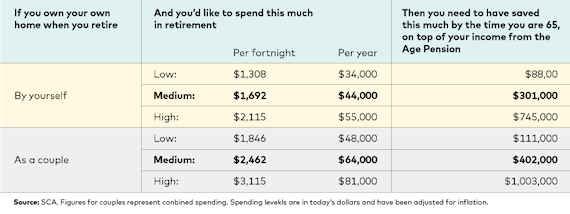
SCA’s calculations are broken down into three retirement spending bands (low, medium, and high).

For example, it calculates that an individual wanting (or needing) to spend $44,000 per year will need $301,000 in savings by the time they reach age 65.

The SCA research is a general guide, and it requires individuals or couples to work out how much they’d like to spend in addition to any entitlement they have to receive the Age Pension.

Not everyone can qualify for the Age Pension. Whether you do or don’t depends on how much money and investments you have (outside of your home) and whether you earn additional income.

To find out more, you can check both the “assets test” and the “income test” on the federal government’s Services Australia website.

Currently, eligible individuals can receive up to $987.60 per fortnight ($25,678 per year) in Age Pension payments.

Couples can receive up to $744.40 each per fortnight ($38,709 per year).

Savings targets for pre-retirees, aged 55-59


Comparing with other data

The Association of Superannuation Funds of Australia’s Retirement Standard approaches retirement savings from a different angle, based on how much it estimates you’ll need to generate in income annually to live your preferred retirement lifestyle.

It benchmarks quarterly the minimum annual cost of a comfortable or modest standard of living in retirement for singles and couples.

As at the end of the March 2022 quarter, it calculated that based on the cost of living a single person needed $46,494 a year to live a comfortable retirement and a couple needed $65,445.

To live a modest retirement, a single needed $29,632 a year and a couple $42,621.

The above figures don’t differentiate between whether the money you need per year comes from your superannuation savings, other investments, the Age Pension, or a combination.

At ASFA’s top level, to achieve a comfortable standard of living ($46,494 per year), a single person eligible for the full Age Pension ($25,678 per year) would need be able to generate around $20,000 per year from other investments.

Likewise, a couple eligible for the full $38,709 in Age Pension would need to generate around $27,000 per year from other investments to achieve a comfortable living standard based on $65,445 per year.

How you can do that ultimately comes down to your overall investment strategy, especially after you retire.

Keep in mind that any income earned on money you hold in superannuation, once it’s converted into an account-based pension, will be tax-free in retirement.

Staying financially active

Taking an active role in your investments, to ensure you have the best chance of protecting and growing your capital, is just as important in retirement as it is before you stop working.

For many retirees, low-risk assets such as cash and government-backed bonds are often seen as the safest ways of protecting capital over the long term.

Yet, depending on your broad retirement goals and tolerance for risk, putting all your eggs into one or two asset classes will most likely expose you to investment hazards over the long term.

That’s because asset classes perform differently from year to year. What you may see as a safe investment strategy today could easily become the opposite over time.

Investing across a range of asset classes during pension drawdown phase, including more volatile growth assets such as shares and listed property, will help smooth out poor returns from other asset classes from year to year.

While there’s no guarantee your retirement savings will last until you die, a diversified investment strategy will inevitably deliver steadier, tax-effective long-term returns.

We can help with your retirement strategy, so contact us today on Phone: 07 5641 4134.

Source: Vanguard

Reproduced with permission of Vanguard Investments Australia Ltd

Vanguard Investments Australia Ltd (ABN 72 072 881 086 / AFS Licence 227263) is the product issuer. We have not taken yours and your clients’ circumstances into account when preparing this material so it may not be applicable to the particular situation you are considering. You should consider your circumstances and our Product Disclosure Statement (PDS) or Prospectus before making any investment decision. You can access our PDS or Prospectus online or by calling us. This material was prepared in good faith and we accept no liability for any errors or omissions. Past performance is not an indication of future performance.

© 2022 Vanguard Investments Australia Ltd. All rights reserved.

Important:
Any information provided by the author detailed above is separate and external to our business and our Licensee. Neither our business nor our Licensee takes any responsibility for any action or any service provided by the author. Any links have been provided with permission for information purposes only and will take you to external websites, which are not connected to our company in any way. Note: Our company does not endorse and is not responsible for the accuracy of the contents/information contained within the linked site(s) accessible from this page.
Paying off your mortgage early will save you money and take a financial load off your shoulders. Here are some ways to get rid of your mortgage debt faster.

Switch to fortnightly payments

If you’re currently paying monthly, consider switching to fortnightly repayments. By paying half the monthly amount every two weeks you’ll make the equivalent of an extra month’s repayment each year (as each year has 26 fortnights).

Make extra payments

Extra repayments on your mortgage can cut your loan by years. Putting your tax refund or bonus into your mortgage could save you thousands in interest.

On a typical 25-year principal and interest mortgage, most of your payments during the first five to eight years go towards paying off interest. So anything extra you put in during that time will reduce the amount of interest you pay and shorten the life of your loan.

Ask your lender if there’s a fee for making extra repayments.

Smart tip: Making extra repayments now will also give you a buffer if interest rates rise in the future.

Find a lower interest rate

Work out what features of your current loan you want to keep, and compare the interest rates on similar loans. If you find a better rate elsewhere, ask your current lender to match it or offer you a cheaper alternative.

Comparison websites can be useful, but they are businesses and may make money through promoted links. They may not cover all your options. See what to keep in mind when using comparison websites.

Switching loans

If you decide to switch to another lender, make sure the benefits outweigh any fees you’ll pay for closing your current loan and applying for another.

Switching home loans has tips on what to consider.

Make higher repayments

Another way to get ahead on your mortgage is to make repayments as if you had a loan with a higher rate of interest. The extra money will help to pay off your mortgage sooner.

If you switch to a loan with a lower interest rate, keep making the same repayments you had at the higher rate.

If interest rates drop, keep repaying your mortgage at the higher rate.

Use this mortgage calculator

See what you’ll save by making higher loan repayments.

Consider an offset account

An offset account is a savings or transaction account linked to your mortgage. Your offset account balance reduces the amount you owe on your mortgage. This reduces the amount of interest you pay and helps you pay off your mortgage faster.

For example, for a $500,000 mortgage, $20,000 in an offset account means you’re only charged interest on $480,000.

If your offset balance is always low (for example under $10,000), it may not be worth paying for this feature.

Avoid an interest-only loan

Paying both the principal and the interest is the best way to get your mortgage paid off faster.

Most home loans are principal and interest loans. This means repayments reduce the principal (amount borrowed) and cover the interest for the period.

With an interest-only loan, you only pay the interest on the amount you’ve borrowed. These loans are usually for a set period (for example, five years).

Your principal does not reduce during the interest-only period. This means your debt isn’t going down and you’ll pay more interest.

To find out more ways to pay down your mortgage sooner, give us a call on Phone: 07 5641 4134.

Source:
Reproduced with the permission of ASIC’s MoneySmart Team. This article was originally published at https://moneysmart.gov.au/home-loans/pay-off-your-mortgage-faster

Important note: This provides general information and hasn’t taken your circumstances into account.  It’s important to consider your particular circumstances before deciding what’s right for you. Although the information is from sources considered reliable, we do not guarantee that it is accurate or complete. You should not rely upon it and should seek qualified advice before making any investment decision. Except where liability under any statute cannot be excluded, we do not accept any liability (whether under contract, tort or otherwise) for any resulting loss or damage of the reader or any other person.  Past performance is not a reliable guide to future returns.

Important
Any information provided by the author detailed above is separate and external to our business and our Licensee. Neither our business nor our Licensee takes any responsibility for any action or any service provided by the author. Any links have been provided with permission for information purposes only and will take you to external websites, which are not connected to our company in any way. Note: Our company does not endorse and is not responsible for the accuracy of the contents/information contained within the linked site(s) accessible from this page.

With markets falling and inflation ramping up, investors might feel they need to ‘do something’ to avoid further losses. However, when it comes to investing, taking action in response to market turmoil may derail a sound investment strategy.

To say that conditions have changed since the initial 2022 outlook would be an understatement.

We welcomed the year with expectations that global economies would continue to recover from the impacts of the COVID-19 pandemic albeit at a more modest pace in comparison to 2021.

But while that continues to hold true, the pace of change in macroeconomic fundamentals such as inflation, growth, and monetary policy has failed to live up to expectations.

What we expect the RBA will do to control inflation

Labour and supply-chain constraints were already fuelling inflation before the year began, but Russia’s invasion of Ukraine and China’s zero-COVID policy have exacerbated the situation.

The RBA has raised the cash rate several times now, faster than anticipated, in an attempt to stay ahead of the race against inflation. However, inflation remains well above what was forecast and will take time to fall back to the RBA’s 2-3% target.

Nonetheless, the sense of urgency remains, and the RBA has signalled further increases will likely be required to address the issue. We expect the cash rate to rise to at least 2.5% by the end of this year and for inflation to peak around 7%.

But the central bank’s actions must be considered alongside the risk of cooling the economy to the point that Australia enters a recession. It is possible that Australia will enter a recession before inflation falls back to target. That said, the chances of a recession are lower in Australia than other developed economies because as a commodities exporter, Australia stands to benefit from higher commodity prices, which will help offset weakness in other parts of the economy.

Fixed income and equity markets have been hit hard, but there’s a silver lining

As a consequence of a rising interest rates and a deteriorating economic backdrop, fixed income and equity markets have been hit hard so far in 2022, keeping many investors on edge. But there is a silver lining to down markets. Because of lower current equity market valuations and higher interest rates, our analysis is now projecting slightly higher long-term returns in comparison to previous modelling.

Our 10-year annualised return forecasts for global equity markets are largely 1.5 percentage points higher than at the end of 2021. And in good news for bond investors, our fixed income return forecasts in many regions are 1.5 percentage points higher. Rising yields may detract from current prices of bonds, but that means higher returns in the future as interest payments are reinvested in higher-interest bonds.

Tip for investors: focus on time in market, not market timing

With markets falling and inflation ramping up, investors might feel they need to ‘do something’ to avoid further losses. However, when it comes to investments, taking action in response to market turmoil may be detrimental to long-term objectives and derail a sound investment strategy.

History can also help put many of today’s challenges into perspective. For example, the heightened volatility we are experiencing currently is far from unusual.

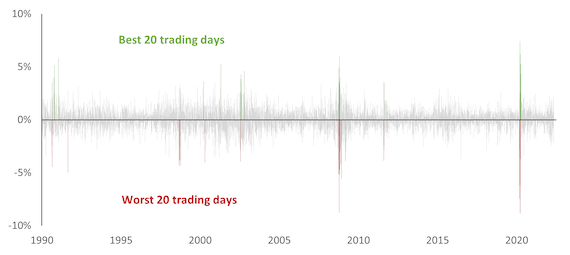
The chart below shows the volatility and price return of the MSCI All Country World Index. It illustrates that volatility is a constant factor that tends to spike when equity markets endure a severe downturn. However, the inevitable troughs that investors will experience over time often give way to higher peaks.

History of volatility and long-term gain


Notes: The chart shows the daily price return to the MSCI All Country World Index in AUD, with the best and worst 20 days by price return highlighted.

Source: Vanguard calculations, using data from Bloomberg from 1 January 1988 to 30 June 2022.

Moreover, the best and worst trading days often occur close together and irrespective of the overall market performance for that year. The data from the last three decades has a clear message for investors – even a bad year for markets can deliver some of the best single-day returns an investor will experience in their lifetime.

For this very reason, investors should continue to invest to build up their long-term wealth, such as for retirement. An investor’s long-term goals, as per the four principles for investing success (set your long-term goals, follow a balanced strategy, maintain discipline and keep investment costs low), should always be forefront of mind when it comes to portfolio decisions.

If you have any questions about your current investment strategy, contact us on Phone: 07 5641 4134.

Source: Vanguard

Reproduced with permission of Vanguard Investments Australia Ltd

Vanguard Investments Australia Ltd (ABN 72 072 881 086 / AFS Licence 227263) is the product issuer. We have not taken yours and your clients’ circumstances into account when preparing this material so it may not be applicable to the particular situation you are considering. You should consider your circumstances and our Product Disclosure Statement (PDS) or Prospectus before making any investment decision. You can access our PDS or Prospectus online or by calling us. This material was prepared in good faith and we accept no liability for any errors or omissions. Past performance is not an indication of future performance.

© 2022 Vanguard Investments Australia Ltd. All rights reserved.

Important:
Any information provided by the author detailed above is separate and external to our business and our Licensee. Neither our business nor our Licensee takes any responsibility for any action or any service provided by the author. Any links have been provided with permission for information purposes only and will take you to external websites, which are not connected to our company in any way. Note: Our company does not endorse and is not responsible for the accuracy of the contents/information contained within the linked site(s) accessible from this page.