
If you stay with the default super fund provided by your employer there’s a chance you’ll miss out on thousands in super. 

It makes sense to take a close look at your current super fund and consider whether your money could be working harder elsewhere. If you still have many years to go until you retire, there could be a way to add thousands of dollars to your final balance.

Here are a few key areas to consider when you’re thinking about the best way to invest your super.

1. Types of investment

Most super funds invest in a mix of cash, fixed interest, property and shares. When you diversify by spreading your money across different asset classes you reduce the overall risk associated with investing your super. This means if one investment performs poorly over a period of time, other investments may perform better, minimising any potential losses.

The various elements are generally mixed in different ways to offer different levels of risk. They often have names like Conservative, Balanced and Growth and you can choose your mix to match your own risk appetite.

You also have a choice of what are known as single and multi-manager funds. A single manager fund is overseen by just one investment manager or trading advisor who may be an expert in particular asset classes. A multi-manager fund can deliver diversification by drawing on the expertise of a number of specialists.

Risk is important but, when you’re considering your mix of investment classes, there are other factors to consider such as:

  • your retirement planning goals

  • how much super you’d need to save for retirement to reach those goals

  • your age and how many years you have to invest

  • any other investments you have and the returns you can expect.

2. Performance

Small differences in the rate of return earned by your super investment can have a significant impact on your retirement savings.

Unfortunately, it’s impossible to predict performance – and there’s no guarantee that a fund that performed well in the past will continue to do so in the future. However, APRA, the superannuation industry’s regulator, has developed a Standard Risk Measure to help you compare the risk of investment options in a superannuation fund.

3. Insurance options

Most super funds include life insurance and many add total and permanent disability insurance and/or income protection also known as salary continuance. The premiums are deducted automatically from your super balance and can be lower than those outside super.

When you’re considering a new fund you should check what cover is provided, whether it’s enough for your needs and, if not, whether there’s an option to increase the level of cover. You should also check whether you can transfer your current level of cover. This is particularly important if you have a pre-existing medical condition.

You can check and compare the details by reading the product disclosure statement on each super fund’s website.

4. Portability

With some limited exceptions, super funds give you the option of moving your money into a fund of your choice. This gives you more control over your super and also gives you the opportunity to consolidate all of your super balances into one account so you’ll pay fewer fees and charges.

However, you may want to check whether there are costs involved or if you lose some benefits with exiting a fund or switching investment options within the fund before deciding on where to invest your super. Also, if you intend to claim a tax deduction for certain personal contributions made into your existing fund, it’s important to ensure your ‘Notice of intent to claim a deduction for personal contributions’ is made and acknowledged by that Trustee before you change funds.

5. Visibility

Whichever fund you choose, it’s a good idea to keep an eye on how your investment is performing as well as any fees or costs. By law, your super fund must send you regular statements with details including:

  • your balance at the start and end of the period

  • details of deposits from your employer and any other contributions you may have made

  • how much interest your investments have earned

  • level of insurance cover

  • any fees or costs.

Remember that visibility works both ways – it’s important to keep your fund up to date with your current contact details.

If you would like to know more about where your super is invested, contact us today on Phone: 07 5641 4134.

Source: NAB

Reproduced with permission of National Australia Bank (‘NAB’). This article was originally published at https://www.nab.com.au/personal/life-moments/manage-money/grow-super/great-super-fund

National Australia Bank Limited. ABN 12 004 044 937 AFSL and Australian Credit Licence 230686. The information contained in this article is intended to be of a general nature only. Any advice contained in this article has been prepared without taking into account your objectives, financial situation or needs. Before acting on any advice on this website, NAB recommends that you consider whether it is appropriate for your circumstances.

© 2022 National Australia Bank Limited (“NAB”). All rights reserved.

Important:
Any information provided by the author detailed above is separate and external to our business and our Licensee. Neither our business nor our Licensee takes any responsibility for any action or any service provided by the author. Any links have been provided with permission for information purposes only and will take you to external websites, which are not connected to our company in any way. Note: Our company does not endorse and is not responsible for the accuracy of the contents/information contained within the linked site(s) accessible from this page.


When markets fall, it’s natural to want to take action to prevent further losses. Doing so however can do more harm than good. Here’s why timing the market to buy low and sell high is not as easy as it sounds.

If you’re invested in the financial markets and also keeping up with the news, you’re probably wondering if you should do anything to insulate your portfolio from incurring further losses alongside rising interest rates and inflation.

In times like these, reminding investors to “maintain discipline” and “stay the course” – in other words, stay invested and here’s why:

Reacting to the here and now

Most market commentary are about the events of the day, with a focus on the here and now. However, the ‘today’ is not as significant to financial markets as they’re generally forward looking and more concerned about what will happen in the future. Thus, using daily developments to make constant adjustments to your portfolio is unlikely to help you accumulate wealth over the long term as the market will have already priced it in.

Additionally, to successfully time the market, investors need to get all five of these investment factors right including precisely timing exit and re-entry – a near impossible feat for even the most experienced of investors.

Locking in your losses

When markets fall, it’s natural to want to sell riskier assets (i.e. equities) and move to cash or safer assets like government securities. But exiting the share market now means locking in your losses permanently and not giving your portfolio the opportunity to benefit when markets recover. Research found that 80 per cent of investors who panicked and moved to cash during the 2020 sell off would have been better off if they had stayed invested1.

Investing at the peak

While we all want to “buy low and sell high” so our portfolios can outperform the market average, in reality, it is extremely hard to execute perfectly every single time. Analysis of the last 5 decades reveals that even in the worst-case scenarios – where investors bought into the market at its peak, just before a dip – as long as investors stayed invested instead of moving to cash, they still benefited from positive annual returns of almost 11%.

If the recent market volatility is keeping you up at night, take a moment to reflect on whether your emotions are short-term reactions to the current conditions, or something you really need to act on. If you feel like you cannot stomach temporary losses, consider if your asset allocation is right for your overall investment goals and risk appetite.

A well-diversified core portfolio, aligned to your risk appetite will help spread your risk and afford you a margin of safety over the long term. Get this right and you will probably sleep better at night.

Contact us on Phone: 07 5641 4134 if you would like to discuss this further.

Source: Vanguard

1https://corporate.vanguard.com/content/dam/corp/research/pdf/Cash-panickers-Coronavirus-market-volatility-US-CVMV_072020_online.pdf

Reproduced with permission of Vanguard Investments Australia Ltd

Vanguard Investments Australia Ltd (ABN 72 072 881 086 / AFS Licence 227263) is the product issuer. We have not taken yours and your clients’ circumstances into account when preparing this material so it may not be applicable to the particular situation you are considering. You should consider your circumstances and our Product Disclosure Statement (PDS) or Prospectus before making any investment decision. You can access our PDS or Prospectus online or by calling us. This material was prepared in good faith and we accept no liability for any errors or omissions. Past performance is not an indication of future performance.

© 2022 Vanguard Investments Australia Ltd. All rights reserved.

Important:
Any information provided by the author detailed above is separate and external to our business and our Licensee. Neither our business nor our Licensee takes any responsibility for any action or any service provided by the author. Any links have been provided with permission for information purposes only and will take you to external websites, which are not connected to our company in any way. Note: Our company does not endorse and is not responsible for the accuracy of the contents/information contained within the linked site(s) accessible from this page.

Retirement means starting a new chapter of your life, one that gives you the freedom to create your own story, as you decide exactly how you want to spend your time. While retirement may not be part of your immediate plans, there are advantages to giving some thought as to what retirement looks like for you and how to best position yourself, well before you leave the workforce behind.

A time of profound change

Even setting aside the huge financial implications of leaving a regular salary behind, retiring from work represents one of the biggest life changes you can experience.

For most people, the freedom of being able to do whatever you want to do, whenever you want to do it, is pretty enticing. However, it is quite common to have mixed feelings about retiring, particularly as you get closer to retirement. What we do for a living often defines us to some extent and leaving your job can mean a struggle with how you perceive yourself as well as how others view you. Coupled with the desire for financial security in retirement and the need to make your retirement savings last the distance, you have a lot to be dealing with.

So, let’s look at the things you need to be thinking about sooner rather than later, from an emotional and practical perspective, to ensure your retirement is everything you want it to be.

Forge your own path

Don’t be tied to preconceptions of what retirement is all about. Retirement has evolved from making a grand departure from the workplace with the gift of a gold watch to a more flexible transition that may unfold over several years. Equally, if the idea of a clean break appeals to you then that’s okay too and you just need to plan accordingly.

The same applies for your timeframe for retirement. The idea that you ‘have’ to retire at a certain age is no longer relevant given advances in healthcare and longer lifespans. If work makes you happy and fulfilled, then it can make sense to delay your departure from the workforce.

Planning how to spend your time

It sounds obvious but you’ll have more time on your hands so it’s important to think about what you want to devote that time to. A study found that 97 per cent of retirees with a strong sense of purpose were generally happy and satisfied in retirement, compared with 76 per cent without that sense.i Think about what gives your life meaning and purpose and weave those elements into your plans.

If you are part of a couple, it’s critical to ensure that you are both on the same page about what retirement means to you. This calls for open and honest communication about what you both want and may also involve some degree of compromise as you work together to come up with a plan that meets both of your needs.

Practical considerations

There’s a myriad of practical considerations once you have started to plan how you’ll spend your time.

Here are a few things you may wish to consider:

  • Where do you want to live? Do you want to be close to a city or are you interested in living in a more coastal or rural area? Are you wanting to travel or live overseas for extended periods?

  • What infrastructure and health services might you need as you age? Are these services adequate and accessible in the area you are thinking of living in?

  • What hobbies and activities do you want to be involved in. Do you need to start developing networks for those activities in advance?

  • Who do you want to spend time with? If you have children and grandchildren, think about what role you’d like to play in their lives upon retirement.

The best laid plans…

Of course, with all this planning it’s also important to acknowledge that the best laid plans can go astray due to factors beyond your control. It’s important to keep an open mind and be adaptable. While redundancy or poor health can play havoc with retirement dreams, it’s still possible to make the best of what life throws at you.

And of course, we are here to help you with the financial side of things to ensure that retirement is not only something to look forward to, but a wonderful chapter of your life once you start to live out your retirement dreams. Contact us on Phone: 07 5641 4134 to find out more.

i https://www.inc.com/magazine/201804/kathy-kristof/happy-retirement-satisfaction-enjoy-life.html

Important: This provides general information and hasn’t taken your circumstances into account. It’s important to consider your particular circumstances before deciding what’s right for you. Although the information is from sources considered reliable, we do not guarantee that it is accurate or complete. You should not rely upon it and should seek qualified advice before making any investment decision. Except where liability under any statute cannot be excluded, we do not accept any liability (whether under contract, tort or otherwise) for any resulting loss or damage of the reader or any other person.

Any information provided by the author detailed above is separate and external to our business and our Licensee. Neither our business nor our Licensee takes any responsibility for any action or any service provided by the author. Any links have been provided with permission for information purposes only and will take you to external websites, which are not connected to our company in any way. Note: Our company does not endorse and is not responsible for the accuracy of the contents/information contained within the linked site(s) accessible from this page.

Everyone saves money differently. From setting aside a portion of your pay, to choosing the right account, here are some tips on how to be a better saver and reach your financial goals.

Have a savings goal and budget

It’s much easier to be a good saver if you have a goal in mind. It might be a holiday, a house deposit, or just a rainy day fund.

To work out the amount you’ll need, be realistic about what you can afford to save each week, fortnight or month.

A well-planned budget will get you started on your savings path. You may also be interested in learning how to bucket your money, which is a great way to automate your savings.

Earn your bonus interest

Good savings habits can reward you with bonus interest on some accounts. Be disciplined and it will pay off in the long run by helping you save a little faster.

How it works

In some accounts, you may get bonus interest each month if you make no withdrawals and at least one deposit.

Then, if you follow those simple rules, you’ll receive your regular interest plus bonus interest at the end of the month. Learn more about how interest rates work and how they can help you save below.

An example

In your first month, let’s say you’ve saved $4,000 and your interest rate is 2.50% per annum. This means you’ll earn approximately $8 in interest for this month.

Your bonus interest varies from different accounts—some need a minimum monthly deposit, some no withdrawals, and some have no conditions (check the account details before you open the account).

For this example, we’ll assume there are no conditions and your bonus interest is 0.90% per annum. So, for month one your bonus interest will be $3.

Every month, you’ll see your interest and bonus interest (if you stick to the conditions) increase along with your savings.

Think of your interest as extra money you might not otherwise have had. Eleven dollars might not sound like much, but at the end of 12 months you may have earned an extra $130.

Set up a regular payment

If you get your phone or power bill direct debited from your account, why not apply the same concept to your savings account?

Simply set up a regular automatic payment to go into your savings account every day.

It’s best to make your payment early in the month, because transfers could take a few days to reach your account – and you don’t want to risk losing your bonus interest.

Compare savings accounts

Just like with insurance and mobile phone plans, it’s best to compare which savings accounts are right for you. To get started, think about your needs.

Perhaps an account you can access at any time will work best. This means you can access your money any time without fees. Depending on the type of savings account you choose, you may lose bonus interest for any withdrawals you make.

Another option is a term deposit. A term deposit is a savings account where you lock the money into the account for a certain time and interest rate. The interest rate is usually based on the amount and length of time you put the money away for. This is fine if you don’t need access to the money during the fixed term. If you need to withdraw the money before the fixed term is up, you may be charged economic costs (not all the original interest you would have received will be paid to you).

What to do if you have trouble saving

Sometimes having quick access to your savings can make it tempting to spend money. If you’re finding it too tempting, we can help.

Hide your savings account

You can hide your savings account by changing your settings in internet banking. This means you won’t see the balance when you log in.

Please note, you can’t hide an account if it has periodic or future-dated payments set up.

Lock your savings account

Having a locked savings account means you can’t withdraw money from that account. With this lock in place, you can still deposit money to your account and watch your balance grow, if your account isn’t hidden from internet banking.

If you need help with your savings goals, call us on Phone: 07 5641 4134.

Source: NAB

Reproduced with permission of National Australia Bank (‘NAB’). This article was originally published at https://www.nab.com.au/personal/life-moments/manage-money/budget-saving/successful-saving-secrets

National Australia Bank Limited. ABN 12 004 044 937 AFSL and Australian Credit Licence 230686. The information contained in this article is intended to be of a general nature only. Any advice contained in this article has been prepared without taking into account your objectives, financial situation or needs. Before acting on any advice on this website, NAB recommends that you consider whether it is appropriate for your circumstances.

© 2022 National Australia Bank Limited (“NAB”). All rights reserved.

Important:
Any information provided by the author detailed above is separate and external to our business and our Licensee. Neither our business nor our Licensee takes any responsibility for any action or any service provided by the author. Any links have been provided with permission for information purposes only and will take you to external websites, which are not connected to our company in any way. Note: Our company does not endorse and is not responsible for the accuracy of the contents/information contained within the linked site(s) accessible from this page.

You may have heard it said, “No risk, no reward.” But did you know that time can actually decrease your risk while increasing your reward? 

Investing: Risky business?

When some people think of investing, they focus on the potential for great rewards—the possibility of picking a winning share that will increase in value over time.

Other people focus on the risk—the possibility of losing everything in a market crash or on a bad stock pick.

Who’s right? Well, it’s true that all investing involves some risk. It’s also true that investing is one of the best ways to build your wealth over time.

In fact, there’s typically a direct relationship between the amount of risk involved in an investment and the potential amount of money it could make.

Different types of investments fall all along this risk-reward spectrum. No matter what your goal is, you can find investments that could help you reach your goal without taking on unnecessary risk.

Time is on your side

Here’s the secret ingredient that can make investments less risky: time.

But there’s a caveat.

If you invest in just a handful of investments or only within the same industry, time won’t necessarily make your portfolio any safer.

The reason it works for diversified investment portfolios that incorporate a range of asset classes (i.e. bonds), regions and markets is that over time, there tend to be more “winners” than “losers.” And the investments that gain money offset the ones that don’t do as well.

The more time you have, the more you benefit from compounding

Not only can the passage of time help lower your investment risk, it can potentially increase the rewards of investing.

Imagine you place one checker on the corner of a checker board. Then you place two checkers on the next square and continue doubling the number of checkers on each following square.

If you’ve heard this brainteaser before, you know that by the time you get to the last square on the board—the 64th—your board will hold a total of 18,446,744,073,709,551,615 checkers.

While there’s no guarantee you can double your money every year, the principle behind this – known as “compounding” – is important to understand that when your starting amount is higher, your increases are higher too. And over time, it can add up to be a material increase.

For example, if you earn 6% on a $10,000 investment, you’ll make $600 in the first year. But then you start the second year with $10,600—during which your 6% returns will net you $636. This is a hypothetical example that does not take into consideration investment costs or taxes.

In the 20th year of this example, you’ll earn more than $1,800—and your balance will have increased more than 200%.

A caveat: reinvesting is key

If you take your earnings out of your account and spend them every year, your balance will never get any bigger—and neither will your annual earnings. So instead of making more than $20,000 over 20 years in the hypothetical example above, you’d only collect your $600 every year for a total of $12,000.

If you instead leave your money alone, your “earnings on earnings” will eventually grow to be larger than the earnings on your original investment – and that’s the power of compounding!

Understanding long-term investing can be confusing, that is why we are here to help. Contact us today on Phone: 07 5641 4134 to find out more. 

Source: Vanguard

Reproduced with permission of Vanguard Investments Australia Ltd

Vanguard Investments Australia Ltd (ABN 72 072 881 086 / AFS Licence 227263) is the product issuer. We have not taken yours and your clients’ circumstances into account when preparing this material so it may not be applicable to the particular situation you are considering. You should consider your circumstances and our Product Disclosure Statement (PDS) or Prospectus before making any investment decision. You can access our PDS or Prospectus online or by calling us. This material was prepared in good faith and we accept no liability for any errors or omissions. Past performance is not an indication of future performance.

© 2022 Vanguard Investments Australia Ltd. All rights reserved.

Important:
Any information provided by the author detailed above is separate and external to our business and our Licensee. Neither our business nor our Licensee takes any responsibility for any action or any service provided by the author. Any links have been provided with permission for information purposes only and will take you to external websites, which are not connected to our company in any way. Note: Our company does not endorse and is not responsible for the accuracy of the contents/information contained within the linked site(s) accessible from this page.
With consecutive rate rises throughout 2022 and talk of more to come, many Australians have been looking at their home loans more closely. Yet one thing that may have gone unnoticed is a loyalty tax and whether you are paying one.

What is a loyalty tax?

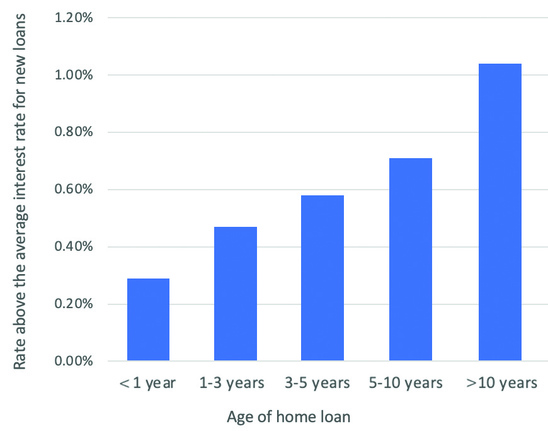
A tax for being loyal? It doesn’t seem fair, though it certainly is common. In recent years the RBA have confirmed that a loyalty tax exists, with pre-existing clients paying more interest on their home loans than new customers do.

Australia’s big four banks – Westpac, ANZ, NAB and CBA – are earning approximately $4.5 billion as a result, with loyal customers bearing the brunt of higher borrowing costs; those of which aren’t passed on to new clients.i

It’s safe to say that as more of us feel the pinch, the greater our desire is to ensure we’re getting the best outcome when it comes to our home loan.

While reviewing your situation and shopping around for a better rate can seem time-consuming, the reward is not having to pay more than you need to.

Are you paying a loyalty tax for an old loan?

*As of September 2020, for owner-occupier loans with principal and interest repayments
Source: ACCC’s Home Loan Price Inquiry – Final Report

The trend towards refinancing

To combat the impact of rising rates on household budgets, it makes sense that more Aussies are reviewing their home loan and refinancing. With inflation being the highest it has been in Australia since the early 1990s, many of us can’t afford to not look for a better deal.

This is especially true in the eastern states. Last financial year saw a record 331,976 property refinances recorded for New South Wales, Queensland and Victoria, which was a 29% increase on the previous financial year.ii Victoria led the refinancing trend in terms of volume, followed by New South Wales, while Queensland saw the highest growth.

This was largely due to the expiration of low fixed-rate loans, which had been taken out in 2020 and 2021, and are collectively worth around $400 billion.iii

Checking your home loan and rate

You may have heard the terms ‘sleepy borrower’ or ‘sleepy mortgage holder’ before – these refer to people who haven’t checked their loan for over two years. Sound like you?

Checking your home loan and rate is always a good idea, and now more than ever. 2022’s cash rate increase – and the prediction that inflation will rise even further to around 7% – means there will be additional financial pressure on many Australian homeowners.iv Yet 55% of 1000 surveyed Australians didn’t know what home loan rate they were on, according to research from Mortgage Choice.v

It is important to refamiliarise yourself with the terms and conditions of your loan. Do they still suit your circumstances? What is the interest rate you are paying? What are the fees?

A mortgage switching calculator can be an easy way to compare deals. But remember, rather than just comparing your interest rate with one being offered by other lenders, you also need to consider the fees both upfront and ongoing. This will help you get a clearer picture of whether you would benefit from moving your loan or refinancing.

It’s also worth speaking with us and we can flag your intention to switch with your current lending to negotiate your home loan rate. This can result in a better deal, especially if you have a good credit rating. With the news confirming the prevalence of a loyalty tax, they won’t be surprised that you’re questioning whether you are getting the best deal.

Pitfalls to watch out for

While refinancing may be in your best interest, it of course doesn’t come without considerations. Depending on the conditions of your loan, you may need to pay an exit fee. While exit fees were no longer applied to home loans as of July 2011, if you have an older loan or extenuating circumstances (relating to early repayment of a fixed rate, for example) you might still need to pay this.

Then there are the fees related to your new loan. You might be able to avoid an application fee or ask for it to be waived, but there are non-negotiable fees as well, so find out what you will need to pay and when. There are establishment fees, related to the property valuation and legal costs, and also ongoing costs such as a monthly servicing fee. And while exit fees aren’t applied anymore, there can be leaving fees related to settlement and refinancing.

Don’t forget about Lenders Mortgage Insurance (LMI), which may be added to your home loan. As it’s non-refundable and non-transferrable, check to see if this applies to your new loan.

Making the right decision

While the greater trend is towards refinancing, your individual circumstances need to be taken into account. Ask yourself whether you are getting the best deal, or if you’re missing out due to loyalty to a lender or a lack of understanding of your situation.

We can help you take the next steps, from reviewing your home loan to future-proofing your financial position, so give us a call Phone: 07 5641 4134 or email to get started.

i https://www.afr.com/companies/financial-services/70-000-home-loan-loyalty-tax-netting-banks-4-5b-20220729-p5b5m8

ii https://www.pexa.com.au/news/property-refinancing-reaches-record-heights-in-fy22

iii https://www.mpamag.com/au/news/general/refinancing-set-to-hit-new-high-in-2023/415036

iv https://www.rba.gov.au/media-releases/2022/mr-22-21.html

v https://www.mortgagechoice.com.au/about-us/media-centre/media-releases/research-reveals-borrowers-unprepared-for-rising-rates/

Important: This provides general information and hasn’t taken your circumstances into account. It’s important to consider your particular circumstances before deciding what’s right for you. Although the information is from sources considered reliable, we do not guarantee that it is accurate or complete. You should not rely upon it and should seek qualified advice before making any investment decision. Except where liability under any statute cannot be excluded, we do not accept any liability (whether under contract, tort or otherwise) for any resulting loss or damage of the reader or any other person.

Any information provided by the author detailed above is separate and external to our business and our Licensee. Neither our business nor our Licensee takes any responsibility for any action or any service provided by the author. Any links have been provided with permission for information purposes only and will take you to external websites, which are not connected to our company in any way. Note: Our company does not endorse and is not responsible for the accuracy of the contents/information contained within the linked site(s) accessible from this page.

Share market investment analysts thrive on numbers.

So, when you read reports about markets or specific companies being “overvalued” or “undervalued”, you can generally assume there’s been a fair bit of analytical number crunching going on behind the scenes.

But how do investment analysts reach their conclusions? Is there a magic formula available that you can use to work out if you’re paying over the top, or getting a bargain?

The answer to that question probably lies somewhere between yes and no, depending on a whole range of different factors.

How analysts value companies

A golden rule of investing is to always do your homework before parting with any money.

If you’re looking to invest in individual companies, part of your due diligence may involve reading research reports written by investment analysts.

Typically, among other things, investment analysts will provide a detailed overview of a company’s current operations, past business performance, and its future earnings and growth outlook.

Based on their findings, they’re likely to produce a recommendation such as “buy”, “hold”, or “sell”.

To reach a conclusion on what they consider to be the “fair value” for a company’s shares, investment analysts have a large toolkit of quantitative measures at their disposal.

Here’s some of the common ones:

The P/E ratio

Commonly referred to as P/E, the price-to-earnings ratio is determined by dividing a company’s current share price by its latest earnings per share.

Earnings per share, or EPS, is calculated by dividing a company’s most recent net profit by the number of shares it has on issue to investors.

In essence, the P/E ratio shows what investors are willing to pay now (the current share price) for a company based on its past earnings.

A high P/E could signal that a company’s share price is high relative to its earnings, while a low P/E could mean the opposite.

Sometimes a high P/E reflects that the market is willing to pay more for the company due to the expectation of above average future growth. To take this into account, some analysts look at forward looking metrics such as the PEG ratio.

The PEG ratio

The PEG, or price/earnings to growth ratio, takes the P/E ratio to a new level.

Instead of just focusing on EPS (which is the past performance measure used for the P/E ratio), the PEG adds the expected future earnings growth rate into the measurement equation.

It’s calculated by dividing the company’s P/E ratio by its future growth rate.

A lower PEG suggests a company is undervalued relative to its future growth compared to a higher PEG.

Return on equity

Return on equity, or ROE, is calculated by dividing a company’s net income by its net assets (total assets minus total liabilities).

ROE is one way of determining how well a company may be performing. A higher ROE suggests a company is better at using shareholder equity to generate profits.

Free cash flow

Free cash flow is essentially the cash left over after a company has paid its operating and capital expenses.

If a company has a high free cash flow, it shows that the company is generating excess cash. This can either be deployed back into the business for further expansion of used to pay shareholder dividends.

Investment analysts often factor in free cash flow as part of their future growth analysis.

The benefits of diversification

Investment analysts have many financial measures at their fingertips, but it’s quite common for a group of analysts to use exactly the same measures and reach different conclusions.

Why? Because, beyond quantitative measures, there’s also a large degree of subjective judgement when it comes to deciding on a company’s investment recommendation.

That’s why you often see companies have a range of share price forecasts from different investment analysts.

You do have an alternative route though, which avoids having to do your own number crunching or having to decipher specific analyst recommendations.

That route is all about diversification.

Instead of focusing on just a few listed companies recommended by analysts, why not cast your investment net over hundreds, or even thousands, of companies using a managed fund or exchange traded fund (ETF)?

A broad-based index fund will typically invest in many companies, usually proportionately based on their market capitalisation, with its largest holdings being in the biggest listed companies.

As an investor, that means you’re essentially buying into all the companies that tick the boxes that investment analysts are looking for but we are always here to help you.

Rather trying to find one listed company or a few companies that may deliver a great investment return over time, investing much more broadly across the wider universe of listed companies using index funds.

Having broad diversification across many companies is a proven strategy to reduce share portfolio risk and has consistently delivered strong investment returns over the long term.

As advisers, we are here to help you along your investment journey. We can talk to you in more detail about portfolio diversification, or understand more about how your money is invested, call us on Phone: 07 5641 4134.

Source: Vanguard

Reproduced with permission of Vanguard Investments Australia Ltd

Vanguard Investments Australia Ltd (ABN 72 072 881 086 / AFS Licence 227263) is the product issuer. We have not taken yours and your clients’ circumstances into account when preparing this material so it may not be applicable to the particular situation you are considering. You should consider your circumstances and our Product Disclosure Statement (PDS) or Prospectus before making any investment decision. You can access our PDS or Prospectus online or by calling us. This material was prepared in good faith and we accept no liability for any errors or omissions. Past performance is not an indication of future performance.

© 2022 Vanguard Investments Australia Ltd. All rights reserved.

Important:
Any information provided by the author detailed above is separate and external to our business and our Licensee. Neither our business nor our Licensee takes any responsibility for any action or any service provided by the author. Any links have been provided with permission for information purposes only and will take you to external websites, which are not connected to our company in any way. Note: Our company does not endorse and is not responsible for the accuracy of the contents/information contained within the linked site(s) accessible from this page.

With the price of iceberg lettuce peaking at an insane $12, and inflation not letting up any time soon, it’s a good time to review what you can do to reduce your food spend.

If you’ve been wincing at the total on the register at the check-out recently, you’re not alone. Food prices have spiralled due to crops being impacted by floods in New South Wales and Queensland, and more recently Victoria, coupled with the increase in the cost of fuel due to the war in Ukraine.

Groceries are the second biggest expense for Australians – putting food on the table is second only to the cost of putting a roof over our heads.i Given that it’s where a lot of our hard-earned cash goes, anything you can do to manage the rising costs of your food shop will really help your bottom line.

Reduce wastage

The first point of call is to reduce the amount of food you throw away. Each year we waste about one in five bags of groceries or around $2,500 per household per year.ii

Good ways to avoid food waste include planning your shop and even creating meal plans for the week ahead. Before you do a shop – have a look at building on what food you already have in the house. The Foodwise website has a planner that lets you enter the ingredients you already have, selects recipes and assembles a shopping list for any extras you may need.

Keep an eye on what’s in the fridge and be aware of use by dates. You can also use your freezer to extend the life of items if they are getting close to the use-by date and you’re unlikely to use them in time.

Seek out specials

The next step is to reduce the amount you are forking out at the checkout.

While it makes sense to shop around, it can be time-consuming but there are a number of apps you can download to help you easily track down the best deals. Trolley Saver and Half Price compare specials across the major supermarkets and Frugl provides the best bargains at a range of grocery retailers.

It’s also worth looking at retailers like Costco and Aldi who offer cost savings across their brands and products. It’s not just the big retailers though – many smaller discount brands are springing up mimicking the Costco model and charging an annual membership fee to access discounts and special offers so it’s worth keeping your eye out for these.

Shop wisely

Making some tweaks to the way you shop can also trim your grocery spend. One of the classic rules of saving money on your groceries is to never shop on an empty stomach. You’d be surprised how many treats make their way into your trolly when you are famished!

It’s also a good idea to look at the unit price of the items you are buying and consider buying in bulk for cost savings. Also consider substituting fresh produce for tinned or frozen and adjusting your recipes to substitute cheaper produce or cuts of meat. Buying what’s currently in season is usually a good way to save on fruit and veggies.

It’s worth seeing if there are any home brand or plain label alternatives to your usual brands. The home brand of a product is usually very similar to the name brand and is often made by the same manufacturer but retailing for a cheaper price. Your taste buds may not even be able to tell the difference – but your hip pocket will.

While these tweaks might not feel like much when you look at individual products, by the time you fill your trolley they can all add up to significant savings at the checkout.

Grow your own

The price of fresh produce is the main culprit for increases – junk food has only increased 1%, compared to around 5.6% for fruit and veggies.iii,iv But saving on food costs does not mean living on pizza. Why not grow some of your own produce? You don’t need a huge garden – or even to have a garden – many herbs and leafy greens do very well in pots or even on a sunny spot on a countertop.

There are many ways you can save on your food bill and each tiny change you make will add up at the checkout and over time. Given that food inflation seems to be a trend that’s not going away any time soon – it makes sense to start saving today.

i https://www.smh.com.au/business/the-economy/are-groceries-really-getting-more-expensive-20220121-p59q75.html

ii https://www.dcceew.gov.au/environment/protection/waste/food-waste

iii https://www.theguardian.com/australia-news/2022/jul/10/rising-food-prices-hit-every-supermarket-aisle-putting-pressure-on-low-income-families

iv https://www.theguardian.com/food/2022/aug/04/how-to-save-money-on-groceries-the-best-value-fresh-produce-in-australia-this-august

Important: This provides general information and hasn’t taken your circumstances into account. It’s important to consider your particular circumstances before deciding what’s right for you. Although the information is from sources considered reliable, we do not guarantee that it is accurate or complete. You should not rely upon it and should seek qualified advice before making any investment decision. Except where liability under any statute cannot be excluded, we do not accept any liability (whether under contract, tort or otherwise) for any resulting loss or damage of the reader or any other person.

Any information provided by the author detailed above is separate and external to our business and our Licensee. Neither our business nor our Licensee takes any responsibility for any action or any service provided by the author. Any links have been provided with permission for information purposes only and will take you to external websites, which are not connected to our company in any way. Note: Our company does not endorse and is not responsible for the accuracy of the contents/information contained within the linked site(s) accessible from this page.

If you’re a sole trader or in a partnership, you may be able to claim the business-use portion of running expenses (the costs incurred using your home’s facilities) and occupancy expenses (what you pay to own or rent your home).

For example, Georgia is a sole trader and runs a hairdressing business from her granny flat. She keeps detailed, accurate and complete records – including all hours she has run her business from home, depreciating assets and equipment and how she works out business versus personal use. This means she has a few methods to choose from to calculate running expenses she can claim for the 2021–22 financial year. These are the:

  • temporary shortcut method, which she can use up to 30 June 2022

  • 52c per hour fixed rate method, which covers heating, cooling, lighting, cleaning and depreciation of furniture and furnishings

  • actual cost method, based on receipts.

As Georgia’s home salon has the character of a place of business, she also calculates occupancy expenses, including mortgage interest, council rates and house insurance premiums, based on the proportion of the floor area and time it was used for business.

If your business is a company or a trust and you run part or all of your business from home, you should have a genuine, market-rate rental contract (or similar agreement) with the owner of the property. This will determine which expenses you pay for and can claim as a deduction.

Find out more about claiming home-based business expenses at the ATO’s web content page, which includes a handy fact sheet. Remember, we can help you, call us on Phone: 07 5641 4134.

Source: ato.gov.au September 2022
Reproduced with the permission of the Australian Tax Office. This article was originally published on https://www.ato.gov.au/Newsroom/smallbusiness/General/Do-you-run-part-or-all-of-your-business-from-home-/.

Important:
This provides general information and hasn’t taken your circumstances into account.  It’s important to consider your particular circumstances before deciding what’s right for you. Although the information is from sources considered reliable, we do not guarantee that it is accurate or complete. You should not rely upon it and should seek qualified advice before making any investment decision. Except where liability under any statute cannot be excluded, we do not accept any liability (whether under contract, tort or otherwise) for any resulting loss or damage of the reader or any other person. 

Any information provided by the author detailed above is separate and external to our business and our Licensee. Neither our business nor our Licensee takes any responsibility for any action or any service provided by the author. Any links have been provided with permission for information purposes only and will take you to external websites, which are not connected to our company in any way. Note: Our company does not endorse and is not responsible for the accuracy of the contents/information contained within the linked site(s) accessible from this page.

Rising inflation brings about concern for many, but Vanguard’s time-tested investment philosophy—and a long-term focus—can help any investor navigate choppy waters.

What is inflation?

Inflation happens when prices rise and purchasing power decreases. This can be the result of a simultaneous high demand for and low supply of goods and services. Consumers have money and want to spend it, but since not enough goods are being produced, prices move skyward.

How has inflation affected the markets?

Inflation has been historically low for most of the last 40 years, so the level of inflation we’re experiencing now is unsettling. When inflation increases, interest rates tend to rise, which can cause both bond and share prices to fluctuate. This can be especially challenging for companies as they plan capital expenditures, budgets, and payrolls. For many investors, this could be their first experience with inflation and they may be wondering how to proceed.

When should I make a portfolio adjustment during high inflation?

In this inflationary environment, as with any period of high uncertainty, investors should reflect on their goals, time horizon, and tolerance for risk. If you determine that you need to make a change after that analysis, you should consider it carefully before making any sweeping changes (such as switching all your investments to cash). It’s important to put what’s going on into perspective and decide if it truly warrants an adjustment to your portfolio. Oftentimes, a moderate change will suffice. A diversified portfolio will give you the best chance at increasing purchasing power over the long run.

If you don’t think your portfolio needs any modifications but you still want to hedge against inflation risk, you can make spending adjustments. Reducing spending during periods of high inflation can help make your investments last, but won’t feel like a permanent change; you can always increase, decrease, or maintain your spending level, depending on your situation and the market environment.

When should I NOT make a portfolio adjustment during high inflation?

Don’t make adjustments to your portfolio in haste. It’s crucial that you take time to think about what makes the most sense for you and your long-term needs. Even if your risk tolerance has changed, your asset allocation shouldn’t change that much. We also discourage spontaneous changes based on hearsay; just because someone on the news or online makes a recommendation doesn’t mean it’s right for your portfolio.

Instead of veering to avoid bumps in the road, we recommend you stay the course and focus on your long-term goals—your future will thank you for it.

Speak to us today on Phone: 07 5641 4134 if you would like to discuss how inflation may impact your portfolio.

Source: Vanguard

Reproduced with permission of Vanguard Investments Australia Ltd

Vanguard Investments Australia Ltd (ABN 72 072 881 086 / AFS Licence 227263) is the product issuer. We have not taken yours and your clients’ circumstances into account when preparing this material so it may not be applicable to the particular situation you are considering. You should consider your circumstances and our Product Disclosure Statement (PDS) or Prospectus before making any investment decision. You can access our PDS or Prospectus online or by calling us. This material was prepared in good faith and we accept no liability for any errors or omissions. Past performance is not an indication of future performance.

© 2022 Vanguard Investments Australia Ltd. All rights reserved.

Important:
Any information provided by the author detailed above is separate and external to our business and our Licensee. Neither our business nor our Licensee takes any responsibility for any action or any service provided by the author. Any links have been provided with permission for information purposes only and will take you to external websites, which are not connected to our company in any way. Note: Our company does not endorse and is not responsible for the accuracy of the contents/information contained within the linked site(s) accessible from this page.