In the past, most people who took out a mortgage doggedly continued with it until they had paid it off. These days, people refinance their mortgage much more frequently. Here we look at some of the reasons people in Australia refinance their home loan.

To get a lower rate

The most common reason for people to refinance their mortgage is to get a better deal. But be careful you don’t become interest rate-fixated.

When you refinance your home loan, you need to consider fees and charges as well as the interest rate. You often have to pay charges for exiting your current home loan, plus charges for taking out the new mortgage. You need to be sure that in refinancing your home loan that you’ll be better off in the long run after taking all costs into account.

To get more flexibility

Many people only discover the full details about their mortgage when it’s too late. They try to do something and get told by their lender that either they can’t do it, or they will incur a hefty charge if they do. 

An example is a redraw facility – the ability to pay extra money into a mortgage and then redraw it later. This feature is not possible with a basic home loan, so many people refinance their mortgage to give themselves this sort of increased flexibility.

To fund a renovation

If you carry out renovations, it often makes sense to refinance your mortgage and take out a construction loan so you only pay interest as building progresses. 

Once construction is over, it might make sense to refinance your home loan again so that you consolidate the total amount you owe into a loan that minimises your interest bill, while giving you a degree of liquidity.

To access home equity

Over recent years property has appreciated at a significant rate. For example, a home you bought for $300,000 five years ago, might now be worth $500,000. Refinancing your mortgage with a home equity loan might let you tap into that extra $200,000 equity.

To avoid defaulting

Some people find they have borrowed more than they can comfortably repay, and they’re in danger of defaulting. 

There’s no shame in that and you shouldn’t suffer in silence. If you’re having trouble making your mortgage repayments, talk to your broker to see if refinancing your home loan to make it more manageable is an option for you. 

Talk about mortgage refinancing with us today on Phone: 07 5641 4134.

Source: MFAA

Reproduced with the permission of the Mortgage and Finance Association of Australia (MFAA)

Important:
This provides general information and hasn’t taken your circumstances into account.  It’s important to consider your particular circumstances before deciding what’s right for you. Although the information is from sources considered reliable, we do not guarantee that it is accurate or complete. You should not rely upon it and should seek qualified advice before making any investment decision. Except where liability under any statute cannot be excluded, we do not accept any liability (whether under contract, tort or otherwise) for any resulting loss or damage of the reader or any other person.  Past performance is not a reliable guide to future returns.

Any information provided by the author detailed above is separate and external to our business and our Licensee. Neither our business nor our Licensee takes any responsibility for any action or any service provided by the author.

Any links have been provided with permission for information purposes only and will take you to external websites, which are not connected to our company in any way. Note: Our company does not endorse and is not responsible for the accuracy of the contents/information contained within the linked site(s) accessible from this page.


A capital gain or loss is the difference between what you paid for an asset and what you sold it for. This takes into account any incidental costs on the purchase and sale. So, if you sell an asset for more than you paid for it, that’s a capital gain. And if you sell it for less, that is considered a capital loss.

Capital gains tax applies to capital gains made when you dispose of any asset, except for specific exemptions (the most common exemption being the family home).

Being organised is key when trying to quickly calculate and pay capital gains tax. And a good way to be organised is to keep up to date records by holding on to things like: 

  • initial sale contracts and other receipts for other expenses

  • interest paid on related borrowings

  • receipts for ongoing expenses

  • expense records

  • valuations.

Deciding how to calculate capital gains tax

There are different ways to calculate your capital gains tax.

Capital gains tax discount

If you sell or dispose of your capital gains tax assets in less than 12 months you’ll pay the full capital gain. But, you (as an individual) could get a 50% discount on your capital gain (after applying capital losses) for any capital gains tax asset held for over 12 months before you sell it.

Indexation

You can choose indexation if you acquired your assets before 21 September 1999, and have held it for at least 12 months. This is an alternative option to the discount method. The indexation method applies a multiplier to account for inflation on the cost base of your asset (up to September 1999).

You can choose the indexation method if you’ve carried forward any capital losses for assets held before 1999.

Capital loss

If you’ve made a capital loss, you can deduct this from your capital gains (that you’ve made from other sources) to reduce the amount of tax. If you don’t have other capital gains (during that income year) you can carry over any capital losses to other income years—something handy for another time.

Paying capital gains tax

When to pay

Although it sounds like it, capital gains tax isn’t a separate tax. Your net capital gains form part of your assessable income in whatever year your capital gains tax happened.

Capital gains tax is payable as part of your income tax assessment for the relevant income year.

When not to pay

If you make a net capital loss in an income year, you shouldn’t pay capital gains tax. But the net capital loss is unable to offset tax on any other income, and can only be ‘carried forward’ to offset capital gains in future income years.

It’s worth noting, some assets and events are exempt from capital gains tax. These include selling your principal home or personal car, or selling an asset acquired before capital gains tax was introduced on 20 September 1985.

Have a read of the ATO’s full list of capital gains tax exemptions.

Working out your capital gain (or loss)

To quickly figure out how much capital gains tax you’ll pay – when selling your asset, take the selling price and subtract its original cost and associated expenses (like legal fees, stamp duty, etc.). The remaining amount is your capital gain (or loss).

If you’ve made a capital gain and you’ve held an asset for greater than 12 months (assuming you don’t have other capital losses), you can apply the 50% discount to work out your net capital gain (unless the indexation method applies).

Companies and individuals pay different rates of capital gains tax. If you’re a company, you’re not entitled to any capital gains tax discount and you’ll pay 30% tax on any net capital gains. If you’re an individual, the rate paid is the same as your income tax rate for that year. For SMSF, the tax rate is 15% and the discount is 33.3% (rather than 50% for individuals).

Have confidence in your future with help from us. Give us a call on Phone: 07 5641 4134 today.

Source: NAB

Reproduced with permission of National Australia Bank (‘NAB’). This article was originally published at https://www.nab.com.au/personal/life-moments/manage-money/money-basics/capital-gains-tax

National Australia Bank Limited. ABN 12 004 044 937 AFSL and Australian Credit Licence 230686. The information contained in this article is intended to be of a general nature only. Any advice contained in this article has been prepared without taking into account your objectives, financial situation or needs. Before acting on any advice on this website, NAB recommends that you consider whether it is appropriate for your circumstances.

© 2022 National Australia Bank Limited (“NAB”). All rights reserved.

Important:
Any information provided by the author detailed above is separate and external to our business and our Licensee. Neither our business nor our Licensee takes any responsibility for any action or any service provided by the author. Any links have been provided with permission for information purposes only and will take you to external websites, which are not connected to our company in any way. Note: Our company does not endorse and is not responsible for the accuracy of the contents/information contained within the linked site(s) accessible from this page.

A good estate plan will help make sure your wishes are carried out when you die. It can also help if you become unable to make your own decisions.

Estate plans

An estate plan records what you want done with your assets after your death. It can include documents such as:

  • your will

  • a testamentary trust (as part of your will)

  • superannuation binding nominations

It also covers how you want to be cared for — medically and financially — if you can no longer make your own decisions. This part of your estate plan may be in documents such as:

  • any powers of attorney

  • a power of guardianship (giving someone the right to choose where you live and to make decisions about your medical care)

  • an advance healthcare directive (your needs, values and preferences for your future care)

The documents you choose will depend on your situation and what you’re comfortable to trust others with. Get legal advice if you’re not sure.

You must be over 18 and mentally competent when you draw up your estate plan.

Your will

A will is a legal document stating what you want to happen to your assets when you die. It is part (but not all) of your estate plan.

Your will can cover things like:

  • how you want your assets shared

  • who will look after your children if they’re still young

  • any trusts you want to set up

  • how much money you’d like to give to charities

  • plans for your funeral

Smart Tip: It’s important to have an up to date will. If you die without one, the law decides who will get your assets — and this may not be who you wanted.

Making your will

You can get your will written by a solicitor (for a fee) or by a Public Trustee. A Public Trustee may not charge if you:

  • are a pensioner or aged over 60, or

  • nominate them to carry out the instructions in your will (that is, to be your executor)

The rules vary, so visit the Public Trustee office website for your state.

If you use an online will kit, get it checked by a solicitor or Public Trustee. They can make sure it’s been done properly. If your will isn’t done properly, it will be invalid.

Make sure you put your will in a safe place and tell someone close to you where it is.

Updating your will

It’s important to update your will as your situation changes — for example, if you:

  • get married

  • divorce or separate

  • have children or grandchildren

  • have a significant financial change

  • lose your spouse (or someone else who is named in your will) through death

Super and your will

A binding nomination directs who your super fund trustee gives your super benefit to when you die. If you don’t nominate someone, the super fund trustee will decide who your money goes to.

Family trusts and your will

If you have a family trust, it continues after your death. The trust determines who gets your assets, even if your will says something different.

Testamentary trusts

A testamentary trust is a trust that is written in your will. It takes effect when you die, and it’s administered by a trustee, who you usually name in your will.

The trustee looks after your assets until your beneficiaries can get them. This is set out in your will, and is either when:

  • a child reaches a certain age, or

  • a beneficiary achieves a specific goal (for example, they get married or earn a particular qualification)

You may want to consider setting up a trust if your beneficiaries:

  • are minors (under 18), or

  • have diminished mental capacity, or

  • may not use their inheritance well

Another reason to consider a trust is to avoid family assets being:

  • split as part of a divorce settlement, or

  • part of bankruptcy proceedings

Powers of attorney

A power of attorney is a document where you give someone else the legal right to look after your affairs for you. It’s important to nominate someone that is trustworthy, financially responsible, and likely to be around when you need them.

Each Australian state and territory allows for the appointment of an enduring power of attorney. However, each jurisdiction has separate and distinct legislation.

There are different types of powers of attorney:

General power of attorney

This allows someone to make financial and legal decisions for you. It’s usually for a specified time — for example, if you’re overseas and can’t manage your affairs at home.

If you become unable to make decisions yourself, a general power of attorney becomes invalid.

Enduring power of attorney

An enduring power of attorney (or EPA) allows someone to make financial and legal decisions for you. If you become unable to make decisions yourself, an enduring power of attorney will still be valid.

Medical power of attorney

This allows someone to make medical decisions for you if you ever become unable to do so yourself. It doesn’t allow them to make other kinds of decisions.

Legal and financial housekeeping

It will help your family and your executor if you list all the documents you have and where they’re kept.

As well as the documents talked about above, other key documents to keep handy are:

  • birth certificate

  • marriage certificate

  • life insurance

  • medical insurance

  • Medicare card

  • pensioner concession card

  • house deeds

  • home and contents insurance

  • deeds and insurance policies for any other real estate you own

  • bank account details

  • superannuation papers

  • investment documents (securities, share certificates, bonds)

  • prepaid funeral plans

Contact us on Phone: 07 5641 4134 today if you would like to discuss any of the information outlined above.

Source:
Reproduced with the permission of ASIC’s MoneySmart Team. This article was originally published at https://moneysmart.gov.au/wills-and-powers-of-attorney

Important note: This provides general information and hasn’t taken your circumstances into account.  It’s important to consider your particular circumstances before deciding what’s right for you. Although the information is from sources considered reliable, we do not guarantee that it is accurate or complete. You should not rely upon it and should seek qualified advice before making any investment decision. Except where liability under any statute cannot be excluded, we do not accept any liability (whether under contract, tort or otherwise) for any resulting loss or damage of the reader or any other person.  Past performance is not a reliable guide to future returns.

Important
Any information provided by the author detailed above is separate and external to our business and our Licensee. Neither our business nor our Licensee takes any responsibility for any action or any service provided by the author. Any links have been provided with permission for information purposes only and will take you to external websites, which are not connected to our company in any way. Note: Our company does not endorse and is not responsible for the accuracy of the contents/information contained within the linked site(s) accessible from this page.

Elder abuse was already an issue across the world, however, the pandemic has exacerbated the issue – with more and more people feeling a financial and emotional burden over the last three years.

It is estimated that one in six older people have experienced some form of elder abuse over the last 12 months and financial abuse is sitting around 2 percent of reported elder abuse cases in Australia.

However, Geoff Rowe, Chief Executive Officer (CEO) of Aged and Disability Advocacy Australia (ADA Australia), says it is likely that financial abuse is a lot more pervasive in the community than people realise and that the financial abuse data is not reflective of what ADA sees on the ground.

Why is COVID-19 making financial abuse worse?

Mr Rowe says that COVID-19 has exacerbated a lot of issues for people and increased financial pressures, which may be passed on to older people.

“Older people I think, particularly throughout the pandemic, have been seen as not the highest priority group despite being the most vulnerable group,” explains Mr Rowe.

“What happens behind closed doors without the normal checks and balances is another contributing factor.

“With lockdowns, all the financial pressures on families, [people] lean more on the bank of mum or dad.”

Mr Rowe adds that a big problem with elder abuse, in general, is that older people are reluctant to seek help or report perpetrators because this abuse is often carried out by people they love.

ADA Australia often sees older people blame themselves for the actions of their children, particularly in the case of financial misuse.

Older people have been disconnected from their community and supports more broadly, explains Mr Rowe, which is allowing financial abuse to happen more so than in pre-pandemic times.

Another reason for the financial abuse of elderly people is early inheritance syndrome.

Mr Rowe says that sometimes family members may start thinking that because they need the money now and the older person “doesn’t need it” they can start accessing their inheritance “right here, right now”.

Signs of financial abuse

Spotting financial abuse can be difficult, especially if you are worried about upsetting family members or the victim.

Things that can signal financial abuse include:

  • An older person not being allowed to access their own money

  • A person no longer being able to access any financial accounts

  • Bills are not being paid regularly or often paid late – either by the Enduring Power of Attorney (EPOA) or the older person

  • Expensive or important items are going missing (like your grandmother’s rings or family jewels) or even expensive furniture going missing from your or your older loved one’s home

  • Changed behaviours, like an older person worrying about affording something they do regularly, such as a morning coffee at their favourite cafe

  • Avoiding going to medical appointments or paying for essential items

  • The older person becomes defensive if you ask them about giving money or large gifts to other family members

  • Random or unexpected changes to the person’s banking or important documents

  • Sudden property transfers or selling their house, where previously the older person has indicated they wanted to remain in their home

Another concern for ADA is the misuse of Enduring Power of Attorney (EPOA) powers by family or close friends.

EPOA’s can give certain powers to family members that are meant to assist older people who find certain decisions or tasks difficult. But Mr Rowe says this very system that is meant to protect the vulnerable is also being used incorrectly – whether by accident or not.

You can learn more about financial abuse and other types of abuse in our article, ‘The signs of elder abuse‘.

Where to go for help

If you are concerned you may be experiencing financial abuse, contact an advocacy service or elder abuse service to get the help you need.

An advocacy service can help you understand what your rights are, negotiate on your behalf or empower you self-advocate, set out a plan to help reduce your stress, and give you the right phone numbers for the appropriate supports.

The Older Persons Advocacy Network (OPAN) can help you understand your rights and direct you to the best support services for your situation. You can contact OPAN on 1800 700 600.

If you want to talk to a specific elder abuse service that can provide you with information or advice, contact ELDERHelp on 1800 353 374 and you will be directed to the relevant State or Territory service.

If it is an emergency, contact the police on Triple 000.

You can learn more about elder abuse in our article, ‘Recognise the signs of elder abuse and how to prevent it‘.

*Case studies provided by ADA Australia

Source:
This article was originally published on https://www.agedcareguide.com.au/talking-aged-care/financial-elder-abuse-increased-due-to-the-pandemic-how-can-you-protect-yourself
. Reproduced with permission of DPS Publishing.

Important:
This provides general information and hasn’t taken your circumstances into account.  It’s important to consider your particular circumstances before deciding what’s right for you. Although the information is from sources considered reliable, we do not guarantee that it is accurate or complete. You should not rely upon it and should seek qualified advice before making any investment decision. Except where liability under any statute cannot be excluded, we do not accept any liability (whether under contract, tort or otherwise) for any resulting loss or damage of the reader or any other person. 

Any information provided by the author detailed above is separate and external to our business. Our business does not take any responsibility for any action or any service provided by the author. Any links have been provided with permission for information purposes only and will take you to external websites, which are not connected to our company in any way. Note: Our company does not endorse and is not responsible for the accuracy of the contents/information contained within the linked site(s) accessible from this page.
While it’s difficult to be the best investor in the world, we can all actively avoid being a ‘bad investor’ by learning from history and staying the course. 

Extended periods of market volatility regularly spark discussions around great investors and the traits that qualify folks to be included in that category.

This is probably because, like most things in life, no one really questions why things are going right; everyone is after an explanation when things aren’t so great.

But rather than focus on what it is to be a great investor or how we could be the next Warren Buffett, perhaps the conversation would be more useful if it was couched in terms of how we could avoid bad investing behaviours that seem to appear when financial markets are turbulent.

Here are a few suggestions from us.

Don’t time the market

It is very common to hear the phrase “time in the market, not timing the market” bandied about but while it sounds logical, analysis backs up both parts of the phrase to explain why it makes sense, rather than take it at face value.

Timing the market is hard, and here’s why. To successfully time the market means an investor has to get not one but the following five factors right, all at the same time:

  • Identify a reliable indicator of short-term future market returns.

  • Time the exit from an asset class or the market, down to the precise day.

  • Time reentry to an asset class or the market, down to the precise day.

  • Decide on the size of the allocation and how to fund the trade.

  • Execute the trade at a cost (reflecting transaction costs, spreads, and taxes) less than the expected benefit.

To further add to the complexity of the five factors above, getting all five factors right just once is not sufficient to reap the benefits of market timing. An investor would have to do this repeatedly in order to benefit meaningfully from the exercise.

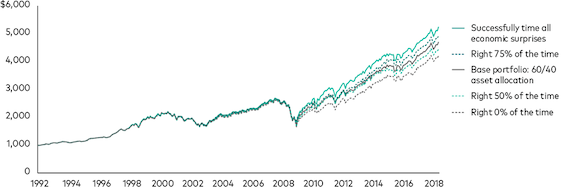
The chart below illustrates this best, showing the return of a $1,000 portfolio in various scenarios, using a traditional balanced portfolio (60% shares, 40% bonds) as the base scenario. It shows that an investor who was right 100% of the time would see a 0.2 percentage point advantage in their annualised returns over 25 years, when compared to a balanced portfolio. Getting things right 75% of the time would see an investor better off than the base scenario at the end of 25 years by $252. And being right half the time meant underperforming the balanced portfolio. Transaction costs were not taken into account in this analysis – meaning the returns would have been even lower had costs been accounted for.

Source: Vanguard paper Here Today, Gone Tomorrow: The Impact of Economic Surprises on Asset Returns, November 2018. Vanguard calculations using data from the U.S. Bureau of Economic Analysis, the U.S. Bureau of Labor Statistics, Bloomberg, and Refinitiv.

Notes: The MSCI USA Index and the Bloomberg U.S. Aggregate Bond Index were used as proxies for U.S. stocks and U.S. bonds. The chart represents the growth of hypothetical portfolios with initial balances of $1,000 as of the start of 1992, growing through August 2018. Significant changes in nonfarm payrolls were used as economic surprises. The hypothetical investors would change the asset allocation to either 80% stocks and 20% bonds in anticipation of a positive economic surprise, or to 40% stocks and 60% bonds in anticipation of a negative surprise.

Disclaimer: Note: The example is illustrative only and is based on the factors stated. It should not be taken to contain or provide an estimate of future returns.

The other conundrum of market timing is not just knowing when to enter the market at the right time, but also exiting at the right time. It can be tempting to stay invested particularly during periods of heightened market volatility and when your portfolio balance fluctuates on a daily basis. But again, the analysis found that 80% of investors who sold equities and moved to cash during the COVID-19 induced volatility fared worse than those who held their nerve and stayed invested. In moving to cash, those investors inadvertently locked in losses permanently and deprived their portfolios of the opportunity to benefit when markets recovered shortly.

This really brings home the point that not only is precise timing nearly impossible but also that being out of the market at the wrong time costs.

Spend time in the market and contribute regularly

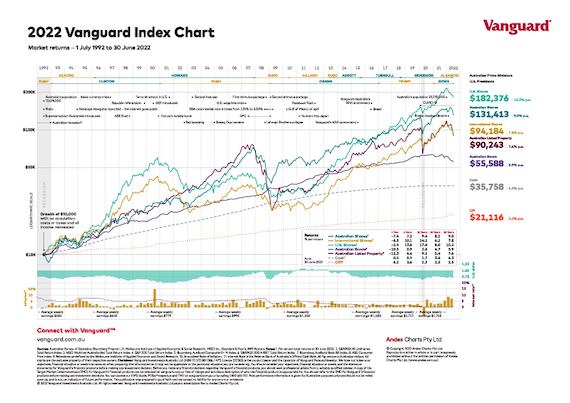
Time in the market is simply putting the theory of compounding into practice. While past performance is no guarantee of future performance, the latest Vanguard Index Chart shows that $10,000 invested in US Shares back in 1992, and left untouched over 30 years would grow to $182,376 while the same $10,000 invested in Australian Shares would result in $131,413 over the same period.

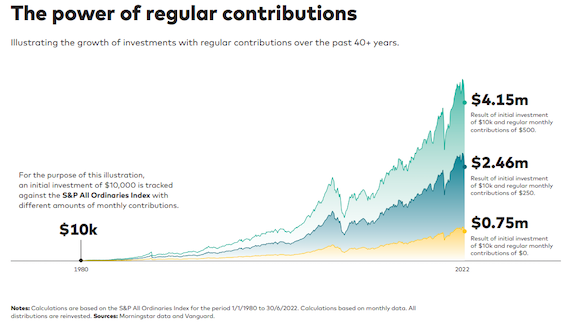
More importantly, the chart below shows that adding monthly contributions of $250 or $500 over that same 30-year period would result in a portfolio balance of almost $3 million or almost $5 million respectively.

Buying high and staying invested

Understandably, the thought of investing during a period of market volatility and potentially losing money can keep any logical person from entering the market. But Vanguard took a look at the worst possible scenarios in the last 50 years to see what happened if an investor invested at the worst possible time – at the peak of a market right before a dip. The table below lists the three worst bear markets in the last five decades and shows how far the market dipped before it started recovering, and the time it took to recover1.

Year

Drawdown

Recovery Time (years)

10Y return from peak

20Y return from peak

1970

-61.9%

8.6

4.2%

10.8%

1987

-41.3%

4.0

6.4%

10.9%

2007

-50.9%

5.9

3.0%

3.9%**

Note: 10Y and 20Y returns are annualised total returns.
** Noting that this is only 15 years of data, not 20 years.

Encouragingly, the results show that if an investor continued investing during the 1970 and 1987 bear markets, their portfolios would have returned an average of nearly 11% in annualised returns after 20 years. If an investor had entered the market just before the Global Financial Crisis, they would have experienced almost 4% in returns over the last 15 years, noting that those returns reflect a shorter period of time.

While we can’t all be the best investor in the world, we can certainly actively avoid being a ‘bad investor’ by learning from history and staying the course.

Contact us today on Phone: 07 5641 4134 to talk about your investment strategy.

1Calculated using data from Australian total return and price indices represented by spliced MSCI Australia (1970-1992)/ASX 300 (1992+). Daily data was used and reflects local currency. ‘Bear’ periods represent a period where a peak to trough drawdown of 20%+ occurs, from the starting peak to the point of recovery.

Source: Vanguard

Reproduced with permission of Vanguard Investments Australia Ltd

Vanguard Investments Australia Ltd (ABN 72 072 881 086 / AFS Licence 227263) is the product issuer. We have not taken yours and your clients’ circumstances into account when preparing this material so it may not be applicable to the particular situation you are considering. You should consider your circumstances and our Product Disclosure Statement (PDS) or Prospectus before making any investment decision. You can access our PDS or Prospectus online or by calling us. This material was prepared in good faith and we accept no liability for any errors or omissions. Past performance is not an indication of future performance.

© 2022 Vanguard Investments Australia Ltd. All rights reserved.

Important:
Any information provided by the author detailed above is separate and external to our business and our Licensee. Neither our business nor our Licensee takes any responsibility for any action or any service provided by the author. Any links have been provided with permission for information purposes only and will take you to external websites, which are not connected to our company in any way. Note: Our company does not endorse and is not responsible for the accuracy of the contents/information contained within the linked site(s) accessible from this page.
While you may be putting more focus into self-care pursuits that boost your physical and mental health, have you thought about a little self-care for your finances? Financial educator, Melissa Browne, shares her three top tips to boost your financial wellness.

The global wellness economy is worth a whopping $4.4 trillion, which means you’re probably indulging in some form of wellness throughout your life.

Maybe it’s practising yoga or meditation, listening to mindfulness apps, using jade rollers, buying scented candles, massages, face masks or booking an annual health retreat. Or maybe it’s going to bed at the same time every night, drinking enough water and moving your body.

Whatever you do, often when it comes to self-care it’s about the physical and the emotional.

Boost your financial wellness

What I am often surprised by, however, is that included in all this self-care isn’t the one area that affects our emotional and physical states, often through stress and worry. The one neglected area in all that wellness? Our finances.

According to a recent Ellevest survey, in pre-COVID times, nearly two thirds of women counted money as their number one source of stress. While since COVID, nearly half of women said they believed that financial stress has taken a toll on their mental and emotional health.

Given the financial stress so many of us are under, it begs the question: Are you really practising self-care if you’re not including your finances?

I believe leaving money out of your self-care routines is like trying to meditate in a room full of mosquitos. If the noise of the mosquitos droning doesn’t push you out of your deep state, the itchiness of the many bites you’ll suffer very soon will. Neglecting your finances when it comes to self-care means you’re not treating the one area that can permeate the rest of your life and threaten to undo any peaceful state you might create.

If, like most people, you suspect you’ve been leaving your finances out in the cold when it comes to self-care, here are three easy things you can do.

1. Indulge in a financial detox

Decide on a length of time (I’m a fan of 30 days, but even seven days is better than nothing) and choose what you’re not going to spend on for that period. It might be clothes and shoes, or it might be lunches and eating out.

The idea is to stop spending on your wants during the detox period, and to be mindful about when you’re tempted to spend. This isn’t to say during life you can’t spend – instead, it’s to question the emotion behind your spending and to turn you back into a conscious consumer.

2. Swap, pause and cancel

During the detox, pull open your bank account and go through three months’ worth of expenses. As you do, ask what expenses you could swap for a cheaper option, what expenses you’re not using currently and can pause, and what expenses you should be cancelling.

These might be subscriptions to pay TV, memberships you’ve signed up to during lockdowns that are no longer relevant, or things you’ve moved on from.

3. Unfollow, unfriend, unsubscribe

Too many people grew up in an environment they had no control over. Yet, as adults, I see too many of us curating an environment which is either harmful at worst, or not beneficial at the very least to our finances.

Certainly, most of us are constantly carrying around a Mobile Shopping Device with us (also known as a mobile phone), and we’ve created online environments through our social media feeds where we’re being sold to 24 hours a day. This might be from brands that we follow, but it could also be influencers who are perpetually peddling products to us that they’re not paying for themselves.

Spend a morning and unfollow, unfriend and unsubscribe from anyone causing you to spend in way that isn’t how you’d choose (if you weren’t carrying your MSD around with you).

Chances are when you think of your finances, you feel overwhelmed or stressed, therefore you push it to one side and hope it will sort itself out. Instead, it’s about reframing financial self-care to be like a soft, supportive, calming bath for your finances.

What’s not to love about that? Contact us today if you need help managing your budget. Call us on Phone: 07 5641 4134.

Source: Flying Solo September 2022

This article by MELISSA BROWNE is reproduced with the permission of Flying Solo – Australia’s micro business community. Find out more and join over 100K others https://www.flyingsolo.com.au/join.

Important:
This provides general information and hasn’t taken your circumstances into account. It’s important to consider your particular circumstances before deciding what’s right for you. Any information provided by the author detailed above is separate and external to our business and our Licensee. Neither our business, nor our Licensee take any responsibility for any action or any service provided by the author. Any links have been provided with permission for information purposes only and will take you to external websites, which are not connected to our company in any way. Note: Our company does not endorse and is not responsible for the accuracy of the contents/information contained within the linked site(s) ac www.flyingsolo.com.au

With interest rates increasing after a lengthy period of historical lows, it’s a good time to think about how your money is working for you and whether your investing style and strategy is still in line with your goals.

Higher interest rates don’t just send a ripple through the economy, aside from the obvious impact on the property market, they often impact stock prices. There are a myriad of other factors that contribute to market movement and portfolio performance and trying to navigate all the things that need to be considered can be challenging but being aware of your preferred investment style and having a considered and appropriate strategy can help.

The benefits of style and strategy

Just as we are all unique individuals, our goals and approach to investing will also be different to our family and friends and it pays to be familiar with your own style and preferences.

It can be common for those new to investing to take the plunge without any real plan, let alone an investment strategy that’s likely to align with their current circumstances, future requirements, and investment goals.

Even those who have been investing for some time can be guilty of a ‘set and forget’ approach that might mean hanging on to a strategy that does not meet their present or future needs.

Having the right investment strategy – the one that’s right for you – improves the likelihood of your investments meeting your goals and allows you to sleep at night.

Your tolerance for risk at the core of your style

While approaches to, and styles of investing are many and varied, your comfort with risk is often the primary driver of any approach you may choose to take. There is of course a trade-off between risk and return that needs to also be considered. Your comfort with risk will determine the right mix of asset classes in your portfolio.

An aggressive investor, commonly someone with higher risk tolerance, is willing to take on greater risk for the possibility of better returns than a conservative investor. This type of investor will be comfortable with a higher proportion of growth assets like shares or listed property that offer higher returns over the long-term that may come at the expense of less stable returns.

A conservative investor will employ a larger proportion of defensive assets in their portfolio to provide long-term stable returns with lower volatility and exposure to risk. Defensive assets are fixed interest investment options including fixed income bonds and cash investment options.

Hands-on vs hands-off approach

Investing strategies can be further separated into two distinct groups: active and passive. Passive investing, as the name implies, focuses on benefitting from the overall increase in market prices over time. One of the benefits of passive investing is that it minimises the mistakes investors can make when they react emotionally to stock market movement.

Active investing involves a more hands-on approach, with more frequent buying and selling to take advantage of short-term price fluctuations and is generally undertaken by a portfolio manager.

Changing your strategy over time

Most investors find that their investment style shifts as they age. Younger investors have a longer time horizon, so they may feel more comfortable making riskier investments as they have time for the market to recover from market falls. Mature investors may be more focused on preserving their savings for retirement, so they may be more interested in diversification and dollar-cost averaging.

For investors nearing or at retirement, a shift from asset growth and capital gains to a focus on income may be something worth considering. The advantage of an income focussed strategy is that investments can produce some of the cash flows needed when you’re no longer working. Dividend stocks are a common way to achieve this goal, with companies showing stable and growing dividends providing the most value.

To ensure you are employing the right strategy to meet your objectives, it pays to be aware of your options and revisit your comfort with risk and your overall investment goals. We can ensure your investment portfolio meets both these elements throughout your various life stages.

If you are interested in exploring the options available to you, please call us on Phone: 07 5641 4134. We can work closely with you to review your strategy or if you are new to investing, find the right mix for your unique circumstances.

Important:
This provides general information and hasn’t taken your circumstances into account. It’s important to consider your particular circumstances before deciding what’s right for you. Although the information is from sources considered reliable, we do not guarantee that it is accurate or complete. You should not rely upon it and should seek qualified advice before making any investment decision. Except where liability under any statute cannot be excluded, we do not accept any liability (whether under contract, tort or otherwise) for any resulting loss or damage of the reader or any other person.
 
Any information provided by the author detailed above is separate and external to our business and our Licensee. Neither our business nor our Licensee takes any responsibility for any action or any service provided by the author. Any links have been provided with permission for information purposes only and will take you to external websites, which are not connected to our company in any way. Note: Our company does not endorse and is not responsible for the accuracy of the contents/information contained within the linked site(s) accessible from this page.

Purchasing an investment property that already has a tenant means you collect rent from day one, with no vacant period and no lease fees to find a new tenant. The lease just carries on as it did before you purchased the property.

There are plenty of upsides to buying an investment property that already has a tenant, as well as a raft of risks. Here’s how to minimise them.

  •  Check whether the lease on your prospective investment is current or the tenants are on an expired lease. If the tenants are off-lease, they can give a short period of notice and vacate the property leaving you to incur the costs of finding a new tenant.

  • Make sure the bond has been lodged properly. Your agent will arrange for the bond guarantee to be transferred into your name on settlement.

  • Check the property condition report, making sure that it is a complete and accurate record of the property as you inspected it.

  • Ensure there are no rental arrears. If there are, or if a landlord has agreed that rental arrears can be taken out of a bond payment, stipulate that this amount is deducted from the purchase settlement amount.

  • Ask the leasing agent about the tenants and their payment record. You cannot demand that you meet the tenants, but attending the open house will give you a sense of how they live in the property. If possible, sight the tenants’ original application for the property and rental ledger.

  • Look at the yield for rental properties in the area and compare them to yours. You won’t be able to increase the rent until the end of the lease.

  • Be aware of any concessions or conditions that are either in the lease or have been agreed with the landlord or property manager, because these will become your responsibility. For example, does rent include electricity or other utilities? Has the landlord agreed to install a new oven or paint a room?

Of course, if you love a property but have doubts about the tenants, the lease or the managing agent, all is not lost. You can easily change the managing agent when you settle. You can also make vacant possession of the property a condition of settlement, you may need to wait until the lease expires to settle, but you aren’t taking on the previous owners’ problems and responsibilities.

If your only problem with a tenanted property is the rental yield, keep in mind that increasing rent on a good, long-term tenant may well drive them away anyway, so do your sums. Work out whether the amount you’d like to increase the rent by equates to more over the year than the lease fee plus any rent lost if your property is vacant for a few weeks.

Source: MFAA

Reproduced with the permission of the Mortgage and Finance Association of Australia (MFAA)

Important:
This provides general information and hasn’t taken your circumstances into account.  It’s important to consider your particular circumstances before deciding what’s right for you. Although the information is from sources considered reliable, we do not guarantee that it is accurate or complete. You should not rely upon it and should seek qualified advice before making any investment decision. Except where liability under any statute cannot be excluded, we do not accept any liability (whether under contract, tort or otherwise) for any resulting loss or damage of the reader or any other person.  Past performance is not a reliable guide to future returns.

Any information provided by the author detailed above is separate and external to our business and our Licensee. Neither our business nor our Licensee takes any responsibility for any action or any service provided by the author.

Any links have been provided with permission for information purposes only and will take you to external websites, which are not connected to our company in any way. Note: Our company does not endorse and is not responsible for the accuracy of the contents/information contained within the linked site(s) accessible from this page.

Staying the course, and not being distracted by short-term market events, is just as important in retirement as it is at any other time.

Retiring from work shouldn’t necessarily equate to retiring from managing your investment portfolio.

In fact, taking an active role in your investments during retirement will ensure you have the best chance of protecting and growing your capital over time.

Australian Bureau of Statistics data shows average life expectancies in Australia are now at a record high and among the highest in the world.

According to the latest ABS statistics, the average male life expectancy at birth had reached 81.2 years in 2018-2020, increasing from 80.9 in 2017-2019.

The average female life expectancy had also increased to 85.3 years, from 85 years.

From a financial perspective, a key question for most of us is whether we’ll have enough money to last all the way through our retirement years?

In fact, it’s such a common question that in financial circles the prospect of running out of retirement money before death is officially known as “longevity risk”.

Reducing financial longevity risk is a challenge.

For many retirees, low-risk assets such as cash and government-backed bonds are often seen as the safest ways of protecting capital over the long term.

Yet, depending on your broad retirement goals and tolerance for risk, putting all your eggs into low-risk asset classes may expose you to investment hazards over the longer term.

What you may see as a safe investment strategy today could easily become the opposite over time.

The index chart below puts that all into context, because it shows exactly how different asset classes have performed over the last 30 years.


Cash is arguably the safest investment there is, especially in Australia where the federal government guarantees the security of all deposits with authorised deposit-taking institutions up to $250,000 per accountholder.

If you’d retired back in 1992 and had invested all your savings into cash that year, you could have earned a return of 9.0 per cent.

But cash returned just 0.1 per cent in 2021-22, and since 1992 it has delivered an average annual return of 4.3 per cent – the lowest return of all asset classes.

Diversification pays off

This underscores the importance of having good asset diversification, even in retirement, to help preserve capital and generate longer term capital growth along with income.

You can see from the index chart that $10,000 invested into different assets in 1992 would have produced very different cumulative returns, ranging from $35,758 (cash) through to $182,376 (U.S. shares).

The Australian share market has produced an average annual return of 9.0 per cent since 1992.

The dollar figures in the index chart are calculated on the basis that all of the distributions over the 30 years, including interest and dividends, had been reinvested back into the same assets to maximise the effect of compounding returns.

Asset classes perform differently from year to year, but the historical data going back for decades shows that despite inevitable short-term price dips, over the long term you can expect each asset class will deliver growth.

Since 1992 there have only been a handful of occasions when the same asset class has been best-performing in consecutive years. So, it never makes sense to chase after last year’s returns.

For example, in 2018-19 Australian listed property was the best-performing asset class, returning 19.3 per cent.

Just a year later the same segment showed a negative return of 21.3 per cent (primarily due to the impact of COVID-19) – a reversal of 40.6 per cent.

That’s where investing across a range of asset classes, including during your pension drawdown phase, will help smooth out poorer returns from other asset classes from year to year.

Avoid knee-jerk decisions

Short-term periods of market volatility can be unsettling.

As global markets fell sharply during the early part of 2020, some retirees hastily chose to divest their equity positions in favour of the relative safety of cash.

In doing so, however, they effectively crystalised their equity losses and may have totally missed the strong rebound in global equity markets that quickly followed.

It’s a powerful example of why time in the market will invariably win over trying to time the market when it comes to achieving investment success.

Staying the course, and not being distracted by short-term market events, is just as important in retirement as it is at any other time.

It’s also important to focus on the things you can control.

That includes reviewing your spending regularly and making sure you’re invested in products that have low management costs.

The lower your investment costs the more money you have to enjoy your retirement.

The best approach to building an investment portfolio that will help protect your retirement capital is to apportion funds across different asset types, such as shares, bonds, property, and cash.

Having a well-diversified portfolio will offset the risks of being too exposed to one asset class.

If you would like to discuss your retirement strategy or would like to review your investment portfolio, call us on Phone: 07 5641 4134.

Source: Vanguard

Reproduced with permission of Vanguard Investments Australia Ltd

Vanguard Investments Australia Ltd (ABN 72 072 881 086 / AFS Licence 227263) is the product issuer. We have not taken yours and your clients’ circumstances into account when preparing this material so it may not be applicable to the particular situation you are considering. You should consider your circumstances and our Product Disclosure Statement (PDS) or Prospectus before making any investment decision. You can access our PDS or Prospectus online or by calling us. This material was prepared in good faith and we accept no liability for any errors or omissions. Past performance is not an indication of future performance.

© 2022 Vanguard Investments Australia Ltd. All rights reserved.

Important:
Any information provided by the author detailed above is separate and external to our business and our Licensee. Neither our business nor our Licensee takes any responsibility for any action or any service provided by the author. Any links have been provided with permission for information purposes only and will take you to external websites, which are not connected to our company in any way. Note: Our company does not endorse and is not responsible for the accuracy of the contents/information contained within the linked site(s) accessible from this page.

As we get older, most of us want to remain independent and in our own home for as long as possible, but this can be challenging without some help with household tasks and personal care.

Recognising this, the government runs a Home Care Packages program where approved aged care service providers work with individuals to deliver co-ordinated services at home.

Approval for a Home Care Package starts with an assessment by the Aged Care Assessment Team (ACAT). Eligibility for a Home Care Package, or other government subsidised help at home, is based on your care needs as determined through the assessment. You must also be an older person who needs co-ordinated services to help them stay at home or a younger person with a disability, dementia, or other care needs not met through other specialist services.

You can make your own referral via the government’s My Aged Care website or by calling 1800 200 422 and answering some questions.

Financial eligibility

Your financial situation won’t affect your eligibility. But once you have been assigned a package, you will need a financial assessment to work out exactly how much you may be asked to contribute.

There are four levels of Home Care Packages – from Level 1 for basic care needs to Level 4 for high care needs.

The annual budgets for the packages are (in round figures) $9,000 for a Level 1, $16,000 for a Level 2, $35,000 for a Level 3 and $53,000 for a Level 4. The government contribution changes on 1 July each year.

The idea is that a person, using a consumer directed care approach, can decide how they would like to use that money for help which may include equipment such as a walker or services such as household tasks, personal care, or allied health.

Your contribution could be a basic daily fee up to $11.26 a day, as well as an income tested fee up to $32.30 a day or $11,759.74 a year.i These fees are adjusted in March and September each year.

Expect a wait

Demand for packages is high, with a wait of 3-6 months for a low-level package and 6-9 months for a higher level package.

It’s not unusual to be approved for a high-level package but be offered or ‘assigned’ a lower level package as an interim measure.

Once approved for a Home Care Package, you must appoint a provider approved by the government, whose role is to administer, and manage the package for you.

The provider will charge a fee for their services which is deducted from the Home Care Package. This essentially reduces the amount of money from the package that can be spent on services. Administration costs can be 10-15 per cent of the package and case management another 10 per cent, or thereabouts.

The services offered and the way they are delivered can vary between providers, so comparing offers is important.

How much help you get from a package will depend on your care needs and fees, but generally a Level 1 package might provide two or three hours of help a week, a Level 2 about four hours, a Level 3 package about 8 hours and a Level 4 about 12 hours.

A recent Fair Work Commission ruling mandating minimum two-hour shifts for casual home care workers, while improving conditions for low-paid workers, is also expected to lead to increased costs for providers and ultimately Home Care Package recipients.

Self-managed home care

One way to get more hours of help and have a greater say in who delivers it, is to self-manage your Home Care Package. As well as saving the case management fee you can generally negotiate directly with workers the hours worked and the rate of pay.

You still need an approved provider to administer the package, with the fee being about 10-15 per cent.

There are currently five providers offering a self-managed option. One way to find support workers to assist with your care needs is through one of several online platforms where carers register their willingness to help, along with their hourly rates.

When paying privately makes sense

While home care packages can provide some welcome financial assistance, if all you need is a couple of services such as cleaning or gardening, it can be more cost effective to pay privately.

Nick is the main carer for his wife Jean, who has a diagnosis of Alzheimer’s Disease. Following an ACAT assessment Jean qualified for a Level 4 Home Care Package but received notification that she had been assigned a Level 2 package. The only help they currently needed was regular cleaning, although they knew the time would come when respite care would be useful to give Nick a break.

After crunching the numbers using the government’s fee estimator, on a Level 2 package it worked out that after paying the income-tested care fee and case management and administration fees they would have about $1,500 a year of government support to spend. It was cheaper to employ a cleaner privately and rely on family for other odd jobs.

Jean opted to decline the lower level package and wait for the approved Level 4 package, which would deliver financial benefits closer to $40,000 a year after costs at a time when she was also more likely to use more services. By declining the lower level she did not lose her place on the waitlist, which was based on her priority and care needs at the time of assessment.

Further reforms on the way

To improve delivery of help at home, further reforms are on the way from July 2023 with a new Support at Home Program.

If you are weighing up your aged care options for yourself or a loved one, and would like to discuss financing arrangements, please get in touch.

i https://www.myagedcare.gov.au/home-care-package-costs-and-fees#basic-daily-fee