
Setting the scene

Marilyn is 67 and has had enough of work. She has worked hard and raised two children on her own and she’s ready for some “me time”. Her children are now adults and live at opposite ends of Australia to her. Marilyn has sold her (big) home and has moved north to be closer to her daughter and partner who have their own baby now.

Marilyn’s daughter and partner are struggling on just the one wage. They rent but are looking for their own home to raise their now-growing family. Marilyn’s son has his own family and home and is doing pretty well in his career.

Marilyn is looking to assist her daughter to purchase a property. She would live there as well and help out whilst being able to come and go as she pleases to live-out her much anticipated retirement adventures. However, Marilyn is also thinking about how her son feels about her retirement and relocation plan.

 

What do others do in this situation?

It’s becoming increasingly common for older Australians to enter into arrangements to live with their family. Adult children help their parents with household and living tasks, whilst grandparents assist their busy children with looking after the grandchildren.

Additionally, the rising costs of residential property in Australia in recent times has led to a greater desire for older Australians to assist their adult children enter the property market.

One way to achieve all of this is by setting up a co-occupancy arrangement. One such arrangement is a “granny flat interest”.

The dream…

Picture this. A “neat as a pin” home that you live in. It’s big enough to be comfortable in, easy to look after and has all your own things in it. Your home is surrounded by a beautiful garden and is a place where you can simply kick back and relax.

The difference is that your home is on the same block of land as your family. Both homes are close enough – but you don’t live on top of each other. You and your family can come and go as you please but still have your own peace-and-quiet and privacy.

That’s the way the television and newspaper ads show it and how the builders sell it to you. This is what life in a granny flat is all about. Right?

Other living arrangements

A granny flat can be more than just a self-contained flat in someone’s house or on their land.

A granny flat interest is established when you transfer assets (such as cash & property/land) to another person in exchange for a right of occupancy for life in a residential property. You are not the “legal owner” of the property – your name isn’t on the property title. You just live there … for the rest of your life.

Granny flat interests are created when you enter into any of the following arrangements:

  1. You transfer the title of the home you own and live in to someone else and retain a lifetime right to live in that home – the other person and their family may or may not also move in with you.

  2. You provide funds to another person in exchange for the right to live in that person’s existing home.

  3. You provide some, or all, of the purchase price of a property registered in another person’s name and retain a right to occupancy for life.

  4. You pay for the construction and/or renovation of a home on another person’s property and retain a right to occupancy for life.

The potential nightmare…

People fall in love with the dream… and that’s really easy to do.

Stephen R. Covey wrote a blockbuster book called The 7 Habits of Highly Effective People. One of the habits (number 2 in fact) is to “begin with the end in mind”. It’s a very important habit to get into … but one that (sadly) many people forget and it only becomes important when something doesn’t work out and the dream starts to unravel.

When setting up a granny flat interest you are contributing something of value to you (money, property, etc) to someone else without actually “owning anything” in the end.

The things for you to consider (at the start … not the end) include:

  • Can you still afford your retirement living lifestyle?

  • What will be the impact on any age pension funding from the Government? There are a number of rules and “special” rules that apply in relation to granny flat interests.

  • You may be signing over your home to another person or providing them with a lot of money. That person is more than likely your son or daughter (your blood) … but what would happen if that person divorces, dies or becomes bankrupt?

  • There may be “other costs” associated with setting up a granny flat interest – these may include capital gains tax (CGT), land tax, stamp duty and legal fees for the drafting of agreements and transfer of property title.

  • You should put everything in writing to ensure everyone knows exactly what’s involved, how it will be achieved and what to do if there are any problems. Yes, it is family… but circumstances can change or the arrangement breaks down and ceases to work at a future point.

  • Your estate planning wishes should also be revisited when establishing a granny flat arrangement – given that one member of your family will benefit now over other family members. What happens if your other children consider that their entitlement (aka inheritance) has been eroded and the arrangement is inequitable?

If you’re considering moving into Aged Care and would like to talk about your financial options, call us today on Phone: 07 5641 4134.

Source: Reproduced with permission of Family Aged Care Advocates

Download 10 aged care traps to avoid for your ageing parents

No specific person’s personal objectives, needs or financial situations were taken into consideration when creating the content for this article. Family Aged Care Advocates Pty Ltd (ABN 77 642 454 484) are aged care specialists. You should seek qualified financial planning, taxation and legal advice before making any decisions that are unique to your circumstances.

This article was prepared in good faith and we accept no liability for any errors or omissions. Any information provided by the author detailed above is separate and external to our business. Our business does not take any responsibility for any action or any service provided by the author. Any links have been provided with permission for information purposes only and will take you to external websites, which are not connected to our company in any way. Note: Our company does not endorse and is not responsible for the accuracy of the contents/information contained within the linked site(s) accessible from this page.


With the Reserve Bank of Australia (RBA) raising the cash rate back in May for the first time since November 2010 – and more rises forecast over the next year – many people are worried about their mortgage repayments.

Even though we hear about the cash rate a lot in the news, there is often some confusion as to what it actually means. It’s important to understand what the cash rate is and then how its fluctuations can impact you.

What is the cash rate?

The cash rate, set by the Reserve Bank of Australia (RBA), is the interest rate banks pay to borrow funds from each other. The RBA uses the rate as a tool to maintain the strength of the Australian economy – increasing, decreasing, or maintaining the cash rate to influence Australia’s monetary policy.

The cash rate increasing reflects the need to tighten the policy; if it decreases, this means an easing of the policy.

On the first Tuesday of every month (except for January), the Reserve Bank Board meet to review the cash rate and release a statement that afternoon outlining any changes. The cash rate can go unchanged for periods of time, as was the case recently, with the increase announced in May 2022 being the first change in over a year.

How is it set?

As you can imagine, a lot of factors go into deciding whether to move the cash rate. Inflation plays a big part in decision making, the board has a medium-term inflation target of between 2-3%, and when inflation is considered too high, the RBA might decide to raise the cash rate so Australians maintain our buying power.

Australia’s economic growth is another major factor. If it’s slowing down, as it did when COVID-19 reached our shores, lowering the cash rate can encourage spending and borrowing, stimulating the economy. Then there is also the international economy that can influence the decisions, because if there is strong international economic growth, this can boost demand for Aussie products.

Unemployment is another aspect they need to consider, as this reflects how well the economy is performing. Lower interest rates stimulate the economy through spending and investing, the RBA might choose to lower the rate when unemployment is high with the aim of creating new jobs.

The impact of fluctuations

Whether you are currently saving up to buy or already have a mortgage, the cash rate will likely impact your financial situation as it often directly relates to interest rates.

When interest rates fall, you can be in a better position to buy or pay off your mortgage. If you are on a variable rate loan, you can take advantage of the savings you will make. On the other hand, if you are on a fixed rate, you’ll be less impacted by the rise in interest rates.

However, you may be buffered by your lender, as banks are not required to pass on cuts to their customers in full.

It’s also worth being aware of the cash rate and its impact on the housing market. With lower interest rates, borrowing costs are lower which can increase competition to buy property, which in turn can drive up property prices. Depending on your position as a buyer or seller, this may work in your advantage or stall your plans.

A rising cash rate tends to put the brakes on the housing market as borrowing costs increase with interest rates. While this is bad news for mortgage holders, it’s good news for savers as you can expect better returns, so if you’re in the position to do so, upping your savings targets is a wise idea.

The RBA’s statements on the cash rate are available on their website if you’re interested in following the trends and getting the latest updates.

For tailored advice as to what the changes mean for you and your financial goals, get in touch with us today on Phone: 07 5641 4134.


Important: This provides general information and hasn’t taken your circumstances into account. It’s important to consider your particular circumstances before deciding what’s right for you. Although the information is from sources considered reliable, we do not guarantee that it is accurate or complete. You should not rely upon it and should seek qualified advice before making any investment decision. Except where liability under any statute cannot be excluded, we do not accept any liability (whether under contract, tort or otherwise) for any resulting loss or damage of the reader or any other person.

Any information provided by the author detailed above is separate and external to our business and our Licensee. Neither our business nor our Licensee takes any responsibility for any action or any service provided by the author. Any links have been provided with permission for information purposes only and will take you to external websites, which are not connected to our company in any way. Note: Our company does not endorse and is not responsible for the accuracy of the contents/information contained within the linked site(s) accessible from this page.

You’ll have heard the old, almost grandmotherly adage that ‘every dollar counts’. But guess what – it’s true.

Voluntary after tax super contributions (also called non-concessional contributions), refer to any payments you make to your super fund out of your take-home pay. Making after-tax super contributions is an easy way to boost your retirement savings on your own schedule.

Your super money jar

Setting up small, automatic after-tax payments is a simple and effective way to add a little extra every month. In the same way people empty their coins into a change jar at the end of a day, making small contributions to your super is like putting your coins into your super savings, which you can access when you retire.

Saving when you can adds real value

One of the great things about making small contributions is that you only have to contribute what you can afford. Whether it’s an extra $5 a month, or an extra $50, even small amounts can add up to make a big difference.

If automatic after-tax contributions aren’t your style, you can make one-off contributions whenever you have spare money. You can also consider looking into salary sacrifice, which is often the most tax effective option. Depending on your financial circumstances, these could be great options for you to make a big difference to your retirement savings.

You can make after-tax contributions to your super any time online.

Have confidence in your future, call us on Phone: 07 5641 4134 today and we can help put a strategy in place to ensure you can enjoy your retirement. 

Source: NAB

Reproduced with permission of National Australia Bank (‘NAB’). This article was originally published at https://www.nab.com.au/personal/life-moments/work/plan-retirement/after-tax-contributions

National Australia Bank Limited. ABN 12 004 044 937 AFSL and Australian Credit Licence 230686. The information contained in this article is intended to be of a general nature only. Any advice contained in this article has been prepared without taking into account your objectives, financial situation or needs. Before acting on any advice on this website, NAB recommends that you consider whether it is appropriate for your circumstances.

© 2022 National Australia Bank Limited (“NAB”). All rights reserved.

Important:
Any information provided by the author detailed above is separate and external to our business and our Licensee. Neither our business nor our Licensee takes any responsibility for any action or any service provided by the author. Any links have been provided with permission for information purposes only and will take you to external websites, which are not connected to our company in any way. Note: Our company does not endorse and is not responsible for the accuracy of the contents/information contained within the linked site(s) accessible from this page.

Teaching good financial habits, such as saving and budgeting, is one of the best ways to prepare children to have a secure financial future. Helping kids establish sound money management skills and strong financial acumen is important, regardless of wealth level.

Younger children (under age 11)

A great way to begin to teach younger children about money is to explain its value and its function in the world. Kids often focus on rewards-based systems, where they earn a reward for good behaviour or academic achievement. Use this time to teach them how to earn money as a reward and divide it into 3 categories: spend, save, and give. For example, spending may be related to buying a fun treat or toy, saving could be taught as a way to buy something they really want in the future, and giving is how you help those in need.

Activity: “Money jars”

  • Set up 3 separate containers for “bank accounts” and label them Spending, Saving, and Giving.

  • Each week, offer opportunities to earn money by using real-life experiences, such as listening well, completing homework early, or doing simple chores.

  • At the end of the week, count how much money they’ve earned in each category.

Tip: Sometimes when sharing the concept of saving with your child, it can be helpful to explain you’re “paying yourself for something fun in the future” and relating it back to an age-appropriate concept they can understand. You can make tweaks to this activity along the way. For example, if your child puts extra money into their Saving jar, you could provide a few additional dollars to help them understand compounding interest—how saving money can help them earn more over time. If they receive money as a gift for a holiday or celebration, bring out the money jars for a refresher. Repetition and reinforcement become important in learning any discipline, especially money management skills.

Preteens and young adults

Parents often associate the tweens and teens as the years their kids desire more independence and more options. In this case, tying money management and financial literacy to something relevant in their lives can help keep them engaged. For example, many young people are interested in gaming, so try to relate investing to playing a game. Before they start the investing game, provide them with an overview of the concepts of shares, bonds, and cash, and how they operate differently, like different players in a game. The different players in the game all act together to form an investment strategy. Depending on a child’s age, engagement, and appetite for these discussions, consider introducing the concept of building model portfolios. Review model portfolios that show different asset allocations, and then have each family member choose a portfolio. Once a family member chooses a portfolio, discuss what stood out to them about the portfolio. This will help reinforce the importance of asset allocation and diversification.

Activity: Investment simulators

  • Google the phrase investment simulators; many are available online.

  • These simulators allow you to invest in different securities and monitor their performance over time.

  • Have frequent conversations with your child about their portfolio’s performance. How would they feel if those were real funds in the market they “lost” or “gained”? This can help reinforce the concept of risk and reward in investing.

University graduates and beyond

At this stage, they may be ready to digest more advanced topics. Discuss the importance of goals-based investing by asking them to think about the next big purchase they want to make—are they saving for a car, a down payment for a home, or even setting aside money for future retirement? Ask: What is their time frame for that investment? When do they want to reach that goal? This helps teach the importance of time horizon as it relates to investing; the longer a person has to save and invest, the greater the likelihood for success in reaching their goals. Depending on their current situation, they may also have student loans to pay back. Budgeting may become a critical topic at this time, and sitting down with them to create that budget can be helpful. This is another important component of financial literacy and money management, and attaching it to an important life stage can make it all the more relevant.

Summary:

It’s never too early or late to start talking about money with your children — start as soon as you are comfortable to and make learning as relevant to their age and life stage as possible.

If you’d like more investment tips and guides, call us on Phone: 07 5641 4134.

Source: Vanguard May 2022

Reproduced with permission of Vanguard Investments Australia Ltd

Vanguard Investments Australia Ltd (ABN 72 072 881 086 / AFS Licence 227263) is the product issuer. We have not taken yours and your clients’ circumstances into account when preparing this material so it may not be applicable to the particular situation you are considering. You should consider your circumstances and our Product Disclosure Statement (PDS) or Prospectus before making any investment decision. You can access our PDS or Prospectus online or by calling us. This material was prepared in good faith and we accept no liability for any errors or omissions. Past performance is not an indication of future performance.

© 2022 Vanguard Investments Australia Ltd. All rights reserved.

Important:
Any information provided by the author detailed above is separate and external to our business and our Licensee. Neither our business nor our Licensee takes any responsibility for any action or any service provided by the author. Any links have been provided with permission for information purposes only and will take you to external websites, which are not connected to our company in any way. Note: Our company does not endorse and is not responsible for the accuracy of the contents/information contained within the linked site(s) accessible from this page.

It’s devastating when a natural disaster destroys or damages your home. Finding out you don’t have enough insurance can add to your distress.

Understanding what events and damage are covered by insurance can help you get the right cover for your home.

Knowing if you live in a disaster-prone area can give you a better understanding of your risk. This helps you choose coverage for the events that are most likely to happen to your home.

Find out if you live in a disaster-prone area

To find out if your home is in a natural disaster prone area, contact:

Ask them about flood mapping, historical flood records, and the Bushfire Attack Level (BAL) of your home. If you contact your council, ask them whether your house meets natural disaster standards.

Smart tip

If you live in North Queensland, visit the Australian Government’s North Queensland home insurance website. This site helps you compare home insurance policies based on where you live.

Understand storm and flood cover

Storms

Most home insurance and contents insurance covers storms. This includes damage caused by lightening, cyclones, strong winds, rainwater, hail and snow.

Rainwater is usually defined as water that falls from the sky. Cover usually includes damage caused by:

  • rainwater run-off — excess rainwater that collects and flows in normally dry areas

  • rainwater that overflows from stormwater drains

Floods

For some policies, cover for damage caused by floods is optional. For example, floods caused by overflowing streams, rivers, creeks and dams due to rainfall or a rise in the water level.

Even if you do pay for flood cover, most policies have exclusions, including:

  • Actions of the sea, such as storm surges, high tides and king tides.

  • Flood water combined with run-off or rainwater.

  • Flood not caused by rainfall, for example a landslide caused by a storm.

  • Flood as a result of a blocked or broken stormwater drain, water pipe or gutter.

  • Damage to gates, fences, retaining walls and driveways.

  • Rainwater entering your home due to a structural defect, faulty design or poor maintenance.

  • Wind, rainwater, hail or snow entering your home through an open window or door.

If you’re not sure what cover you have, ask your insurer or read your policy’s product disclosure statement (PDS).

Understand fire cover

Most home and contents insurance covers you for damage caused by fire, including bushfire.

Generally, a flame has to cause the damage. This means you’re not covered for heat-related damage, like scorching and melting, or smoke, ash and soot damage. For example, if your home is damaged by a nearby fire or bushfire.

Common exclusions from fire insurance include:

  • A bushfire that occurs less than 72 hours after you bought your policy.

  • Intentional fires.

  • Accidental fires caused by negligence or recklessness.

  • If your house doesn’t comply with fire regulations, for example a heater isn’t installed properly.

CHOICE provides more information on the definition of fire and how to check it in your policy’s PDS.

Check if you have enough insurance to rebuild and repair

If you live in a disaster-prone area, it’s worth considering ‘total replacement cover’ with your home insurance. This covers whatever it costs to repair or rebuild your house to the same standard. It’s generally more expensive, but means you’re less likely to be underinsured.

However, most insurers only offer ‘sum-insured cover’. This is an estimate of how much it would cost to repair or rebuild your house.

To avoid being underinsured with sum-insured cover, check if your insurer offers a ‘safety net’ or ‘safeguard’. This means they add up to 30% to your sum-insured amount in the event of a total loss.

For more information, see cover the cost of rebuilding your house.

Also check your policy or ask your insurer about claim limits (or caps). These are maximum amounts for repairing damaged items and the total amount you can claim.

What to do after a natural disaster

For steps and help to manage the recovery process, see what to do after a natural disaster.

Source:
Reproduced with the permission of ASIC’s MoneySmart Team. This article was originally published at https://moneysmart.gov.au/home-insurance/storm-flood-and-fire-insurance

Important note: This provides general information and hasn’t taken your circumstances into account.  It’s important to consider your particular circumstances before deciding what’s right for you. Although the information is from sources considered reliable, we do not guarantee that it is accurate or complete. You should not rely upon it and should seek qualified advice before making any investment decision. Except where liability under any statute cannot be excluded, we do not accept any liability (whether under contract, tort or otherwise) for any resulting loss or damage of the reader or any other person.  Past performance is not a reliable guide to future returns.

Important
Any information provided by the author detailed above is separate and external to our business and our Licensee. Neither our business nor our Licensee takes any responsibility for any action or any service provided by the author. Any links have been provided with permission for information purposes only and will take you to external websites, which are not connected to our company in any way. Note: Our company does not endorse and is not responsible for the accuracy of the contents/information contained within the linked site(s) accessible from this page.
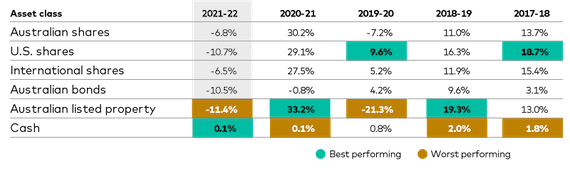
While 2021-2022 may not have been a stellar year for the majority of investors, it’s worth remembering that the worst performing asset class one year can be the best the next, and vice versa. That’s why successful investing benefits from having a good balance.

The last financial year, particularly the first half of 2022, saw a sharp rise in volatility on global investment markets.

It was hardly surprising. Stock markets, bond markets, commodities markets, and currency markets all found themselves caught up in a turbulence, shaped by a series of unsettling events.

They included the ongoing spread of COVID-19, with China forcing many of its major cities and manufacturing hubs back into lockdowns, and the start of the Russia-Ukraine war this year.

Inflation levels were already starting to rise in the second half of 2021, but the combination of these events has intensified the pressure on already strained global supply chains in 2022.

With the prices of goods and services rising at their fastest pace in decades, central banks have quickly begun raising their official interest rates in a bid to dampen demand.

Reflecting the stormy conditions – and the widespread sell-offs on financial markets over recent months – most investment asset classes recorded losses over the 12 months to 30 June.

A turbulent financial year

Australian share market

-6.8%

U.S. share market

-10.7%

International shares

-6.5%

Australian bonds

-10.5%

Australian listed property

-11.4%

Cash

0.1%

Note: Asset class percentage return calculations are based on market open levels on 1 July 2021 and closing levels on 30 June 2022 for the S&P/ASX All Ordinaries Accumulation Index. MSCI World ex-Australia Net Total Return Index. S&P 500 Total Return Index. Bloomberg AusBond Composite 0+ Yr Index. S&P/ASX 200 A-REIT Accumulation Index. Bloomberg AusBond Bank Bill Index.

Putting 2021-22 into perspective

2021-22 was anything but a stellar financial year for the majority of investors.

That’s especially the case when you compare it with 2020-21, when the Australian share market gained 30.2 per cent, the U.S. share market grew by 29.1 per cent, and international shares recorded a 27.5 per cent return.

But the last financial year wasn’t the first period where returns have been negative across most key asset classes.

Think back to the Global Financial Crisis in 2008 and 2009, when most investors recorded back-to-back negative returns.

The Australian share market fell 12.1 per cent in the 2007-08 financial year, and then by a further 22.1 per cent in 2008-09.

Over the same two-year period the U.S. share market fell 23.2 per cent and 12.4 per cent, while the returns from Australian listed property were negative 28.6 per cent and 31.2 per cent.

Then, as economies around the world emerged from the GFC, financial markets embarked on a growth spurt for the best part of the next decade.

Even in early 2020, when financial markets fell heavily as the spread of COVID sparked widespread investor panic, returns from most asset classes had started to recover by 30 June 2020.

Five years of returns

Another point to keep in mind that asset class returns vary from year to year. The best performing asset class one year can be the worst the next.

The above table has the best performing asset class for each year highlighted in green, and the worst performing in red.

In 2021-22, cash was the only asset class to deliver a positive return – albeit that after inflation, the purchasing value of cash savings declined.

In 2020-21 cash was once again the worst performing asset class.

The bottom line

Returns from asset classes are never consistent. Successful investing benefits from having a good balance.

Rather than trying to pick the winning investment each year, spreading your investments across a wide range of assets can help to reduce the risk of loss over longer periods that could occur if you had all your capital tied to just one asset class.

Investors who are well diversified tend to enjoy a smoother investment ride over the long term.

Long-term returns data also proves that time in the market will deliver consistent growth over longer periods despite periods of short-term volatility.

Making additional contributions and harnessing the power of compounding returns can make an enormous difference over time.

And it’s never too late to start doing this to give yourself the best chance of investment success.

If you would like to discuss your investment portfolio in light of recent market volatility, please call us on Phone: 07 5641 4134.

Source: Vanguard

Reproduced with permission of Vanguard Investments Australia Ltd

Vanguard Investments Australia Ltd (ABN 72 072 881 086 / AFS Licence 227263) is the product issuer. We have not taken yours and your clients’ circumstances into account when preparing this material so it may not be applicable to the particular situation you are considering. You should consider your circumstances and our Product Disclosure Statement (PDS) or Prospectus before making any investment decision. You can access our PDS or Prospectus online or by calling us. This material was prepared in good faith and we accept no liability for any errors or omissions. Past performance is not an indication of future performance.

© 2022 Vanguard Investments Australia Ltd. All rights reserved.

Important:
Any information provided by the author detailed above is separate and external to our business and our Licensee. Neither our business nor our Licensee takes any responsibility for any action or any service provided by the author. Any links have been provided with permission for information purposes only and will take you to external websites, which are not connected to our company in any way. Note: Our company does not endorse and is not responsible for the accuracy of the contents/information contained within the linked site(s) accessible from this page.

As technology creeps further into our everyday lives, cybercriminals are taking advantage of the latest that technology has to offer and carrying out increasingly sophisticated scams worth eye-watering sums.

In the 2020-21 financial year alone, individuals and businesses in Australia reported total losses of more than $33 billion. The main types of cybercrime were fraud (23 per cent), shopping (17 per cent), online banking (12 per cent) and ID theft (7 per cent); while Queenslanders were the most frequent targets, at 30 per cent of total reports.i

The federal government agency, the Australian Cyber Security Centre (ACSC) says there was an increase in the severity and impact of incidents last year with nearly half categorised as “substantial”. They are also becoming more frequent. The agency received reports of cyberattacks at a rate of about one every eight minutes during the year, up from every 10 minutes the previous year.

Business losses add up

Small to medium businesses were often in the firing line. Small businesses lost an average $8,899 each in cyber scams during the year while medium businesses lost an average $33,442 each.

One of the most significant threats is so-called ransomware, malicious software that blocks access to a computer system until money is paid. The ACSC reports a 15 per cent increase in attacks with ransom demands ranging from thousands to millions of dollars.

But it’s not only the loss of money that affects organisations. The attacks also disrupt services and can damage the reputation of a business if the cybercriminals carry out their threat to release sensitive data.

One regular scam has seen hackers gain access to a business’s email account then email the firm’s customers changing bank account details for upcoming payments. The payment redirection scams cost businesses $128 million in 2020 with small and micro businesses suffering most, according to the Australian Competition and Consumer Commission’s Scamwatch.

So how do scammers access your system?

Phishing for cash

Most often these cyber criminals begin by fishing, or ‘’phishing” for personal information. They do this through phishing emails, where the email appears to be a legitimate request for information, such as passwords or credit card information, or encourages the user to click a link to a website that installs malicious software on the computer.

These phishing attacks can also come through mobile phone messages and from apparently trusted friends, colleagues or business partners.

Another access point is via vulnerabilities in computer software. These vulnerabilities are regularly patched by the software vendors, so it is a good idea to keep on top of any software updates to keep your system more secure.

Time for action

It might be difficult to imagine that anyone would bother to attack you or your business, but it appears cybercriminals don’t discriminate when it comes to searching for victims. The ACSC notes that no one is immune from cybercrime. That includes everyone from government agencies, large organisations, critical infrastructure providers, small to medium businesses, families and individuals.

So, it’s important to take a few steps to keep you and your business as safe as possible.

The ACSC guide to protecting your business recommends improving your chances of warding off attacks by:

  • Installing the latest anti-virus software,

  • Regular back-ups of your phones and computers in case of a ransomware attack,

  • Immediately restoring data from your latest back up to minimise any losses or business disruption,

  • Thinking carefully about responding to requests for identifying information or passwords even if an email appears to be from a trusted source such as your bank.

The ACSC warns that scammers are savvy enough to perfectly reproduce bank logos and email formats. The rule of thumb is to never give out your password to anyone and to contact the organisation directly through a phone number that you source independently of the email to check the request.

That goes for an unusual payment request from a supplier too, which may be a payment redirection scam. If your supplier unexpectedly changes their bank account details or sends an invoice you did not expect, it might be worth investigating further. Cybercrime is a serious threat that can disrupt businesses and take a heavy financial and emotional toll on individuals. So call us on Phone: 07 5641 4134 to discuss any concerns you may have about securing your business and personal financial information.

i ACSC Annual Cyber Threat Report 2020-21 | Cyber.gov.au


Important: This provides general information and hasn’t taken your circumstances into account. It’s important to consider your particular circumstances before deciding what’s right for you. Although the information is from sources considered reliable, we do not guarantee that it is accurate or complete. You should not rely upon it and should seek qualified advice before making any investment decision. Except where liability under any statute cannot be excluded, we do not accept any liability (whether under contract, tort or otherwise) for any resulting loss or damage of the reader or any other person.

Any information provided by the author detailed above is separate and external to our business and our Licensee. Neither our business nor our Licensee takes any responsibility for any action or any service provided by the author. Any links have been provided with permission for information purposes only and will take you to external websites, which are not connected to our company in any way. Note: Our company does not endorse and is not responsible for the accuracy of the contents/information contained within the linked site(s) accessible from this page.

Here are five investing tips for those who are just beginning their investment journey. 

1. Evaluate where you’re at financially

Before beginning your investment journey, it’s important to sit down and map out your financial position and goals so that you know where you are and exactly what you’re working towards.

Start by looking at your savings, income, living expenses and personal debts – this will paint a clear picture of your financial position and what funds you have available to invest.

A common misconception when it comes to investing is that you need a large sum of money to start building your portfolio. Research  recently revealed that seven-in-10 Australians believed they needed more than $1,000 to start investing, while three-in-10 believed they needed more than $10,000.i Not so, you’ll be surprised to know there are investment options that start from just $500.

2. Create clear goals

It’s important to plan your goals clearly when you invest to give yourself the best chance of success.

Without a plan, it’s easy to get distracted by daily headlines or rattled by short-term share market bumps. You may end up trying to time the market, chasing unrealistic investment returns and missing out on long-term gains. Make sure your goals are clear, you have a plan and you know where you’re heading.

Write down your financial goals in weeks, months and years. Keeping your goals front of mind will help you create an investment plan and stick to it.

3. Diversify your assets

Diversification is an investment strategy that lowers your portfolio risk and helps you get more stable returns.

Diversification lowers your portfolio’s risk because different asset classes do well at different times. An important decision for every investment portfolio is how much to allocate to different types of investments. This mix of investments such as shares, bonds, property or cash is referred to as your asset allocation.

What this essentially means is that if one business or sector fails or performs badly, you won’t lose all your money. Having a variety of investments with different risks will balance out the overall risk of a portfolio.

4. Do your research

A national survey recently revealed where Australians seek their investing information. Gen Z (47%) and Millennials (36%) sought the opinion of friends and families the most, while Gen X looked to the media (21%), and social influencers (11%) for information.ii

While talking to a financial planner is the most effective way to manage your personal finances, there are other ways to do your own initial research as a jumping-off point. Beginner investors can consider reputable podcasts, seminars and investment company websites for general information.

Having the right information at hand before you begin investing will allow you to make considered decisions.

5. Keep your eyes on the prize

While it’s tempting to impulse buy a new outfit or order takeaway three times a week, make sure to exercise some financial discipline. A useful way to stay on top of your spending is to create a realistic budget. If you know you will buy a coffee every single day, add this to your budget – you need to be transparent and honest with yourself about where your money is going.

Above all, stay focused on your end goal and what you’re hoping to achieve. This will be the biggest motivating factor for you to maintain your discipline.

To discover more tips about investing – call us today on Phone: 07 5641 4134.

Source: Vanguard

i & ii- Vanguard Australia


Reproduced with permission of Vanguard Investments Australia Ltd

Vanguard Investments Australia Ltd (ABN 72 072 881 086 / AFS Licence 227263) is the product issuer. We have not taken yours and your clients’ circumstances into account when preparing this material so it may not be applicable to the particular situation you are considering. You should consider your circumstances and our Product Disclosure Statement (PDS) or Prospectus before making any investment decision. You can access our PDS or Prospectus online or by calling us. This material was prepared in good faith and we accept no liability for any errors or omissions. Past performance is not an indication of future performance.

© 2022 Vanguard Investments Australia Ltd. All rights reserved.

Important:
Any information provided by the author detailed above is separate and external to our business and our Licensee. Neither our business nor our Licensee takes any responsibility for any action or any service provided by the author. Any links have been provided with permission for information purposes only and will take you to external websites, which are not connected to our company in any way. Note: Our company does not endorse and is not responsible for the accuracy of the contents/information contained within the linked site(s) accessible from this page.

When you start a job, you can usually either choose a super fund or let your employer choose for you.

Understanding the basics can help you work out what kind of account you get and whether it’s right for you.

If you want to choose your own — or change your account — there are lots of options.

Most funds offer a simple, low-fee option, called a MySuper product. This is the default product your employer will use for you.

Types of super funds

There are two types of super funds: defined benefit funds and accumulation funds. Most super funds are accumulation funds.

Accumulation funds

In an accumulation fund, your money grows or ‘accumulates’ over time.

The value of your super depends on the money that you and your employers put in (known as super contributions), and on the investment return generated by the fund after fees and costs.

Defined benefit funds

In a defined benefit fund, your retirement benefit is determined by a formula instead of being based on investment return.

Most defined benefit funds are corporate or public sector funds. Many are now closed to new members.

Typically, your benefit is calculated using:

  • the money put in by you and your employer

  • your average salary over the last few years before you retire

  • the number of years you worked for your employer

Smart tip

If you’re thinking about leaving a defined benefit fund, get professional advice. Some funds are very generous, so make sure you’ll be better off. If you leave, you can’t rejoin.

MySuper 

MySuper is a type of product you can have with a super fund.

It’s the default product that your employer will pay your super into, unless you choose a different option.

MySuper products typically offer:

  • lower fees

  • simple features — so you don’t pay for services you don’t need

  • either a ‘single diversified’ or a ‘lifecycle’ investment option

Even if you’ve already chosen a super investment option within your existing fund, you can choose to move to a MySuper option.

Compare MySuper products

You can find out about and compare MySuper products by using:

What to do if your MySuper product is underperforming

If you have a MySuper product, your super fund must let you know if it has performed badly under an annual performance test done by the Australian Prudential Regulation Authority (APRA).

To help you make a decision about whether to switch funds and which product to switch to, you can use the ATO’s YourSuper comparison tool.

Super fund categories

Most super funds fall into one of the following categories: retail, industry, public sector or corporate.

Retail super funds

Retail funds are usually run by banks or investment companies. Anyone can join.

Main features:

  • They often have a wide range of investment options.

  • They may be recommended by a financial adviser – contact us if you’d like to find out more on Phone: 07 5641 4134.

  • Most range from medium to high cost, but many offer a low-cost or MySuper alternative.

  • The company that owns the fund may keep some profit.

Industry super funds

Anyone can join the bigger industry funds. Smaller funds may only be open to people working in a certain industry, for example, health.

Main features:

  • Most industry funds are accumulation funds. A few older industry funds still have defined benefit members.

  • They generally range from low to medium cost, and most offer MySuper products.

  • They are profit-for-member funds, which means profits are put back into the fund.

Public sector super funds

Public sector funds are for government employees.

Main features:

  • They usually have a modest range of investment choices.

  • Newer members are usually in an accumulation fund. Many long-term members have defined benefits.

  • They generally have low fees and some offer MySuper products.

  • Profits are put back into the fund.

Corporate super funds

A corporate fund is arranged by an employer for their employees.

Some large companies operate a corporate fund under a board of trustees who they appoint. Other corporate funds are operated by a retail or industry fund, but are only available to that company’s employees.

Main features:

  • Those managed by a bigger fund may offer a wider range of investment options.

  • Some older corporate funds have defined benefit members, but most others are accumulation funds.

  • They are generally low to medium cost funds for large employers, but may be high cost for small employers.

  • Corporate funds run by the employer or an industry fund will usually return all profits to members. Those run by retail funds will keep some profits.

Self-managed super funds

To weigh up the pros and cons of managing your own super fund, see self-managed super funds, or call us on Phone: 07 5641 4134.

Source:
Reproduced with the permission of ASIC’s MoneySmart Team. This article was originally published at https://moneysmart.gov.au/how-super-works/types-of-super-funds

Important note: This provides general information and hasn’t taken your circumstances into account.  It’s important to consider your particular circumstances before deciding what’s right for you. Although the information is from sources considered reliable, we do not guarantee that it is accurate or complete. You should not rely upon it and should seek qualified advice before making any investment decision. Except where liability under any statute cannot be excluded, we do not accept any liability (whether under contract, tort or otherwise) for any resulting loss or damage of the reader or any other person.  Past performance is not a reliable guide to future returns.

Important
Any information provided by the author detailed above is separate and external to our business and our Licensee. Neither our business nor our Licensee takes any responsibility for any action or any service provided by the author. Any links have been provided with permission for information purposes only and will take you to external websites, which are not connected to our company in any way. Note: Our company does not endorse and is not responsible for the accuracy of the contents/information contained within the linked site(s) accessible from this page.

Superannuation (or Super) is a percentage of your income put aside by your employer over your working life to help fund your retirement.

It’s a compulsory system in Australia that requires contributions to be made, most commonly, into either an APRA regulated retail or industry superfund (run by a board of trustees) or an ATO regulated self-managed super fund (run by the members).

Here are three more things every Australian should know about their super:

1. Super should be thought of as an investment like every other

When we talk about investing, many of us automatically think about investing individually in the share market, or perhaps investing in property.

What some might not always remember is that superannuation is an investment too. In fact, it could be one of the most important long-term investments you ever make because its purpose is to ensure you have money once you stop actively earning money.

While for APRA regulated superfunds a team of professionals are employed to invest your superannuation savings on your behalf, you do have the ability to decide on your investment strategy.

In the same way you would determine an asset allocation strategy for your individual investment portfolio, you can also do the same for your superannuation.

For example, most super funds offer a growth, balanced or conservative investment option. Similar to a diversified ETF where the mix of underlying assets is tailored to your return objectives and risk profile, super investment options do the same.

A growth superannuation option often allocates upwards of 70 per cent to growth assets like shares or property, and 30 per cent or less to fixed interest or cash. A conservative option will generally allocate 30 per cent to growth assets and the remaining 70 per cent to income assets.

2. Just like when investing in shares and bonds, keeping costs low is essential when it comes to Super

Like with every investment, the less you pay, more you get to keep and compound over time. It’s no different when it comes to super.

The easiest way to ensure you manage costs effectively is to consolidate all of your superannuation savings into the one account. This will remove any duplicate account or management and possibly insurance fees, and it makes keeping track of your super a lot easier.

Some investors also view tax as a cost. While both contributions to super and their earnings are taxed, they are done so at lower rates (15 per cent) than many investors’ marginal tax rates.

Salary earners can make additional super pre-tax contributions in lieu of take-home pay; generally known as concessional contributions or salary sacrifice contributions. These contributions (up to a cap) are again all taxed at 15 per cent, which may result in tax savings as you reduce your taxable income, and therefore potentially the income tax you pay.

3. Just because retirement is far away, doesn’t mean attention to super should wait

For younger Australians, it might seem backwards to worry about retirement income before you think about meeting other financial goals. But because compounding is so powerful, starting early gives you more flexibility later in life.

Because of this, it’s useful to remember that it’s never too early to save for retirement and that your super deserves consideration well before it’s time to retire.

This could be as easy as checking your super is being paid correctly by your employer or ensuring all your details are accurately provided to your superfund so that your contributions can be claimed (according to the ATO, there’s up to $14 billion in “lost” super because the fund can’t contact its owner).

It’s also as simple as comparing the performance and costs of different super products and funds to find the right investment option and provider for you. Recently under the government’s Your Super, Your Future reforms, superfund providers are required to conduct an annual performance test for its MySuper products to increase transparency for its members. You can read more about it here.

If you would like to learn more about your super, talk to us today on Phone: 07 5641 4134.

Source: Vanguard May 2022


Reproduced with permission of Vanguard Investments Australia Ltd

Vanguard Investments Australia Ltd (ABN 72 072 881 086 / AFS Licence 227263) is the product issuer. We have not taken yours and your clients’ circumstances into account when preparing this material so it may not be applicable to the particular situation you are considering. You should consider your circumstances and our Product Disclosure Statement (PDS) or Prospectus before making any investment decision. You can access our PDS or Prospectus online or by calling us. This material was prepared in good faith and we accept no liability for any errors or omissions. Past performance is not an indication of future performance.

© 2022 Vanguard Investments Australia Ltd. All rights reserved.

Important:
Any information provided by the author detailed above is separate and external to our business and our Licensee. Neither our business nor our Licensee takes any responsibility for any action or any service provided by the author. Any links have been provided with permission for information purposes only and will take you to external websites, which are not connected to our company in any way. Note: Our company does not endorse and is not responsible for the accuracy of the contents/information contained within the linked site(s) accessible from this page.