Be deliberate

The first step to building a sound investment portfolio is to know why you’re investing.

Setting measurable investment goals gives investors clarity and direction, and prevents them from falling into common investment traps like chasing unrealistic market returns or being overly influenced by transitory factors like product fads or short term performance.

Before you invest a single dollar, ask yourself what are your key reasons for growing your wealth – is it to fund retirement? Or perhaps work towards a house deposit? By establishing goals at the outset, investors can get a better idea of their time horizon and tolerance for risks – two important factors that contribute to developing the right asset allocation.

More is not always better

Without a plan, investors often build their portfolios from the bottom-up, focusing on each investment holding rather than the portfolio as a whole, and often lacking the diversification needed to adequately mitigate market risks.

Diversification is not necessarily about owning more securities, but rather the right mix of securities.

Investing in several bank shares instead of just one may help mitigate single security risk but concentration risk remains high given the single industry focus.

Similarly, investing solely in ASX-listed companies increases diversification across sectors but remains concentrated in the local market.

Remember, markets will often behave differently from each other—sometimes marginally, sometimes greatly—at any given time. Owning a diversified portfolio with exposure to different markets allows the investor to participate in stronger-performing areas while also mitigating the impact of weaker areas.

Focus on what you can control

Lastly, two of the most important qualities to have when it comes to investing are not the ability to pick winning stocks or to perfectly time the market, but rather the ability to maintain both discipline and perspective even when conditions get tough.

These two qualities are instrumental in helping investors remain committed to their long-term investment plan through periods of market uncertainty.

While deciding on the right asset allocation is one of the cornerstones for successful investing, it only works if the allocation is adhered to over time and through varying market environments.

This means ignoring the temptation to alter asset allocations when markets are volatile and succumb to the appeal of market-timing, even when there appears to be visible winners and losers. This is because the opportunities that are clear in retrospect are rarely visible in prospect; investors cannot control nor predict what markets will do but they can focus on their own mindset and approach.

If you are considering investing for the first time or would like to discuss your current investment portfolio, please call us on Phone: 07 5641 4134.

Source: Vanguard

Reproduced with permission of Vanguard Investments Australia Ltd

Vanguard Investments Australia Ltd (ABN 72 072 881 086 / AFS Licence 227263) is the product issuer. We have not taken yours and your clients’ circumstances into account when preparing this material so it may not be applicable to the particular situation you are considering. You should consider your circumstances and our Product Disclosure Statement (PDS) or Prospectus before making any investment decision. You can access our PDS or Prospectus online or by calling us. This material was prepared in good faith and we accept no liability for any errors or omissions. Past performance is not an indication of future performance.

© 2022 Vanguard Investments Australia Ltd. All rights reserved.

Important:
Any information provided by the author detailed above is separate and external to our business and our Licensee. Neither our business nor our Licensee takes any responsibility for any action or any service provided by the author. Any links have been provided with permission for information purposes only and will take you to external websites, which are not connected to our company in any way. Note: Our company does not endorse and is not responsible for the accuracy of the contents/information contained within the linked site(s) accessible from this page.


Education is the gift that keeps on giving. If you are considering a private school this article is for you as we discuss how to save for your child’s education.

Education is the gift that parents can give their children that keeps on giving.

But if you are considering private schools it is a gift that comes with a significant – and usually rising – bill attached.

Cue visions of stately buildings, sweeping playing fields, uniformed students—and steadily rising school fees.

One in three Australian children attend a non-government school1 and education is the second largest expense for many families, with some spending a third of their household budget on school fees2. Private school education costs are outpacing both inflation and wages growth3.

A cursory internet search found that a private school in New South Wales charges almost $37,000 a year for a year 12 place.

And even if you were sending your child to a public school, fees aren’t the only thing you need to plan for. Other items to consider include is the cost of textbooks, contributions to the increasingly prevalent compulsory laptop program, school uniforms and an endless list of ‘back to school’ items you’ve never heard of.

So savvy parents start planning early. But what’s the best way to save for your children’s education? And how can you avoid the trap of redrawing your mortgage, or worse?

The first step to successfully funding your children’s education expenses is planning.

And the first question to ask is – how much will you need?

The costs of education vary dramatically depending on both your choice of school and how early you choose a fee-paying school. There is an enormous difference between sending a child to a private school from kindergarten and going private for high school only. Some schools also offer day-care and pre-school places, potentially adding up to five extra years of fees.

Once you understand how much you need, the next question is how long you have—and how much you can add to your savings pool as you go. The longer the time frame before school fees become due, the more time there is to invest and compound your earnings. The more you can save along the way, the faster you will reach your goal.

It’s also important to think about your risk tolerance as higher returns are possible only with higher risk.

The next step is to select an appropriate savings vehicle for your money.

There are three basic ways to hold and grow the money you save for your children’s education: you can save regular amounts into a bank account, but given record low interest rates that is looking less attractive, you could build an investment portfolio – a basket of shares for example – or buy a managed fund or a more specialised product like an investment bond.

Saving your money in the bank might seem the safest option, but with school fee growth outpacing inflation it can actually mean you go backwards. Still, it remains a good option if your timeframe is tight or your risk tolerance low.

For people paying off a mortgage it can make sense to use an offset account to park savings. An offset account effectively earns interest at an equivalent rate to your mortgage. You can then redraw the funds when it is time to pay the school fees.

Managed investment schemes are another option for growing your savings over the years before school begins. Many people opt for making regular contributions to managed funds) or exchange traded funds allowing their savings to compound over time.

Managed investments can be terrific for providing diversification, which can reduce your risk of capital loss by spreading your investments over different asset classes and over hundreds or thousands of individual investments. They also come with the flexibility of withdrawing fund whenever you need them.

But as with every investment, do your research as some of these products come at a high cost, with fees varying wildly.

Investment bonds are another option for saving but they are a peculiar beast so extra research may be required to understand what you are investing in and any specific restrictions or conditions.

As you make these decisions, keep two principles in mind—watch your costs and stay the course.

Remember that lower-cost investments usually outperform their higher-cost counterparts4, and starting early will give you – and your children – the best chance of success.

Contact us today if you would like to work out a strategy to help save for your child’s education. Call us on Phone: 07 5641 4134.

1 https:https://intl.assets.vgdynamic.info/intl/australia//www.abs.gov.au/ausstats/
2 https://edstart.com.au/blog/record-low-wage-growth-impact-on-family-budget-and-school-fees/
3 https://edstart.com.au/report
4 https://personal.vanguard.com/pdf/ISGSFA.pdf

Source: Vanguard

Reproduced with permission of Vanguard Investments Australia Ltd

Vanguard Investments Australia Ltd (ABN 72 072 881 086 / AFS Licence 227263) is the product issuer. We have not taken yours and your clients’ circumstances into account when preparing this material so it may not be applicable to the particular situation you are considering. You should consider your circumstances and our Product Disclosure Statement (PDS) or Prospectus before making any investment decision. You can access our PDS or Prospectus online or by calling us. This material was prepared in good faith and we accept no liability for any errors or omissions. Past performance is not an indication of future performance.

© 2022 Vanguard Investments Australia Ltd. All rights reserved.

Important:
Any information provided by the author detailed above is separate and external to our business and our Licensee. Neither our business nor our Licensee takes any responsibility for any action or any service provided by the author. Any links have been provided with permission for information purposes only and will take you to external websites, which are not connected to our company in any way. Note: Our company does not endorse and is not responsible for the accuracy of the contents/information contained within the linked site(s) accessible from this page.

Given the inherent volatility of security prices in capital markets, it is useful to remind ourselves of strategies that investors can utilise to meet their investment goals. This is important when constructing and positioning a diversified portfolio of assets, a challenge that most financial advisers face daily. Reminding ourselves of the fundamentals of portfolio construction can help investors position portfolios appropriately in times of crisis and volatility.

Exploit a long-run time horizon

Investors with a long horizon do not need short-term liquidity, giving them an edge during market sell-offs. As markets fall, long-run investors have often generated excellent returns by buying quality distressed assets across major asset classes.

Additionally, if the market rewards illiquid assets with a higher risk premium, it makes sense that investors over-allocate to such assets, as it is unlikely that they will need to sell during bouts of market volatility. Pockets of traditional asset classes like corporate bonds, small-cap equity, and emerging market equity offer the opportunity for long-run investors to generate superior returns over time.

Whilst many would like to describe themselves as long-term investors, this time horizon can shorten very quickly. During financial and economic turmoil, both institutional and individual investment horizons tend to shorten due to immediate cash flow needs or because of psychological factors. The last thing that any investor wants to do is sell an asset into a volatile and illiquid market, where bid–offer spreads can widen materially, and asset prices can fall well below fair value.

The free lunch

Diversification is the rare free lunch available for all investors: it can reduce portfolio volatility without reducing its return. A key challenge to achieving diversification is reducing the dominance of equity risk in a balanced portfolio. Even if diversification tends to fail in crises (as correlations spike across asset classes), it can still be useful in the long run. This matters more for long-run investors who face less liquidation pressure during market drawdowns.

Most portfolios have positive exposures to the equity market and to economic growth. This directional risk is difficult to diversify away, making those assets with a negative correlation to equities a valuable addition. Despite yields being at all-time lows, cash and high-quality government bonds and gold can play an important role to play in most portfolios.

Diversification, of course, has limitations, one of which is the tendency for correlations to approach one during crises. Many good fund managers distinguish themselves by managing downside risk instead of just relying on diversification. A strong risk management framework and avoidance of large drawdowns is key in generating good long-run compounded returns.

Risk-free is return-free

Developed market central banks have taken the actions that they have with a defined monetary policy transmission mechanism in mind. One of the channels of monetary policy is the asset prices and wealth channel, with lower interest rates and quantitative easing expected to spur demand for higher risk assets. Risk-free assets like cash and government bonds no longer generate a positive inflation-adjusted yield and are return-free. Long-run investors can position for ‘the portfolio rebalancing effect’ that is likely to dominate investment flows in the next decade.

Expected portfolio returns can be improved by increasing the weight of the most volatile asset class. The classic approach is to raise the weight of ‘high-risk, high-return’ equities and reduce the weight of ‘low-risk, low-return’ assets such as cash and government bonds. Taking more risk in this way, and getting rewarded for it, is an easy way to boost long-run returns for investors.

Minimising costs can come at a cost

Passive investing minimises trading costs. However, some costs are worth paying. For example, buying an equity index fund costs more than investing in a bank deposit, but the equity risk premium should make the cost worthwhile in the long run. In general, investors should allocate more to active products the less they believe in market efficiency. Minimising costs is not always smart; being cost-effective and avoiding wasteful expense is.

The importance of being selective

Market outperformance – through the compounding of returns – can help investors increase their ability to achieve their financial goals. Excess returns can be an important driver of wealth creation, and actively managed funds offer the opportunity to outperform the market. Even seemingly small amounts of excess return can lead to significantly better outcomes.

Over the intermediate term, asset performance is often driven largely by cyclical factors tied to the state of the economy, such as corporate earnings, interest rates, and inflation. The business cycle, which encompasses the cyclical fluctuations in an economy over many months or a few years, can, therefore, be a critical determinant of market returns.

As volatility is ever-present in capital markets, protection in the form of safe-haven assets and portfolio diversification will be increasingly important for investors. However, investors must now acknowledge that returns from defensive assets will likely be far less than historic averages. Due to central bank action, riskier asset classes like equities appear likely to attract increasing inflows over the coming decade. The traditional methods of portfolio construction – a long-run horizon, diversification, cost-control, and active investing – remain the best approach to generating sustainable long-run returns.

To find out more about diversifying your investments, please call us on Phone: 07 5641 4134.

Source:
Reproduced with permission of Fidelity Australia. This article was originally published at https://www.fidelity.com.au/insights/investment-articles/strategies-for-long-term-investing/

This document has been prepared without taking into account your objectives, financial situation or needs. You should consider these matters before acting on the information. You should also consider the relevant Product Disclosure Statements (“PDS”) for any Fidelity Australia product mentioned in this document before making any decision about whether to acquire the product. The PDS can be obtained by contacting Fidelity Australia on 1800 119 270 or by downloading it from our website at www.fidelity.com.au. This document may include general commentary on market activity, sector trends or other broad-based economic or political conditions that should not be taken as investment advice. Information stated herein about specific securities is subject to change. Any reference to specific securities should not be taken as a recommendation to buy, sell or hold these securities. While the information contained in this document has been prepared with reasonable care, no responsibility or liability is accepted for any errors or omissions or misstatements however caused. This document is intended as general information only. The document may not be reproduced or transmitted without prior written permission of Fidelity Australia. The issuer of Fidelity Australia’s managed investment schemes is FIL Responsible Entity (Australia) Limited ABN 33 148 059 009. Reference to ($) are in Australian dollars unless stated otherwise.
© 2022. FIL Responsible Entity (Australia) Limited.

Important:
This provides general information and hasn’t taken your circumstances into account. It’s important to consider your particular circumstances before deciding what’s right for you. Any information provided by the author detailed above is separate and external to our business and our Licensee. Neither our business nor our Licensee takes any responsibility for any action or any service provided by the author. Any links have been provided with permission for information purposes only and will take you to external websites, which are not connected to our company in any way. Note: Our company does not endorse and is not responsible for the accuracy of the contents/information contained within the linked site(s) accessible from this page.
 

Working out how much you need to save for retirement is a question that keeps many pre-retirees awake at night. Recent market volatility and fluctuating superannuation balances have only added to the uncertainty.

So it’s timely that new research shows you may need less than you fear. For most people, it will certainly be less than the figure of $1 million or more that is often bandied around.

For most people, the amount you need to save will depend on how much you wish to spend in retirement to maintain your current standard of living. One way of doing that is to look at how much you spend now.

When Super Consumers Australia (SCA) recently set about designing retirement savings targets they started by looking at what pre-retirees aged 55 to 59 are actually spending.

Retirement savings targets

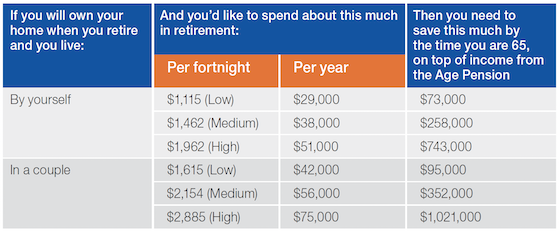
As you can see in the table below, SCA estimated retirement savings targets for three levels of spending – low, medium and high – for recently retired singles and couples aged 65 to 69.

Significantly, only so-called high spending couples who want to spend at least $75,000 a year would need to save more than $1 million. A couple hoping to spend $56,000 a year would need to save $352,000. High spending singles would need $743,000 to cover spending of $51,000 a year, and $258,000 for medium annual spending of $38,000.i

Table: Savings targets for current retirees (aged 65-69)


Source: Super Consumers Australia

While these savings targets are based on what people actually spend, there is a buffer built in to provide confidence that your savings can weather periods of market volatility and won’t run out before you reach age 90.

They assume you own your home outright and will be eligible for the Age Pension (which is reflected in the relatively low savings targets for all but wealthier retirees), and also make assumptions about future inflation and investment returns.*

Retirement planning rules of thumb

The SCA research is the latest attempt at a retirement planning ‘rule of thumb’. Rules of thumb are popular shortcuts that give a best estimate of what tends to work for most people, based on practical experience and population averages.

These tend to fall into two camps:

  • A target replacement rate for retirement income. This approach assumes most people want to continue the standard of living they are used to, so it takes pre-retirement income as a starting point. Once you have an income target you can work out the savings required to generate that level of income for the time you expect to spend in retirement. The government’s 2020 Retirement Income Review suggests a target replacement range of 65-75 per cent of pre-retirement income would be appropriate for most Australians.ii

  • Budget standards. This approach estimates the cost of a basket of goods and services likely to provide a given standard of living in retirement. The best-known example in Australia is the ASFA Retirement Standard which provides ‘modest’ and ‘comfortable’ budget estimates updated quarterly for changes in the cost of living.

SCA sits somewhere between the two, offering three levels of spending to ASFA’s two, based on pre-retirement spending rather than a basket of goods. Interestingly, the results are similar with ASFAs ‘comfortable’ budget falling between SCA’s medium and high targets.

ASFA estimates a single retiree will need to save $545,000 to live comfortably on annual income of $46,494 a year, while retired couples will need $640,000 to generate annual income of $65,445. This also assumes you own your home outright and will be eligible for the Age Pension.

Limitations of shortcuts

You may think these spending levels and targets are too low, or out of reach, depending on your personal circumstances and retirement goals. You may also query some of the underlying assumptions, especially if you rent or don’t own your home outright and expect to retire with a mortgage or other debts.

The big unknown is how long you will live. If you’re healthy and have good genes, you might expect to live well into your 90s which may require a bigger nest egg.

If for whatever reason you think your super nest egg is too small for comfort, it’s never too late to give it a boost. You could:

  • Ask your employer to put a salary sacrifice arrangement in place or make a personal super contribution and claim a tax deduction, being mindful to stay within the annual concessional contributions cap of $27,500.iii

  • Make an after-tax super contribution of up to the annual limit of $110,000, or up to $330,000 using the bring-forward rule.iv

  • Downsize your home and put up to $300,000 of the proceeds into your super fund (up to $600,000 for couples).v

Thanks to new rules that came into force on July 1, you may be able to add to your super up to age 75 even if you’re no longer working. As with everything to do with super, strict rules and eligibility hurdles apply so ask us about the most appropriate strategies for your situation.

While retirement planning rules of thumb are a useful starting point, they are no substitute for a personal plan. If you would like to discuss your retirement income strategy, give us a call on Phone: 07 5641 4134.

*Assumptions include average annual inflation of 2.5% in future, which is the average rate over the past 20 years, and average annual returns net of fees and taxes of 5.6% in retirement phase and 5% in accumulation phase.

i https://www.superconsumers.com.au/retirement-targets

ii https://treasury.gov.au/publication/p2020-100554

iii https://www.ato.gov.au/individuals/super/in-detail/growing-your-super/super-contributions—too-much-can-mean-extra-tax/

iv https://www.ato.gov.au/individuals/super/in-detail/growing-your-super/super-contributions—too-much-can-mean-extra-tax/?page=5

v https://www.ato.gov.au/individuals/super/growing-your-super/adding-to-your-super/downsizing-contributions-into-superannuation/

Important: This provides general information and hasn’t taken your circumstances into account. It’s important to consider your particular circumstances before deciding what’s right for you. Although the information is from sources considered reliable, we do not guarantee that it is accurate or complete. You should not rely upon it and should seek qualified advice before making any investment decision. Except where liability under any statute cannot be excluded, we do not accept any liability (whether under contract, tort or otherwise) for any resulting loss or damage of the reader or any other person. 

Any information provided by the author detailed above is separate and external to our business and our Licensee. Neither our business nor our Licensee takes any responsibility for any action or any service provided by the author. Any links have been provided with permission for information purposes only and will take you to external websites, which are not connected to our company in any way. Note: Our company does not endorse and is not responsible for the accuracy of the contents/information contained within the linked site(s) accessible from this page.

Despite much talk of rising interest rates and possible recession, here are a few reasons to stay the course and stick to your long-term investment strategy.

There has been much discussion of rising interest rates, recent inflation spikes and ongoing market volatility impacting investment and super balances. Add to that the increased chatter about the possibility of Australia falling into a recession and things certainly aren’t looking too hopeful for investors at present.

But before you start panicking and thinking about whether you should adjust your portfolio to weather a possible recession, here are a few reasons to stay the course and stick to your long-term investment strategy.

Firstly, a recession is often defined as two consecutive quarters of GDP contraction, and while there is indeed a more meaningful risk of recession emerging, particularly in Europe, modelling has estimated the chances of this happening at around 35% over the next 12 months in Australia, and 45% over the next 24 months, which is to say, it is not our base case scenario.

The Australian economy continues to grow, supported by low unemployment and robust household spending. Australia is also benefiting from high global energy prices, given our status as a net exporter of energy-related commodities such as coal. As interest rates rise at home and abroad, we expect economic growth to soften, however, it should not be sufficient to trigger a recession.

Secondly, thanks to the contraction in both fixed income and equity markets earlier this year, equities previously perceived to be overvalued are now at a fairer price. In addition, current market valuations and higher interest rates mean our analysis is forecasting slightly higher returns in financial markets over the long-term, in comparison to previous projections. Our 10-year annualised return forecasts for global equity markets are largely 1.5 percentage points higher than at the end of 2021, while our fixed income return forecasts in many regions are 1.5 percentage points higher. This spells good news for both equity and fixed income investors who have the discipline to stay invested and focussed on long-term objectives.

Also, while the turbulence in the share markets has somewhat petered out, investors should recognise that the volatility experienced this year is far from unusual. Rather, it is a factor that tends to spike when equity markets undergo a severe contraction. That said, the inevitable troughs that investors will experience over time often give way to higher peaks.

Thirdly, while there is no guarantee Australia will avoid a recession, investors could perhaps look to the past to help calm their nerves. Analysis using US stock market data over the last 48 years found that share markets tend to recover soon after recessions started. The earliest recovery began a mere two months after the COVID-induced economic downturn in 2020, while the recovery after the 2007-2009 Global Financial Crisis commenced 16 months into that recession.

If you’re still dreading the thought of suffering further losses in anticipation of a possible recession and resolute about moving your investments to cash, consider this final point – Vanguard analysis has found that selling down during past recessions has proved to be a costly mistake for many investors. Those investors locked in their losses permanently because they were out of the market at the wrong time and thus weren’t able to benefit when it rose again.

All this to say, regardless of whether Australia – or any other country or region – goes into a recession, investors should tune out the noise and not use today’s headlines to make short-term decisions for an investment portfolio with a long-term time horizon. Afterall, there’s been little evidence that timing the market delivers rewards. If anything, it has been quite the opposite.

If you have concerns about the current share market and how it affects your portfolio, please call us on Phone: 07 5641 4134.

Source: Vanguard

Reproduced with permission of Vanguard Investments Australia Ltd

Vanguard Investments Australia Ltd (ABN 72 072 881 086 / AFS Licence 227263) is the product issuer. We have not taken yours and your clients’ circumstances into account when preparing this material so it may not be applicable to the particular situation you are considering. You should consider your circumstances and our Product Disclosure Statement (PDS) or Prospectus before making any investment decision. You can access our PDS or Prospectus online or by calling us. This material was prepared in good faith and we accept no liability for any errors or omissions. Past performance is not an indication of future performance.

© 2022 Vanguard Investments Australia Ltd. All rights reserved.

Important:
Any information provided by the author detailed above is separate and external to our business and our Licensee. Neither our business nor our Licensee takes any responsibility for any action or any service provided by the author. Any links have been provided with permission for information purposes only and will take you to external websites, which are not connected to our company in any way. Note: Our company does not endorse and is not responsible for the accuracy of the contents/information contained within the linked site(s) accessible from this page.

With interest rates on the rise and investment returns increasingly volatile, Australians with cash to spare may be wondering how to make the most of it. If you have a mortgage, should you make extra repayments or would you be better off in the long run boosting your super?

The answer is, it depends. Your personal circumstances, interest rates, tax and the investment outlook all need to be taken into consideration.

What to consider

Some of the things you need to weigh up before committing your hard-earned cash include:

Your age and years to retirement

The closer you are to retirement and the smaller your mortgage, the more sense it makes to prioritise super. Younger people with a big mortgage, dependent children, and decades until they can access their super have more incentive to pay down housing debt, perhaps building up investments outside super they can access if necessary.

Your mortgage interest rate

This will depend on whether you have a fixed or variable rate, but both are on the rise. As a guide, the average variable mortgage interest rate is currently around 4.5 per cent so any money directed to your mortgage earns an effective return of 4.5 per cent.i

When interest rates were at historic lows, you could earn better returns from super and other investments; but with interest rates rising, the pendulum is swinging back towards repaying the mortgage. The earlier in the term of your loan you make extra repayments, the bigger the savings over the life of the loan. The question then is the amount you can save on your mortgage compared to your potential earnings if you invest in super.

Super fund returns

In the 10 years to 30 June 2022, super funds returned 8.1 per cent a year on average but fell 3.3 per cent in the final 12 months.ii In the short-term, financial markets can be volatile but the longer your investment horizon the more time there is to ride out market fluctuations. As your money is locked away until you retire, the combination of time, compound interest and concessional tax rates make super an attractive investment for retirement savings.

Tax

Super is a concessionally taxed retirement savings vehicle, with tax on investment earnings of 15 per cent compared with tax at your marginal rate on investments outside super.

Contributions are taxed at 15 per cent going in, but this is likely to be less than your marginal tax rate if you salary sacrifice into super from your pre-tax income. You may even be able to claim a tax deduction for personal contributions you make up to your annual cap. Once you turn 60 and retire, income from super is generally tax free. By comparison, mortgage interest payments are not tax-deductible.

Personal sense of security

For many people there is an enormous sense of relief and security that comes with having a home fully paid for and being debt-free heading into retirement. As mortgage interest payments are not tax deductible for the family home (as opposed to investment properties), younger borrowers are often encouraged to pay off their mortgage as quickly as possible. But for those close to retirement, it may make sense to put extra savings into super and use their super to repay any outstanding mortgage debt after they retire.

These days, more people are entering retirement with mortgage debt. So whatever your age, your decision will also depend on the size of your outstanding home loan and your super balance. If your mortgage is a major burden, or you have other outstanding debts, then debt repayment is likely a priority.

Older couple nearing retirement

Tony and Elena, both 60, would like to retire in the next few years. Together they earn $180,000 a year, excluding super, but they still have $100,000 remaining on their mortgage. Tony has a super balance of $600,000 and Elena has $200,000.

They want to be debt free by the time they retire but they are also worried they won’t have enough super to afford the lifestyle they look forward to in retirement.

If they do nothing, at a mortgage interest rate of 4.5 per cent it will take five years to repay their mortgage with monthly mortgage payments of $1,864. At age 65, their combined super balance will be a projected $1,019,395.

Jolted into action, they decide they can afford to put an extra $1,000 a month into their mortgage or super.

  • If they increase their mortgage payments by $1,000 a month, the loan will be repaid in three years and two months. But their super will only be a projected $931,665 by then, so they may need to work a little longer to fund a comfortable retirement. From age 63, they might consider salary sacrificing into super with money freed up from early repayment of their mortgage.

  • If they salary sacrifice $1,000 a month to super from age 60, their combined super balance will grow to a projected $1,082,225 by the time they are 65 and their home is fully paid for.

These are complex decisions, but whichever option they choose they will probably need to consider working until at least age 65 to be debt free and build their super.

All calculations based on the MoneySmart mortgage and retirement planner calculators.

All things considered

As you can see, working out how to get the most out of your savings is rarely simple and the calculations will be different for everyone. The best course of action will ultimately depend on your personal and financial goals.

Buying a home and saving for retirement are both long-term financial commitments that require regular review. If you would like to discuss your overall investment strategy, give us a call.

i https://www.finder.com.au/the-average-home-loan-interest-rate

ii https://www.chantwest.com.au/resources/super-members-spared-the-worst-in-a-rough-year-for-markets/

Important: This provides general information and hasn’t taken your circumstances into account. It’s important to consider your particular circumstances before deciding what’s right for you. Although the information is from sources considered reliable, we do not guarantee that it is accurate or complete. You should not rely upon it and should seek qualified advice before making any investment decision. Except where liability under any statute cannot be excluded, we do not accept any liability (whether under contract, tort or otherwise) for any resulting loss or damage of the reader or any other person.

Any information provided by the author detailed above is separate and external to our business and our Licensee. Neither our business nor our Licensee takes any responsibility for any action or any service provided by the author. Any links have been provided with permission for information purposes only and will take you to external websites, which are not connected to our company in any way. Note: Our company does not endorse and is not responsible for the accuracy of the contents/information contained within the linked site(s) accessible from this page.

While you may not need a six-figure salary to invest in property, those who earn a relatively low income will require a little more creative thinking to start a portfolio. Here are some tips to help you get started.

Find an investor-friendly loan

The challenge for low-income earners is the time it takes to save for a sufficient deposit. Some lenders require a higher deposit for an investor than is required for an owner-occupier, so seek out a lender and loan that is investor friendly, or consider living in the property for a period after the purchase before converting it into an investment property as your portfolio grows.

In any case, having at least 10% of the property’s purchase price as a deposit will not only increase the likelihood of loan approval, it will also increase your borrowing capacity.

Prove your financial discipline

Your lower income on an application can be offset by proving yourself a low risk borrower. Having genuine savings will not only highlight to lenders your ability to consistently meet financial payments and live within your means, it is also an opportunity to increase your borrowing power. 

The same can be said for lowering any existing debts. Keep credit card limits as low as possible as lenders always calculate servicing based on the limit, not the balance and try to pay off any personal or car loans before applying for an investment loan. Because of the short-term nature of these commitments, repayments can have a significant impact on an applicant’s borrowing power and should be paid out where possible.

Choose the right property

When it comes to choosing the property, low-income earners will generally do well to steer clear of anything that’s negatively geared, as you are not trying to offset your high income with losses, and remember the importance of profit over property.

Seek out different strategies

For those who don’t have other non-deductible debt they want to pay down first, adopting a principle and interest payment is the obvious choice. Interest-only loans are only suitable in specific circumstances when strong exit plans are in place, while principle and interest payments reduce debt, freeing up borrowing capacity and allowing the borrower to leverage equity.

Investing with a close friend or relative is another way to enter the market for those who earn a low income. As long as agreements are in place, including who is responsible for the mortgage and what happens if one owner defaults, how the property will be used, in what circumstances it may be sold, and how maintenance will be paid for.

Find the right loan

Recent research suggests that as many as 60% of applicants who are rejected by the major banks would be eligible for a loan through a specialist lender. As a rule, specialist or non-conforming loans do carry higher interest rate to account for the higher perceived risk the lender is taking, but a good finance broker will see this type of loan as a stepping-stone to a prime loan, and help their client prove themselves so that they can switch to a prime loan when they meet the conditions.

Property investment may not be as straightforward for low-income earners, but provided the right properties and finance products are sought out it can be possible. For further insight, speak to us today on Phone: 07 5641 4134.

Source: MFAA

Reproduced with the permission of the Mortgage and Finance Association of Australia (MFAA)

Important:
This provides general information and hasn’t taken your circumstances into account.  It’s important to consider your particular circumstances before deciding what’s right for you. Although the information is from sources considered reliable, we do not guarantee that it is accurate or complete. You should not rely upon it and should seek qualified advice before making any investment decision. Except where liability under any statute cannot be excluded, we do not accept any liability (whether under contract, tort or otherwise) for any resulting loss or damage of the reader or any other person.  Past performance is not a reliable guide to future returns.

Any information provided by the author detailed above is separate and external to our business and our Licensee. Neither our business nor our Licensee takes any responsibility for any action or any service provided by the author.

Any links have been provided with permission for information purposes only and will take you to external websites, which are not connected to our company in any way. Note: Our company does not endorse and is not responsible for the accuracy of the contents/information contained within the linked site(s) accessible from this page.

Having a career is so much more than making a living. It is immeasurably life enhancing to be doing something you enjoy and to feel a sense of progression as you develop in your chosen career. But developing and maintaining a satisfying career does not just happen, it takes work but the good news is you are in control of the process and can act as your own ‘career coach’ to lift your game.

And many of us do need to lift our game as far as our careers are concerned. Job satisfaction seems to be a precious commodity at present amongst Australian workers. In fact, when respondents to a survey run by godaddy.com.au were asked to describe how they feel about their current role, only 51% said they either love it or like iti. That means for around half of us there is a lot of room for improvement. Even if you are satisfied with your current role for now, in an environment of constant change and complexity it’s always a good idea to take steps to be more active and in control of your career.

It’s estimated that the average person changes jobs 12 times in their lifetime and the main reason for a shift is career progressionii. In order to achieve long lasting satisfaction with our career choices it’s important to feel a sense of progression and that’s where career coaching comes in.

Lifting your game

A whole industry has grown up around career coaching, where you engage the services of a professional to help you progress to the next level and “lift your game”. While we may be talking about your performance in the boardroom rather than the sports field, sports and career coaches similarly enable the people they support and work with to elevate their capabilities.

Engaging a career coach is not for everybody. Not everyone has the means or the desire to get expert help, but there are a few things we can learn from the experts that can be applied to your own career to get you out of that rut or jump to the next challenge.

Self-reflection is key

The first step is reflection – to develop self-awareness of your strengths and your weaknesses and understand how others perceive you. Be a little ruthless in your self-examination and realistic about what you have to offer, as well as the areas you have to work on. It can help to frame “weaknesses” as “opportunities” – just be sure that addressing those opportunities will advance your career.

Open questioning

The experts in this field use questioning as a tool to encourage self-reflection and the most effective form of questioning is to keep things open ended. For example, instead of asking “do I like this job?”, try asking “what do I most like about this job?” Here are a few useful open-ended questions to get you started;

  • What gives me the most energy at work?

  • How do I improve the feedback I receive?

  • When do my internal doubts hold me back?

  • How can I accelerate my career progression?

Set career goals

That old dinosaur that’s dragged out in job interviews “where do you want to be in 5 years?” has some validity when it comes to your career aspirations. The first step towards finding your destination is deciding what it is. Think about the short-term (i.e. a year) as well as the longer term (i.e. 5-10 years).

Then once you have a destination (or series of destinations) in mind, you need to put some steps in place to achieve your goals and make and protect the necessary time to work on the steps that support your career aspirations.

Get help

Even if you are comfortable being your own career coach, you don’t have to go it alone. Identify when you are at a point where you need a hand and reach out, whether that means learning additional skills and accessing further education or seeking out advice. Help can also be in the form of a mentor or even a good friend in a similar field who can act as a sounding board and source of encouragement.

There is a saying “chose a job you love, and you’ll never have to work a day in your life”. Achieving a challenging and fulfilling career takes work and ideally is an ongoing process but given the importance of our jobs in our lives, any time and effort you can spend advancing your career is going to be very well spent.

i https://au.godaddy.com/blog/australians-report-on-job-satisfaction-in-new-survey-from-godaddy/

ii https://www.zippia.com/advice/average-number-jobs-in-lifetime/

As the days get longer and we understand more about how the outlook for interest rates and the property market are shaping up, it’s the perfect time to pull back the curtains to give your home loan and general finances a thorough spring clean. You’ll then be in a better position to stay on top of your finances and property dreams.

Compare the current rates

You may have noticed that your home loan repayments have probably risen or will rise once your fixed-rate term ends, and you may be understandably nervous about how high they might go.

The most important thing to remember is that when you took out a mortgage, your repayment ability was measured to at least 2-3% above the default product rate (depending on when you took out the loan), with many brokers and lenders stress testing to 5%.

This means that unless your income has dramatically reduced, you are probably still able to service today’s rates, especially since they are rising from an all-time low. But to be sure, let’s start by checking that your current mortgage rate and structure is still the best fit for you.

Spruce up your mortgage rate

To assess your current mortgage, you first need to compare your interest rate against those currently on offer. This can be trickier than it looks, as mortgage benefits and discounts can differ widely, with your rate depending on the type of mortgage you have as well as your lender.

It is also wise to check your loan type – fixed, variable or mixed – and assess if it is still best for you going forward. We can help ensure you’re comparing apples with apples through our comprehensive data base that includes broker-only and up-coming offers. We can also give you a guide on how much your repayments are likely to rise with different rate rises and on different loan structures. If you are considering refinancing your mortgage, don’t forget that you’ll need to factor in any re-mortgaging costs when deciding if changing your mortgage is worthwhile.

Decluttering your finances

Whether you already have a mortgage or are hoping to buy your first property, you need to look at your whole budget and identify the monthly mortgage repayment level, that will tip you into tightening your financial belt and possibly mortgage stress.

Knowing where you stand and what the future may look like, should help you feel more in control and allow you to plan for the months ahead.

There are a lot of free budget templates online, including this MoneySmart one that makes it easy to include all your expenses. Don’t forget that annual payments like home insurance as well as quarterly utilities may be substantially higher the next time you receive a bill.

Plan ahead

Building a buffer or emergency fund can assist with not only unexpected expenses but provide you with some breathing room should rates continue to increase. Many people are deciding to build a financial buffer by cutting back on their discretionary spending before it’s really necessary, reducing items like TV subscriptions and meal deliveries. And don’t forget that if you’ve got an offset account, maintaining, or building your savings can reduce your monthly interest payments.

If your finances are stretched, you could also consider moving to interest only payments for a time or contacting your lender for a repayment ‘holiday’. Just be aware of how much extra interest you will be accruing. We can let you know what options your lender offers before you apply.

If you’re saving for a deposit or want to buy an investment property, you’ll need to check that you’re still on track for achieving your goals. Changing interest rate rises will impact the amount lenders will offer you, so you may need adjust your expectations as to what you can realistically afford. This includes the price of properties, as they may have gone up or down and you may need to adjust your expectations or timeline.

If you have any questions about managing rising interest rates or want some help giving your mortgage a spring clean, please give us a call on Phone: 07 5641 4134.

Important: This provides general information and hasn’t taken your circumstances into account.  It’s important to consider your particular circumstances before deciding what’s right for you. Although the information is from sources considered reliable, we do not guarantee that it is accurate or complete. You should not rely upon it and should seek qualified advice before making any investment decision. Except where liability under any statute cannot be excluded, we do not accept any liability (whether under contract, tort or otherwise) for any resulting loss or damage of the reader or any other person.  Past performance is not a reliable guide to future returns.

Any information provided by the author detailed above is separate and external to our business and our Licensee. Neither our business nor our Licensee takes any responsibility for any action or any service provided by the author. Any links have been provided with permission for information purposes only and will take you to external websites, which are not connected to our company in any way. Note: Our company does not endorse and is not responsible for the accuracy of the contents/information contained within the linked site(s) accessible from this page.

Investing on behalf of your children can give them a great financial head start in life. And the earlier you can begin, the higher the potential financial rewards for them in the longer term.

The combination of regular ongoing contributions and compounding investment returns can add up to a decent chunk of money for buying a first car, funding a university gap year, or even a sizeable first-home deposit down the track.

But where should you start off, and what are the things you need to consider?

Create a plan

Before doing anything, you need to make sure you have a realistic investment plan.

Which is all about deciding what makes the most sense in terms of your family’s overall financial budget.

That includes determining what you can afford to invest initially, and how much you can afford to contribute on an ongoing basis.

For example, you may have $1,000 to invest as a starting amount and can afford to make additional contributions of $100 a month or quarter.

While your financial circumstances are likely to change over time, it’s important to at least have mapped out a strategy that makes sense financially and that ideally can be followed for years.

That will give your children the best chance for long-term investment success.

Decide on how

Investing for children can be done on their behalf using a minor’s account where the investment is held in an adult’s name as trustee (and the child is listed as a beneficiary).

Parents will essentially be custodians for the investments until the child turns 18. They can then be transferred from the parent across to their adult child.

It may be worth seeking some professional advice on what structure will work best for your family, especially in regard to ongoing tax on income and future capital gains tax.

Unless a tax file number is quoted, pay as you go (PAYG) tax will be withheld at 47 per cent from the unfranked amount of any dividend income earned.

Also keep in mind that if a minor owns shares and currently earns more than $416 a year, a parent must lodge a tax return on their behalf.

Choose a strategy

Just like adults, there are different ways to invest for children.

Again, it comes down to what you can afford to invest together with your investment time horizon.

For a longer-term strategy, you could consider a low-cost managed fund that invests in the share market.

That’s because, when you’re looking at investing over a long-term period, you could say that children have time on their side.

The share market is prone to short-term volatility. Yet, over the longer term, it has delivered strong growth. For a child investor, what happens in the short term will have little bearing on their long-term returns.

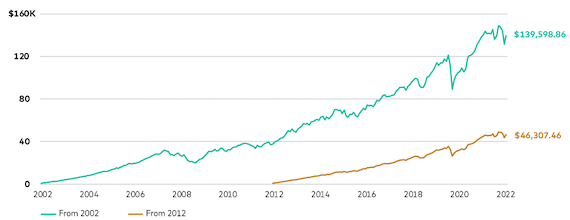
Below is a chart showing the past 20 years of performance from the Vanguard Australian Shares Index Fund.

This is a professionally managed fund that invests in the biggest 300 companies listed on the Australian share market.

Growth of Australian shares with $250 monthly contributions


Source: Vanguard

In effect, the chart is a financial simulation that could be applied to a hypothetical child born in mid-2002 who would have turned 20 in June of this year.

It assumes a $500 investment was made at the time of birth, that all fund distributions were reinvested, and that this child’s parents could afford to continue investing $250 per month for 20 years. The returns are after management fees but before tax.

After 20 years, and including $60,000 of total investments, the balance had grown by approximately $80,000 to a total of almost $140,000.

But let’s say the child’s parents didn’t start investing for them until they were 10 years old, in 2012.

Also starting off with $500 and making ongoing investments of the same amount, the investment balance would have reached just over $46,000 by mid-2022.

That includes $30,000 of contributions made over 10 years and growth of approximately $16,000.

This underscores the benefit of starting off a child’s investment plan as early as possible.

Of course, beyond managed funds, there are other ways to invest for children that have more exposure to lower-risk investments such as bonds and cash.

Among these, think of a managed bond fund, a child’s bank savings account or a term deposit.

These can be appropriate for short-term savings strategies, but keep in mind they typically produce lower average annual returns than the share market over long periods.

Over 20 years, Australian shares have delivered an average annual return of 8.2 per cent versus 4.7 per cent for Australian bonds and 3.6 per cent for cash.

Investment bonds are a longer-term “tax-effective” product, where no tax is payable on earnings if the bond is held for a minimum of 10 years.

They are usually held in an adult’s name, and could be suitable for a child.

But the average annual returns on investment bonds (less than 5 per cent) are also much lower when compared to the long-term growth of the share market.

If you are interested in learning more about investing for your children or an investment strategy just for you, call us on Phone: 07 5641 4134 today.

Source: Vanguard

Reproduced with permission of Vanguard Investments Australia Ltd

Vanguard Investments Australia Ltd (ABN 72 072 881 086 / AFS Licence 227263) is the product issuer. We have not taken yours and your clients’ circumstances into account when preparing this material so it may not be applicable to the particular situation you are considering. You should consider your circumstances and our Product Disclosure Statement (PDS) or Prospectus before making any investment decision. You can access our PDS or Prospectus online or by calling us. This material was prepared in good faith and we accept no liability for any errors or omissions. Past performance is not an indication of future performance.

© 2022 Vanguard Investments Australia Ltd. All rights reserved.

Important:
Any information provided by the author detailed above is separate and external to our business and our Licensee. Neither our business nor our Licensee takes any responsibility for any action or any service provided by the author. Any links have been provided with permission for information purposes only and will take you to external websites, which are not connected to our company in any way. Note: Our company does not endorse and is not responsible for the accuracy of the contents/information contained within the linked site(s) accessible from this page.