
Key Points:

  • Never use the same password or variations of the same password, utilise different numbers and letters with a mixture of capital and lower case letters

  • Online quizzes may be fun but usually there is a catch, and that catch can be your personal data

  • Scammers either attempt to build rapport with their targets or are very aggressive and frightening

This is doubled by the fact that more and more scammers are utilising the current COVID-19 crisis to target people through phone calls and email phishing scams.

It can be hard to differentiate between real or fake news, and genuine or false information in your emails and text messages.

While technology is a great way to create profiles for advertisers and companies, it is also an easy platform for scammers to use.

Older people are becoming warier of what they post online and on social media, but may not be as careful about the data they give away freely for competitions they enter or anything else that involves giving away personal information.

Elderly people are also more prone to falling victim to online and over-the-phone scams, which could result in substantial amounts of money being taken from your hard-earned savings.

It’s important to always double-check with someone you trust about whether you are making the right decision before handing over money or information.

One thing to keep in mind is scams are always developing and becoming more clever as the years go on. Always be vigilant with odd links, monetary requests you aren’t expecting, and be aware of who you are providing your personal information to.

Passwords: Variety is the spice of life

Using easy passwords to safeguard some of your most important assets can be really dangerous in today’s online climate.

Especially when you are storing away your hard-earned savings for retirement or a nice holiday.

Using really easy passwords, like ‘password’ or ‘abc123’, can be very easy to guess by hackers or even people you know.

Another concerning factor is the number of people who use derivatives of the same passwords.

For example, say you decided to make your password named after your cat, Fluffy. You used the same name as the basis for the password, but just added numbers to make it different between the multiple online accounts you have. Such as, your bank account password is ‘Fluffy1’, your superannuation is Fluffy followed by the day of your birth, ‘Fluffy25’.

While derivatives of the same password may make it easier to remember, it also makes it easier for someone to guess.

A good idea is to mix up your passwords where possible to make your online accounts safer. This means utilising a mixture of letters and numbers and a mixture of capitals or lower case letters.

If you are worried about losing your passwords, start using an online password manager to keep all of your passwords in one place under a strong primary password key.

Data is up for grabs

Data has been a massive commodity for advertising companies online, and offline, over the last decade.

Many older people may not be aware they are giving out their personal information for free while online.

While older people tend not to post too much revealing information on social media, it can be as easy as entering an online competition for you to have all your personal information stored and sold on to a third party.

The same goes for loyalty cards, if you spend $100 on groceries at a supermarket and use your loyalty card, that supermarket now knows how much you spend, what products you are buying and if you are able to withdraw and pay that much money.

This information is usually taken by those companies to try and sell you specific things based on your recent purchases, but this information is also a hot commodity for other companies to buy. You may never know how far your information can be passed along.

Similarly, some ‘fun quizzes’ online can not only take your personal data but also formulate a personal profile about you as an individual from the answers you chose in the quiz.

A good idea to be safe online is to reduce how much information you pass out, like phone numbers, home addresses and emails, and be careful with what you are engaging with online.

Scammers are not your friend

Many scams these days target older people online and on the phone. However, scams over the phone are more effective because it brings a human element into the ruse.

There are generally two types of scams, threatening and aggressive scams, or social engineering scams.

Threatening scams aim to scare the person on the end of the phone into making decisions on the spot, either forfeiting information or money.

These calls can be aggressive, like someone threatening to get the police involved and have you put in jail.

Social engineering scams are a lot sneakier compared to threatening scams, because they involve gaining your trust, resulting in you passing along your details or money to the scammer none the wiser.

Social isolation is a big problem with older people and scammers use this fact to engage and chat with an elderly target on the phone, convincing the older person they are trustworthy.

Because they take an interest in the person, a lonely older person may soon consider the scammer a friend and undertake what is being asked of them.

It’s important to regularly check your bank statements, especially since scams are carried out in lots of different smart ways.

Rather than taking out big amounts of money, scammers tend to take out $10 – $20 dollars on a recurring basis, so the withdrawal doesn’t look huge and cause suspicion.

‘Love’ scams are another popular and big-paying swindle. There are many stereotypical ideas of the love scam, generally around a far-off prince needing some financial assistance from you – his greatest love, however, that is not the most successful type of love scam.

In most cases, love scams involve an older man and woman, who has developed a relationship of some sort with someone, somewhere in Australia.

The scammer would first spend time creating a connection with the elderly victim before making up extravagant scenarios where they need the individual to pay money to help them.

It is an incredible form of emotional manipulation, which can result in a lot of money passing between hands.

Standing up to scammers

The best way to combat these types of scams is to never give your credit card or personal details over the phone.

No matter the business, a caller should never ask you to pay for something over the phone, especially for small transactions.

Additionally, when online or checking your emails, avoid pressing on dodgy links. If you receive an invoice from an unknown and weird email address, go to the actual company website, for example, Telstra, and see if you have any outstanding bills.

Another good option for when you receive a concerning call or odd email asking for money is to check with someone you trust.

The aim of these scams is to isolate you from the herd. Ask a friend or family friend about their opinion before paying any money.

And if the scammer is becoming aggressive in their communication with you, tell them you will contact the organisation directly and hang up.

You are well within your right to say you will call the company back directly on the official company number and pay a bill rather than right on the spot.

For more information or to report a scam, head to the Government Scam Watch website for more information.

Source:
This article was originally published on https://www.agedcareguide.com.au/information/being-wary-of-scams-and-sharing-your-personal-information
. Reproduced with permission of DPS Publishing.

Important:
This provides general information and hasn’t taken your circumstances into account.  It’s important to consider your particular circumstances before deciding what’s right for you. Although the information is from sources considered reliable, we do not guarantee that it is accurate or complete. You should not rely upon it and should seek qualified advice before making any investment decision. Except where liability under any statute cannot be excluded, we do not accept any liability (whether under contract, tort or otherwise) for any resulting loss or damage of the reader or any other person. 

Any information provided by the author detailed above is separate and external to our business. Our business does not take any responsibility for any action or any service provided by the author. Any links have been provided with permission for information purposes only and will take you to external websites, which are not connected to our company in any way. Note: Our company does not endorse and is not responsible for the accuracy of the contents/information contained within the linked site(s) accessible from this page.


There’s a lot of investment guidance out there. Too much can be overwhelming. So, how can you cut through the noise and find what you need? To help you out, we’ve put together a cut out and keep 8-step guide to successful investing.

The list includes tips on how to manage your portfolio effectively – covering everything from diversification to saving tax efficiently – to help you build, manage and grow your investments with confidence and ease.

Stay invested

This may seem like an obvious tip but actually time in the market is more important than timing the market. We recommend you drip feed money into the market through regular investing.

Learn about staying invested in volatile times.

Be diversified

Assets respond differently to the same events. Maintaining a diversified portfolio across different asset classes, sectors and geographies may provide a smoother ride.

Learn about diversification and asset allocation.

Look ahead

It’s hard to not react to the headlines, especially when they’re gloomy. But remember that the market moves before the economy.

Investors don’t wait for the dawn to break, so don’t become more bearish as the market falls – instead it is preferable to be fully invested, ahead of the upturn.

Learn about strategies for long term investing.

Get started

Time matters more than how much you save. Investing in your twenties is supercharged compared to your fifties. An investor who hesitates for even a handful of years is unlikely to ever catch up with their more prudent friends who get on with it. The early starter can even stop contributing in later years and still end up with a bigger pot.

Learn about timing the market.

Every cent counts

There’s power in small amounts. Developing the habit of regular investing is more important than how much you can save.

Learn more about the benefits of regular investing.

Take the right risks

Risk is rewarded in the long run. For example, the evidence of the last 120 years or so is that shares outperform bonds and cash over long periods. Over 18 years or longer shares have never underperformed other assets so if time is on your side then give yourself the best chance by taking sensible risks.

Learn about how markets recover in the long term.

Know yourself

Invest when it feels hardest. Don’t follow the crowd. Be fearful when others are greedy and greedy when others are fearful. The best investment returns can be achieved when you swim against the tide, investing when most people are too anxious to do so.

What does Tom Stevenson wish he’d known about investing at 30?

Make the market work for you

Volatility is not the same as risk. Short term fluctuations are irrelevant as long as you intend to remain invested. What matters is when you crystallise a loss or a gain. Volatility creates opportunity.

Learn more about investing through volatility.

Source:
Reproduced with permission of Fidelity Australia. This article was originally published at https://www.fidelity.com.au/insights/investment-articles/8-pearls-of-wisdom-for-investors/

This document has been prepared without taking into account your objectives, financial situation or needs. You should consider these matters before acting on the information. You should also consider the relevant Product Disclosure Statements (“PDS”) for any Fidelity Australia product mentioned in this document before making any decision about whether to acquire the product. The PDS can be obtained by contacting Fidelity Australia on 1800 119 270 or by downloading it from our website at www.fidelity.com.au. This document may include general commentary on market activity, sector trends or other broad-based economic or political conditions that should not be taken as investment advice. Information stated herein about specific securities is subject to change. Any reference to specific securities should not be taken as a recommendation to buy, sell or hold these securities. While the information contained in this document has been prepared with reasonable care, no responsibility or liability is accepted for any errors or omissions or misstatements however caused. This document is intended as general information only. The document may not be reproduced or transmitted without prior written permission of Fidelity Australia. The issuer of Fidelity Australia’s managed investment schemes is FIL Responsible Entity (Australia) Limited ABN 33 148 059 009. Reference to ($) are in Australian dollars unless stated otherwise.
© 2022. FIL Responsible Entity (Australia) Limited.

Important:
This provides general information and hasn’t taken your circumstances into account. It’s important to consider your particular circumstances before deciding what’s right for you. Any information provided by the author detailed above is separate and external to our business and our Licensee. Neither our business nor our Licensee takes any responsibility for any action or any service provided by the author. Any links have been provided with permission for information purposes only and will take you to external websites, which are not connected to our company in any way. Note: Our company does not endorse and is not responsible for the accuracy of the contents/information contained within the linked site(s) accessible from this page.

The excitement of heading towards retirement and a new stage of life can be tinged with concern over how to manage finances. For many people, seniors’ concession cards are a good way to help make ends meet.

While discounts on goods and services are always welcome, they’re even more valued right now as living costs continue to climb.

Concession cards for seniors provide significant discounts on medicines, public transport, rates and power bills. Many private businesses – from cinemas to hairdressers – also offer reduced prices to concession card holders.

There are different types of concession cards offered by federal, state and territory governments. While some are for those receiving government benefits, others are available to almost anyone aged over 60.

The cards are free and should not be confused with commercial discount cards that require an upfront fee or ongoing subscription.

Seniors Card

The Seniors Card is offered by all state and territory governments when you turn 60 (64 years in Western Australia) and are no longer working full time. This card is offered to everyone, regardless of your assets or income.

The Card will allow you to claim discounts on things like public transport fares, council rates and power bills. Thousands of businesses across Australia also offer reduced prices to Seniors Card holders. In some states, a separate card is offered to access discounts provided by private businesses and another card is provided for public transport.

For eligibility requirements and the range of services offered in your state or territory, click on a link below:

Victoria

South Australia

Western Australia

Northern Territory

Queensland

New South Wales

Australian Capital Territory

Tasmania

Federal Government concession cards

If you’re receiving a government pension or allowance, you’re a self-funded retiree or you’re a veteran, you may be eligible for one of several cards issued by the Federal Government.

The Pensioner Concession Card is automatically issued to people receiving pensions or certain allowances.

The card provides discounts on most medicines, out-of-hospital medical expenses, hearing assessments, hearing aids and batteries, and some Australia Post services.

In most states and territories, card holders receive at least one free rail journey within their state or territory each year.

Commonwealth Seniors Health Card

If you’ve reached the qualifying age for an Age Pension (currently 66 years and 6 months) but you’re not eligible to receive a pension, you may be entitled to the Commonwealth Seniors Health Card.

You can receive the card if you:

While there is an income test, no assets test applies. You will receive similar benefits to the Pensioner Concession Card.

Low Income Health Card

For those on a low income but not yet at Age Pension age, the Low Income Health Care Card can be a big help. If you meet the income test, you’ll get cheaper health care and medicines and other discounts.

Your gross income, before tax, earned in the eight weeks before you submit your claim is assessed and must be below certain limits.

The types of income included in the test includes wages and any benefits you receive from an employer, self employment income, rental income, super contributions as well as pensions and government allowances.

Other types of income are also counted including:

  • Deemed income from investments

  • Income and deemed income from income stream products such as super pensions

  • Foreign income

  • Distributions from private trusts and companies

  • Compensation payments

  • Lump sums such as redundancy, leave or termination payments.

Veteran Card

The Department of Veterans’ Affairs has a concession card for anyone who has served in the armed forces and their dependents. Like other government concession cards, the Veteran Card provides access to cheaper medicines and medical care as well as discounts from various businesses. The Veteran Card is a new offering, combining the former white, gold and orange cards. There is no change to entitlements or services with the new card.

As you can see, the potential savings from seniors concession cards can be significant so be sure to check your eligibility. If you would like help working out your income and other eligibility requirements, give us a call.


This provides general information and hasn’t taken your circumstances into account. It’s important to consider your particular circumstances before deciding what’s right for you. Although the information is from sources considered reliable, we do not guarantee that it is accurate or complete. You should not rely upon it and should seek qualified advice before making any investment decision. Except where liability under any statute cannot be excluded, we do not accept any liability (whether under contract, tort or otherwise) for any resulting loss or damage of the reader or any other person.

Any information provided by the author detailed above is separate and external to our business and our Licensee. Neither our business nor our Licensee takes any responsibility for any action or any service provided by the author. Any links have been provided with permission for information purposes only and will take you to external websites, which are not connected to our company in any way. Note: Our company does not endorse and is not responsible for the accuracy of the contents/information contained within the linked site(s) accessible from this page.

How much money you’re able to invest each year is one of the biggest factors in achieving your financial goals. And the longer you’re invested, the more time your money has to compound and grow.

Inflation is up and markets are down. What does this mean for you?

Entering the world of investing can be intimidating, even during the best of times. After all, it’s normal to have some hesitation when you’re doing something new. But what about when the markets are choppy?

The truth is, ups and downs in the markets are normal parts of the investment landscape. But starting out during a rocky market is not a bad place to be.

When you’re still in the accumulation phase of your financial life, you’re trying to grow your portfolio—by holding more growth-oriented investments, for example. At this stage, you’re more likely to have time to take on more risk because you won’t be accessing your money for many years. In short, time is on your side.

A volatile market can be seen as a formidable hurdle. But down markets can be favourable for investors. As the mantra goes, “buy low, sell high.”

If you can start saving for your future when the share market is down, you give yourself a better chance of meeting your goals. That’s because you’ll be able to buy more shares at a lower price, which can give you more value over the long term.

The longer you wait to start investing, the more money you’ll likely need to invest over time to accumulate the same amount. You could also end up purchasing shares when they’re more expensive and miss out on market appreciation.

This also could be a great time to dollar-cost average. “Dollar-cost averaging” is the practice of purchasing a fixed dollar amount of a particular investment on a regular basis, regardless of the share price. You’ll automatically buy more shares when prices are low and fewer shares when prices are high. This helps you avoid the risk of investing a lump-sum amount when prices are at their peak. With each contribution, your portfolio has the potential to grow—increasing your nest egg.

Tips for getting started on your investment journey

The Dos

1. Start now, start small

Create a budget for yourself and commit to investing a comfortable amount on a regular basis. For example, you could:

  • Start contributing a little each month into an account dedicated to investing suitable for your situation.

  • Set up a monthly investment into a high-yield account where you may be able to earn more interest than a standard savings account.

2. Maintain voluntary contributions to super

If your company provides a matching contribution, contribute up to the full match. The company’s match is essentially “free money” toward your future that can help you reach your goals sooner—so why miss out?

3. Start an emergency fund

An emergency fund should cover about 3 to 6 months of your living expenses. Keep in mind:

Your emergency fund should be kept in a liquid and stable place like a high-yield savings account.

The Don’ts

1. Don’t spend your money on trendy investments.

While it may be alluring (who wouldn’t want to get rich quick?), jumping on the bandwagon for an individual stock that’s momentarily in the spotlight is high-risk.

2. Don’t stop contributing to your investment when markets are volatile.

The sooner money is invested, the more time it has to grow. Stopping contributions altogether will slow your progress. You work hard for your money; let it work hard for you.

3. Don’t focus on the value of your portfolio on a single day.

On any given day, the market can go up or down. Instead of stressing over your balance, ask yourself, “When will I need this money?” If the money is for a longer-term goal—say 10, 20, or even 30 years—the value of your portfolio today doesn’t matter.

These are general tips and every investor should consider their own personal situation when making financial decisions.

If you’d like to start your investment journey, call us on Phone: 07 5641 4134.

Source: Vanguard

Reproduced with permission of Vanguard Investments Australia Ltd

Vanguard Investments Australia Ltd (ABN 72 072 881 086 / AFS Licence 227263) is the product issuer. We have not taken yours and your clients’ circumstances into account when preparing this material so it may not be applicable to the particular situation you are considering. You should consider your circumstances and our Product Disclosure Statement (PDS) or Prospectus before making any investment decision. You can access our PDS or Prospectus online or by calling us. This material was prepared in good faith and we accept no liability for any errors or omissions. Past performance is not an indication of future performance.

© 2022 Vanguard Investments Australia Ltd. All rights reserved.

Important:
Any information provided by the author detailed above is separate and external to our business and our Licensee. Neither our business nor our Licensee takes any responsibility for any action or any service provided by the author. Any links have been provided with permission for information purposes only and will take you to external websites, which are not connected to our company in any way. Note: Our company does not endorse and is not responsible for the accuracy of the contents/information contained within the linked site(s) accessible from this page.
Saving regularly is a habit that needs to be cultivated and as with most things in life, starting sooner rather than later often gives investors a huge advantage.

When it comes to the topic of spending and saving, it seems like there are countless ways of doing it.

A quick internet search throws up guidelines around how much of your income you can spend and how much you should save. Some articles focus on a percentage rule – with the most common being the 50/30/20 breakdown where 50% goes towards essential living expenses such as rent and utility bills, 30% towards your everyday expenses such as entertainment, eating out and clothing, and then allocating the remainder 20% to your savings. And then there are other guidelines which adjust those percentages according to your age – suggesting that you should save between 25-35% of your income if you begin your savings journey in your early 40s.

But many of these articles gloss over one very important point – and that is, knowing how much to save is important but how regularly you save is equally so, if not more. Learning to save and doing it regularly is not something that everyone does naturally, especially if you’ve just started working and you feel like there isn’t much left to save after all the essentials have been accounted for.

But saving regularly is a habit that needs to be cultivated and as with most things in life, starting sooner rather than later often gives you a huge advantage, assuming this is a habit that you stick to through your working life.

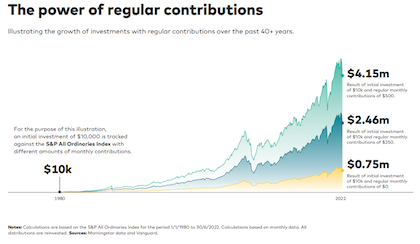
If you’re not yet convinced, the illustration below might perhaps change your mind and push you a little closer to building a habit that could set you up for life.


The chart shows that investing $10,000 in 1980 in a broadly diversified fund and leaving it untouched for the next 40 years would have delivered approximately $800,000 at the end of the four decades, thanks to the tried and true investment principle of staying the course.

However, the chart also shows that regularly contributing $250 or $500 every month to that initial $10,000 would have resulted in a portfolio balance of $2.7 million or $4.5 million respectively. While the chart does not take into account the cost of fees and assumes that all dividends are reinvested, it really paints a picture of how regular contributions could make a significant difference to your overall goals.

If you’ve just started on your savings journey, putting in place a set-and-forget system such as an automatic transfer to your savings or investment account each payday could be useful. That way, you don’t have to make any decisions about saving more or spending more each month. For those wanting to take less of a hit to your take home pay, consider contributing your pre-tax pay to your super fund (noting that you won’t be able to draw on those savings until you retire, aside from exceptional circumstances).

Finally, it is important to note that saving is different to investing, particularly if you have a short-term savings goal. If you are saving for a goal that has a time horizon of less than five years, be highly aware of the risks that you are taking on if you decide to invest those savings into the financial markets. But if you have a goal of more than five years, then consider the potential benefits that regular investing in a broadly diversified portfolio could deliver, because time is on your side.

Call us today on Phone: 07 5641 4134 if you’d like to start your savings or investment journey.

Source: Vanguard

Reproduced with permission of Vanguard Investments Australia Ltd

Vanguard Investments Australia Ltd (ABN 72 072 881 086 / AFS Licence 227263) is the product issuer. We have not taken yours and your clients’ circumstances into account when preparing this material so it may not be applicable to the particular situation you are considering. You should consider your circumstances and our Product Disclosure Statement (PDS) or Prospectus before making any investment decision. You can access our PDS or Prospectus online or by calling us. This material was prepared in good faith and we accept no liability for any errors or omissions. Past performance is not an indication of future performance.

© 2022 Vanguard Investments Australia Ltd. All rights reserved.

Important:
Any information provided by the author detailed above is separate and external to our business and our Licensee. Neither our business nor our Licensee takes any responsibility for any action or any service provided by the author. Any links have been provided with permission for information purposes only and will take you to external websites, which are not connected to our company in any way. Note: Our company does not endorse and is not responsible for the accuracy of the contents/information contained within the linked site(s) accessible from this page.

What exactly does responsible investment mean? Is there trade-off between ESG considerations (investing responsibly) and investment returns? Read on to find out more.

A growing number of Australian investors are taking a responsible approach to their investing, quite possibly without even realising they’re doing so.

That’s the reality of a rapidly evolving global investment universe, in which more and more investment products are being designed around very specific responsible investing criteria.

Added to that is the fact that investment fund managers worldwide are increasingly engaging with the companies that they’re investing in, on multiple levels, ultimately to drive long term-value creation for their end-investor clients.

According to the Responsible Investment Association Australasia (RIAA), Australia’s responsible investment market reached $1.54 trillion in 2021, up from $1.28 trillion the year before.

This represented 43 per cent of the $3.60 trillion that’s invested into the Australian managed funds sector.

To put that another way, almost half of all the money that’s invested by Australians via an investment fund manager is being invested responsibly.

Understanding responsible investment

What exactly does responsible investment mean?

Responsible investment, also known as sustainable or ethical investment, is a broad-based approach to investing which factors in people, society and the environment, along with financial performance, when making and managing investments.

The environmental aspect of ESG investing relates to how companies and industries manage their impact on the environment. This could include climate change, deforestation, pollution and waste management.

Social covers how companies and industries manage their impact on society, including their treatment of employees and suppliers, their community engagement, and their focus on health and safety.

Governance revolves around whether a company employs good governance practices, such as having gender diversity on its board and leadership team, and appropriate executive remuneration.

Five broad ESG categorisations, described below, are a useful starting point for investors to understand the variety of approaches taken by asset managers.

Exclusionary portfolio screening

Excludes companies based on their products or business activities (e.g. tobacco and fossil fuels) that conflict with certain values.

Inclusionary portfolio screening

Invests in companies or sectors considered to be more effective in the management of ESG risks, including those demonstrating meaningful improvement in the management of those risks.

ESG integration

Systematic inclusion of material ESG information in investment analysis and decision making.

Impact investing

Targeted investments with the dual objective of generating financial return in addition to positive ESG-related impact.

Stewardship

The responsible use of proxy voting and engagement activities by institutional investors to maximise overall long-term value.

Weighing up ESG investment performance

A common question asked by many investors is whether there’s a trade-off between ESG considerations (investing responsibly) and investment returns?

The weight of market evidence shows that ESG-focused products have largely moved in line with broader markets over the longer term, although it’s also evident they can outperform or underperform over shorter time periods.

For example, the recent global surges in energy prices has seen many ESG products underperform the broader market because they typically exclude listed oil and gas producers and supporting businesses.

Overall, however, ESG index fund products are designed to behave like the broader market and still provide a diversified, low-cost exposure to a large number of companies while avoiding certain ESG risks.

ESG risks and opportunities should be considered in the context of delivering long-term value and helping investors to meet their investment objectives.

To find out more about ESG investing, give us a call today. Contact us on Phone: 07 5641 4134.

Source: Vanguard

Reproduced with permission of Vanguard Investments Australia Ltd

Vanguard Investments Australia Ltd (ABN 72 072 881 086 / AFS Licence 227263) is the product issuer. We have not taken yours and your clients’ circumstances into account when preparing this material so it may not be applicable to the particular situation you are considering. You should consider your circumstances and our Product Disclosure Statement (PDS) or Prospectus before making any investment decision. You can access our PDS or Prospectus online or by calling us. This material was prepared in good faith and we accept no liability for any errors or omissions. Past performance is not an indication of future performance.

© 2022 Vanguard Investments Australia Ltd. All rights reserved.

Important:
Any information provided by the author detailed above is separate and external to our business and our Licensee. Neither our business nor our Licensee takes any responsibility for any action or any service provided by the author. Any links have been provided with permission for information purposes only and will take you to external websites, which are not connected to our company in any way. Note: Our company does not endorse and is not responsible for the accuracy of the contents/information contained within the linked site(s) accessible from this page.

With official interest rates on the move, shrewd mortgage holders may take the opportunity to call their lender to ask for a better deal.

But when even a small interest rate reduction means potential savings of thousands of dollars, is a simple phone call really enough to get you there?

While a number of lenders offer lower rates to new customers, it’s not always so simple for existing customers to secure the same outcome.

If you’re looking for a better deal on your mortgage, there are basically two options:

  • Call your bank and ask them to match the new rate.

  • Contact your broker and vote with your feet.

Although the first option is commonly recommended, lenders aren’t always so obliging when it comes to rate-matching to get you a more affordable mortgage.

Lenders regularly try to ‘win’ new customers by offering low rates, but if they refuse to match your current rate to this new offer, you can always contact a finance broker and refinance with a lender who is hungry to win your business.

Mortgage brokers have access to a range of lenders and products, and are also in a position to offer you a more in-depth and customised level of service. This can allow them to find their customers a mortgage product that may suit their current needs, wants and circumstances.

Call us on Phone: 07 5641 4134 to discuss your refinancing options.

Source: MFAA

Reproduced with the permission of the Mortgage and Finance Association of Australia (MFAA)

Important:
This provides general information and hasn’t taken your circumstances into account.  It’s important to consider your particular circumstances before deciding what’s right for you. Although the information is from sources considered reliable, we do not guarantee that it is accurate or complete. You should not rely upon it and should seek qualified advice before making any investment decision. Except where liability under any statute cannot be excluded, we do not accept any liability (whether under contract, tort or otherwise) for any resulting loss or damage of the reader or any other person.  Past performance is not a reliable guide to future returns.

Any information provided by the author detailed above is separate and external to our business and our Licensee. Neither our business nor our Licensee takes any responsibility for any action or any service provided by the author.

Any links have been provided with permission for information purposes only and will take you to external websites, which are not connected to our company in any way. Note: Our company does not endorse and is not responsible for the accuracy of the contents/information contained within the linked site(s) accessible from this page.

You don’t have to pay yourself super, but when you retire, you might be glad you did.

You can make regular or lump sum payments, can usually claim a tax deduction on contributions, and may be able to save tax.

Why pay yourself super

There are advantages to contributing to super, depending on the type of contribution made:

  • You save for your retirement.

  • You can claim a tax deduction for super contributions.

  • Super contributions are taxed at 15%, so you may save tax depending on your situation.

  • Super investments usually get better returns than bank savings accounts, so your savings will grow faster.

How to pay yourself super

If you already have a super fund, check that you can make contributions when you’re self-employed. You’ll need to give your fund your tax file number (TFN) so they can accept contributions.

Check if moving from employee to self-employed affects the insurance cover through your super. Insurance terms and conditions vary from fund to fund.

Transfer a regular amount or a lump sum

There are two ways to contribute, depending on how you pay yourself. If you receive:

  • A wage — set up a regular transfer into super from your before-tax income.

  • Income from business revenue — transfer a lump sum when you have enough cash flow.

Tax deductions for super contributions

You can claim a tax deduction for contributions you make from your after-tax income (known as personal super contributions).

To claim a tax deduction, you need to send a ‘Notice of intent to claim’ form to your super fund and receive an acknowledgement from your fund.

See claiming deductions for personal super contributions on the Australian Taxation Office (ATO) website for detailed information.

Always confirm the details of any super contributions with your accountant or tax agent.

How much to contribute to super

As a guide, employers contribute at least 10.5% of an employee’s earnings to super.

There are limits to how much you can contribute each financial year:

  • up to $27,500 in concessional contributions (from your pre-tax income, for which you can claim a deduction), and

  • up to $110,000 in non-concessional contributions (from your after-tax income)

The ATO has more information about super contribution caps.

If you’re on a low income, you may be eligible for government super contributions, see super contributions.

Talk to us today if you’re self-employed and would like to start contributing to your super. Call us on Phone: 07 5641 4134.

Source:
Reproduced with the permission of ASIC’s MoneySmart Team. This article was originally published at https://moneysmart.gov.au/grow-your-super/super-for-self-employed-people

Important note: This provides general information and hasn’t taken your circumstances into account.  It’s important to consider your particular circumstances before deciding what’s right for you. Although the information is from sources considered reliable, we do not guarantee that it is accurate or complete. You should not rely upon it and should seek qualified advice before making any investment decision. Except where liability under any statute cannot be excluded, we do not accept any liability (whether under contract, tort or otherwise) for any resulting loss or damage of the reader or any other person.  Past performance is not a reliable guide to future returns.

Important
Any information provided by the author detailed above is separate and external to our business and our Licensee. Neither our business nor our Licensee takes any responsibility for any action or any service provided by the author. Any links have been provided with permission for information purposes only and will take you to external websites, which are not connected to our company in any way. Note: Our company does not endorse and is not responsible for the accuracy of the contents/information contained within the linked site(s) accessible from this page.

With a degree of economic uncertainty in the air as interest rates rise around the world, being able to get investors on board is more important than ever. Being able to clearly demonstrate your ideas to external parties is only going to become more critical, writes Alan Manly OAM, CEO of Universal Business School Sydney (UBSS) and author of The Unlikely Entrepreneur.

Let’s look at five ways to impress investors and give them confidence in your ability to deliver:

1. Knowledge is power

Whatever your great new idea is, own the idea and know all about it. Research every angle of the problem that you are solving, and all the solutions that you can find that then lead to how good your idea is.

Be it technologically advanced or a simple implementation of a great approach, explain it so that a child could understand it; show some empathy to the less informed investor. You are in love with your idea and jumping out of the dark at an investor with new ideas.

Have in your presentation credible and clearly defined references; the more the better.

2. Get a customer

If your product can be implemented, all the better. Be it as a test site for free, any proof of concept is valuable.

If the product or service is not able to be delivered yet, try to find a potential customer who will attest that if it was available they would seriously consider it, and how it would advance their company, as in improved customer service or general efficiency.

3. Cash flow

Once you have a few customers you can project that if you had more money to invest, then you would get more customers.

With your current customers, project the cash flow to demonstrate you have a positive cash flow. You want to have more cash coming in than going out over a period of time, especially before you run out of any investment capital.

The numbers need to really add up. If nothing else, investors can calculate numbers in the blink of an eye.

4. Return on investment

Once you have cash flow, you now build up to having more cash than needed to operate the business. That is when you get an investor’s attention.

That surplus to immediate needs is potential dividends; that is when you get investors, by speaking their language with expressions such as ROI – return on investment.

5. Sustainable returns

You have found a customer, got paid and kept a small surplus? Now the challenge is not about the operations of the company, but rather dealing with the world of investors.

Show me the money, they cry, but not only once – each and every financial quarter for as far as the eye can see, on the widest of Excel spreadsheets.

All of these steps might sound quick and easy, but it’s best to practice your pitch on family and friends first. Once you’ve made a compelling business case to those closest to you, then reach out to an accountant that you don’t know personally to review your presentation.

This might require that you go over the presentation many times to fine-tune every detail, but in the end, you’ll be better positioned to entice and impress investors.

Source: Flying Solo August 2022

This article by Alan Manly OAM is reproduced with the permission of Flying Solo – Australia’s micro business community. Find out more and join over 100K others https://www.flyingsolo.com.au/join.

Important:
This provides general information and hasn’t taken your circumstances into account. It’s important to consider your particular circumstances before deciding what’s right for you. Any information provided by the author detailed above is separate and external to our business and our Licensee. Neither our business, nor our Licensee take any responsibility for any action or any service provided by the author. Any links have been provided with permission for information purposes only and will take you to external websites, which are not connected to our company in any way. Note: Our company does not endorse and is not responsible for the accuracy of the contents/information contained within the linked site(s)

It’s common for business owners to get frustrated that their bank account doesn’t seem to reflect their profits. It’s essential that you understand the difference between profit and cash, and why a high profit doesn’t necessarily result in more cash in your bank account, writes Brad Turville, director and business advisor at BJT Financial.

A profitable business can go out of business because it’s starved of cash. A business running at a loss can survive because it has access to funds from investors or financiers.

In other words, cash flow is every business’ reality.

Why your profits don’t match your cash flow

Don’t worry, you’re not alone!

The problem is that cash is simply never going to be the same as profit. Here are eight reasons why:

1. Tax/GST/Super payments

End of financial year (30 June) might have ticked by and your accountant has prepared your financial statements that shows Profit After Tax. But in this case, you might have many months before you need to pay the tax to the tax office. So the financials show the tax payable but you haven’t transferred that cash to the ATO yet.

Same with superannuation, it shows on your Profit & Loss Report as an expense every month but for many small businesses, you don’t pay until the end of the quarter.

As for GST, it doesn’t show on your Profit & Loss at all, so doesn’t affect your profit numbers, but it comes in and out of your bank account’s cash.

2. Asset purchases

If you purchase an asset for cash, such as a motor vehicle, office fit-out or bulldozer, this won’t affect your profit but by paying cash, it will reduce your bank balance.

You might be able to depreciate which I’ll cover off below.

3. Owner’s drawings

When you withdraw cash from your business for personal usage without properly accounting for it as a salary or wage, this will not show on your Profit & Loss as an expense, so won’t impact profit – but obviously, by taking cash you are reducing your business’ cash reserves.

4. Changes to debtors

The revenue on your Profit & Loss will increase as you send out more and more invoices. But this doesn’t guarantee that your customers are actually paying them quickly.

For example, if you send an invoice for $5,000 it will show an extra $5,000 revenue this month, but the customer might not pay for 90 days. So there is a timing difference between revenue showing on Profit & Loss and changing your profit, and actually receiving the cash from the customer.

5. Changes in inventory or work in progress

Your Profit & Loss Report records what inventory or work in progress has been consumed in the sales you’ve made. If you are holding excess or obsolete inventory, that is essentially cash tied up on the shelf in a warehouse.

The same goes with WIP, the more regularly you invoice it out, the quicker you turn it into cash.

6. Changes to creditors

As with debtors, your Profit & Loss Report records the expenses you’ve incurred during the period. If you haven’t yet paid some of these expenses, your profit will be lower but your cash will be higher.

So if you receive an invoice today for $400, it will show as a $400 expense on your Profit & Loss, but you might not pay the supplier for 45 days – at which point you then transfer the cash.

7. Loan repayments

Many loan repayments are made up of principal and interest components, but only the interest component is an expense showing on your Profit & Loss Report.

Which means that if you make monthly loan repayments of $2,750 (where $750 is interest and $2,000 is principal), your bank balance will reduce by $2,750 for the payment you make, but your profit will only go down by $750 for the interest expense you pick up.

8. Depreciation

Depreciation is the write-down of an asset’s value over its effective useful life. That means you can pick up an expense on your Profit & Loss and show a reduced asset holding value on your balance sheet, but no cash has changed hands – it is simply an accounting entry.

You could relate it to buying a new sports car – the day you drive it off the showroom floor, it starts losing value.

The key is to work with your accountant to review and understand why these amounts are different, identify areas where cash is being tied up, and build strategies to access improved cash flow.

The most successful businesses I work with have a concise and actionable Business Plan and a Cash Flow Forecast for at least the next 12 months. We then regularly review their numbers each month/quarter to keep the business on track, manage cash and make better business decisions.

These, I believe, are the foundations of good business management.

Source: Flying Solo July 2022

This article by Brad Turville is reproduced with the permission of Flying Solo – Australia’s micro business community. Find out more and join over 100K others https://www.flyingsolo.com.au/join.

Important:
This provides general information and hasn’t taken your circumstances into account. It’s important to consider your particular circumstances before deciding what’s right for you. Any information provided by the author detailed above is separate and external to our business and our Licensee. Neither our business, nor our Licensee take any responsibility for any action or any service provided by the author. Any links have been provided with permission for information purposes only and will take you to external websites, which are not connected to our company in any way. Note: Our company does not endorse and is not responsible for the accuracy of the contents/information contained within the linked site(s) ac www.flyingsolo.com.au > Logo file is here: https://bit.ly/flying-solo-logo