Using a fundamental investing principle could help many Australians bring their retirement forward.

It’s simple investing mathematics really. The more money you can save in investing fees, the more of your total returns you ultimately get to keep in your pocket.

In actual fact, investment fees (management and administrative fees, commissions and other costs) are the one thing in investing we can control.

And, when we’re talking about investing, don’t forget your superannuation fund is also charging you to invest your hard-earned retirement savings. They won’t hit your hip pocket directly, because super fees are generally deducted from the regular contributions made into your super account.

Alarmingly, Vanguard’s How Australia Retires study, released in May 2023, found that one-in-two Australians don’t know how much they are paying in super fees, and two-in-five are unsure if their super fund is charging them low fees.

Australians are retiring later

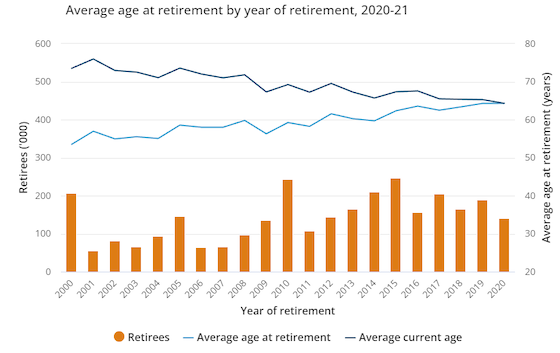
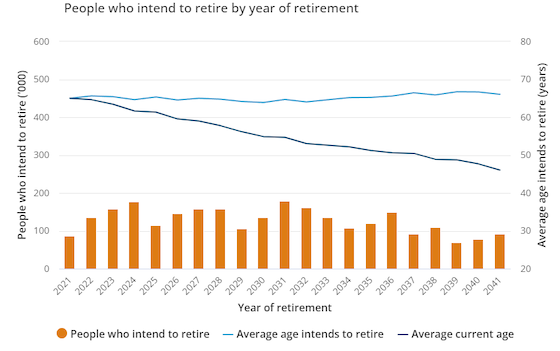
The Australian Bureau of Statistics’ latest Retirement and Retirement Intentions data covering the 2020-21 financial year, released at the end of August, shows that the average age of retirement has been steadily increasing over time. So is the average age that people intend to retire.

Of the total number of Australians who retired in 2020, the average age at retirement was 64.3 years. For men, the average age was 65.4 years and for women the average was 63.7 years.

That compares with 2000 when the average age at retirement was 53.5 years.
Source: Australian Bureau of Statistics

The average age when Australians intend to retire has also been creeping up over time. In 2020-21, when the latest ABS data was captured, it was 65.5 years. For men, the average intending to retire age was 66 years and for women the average was 64.9 years.
Source: Australian Bureau of Statistics

Tying costs to retirement age

There are a wide range of reasons why people earmark an intended retirement age. It can relate to financial reasons, lifestyle reasons, personal reasons, or a combination of all three.

One’s actual age of retirement may be the same as one’s intended age of retirement, but of course one’s circumstances can change and result in retirement being brought forward or pushed out.

Having the financial capacity to retire is a key reason why many people decide to retire earlier than they expected to.

This is where 2018 research by the Productivity Commission (Superannuation: Assessing efficiency and competitiveness) on the impact of superannuation investment costs has particular relevance.

The Productivity Commission’s analysis revealed a strong negative relationship between net returns and total fees – that is, funds with higher total fees on average deliver lower returns (net of administration and investment fees) for their members.

“The material amount of member assets in high-fee funds, coupled with persistence in fee levels through time, suggests there is significant potential to lift retirement balances overall by members moving, or being allocated, to a lower-fee and better-performing fund,” the Productivity Commission found.

“Fees have a significant impact on retirement balances. For example, an increase of just 0.5% a year in fees would reduce the retirement balance of a typical worker (starting work today) by a projected 12% (or $100 000).”

On a pure financial level, the benefits than can achieved by reducing super investment costs (the potential positive impact of doing so on one’s retirement balance) may be the catalyst for many Australians to bring their intended retirement age forward.

Source: Vanguard December 2023 – By Tony Kaye, Senior Personal Finance Writer

This article has been reprinted with the permission of Vanguard Investments Australia Ltd. Copyright Smart Investing™

GENERAL ADVICE WARNING
Vanguard Investments Australia Ltd (ABN 72 072 881 086 / AFS Licence 227263) (VIA) is the product issuer and operator of Vanguard Personal Investor. Vanguard Super Pty Ltd (ABN 73 643 614 386 / AFS Licence 526270) (the Trustee) is the trustee and product issuer of Vanguard Super (ABN 27 923 449 966).
The Trustee has contracted with VIA to provide some services for Vanguard Super. Any general advice is provided by VIA. The Trustee and VIA are both wholly owned subsidiaries of The Vanguard Group, Inc (collectively, “Vanguard”).
We have not taken your or your clients’ objectives, financial situation or needs into account when preparing our website content so it may not be applicable to the particular situation you are considering. You should consider your objectives, financial situation or needs, and the disclosure documents for the product before making any investment decision. Before you make any financial decision regarding the product, you should seek professional advice from a suitably qualified adviser. A copy of the Target Market Determinations (TMD) for Vanguard’s financial products can be obtained on our website free of charge, which includes a description of who the financial product is appropriate for. You should refer to the TMD of the product before making any investment decisions. You can access our Investor Directed Portfolio Service (IDPS) Guide, Product Disclosure Statements (PDS), Prospectus and TMD at vanguard.com.au and Vanguard Super SaveSmart and TMD at vanguard.com.au/super or by calling 1300 655 101. Past performance information is given for illustrative purposes only and should not be relied upon as, and is not, an indication of future performance. This website was prepared in good faith and we accept no liability for any errors or omissions.
Important Legal Notice – Offer not to persons outside Australia
The PDS, IDPS Guide or Prospectus does not constitute an offer or invitation in any jurisdiction other than in Australia. Applications from outside Australia will not be accepted. For the avoidance of doubt, these products are not intended to be sold to US Persons as defined under Regulation S of the US federal securities laws.
© 2024 Vanguard Investments Australia Ltd. All rights reserved.


A self-managed super fund (SMSF) is a private super fund that you manage yourself. SMSFs are different to industry and retail super funds.

When you manage your own super, you put the money you would normally put in a retail or industry super fund into your own SMSF. You choose the investments and the insurance.

Your SMSF can have no more than six members. As a member, you are a trustee of the fund — or you can get a corporate trustee. In either case, you are responsible for the fund.

While having control over your own super can be appealing, it’s a lot of work and comes with risks. 

Only set up your own super fund if you’re 100% committed and understand what’s involved.

The risks and responsibilities of SMSFs

All members of an SMSF are responsible for the fund’s decisions and for complying with the law.

These responsibilities come with risks:

  • If you lose money through theft or fraud, you won’t have access to any special compensation schemes or to the Australian Financial Complaints Authority (AFCA).

  • You are personally liable for all the fund’s decisions — even if you get help from a professional (such as a financial adviser, accountant or legal professional), or if another member made the decision.

  • Your investments may not bring the returns you expect.

  • You are responsible for managing the fund even if your circumstances change — for example, if you lose your job.

  • There may be a negative impact on your SMSF if there is a relationship breakdown between members, or if a member dies or becomes ill.

  • You could lose insurance if you’re moving from an industry or retail super fund to an SMSF. See consolidating super funds.

The ATO has more information on the key responsibilities for SMSF trustees. 

SMSFs take time and money

Managing an SMSF is a lot of work. Even if you get professional help, it’s time-consuming.

You need enough time to set up the fund, and time to manage ongoing activities, such as:

  • researching investments

  • keeping up to date with changes in superannuation and tax laws

  • setting up and reviewing an investment strategy

  • accounting, keeping records, and arranging an audit each year by an approved SMSF auditor

SMSF trustees spend on average more than eight hours a month managing an SMSF. That’s more than 100 hours a year. (Source: SMSF Investor Report, April 2021, Investment Trends)

Set-up costs

The set-up and running costs of an SMSF can be high. Ongoing costs can include:

  • investing

  • accounting

  • auditing

  • tax advice

  • legal advice

  • financial advice

  • insurance premiums

Some costs may be tax deductible, but most will be out-of-pocket expenses for the SMSF.

You don’t have to set up an SMSF to choose your own investments. See super investment options.

You need financial and legal knowledge

You need the financial and legal knowledge and skills to:

  • set and manage an investment strategy that meets your risk-tolerance and retirement needs

  • comply with tax, super and investment laws

  • arrange insurance for fund members

  • understand different investment markets, and build and manage a diversified investment portfolio

Be wary of anyone who offers to set up an SMSF to withdraw your super to pay off debts. It’s illegal. See superannuation scams.

SMSF starting balance

When making the decision to set up an SMSF, it’s important to focus on the overall suitability rather than just the starting balance of the fund. 

An SMSF with a lower starting balance may be suitable for you if, for example:

  • you are willing and able to do most of the administration and management of the SMSF yourself

  • a business property, an inheritance, or funds from another superannuation account will be added to your SMSF

There may also be circumstances when an SMSF with a higher starting balance is not suitable for you because it does not meet your objectives, financial situation or needs. 

For example, you may not have the skills, time or experience to be an SMSF trustee. 

ASIC has prepared case studies to help you work out if an SMSF is suitable for you based on your superannuation balance. 

When a SMSF might be suitable for you

Some indicators that an SMSF might be suitable are:

  • you are willing to play an active part in managing your financial affairs

  • you have a good understanding of your role and responsibilities as an SMSF trustee

  • setting up an SMSF will help you achieve your goals and objectives, and

  • setting up an SMSF would be cost-effective for you.

The ATO has information about SMSF expenses by fund size.

If you want to set up an SMSF

If you are 100% sure about managing your own super fund, start researching investment options. Also, consider getting advice – you can reach out to us.

Research your investment options

Part of the appeal of an SMSF is controlling and having access to a broader range of investments.

However, there are some very strict rules about what you can invest your super in. Check restrictions on investments on the ATO website.

Get professional advice

Professionals like SMSF auditors, accountants and lawyers can help you with an SMSF. However, these professionals may be limited to the kind of advice they can give you.

A licensed financial adviser with specialist SMSF knowledge can help you:

  • make an informed decision about whether an SMSF is right for you

  • set up and run your SMSF

  • decide on an appropriate trustee structure for your SMSF

  • understand the penalties for SMSF non-compliance

Financial advice about setting up an SMSF should always include information about:

  • why an SMSF is suitable for you and how it will help you achieve your retirement savings goals

  • the risk and costs

  • the potential benefits you may lose

  • your compliance responsibilities and any penalties for non-compliance

  • the skills, knowledge and time commitment you need

Set up your SMSF

All SMSFs are regulated by the ATO. The self-managed super funds section of the ATO website explains what you need to do to set up your fund. 

How you structure your SMSF is also important as this can impact your compliance obligations.

There are two types of structures you can choose for your SMSF: individual trustees or a corporate trustee. The ATO has more information about the obligations for each structure.

Talk to us if you have any questions.

Source:
Reproduced with the permission of ASIC’s MoneySmart Team. This article was originally published at https://moneysmart.gov.au/how-super-works/self-managed-super-fund-smsf

Important note: This provides general information and hasn’t taken your circumstances into account.  It’s important to consider your particular circumstances before deciding what’s right for you. Although the information is from sources considered reliable, we do not guarantee that it is accurate or complete. You should not rely upon it and should seek qualified advice before making any investment decision. Except where liability under any statute cannot be excluded, we do not accept any liability (whether under contract, tort or otherwise) for any resulting loss or damage of the reader or any other person.  Past performance is not a reliable guide to future returns.

Important
Any information provided by the author detailed above is separate and external to our business and our Licensee. Neither our business nor our Licensee takes any responsibility for any action or any service provided by the author. Any links have been provided with permission for information purposes only and will take you to external websites, which are not connected to our company in any way. Note: Our company does not endorse and is not responsible for the accuracy of the contents/information contained within the linked site(s) accessible from this page.

After accumulating superannuation savings over multiple decades, many retirees are fearful of spending too much. When it comes to life in retirement, many Australians are probably being more frugal than they need to be.

And that’s largely built around a fear of running out of their retirement savings before they die – an outcome that’s known as longevity risk.

Giving people the confidence to spend more of their accumulated savings in retirement is likely to remain a challenge for individuals over time, and for Federal Governments in terms of how much budget funding to allocate towards the Age Pension.

The Intergenerational Report 2023 discusses longevity risk in detail, projecting that average life expectancies will continue to rise over time, reaching 87.0 years for men and 89.5 years for women by 2062-63.

Meanwhile, it projects that the proportion of people with accounts in the retirement phase, from which they are drawing a superannuation pension, will increase from 8% currently to 19% over the next 40 years.

“Longevity risk – the risk of outliving savings – is a key concern for retirees in deciding how to draw down their superannuation, consequently, most retirees draw down at the legislated minimum drawdown rates,” the report notes.

“This results in many retirees leaving a significant proportion of their balance unspent, for example, a single retiree drawing down at the minimum rates would be expected to still have a quarter of their retirement assets at death.”

The 2020 Retirement Income Review included projections from Treasury that outstanding superannuation death benefits could increase from around $17 billion in 2019 to just under $130 billion in 2059, assuming there’s no change in how retirees draw down their superannuation balances.

How much is enough?

Retirees continue to face significant cost pressures on their household budgets due to historically high consumer price inflation.

The Association of Superannuation Funds Australia (ASFA) recently reported that the annual expenditure needed to reach ASFA’s comfortable retirement standard had hit a record high in the June quarter of $72,148 per year for couples, and $51,278 for singles. The expenditure needed to reach ASFA’s modest retirement standard was $46,994 for couples and $32,665 for singles.

Vanguard’s How Australia Retires study of over 1,800 working and retired Australians, released in May 2023, found that broad uncertainty over how much money will be enough to fund one’s retirement is a key factor in overall retirement confidence.

“Most people rely on the Government for protection against longevity risk through the Age Pension, which provides a safety net for retirees who outlive their savings,” according to the Intergenerational Report 2023.

“Well-designed superannuation retirement products can assist retirees to make decisions to help smooth consumption over retirement – aligning income needs with expenditure needs – and draw down on their balances efficiently. This would also enable decision making early in retirement.”

Planning and retirement confidence

The How Australia Retires research has found that having high retirement confidence is not dependent on age or income, but rather on having a plan.

More than half (52%) of the people we surveyed who presented themselves as being highly confident about their retirement readiness feel that they know what they need to do to achieve the retirement outcome they desire and are optimistic about this phase of their life.

They are relatively likely to use budgets and prioritise their savings. Of the people participants who received professional financial advice, 44% indicated they were extremely or very confident in funding their retirement.

And, of the Australians who have never sought any professional advice, only 25% indicated they were extremely or very confident in being able to fund their retirement. Furthermore, those who had not sought professional advice or sought only the assistance of family and friends tended to have less comprehensive retirement plans.

The thematic review of the retirement income covenant by the Australian Prudential Regulation Authority (APRA) and the Australian Securities & Investments Commission (ASIC) into how super trustees are helping members enhance retirement outcomes concluded that more needs to be done to improve superannuation member outcomes in retirement.

“There is evidence that a high proportion of the superannuation benefits of many members in the Australian community remain unspent over the retirement phase,” the review found. “This suggests the Australian community needs assistance to use their superannuation benefits for retirement income.”

The Federal Government issued a discussion paper in February focussed on retirement income strategies and financial advice.

Contact us if you have any questions.

Source: Vanguard September 2023 – By Tony Kaye, Senior Personal Finance Writer

This article has been reprinted with the permission of Vanguard Investments Australia Ltd. Copyright Smart Investing™

GENERAL ADVICE WARNING
Vanguard Investments Australia Ltd (ABN 72 072 881 086 / AFS Licence 227263) (VIA) is the product issuer and operator of Vanguard Personal Investor. Vanguard Super Pty Ltd (ABN 73 643 614 386 / AFS Licence 526270) (the Trustee) is the trustee and product issuer of Vanguard Super (ABN 27 923 449 966).
The Trustee has contracted with VIA to provide some services for Vanguard Super. Any general advice is provided by VIA. The Trustee and VIA are both wholly owned subsidiaries of The Vanguard Group, Inc (collectively, “Vanguard”).
We have not taken your or your clients’ objectives, financial situation or needs into account when preparing our website content so it may not be applicable to the particular situation you are considering. You should consider your objectives, financial situation or needs, and the disclosure documents for the product before making any investment decision. Before you make any financial decision regarding the product, you should seek professional advice from a suitably qualified adviser. A copy of the Target Market Determinations (TMD) for Vanguard’s financial products can be obtained on our website free of charge, which includes a description of who the financial product is appropriate for. You should refer to the TMD of the product before making any investment decisions. You can access our Investor Directed Portfolio Service (IDPS) Guide, Product Disclosure Statements (PDS), Prospectus and TMD at vanguard.com.au and Vanguard Super SaveSmart and TMD at vanguard.com.au/super or by calling 1300 655 101. Past performance information is given for illustrative purposes only and should not be relied upon as, and is not, an indication of future performance. This website was prepared in good faith and we accept no liability for any errors or omissions.

Important Legal Notice – Offer not to persons outside Australia

The PDS, IDPS Guide or Prospectus does not constitute an offer or invitation in any jurisdiction other than in Australia. Applications from outside Australia will not be accepted. For the avoidance of doubt, these products are not intended to be sold to US Persons as defined under Regulation S of the US federal securities laws.

© 2024 Vanguard Investments Australia Ltd. All rights reserved.

Cost of living pressures coupled with rate rises have made it more difficult to save for a home deposit and afford the lifestyle you’ve either become accustomed to or are dreaming of.

Budget Direct’s Cost of Living Survey & Statistics 2023 found that despite the living cost index for employee households recording its largest quarterly rise in more than two decades (3.2%), half of all participants hadn’t seen a change in their income in the past 12 months.i

There’s not much control we have over these rising rates, however we can adjust our budgets and make some tweaks to our lifestyles to beat the cost of living.

Shop carefully and reduce food waste

While it seemed outrageous to pay up to $3 per banana following cyclone Yasi in 2011, Australians are having to fork out more at the supermarket check-out for everyday items including fresh produce.ii Given the high cost of food, it makes sense to reduce food waste to get the most value for your money – the last thing you want is your very pricey banana withering away at the bottom of your fruit bowl!

Simple acts such as batch cooking, freezing excess produce and using what you already have can cut down on food waste. There are also alternatives to supermarket shopping, such as visiting a market near closing time to grab some produce bargains. Buying in bulk can help you save money as well.

Shop around to reduce bills

While we can make savings on our bills by reducing our consumption, you can also look around for better deals. A 2023 report found that brand loyalty cost Australians $4.5 billion that year, with households in NSW and VIC more likely to be paying a loyalty tax for electricity.iii

That extra effort to find a better deal can save you money, and it doesn’t have to be a time-consuming process thanks to comparison websites (such as Energy Made Easy and Finder). Look at your last couple of bills to see what you are usually charged to see how they compare.

Save money on entertainment and transport

You don’t have to give up on the fun things in life, but it’s worth seeing what savings can be made when it comes to entertainment and transport.

Regular restaurant dinners can be swapped for lunches (as these tend to be cheaper) or sharing hosting duties at home with friends. You might want to assess how many streaming services you are paying for and actually use, and if it’s been a while since you’ve entered a library, check out all their free resources such as books, audiobooks, movies, and magazines.

Facebook Marketplace and Gumtree are full of second-hand buys, and you can keep an eye out for discounted event tickets in your area. If you’re paying for a gym membership you’re not using, opt for free fitness instead, such as parkrun, a free 5km community run held each weekend across Australia.

With the cost of petrol being so high, it may be a smart idea to drive less often. Consider if you can carpool on some occasions or whether public transport would be cheaper. For short distances, you can combine your need for getting somewhere with getting fit by jumping on the bike, walking, or jogging.

Make a budget

A budget doesn’t have to be focused on restriction – in fact, by budgeting you can ensure you still have room for the things you enjoy. Start by keeping track of what you are spending and use a budget planner, entering your income and expenditure to see where there is room to save. This can help you identify what you can cut back on and where you can spend.

There’s no doubt that it is tough to get ahead at the moment, but some small changes can help you reach your financial goals.

i https://www.budgetdirect.com.au/life-insurance/articles/cost-of-living-survey-statistics.html
ii https://www.theage.com.au/national/victoria/banana-prices-bend-up-as-cyclone-shortage-hits-20110307-1bl65.html
iii https://www.finder.com.au/utility-bill-statistics

Important: This provides general information and hasn’t taken your circumstances into account. It’s important to consider your particular circumstances before deciding what’s right for you. Although the information is from sources considered reliable, we do not guarantee that it is accurate or complete. You should not rely upon it and should seek qualified advice before making any investment decision. Except where liability under any statute cannot be excluded, we do not accept any liability (whether under contract, tort or otherwise) for any resulting loss or damage of the reader or any other person.

Any information provided by the author detailed above is separate and external to our business and our Licensee. Neither our business nor our Licensee takes any responsibility for any action or any service provided by the author. Any links have been provided with permission for information purposes only and will take you to external websites, which are not connected to our company in any way. Note: Our company does not endorse and is not responsible for the accuracy of the contents/information contained within the linked site(s) accessible from this page.

Investing success can mean different things to different people. Being clear on what success means for you is key to mapping out your plan.

Although investing can seem perplexing and complex, success is largely within your control.

Having a tailored investment strategy can go a long way to reducing the stress and noise associated with investment decisions.

Vanguard has four guiding principles designed to help investors focus on what’s important to them and give them the best chance for investment success.

1. Create clear, appropriate investment goals

There is no one-size-fits-all plan for reaching financial objectives. Goals are unique to your situation, preferences, and aspirations.

Identifying and prioritising your financial intentions allows you to focus on what matters most, in an order that works for you. It also helps you decide where you’re willing to compromise.

Once you set and prioritise your goals you can figure out how much—and for how long—you’ll need to save.

The value any portfolio achieves over time is the sum of two elements: savings (the amount you put into your portfolio) and investment returns. Much of the discussion about investment success tends to focus on investment returns, but both elements are crucial in reaching a goal.

Time is a key factor here. For short time horizons, savings—which is within your control—is the driving force in achieving an investment goal. As the time horizon increases, investment returns increase in importance.

Savings and investment returns both contribute to the achievement of any investment goal

Over any given goal horizon, an investment balance is the sum of savings (the amount you put into your investment portfolio) plus the investment returns on the total amount invested.

Notes: The calculation for the contribution of savings and investment returns is as follows: Assuming a 4% real return (after inflation), we calculate how much an investor needs to invest annually to achieve a given investment goal for different time horizons, varying from 0 years (now) to 40 years. Savings represent the amount invested (the principal). Contributions are assumed to be the same every year relative to the year investing begins.

Source: Vanguard

2. Keep a balanced and diversified mix of investments

Shares can be risky, but so is avoiding them. While they can be more volatile in the short run, historically they’ve outperformed cash-equivalent assets in the long run.

Investors can reduce overall portfolio volatility while also safeguarding against unnecessarily large losses by spreading their investments across shares and bonds and among sectors and countries.

An appropriate asset allocation takes into account your risk tolerance—how much volatility you can tolerate in your portfolio—and risk capacity—your ability to withstand a loss in your portfolio (a reflection of your time horizon and cash flow needs).

Factoring in your time horizon and your tolerance for risk can lead to a tailored portfolio that’s suitable to personalised situations.

3. Minimise costs

Market movements and financial returns are hard to predict, but costs are often controllable. The two broad types of costs that you can minimise are (1) taxes and (2) investment costs, which include expense ratios, transaction costs, and sales charges.

Together, these costs cut into investment returns, sometimes significantly. To reduce these expenditures, and help improve returns, you can:

  • Seek out lower-cost funds. The higher the investment costs, the higher the odds of market underperformance. Lower-cost investment funds have historically outperformed higher-cost investment funds.

  • Implement tax-advantaged and tax-efficient investment strategies, where available. These strategies could include contributing more concessional contributions into your superannuation, which are taxed at 15%, minimising transaction activity to avoid triggering capital gains tax liabilities, and having a strategic plan for tax-efficient asset location

4. Maintain perspective and long-term discipline

Discipline in investing is the ability to adhere, over time, to an investment plan. It’s natural to want to react to market volatility, but acting on that emotion can lead to an impulsive decision, like panic selling during an unstable market.

Taking a long-term perspective can help you maintain discipline and avoid a potentially harmful emotional move.

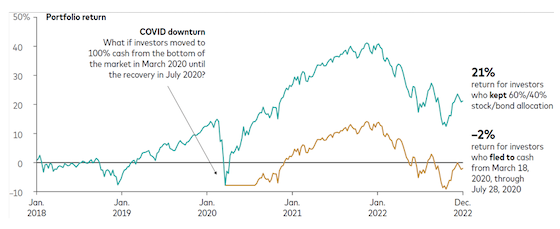
Reacting to market volatility can jeopardise returns

What if investors shifted to cash at the bottom of the COVID downturn and stayed there until the market recovered?

Notes: Stocks are represented by the MSCI All Country World Index; bonds are represented by the Bloomberg Global Aggregate Bond Index (USD Hedged). Cash is represented by the Bloomberg U.S. Treasury 1–3 Month U.S. Treasury Bill Index. Returns are in nominal terms.

Sources: Vanguard calculations, using data from Morningstar, Inc.

Past performance is no guarantee of future returns. The performance of an index is not an exact representation of any particular investment, as you cannot invest directly in an index.

Staying the course can help increase your chance of success, but so can other actions, like making regular contributions to your portfolio, and increasing them over time.

Other actions that can increase the likelihood of reaching an investment goal including having a consistent plan to rebalance your portfolio, a disciplined spending strategy, and a regularly scheduled date to monitor and review your goals.

Vanguard’s four principles can help you focus on the aspects within you control so you can build tailored plans to help you achieve long-term investing success.

Source: Vanguard January 2024

This article has been reprinted with the permission of Vanguard Investments Australia Ltd. Copyright Smart Investing™

Important information and general advice warning

Vanguard Investments Australia Ltd (ABN 72 072 881 086 / AFS Licence 227263) is the product issuer and the Operator of Vanguard Personal Investor. We have not taken your objectives, financial situation or needs into account when preparing this article so it may not be applicable to the particular situation you are considering. You should consider your objectives, financial situation or needs, and the disclosure documents for any financial product we make available before making any investment decision. Before you make any financial decision regarding Vanguard products, you should seek professional advice from a suitably qualified adviser. A copy of the Target Market Determinations (TMD) for Vanguard’s financial products can be obtained at vanguard.com.au free of charge and include a description of who the financial product is appropriate for. You should refer to the TMD before making any investment decisions. You can access our IDPS Guide, PDSs, Prospectus and TMDs at vanguard.com.au or by calling 1300 655 101. Past performance information is given for illustrative purposes only and should not be relied upon as, and is not, an indication of future performance. This article was prepared in good faith and we accept no liability for any errors or omissions.

2024 Vanguard Investments Australia Ltd. All rights reserved.

Investing successfully and improving your investment portfolio can be as much about minimising mistakes as trying to pick the ‘next big thing’. It’s all about taking a calm and considered approach and not blindly following trends or hot tips.

Let’s delve into some of the most prevalent investment mistakes and look at the principles that underpin a robust and successful portfolio.

Chasing hot and trending shares

Every so often there are industries or shares that are all over the media and you may begin to worry that you are missing out on something. Jumping on every trend is like trying to catch a wave; you might ride it for a bit, but you’re bound to wipe out sooner or later. That’s because the hot tips and ‘buy now’ rumours often don’t pass the fundamentals of investing test.

The key is to keep a cool head and remember that the real winners are often the ones playing the long game.

Not knowing your ‘why’

What would you like your investment portfolio to achieve? Understanding your motivations and goals will help you to choose investments that work best for you.

If you want to build wealth for a comfortable retirement, say 20 to 30 years down the track, you can afford to invest in riskier investments to play the long-term game. If you have already retired and plan to rely on income from your portfolio, then your focus will be on investments that provide consistent dividends and less on capital growth.

Timing the market

Timing the market involves buying and selling shares based on expected price movements but at best, you can only ever make an educated guess and then get lucky. At worst, you will fail.

As the world-renowned investor Peter Lynch wrote in his book Learn to Earn: “Far more money has been lost by investors trying to anticipate corrections, than lost in the corrections themselves”.i

Putting all the eggs in one basket

This is one of the classic concepts of investing but it’s worth repeating because, unless you are regularly reviewing your portfolio, you may be breaking the rule.

Diversifying your portfolio allows you to spread the risk when one particular share or market is performing badly.

Diversification can include different countries (such as adding international shares to your portfolio), other financial instruments (bonds, currency, real estate investment trusts, exchange traded funds), and industry sectors (ensuring a spread across various sectors such as healthcare, retail, energy, information technology).

Avoiding asset allocation

While diversification is key, how do you achieve it? The answer is by setting an asset allocation plan in place and reviewing it regularly.

How much exposure do you want to diversify into defensive and growth assets? Within them, how much should be invested in the underlying asset classes such as domestic shares, international shares, property, cash, fixed interest and alternatives.

Making emotional investment decisions

The financial markets are volatile and that often leads investors to make decisions that in hindsight seem irrational. During the COVID-19 pandemic, on 23 March 2020 the ASX 200 was 35 per cent below its 20 February 2020 peak.ii By May 2021, the ASX 200 crossed the 20 February 2020 peak. Many investors may have made an emotional decision to sell out during the falling market in March 2020 but then would have missed the some of the uplift in the following months in.

Seeking out quality and trustworthy financial advice can help to minimise investment mistakes. Give us a call if you would like to discuss options for growing your portfolio.

i From the Archives: Fear of Crashing, Peter Lynch – From the Archives: Fear of Crashing – Worth
ii Australian Securities Markets through the COVID-19 Pandemic – Australian Securities Markets through the COVID-19 Pandemic | Bulletin – March 2022 | RBA

Important: This provides general information and hasn’t taken your circumstances into account. It’s important to consider your particular circumstances before deciding what’s right for you. Although the information is from sources considered reliable, we do not guarantee that it is accurate or complete. You should not rely upon it and should seek qualified advice before making any investment decision. Except where liability under any statute cannot be excluded, we do not accept any liability (whether under contract, tort or otherwise) for any resulting loss or damage of the reader or any other person.

Any information provided by the author detailed above is separate and external to our business and our Licensee. Neither our business nor our Licensee takes any responsibility for any action or any service provided by the author. Any links have been provided with permission for information purposes only and will take you to external websites, which are not connected to our company in any way. Note: Our company does not endorse and is not responsible for the accuracy of the contents/information contained within the linked site(s) accessible from this page.

Understanding your redundancy payout

According to ASIC, a redundancy payout can be made up of any of the following:

  • a severance payment

  • an incentive payment

  • a payment in lieu of notice

  • unused annual leave and long service leave.

Regardless of its makeup, in most cases you’ll get a lump sum when you finish your role. The amount of the payout will likely vary depending on how long you’ve been with your company, and will be taxed accordingly.

It can be helpful to sit down with a financial expert and explore your options. Keep in mind key dates, major debts or payments, and whether you can afford a break before looking for work.

Depending on where you are in your career, a redundancy payout could be a blessing in disguise. It can sometimes provide you with a financial buffer to explore other opportunities.

Managing your spending habits

Redundancy can give you a certain amount of freedom, but you may still need to adjust your spending habits. Without any income, you should consider revising your necessary and unnecessary expenses.

  • Weekly budgets can help manage your day-to-day needs.

  • Consider yearly budgets for the bigger costs such as mortgage payments, school fees and holidays.

Just remember that reworking your spending habits doesn’t have to mean restricting your lifestyle. Figuring out what you’re happy to compromise on is a great place to start.

Dealing with debts

Depending on the size of your payout, you might find it hard to keep up debt repayments on things like your home, car, or school fees. If you’re finding it tricky, there are a number of ways we can help.

The important thing is to act quickly and not simply avoid making payments. That could be where you’ll run into trouble.

Reviewing your contractual rights

You can learn more about your redundancy rights and entitlements under the 2009 Fair Work Act.

If you believe that you’re being paid an amount less than what was agreed in your contract, or less than what the Fair Work Act indicates, seek out legal advice or contact the Fair Work Ombudsman directly.

Planning ahead

Unless you’re looking to move into retirement, it’s important to plan your next career move. If you’re having challenges re-entering your industry, it might be a good idea to look into education or retraining opportunities. The Department of Human Services may be able to provide services to assist you to update or change your skills

There are also plenty of legal, financial, employment and mental health networks and services available in Australia that can help you.

Source: NAB

Reproduced with permission of National Australia Bank (‘NAB’). This article was originally published at https://business.nab.com.au/

National Australia Bank Limited. ABN 12 004 044 937 AFSL and Australian Credit Licence 230686. The information contained in this article is intended to be of a general nature only. Any advice contained in this article has been prepared without taking into account your objectives, financial situation or needs. Before acting on any advice on this website, NAB recommends that you consider whether it is appropriate for your circumstances.

© 2023 National Australia Bank Limited (“NAB”). All rights reserved.

Important:
Any information provided by the author detailed above is separate and external to our business and our Licensee. Neither our business nor our Licensee takes any responsibility for any action or any service provided by the author. Any links have been provided with permission for information purposes only and will take you to external websites, which are not connected to our company in any way. Note: Our company does not endorse and is not responsible for the accuracy of the contents/information contained within the linked site(s) accessible from this page.

Buying a house is an exciting time. These steps will smooth your way through the house buying process.

1. Save for a house deposit

The first step is to get your finances sorted. Do a budget to identify how much you can afford to save for your deposit.

Next, do some house price research. Getting a general idea of house prices helps you set a goal to work towards. A great savings goal for a house deposit is 20% of the purchase price, plus enough to cover buying costs (see steps 5 and 6, below).

2. Work out what you can afford to borrow

Everyone’s situation is different. How much you can afford to borrow depends on your:

Be realistic about what you can afford. Mortgage interest rates have risen, so give yourself some breathing room.

3. Find the best home loan rate

When looking for a good deal on a home loan (mortgage), the interest rate matters. A home loan is a long-term debt, so even a small difference in interest adds up over time.

Compare home loan rates

Contact at least two different lenders to get loan options personalised for your situation. A rate even 0.5% lower could save you thousands of dollars over time. 

Get help if you need it

With many lenders to choose from, you may decide to get a mortgage broker to find loan options for you. We can help. 

Get pre-approval to buy

Consider getting loan pre-approval from a lender. They’ll ask for evidence of your current financial situation to assess your ability to repay the loan. Pre-approval lasts for 3–6 months and shows you’re eligible to apply for a loan up to a certain amount. It doesn’t commit you to a loan. It lets you set an affordable price range, and tells sellers you’re serious about buying.

4. Find a house to buy

Find a balance between the lifestyle you want and what you can comfortably afford.

Know why you’re buying

Reflect on why you want to buy. Are you planning to grow your family? Do you want to renovate? If you’re buying with a partner, talk about this together. Being clear about why you’re buying helps narrow down your property search.

Consider your must-haves and nice-to-haves

Make a list of your:

  • ‘must-haves’ (can’t do without), e.g. property size, layout, public transport, schools

  • ‘nice-to-haves’ (could do without for now), e.g. design, fittings, outdoor space

Focusing on your must-haves will help you prioritise the things that matter most.

Stick to your price range

If you’ve been pre-approved for $500,000, don’t waste time looking at properties advertised at $600,000. If your ideal suburb is outside your price range, keep an open mind about where to look.

Do your research

Look online, talk to real estate agents, go to property inspections and explore what’s on offer. Pace yourself — your search could take months.

5. Negotiate to buy your house

Finding a house you love is thrilling. It’s easy to get carried away by your emotions. Stick to your budget, and be as clear-headed as possible when bidding or negotiating to buy.

Auction or private treaty

If you’re a first home buyer, observe a few auctions so you understand how they work. Bring an experienced friend or family-member along to help you bid. Or consider hiring a buyer advocate to help with the buying process.

If buying at auction, expect to pay a deposit immediately (for example, 10% of the purchase price). There’s no cooling-off period if you buy at auction.

If buying privately, the contract of sale will include the deposit amount and when you need to pay it. There’s a short cooling-off period in most states and territories. You can usually get out of the contract and get most of your deposit back if you give written notice.

Contract of sale

The seller (vendor) of a property will prepare a contract of sale. As a potential buyer, first inspect the property and talk to the real estate agent or seller. Then, ask to see the contract of sale. Get help from a solicitor or conveyancer to review the contract before signing. Paying a legal expert is the best way to avoid costly mistakes.

Building and pest inspection

Once you’ve found a property you like, get a building and pest report done by a professional:

  • building inspection — structural issues, damp, electrical safety, cost of maintenance or repairs

  • pest inspection — termite activity, other pest issues

This could save you a lot of money down the track.

Make an offer

When you’re ready, there are two ways of making an offer:

  • unconditional — a binding contract to buy outright, if you have confirmed finance and are sure about the property

  • conditional — becomes a binding contract to buy, if certain conditions are met (e.g. valuation, finance approval, inspections)

Finalise your loan

Tell your lender you’ve found a property you wish to buy, and apply to finalise your loan.

6. Settle on your new home

You’re on the home stretch now, with a few more costs to take care of before you can move in.

Settlement

The settlement date is when the property title is transferred into your name, and your mortgage begins. The contract of sale sets out the settlement period, when you have to pay the full purchase price. Your solicitor or conveyancer will finalise the settlement with the lender and seller. Then you’ll get the keys to your new home.

Stamp duty

Stamp duty is a one-off state government property-transfer tax. You typically need to pay this within 30 days of settlement.

Find out how much you have to pay by using one of these calculators:

If you’re a first home buyer, check if you’re exempt from stamp duty or entitled to a rebate or concession.

Home and contents insurance

Protect your home and contents against damage or loss. This may be a condition of your home loan. 

Stay on track with your repayments

Finally, update your budget with your mortgage repayments, plus ongoing costs like council rates and land tax (when known). Extra expenses may take time to get used to, so keep an eye on your spending for a while.

Talk to us today about getting finance.

Source:
Reproduced with the permission of ASIC’s MoneySmart Team. This article was originally published at https://moneysmart.gov.au/home-loans/buying-a-house

Important note: This provides general information and hasn’t taken your circumstances into account.  It’s important to consider your particular circumstances before deciding what’s right for you. Although the information is from sources considered reliable, we do not guarantee that it is accurate or complete. You should not rely upon it and should seek qualified advice before making any investment decision. Except where liability under any statute cannot be excluded, we do not accept any liability (whether under contract, tort or otherwise) for any resulting loss or damage of the reader or any other person.  Past performance is not a reliable guide to future returns.

Important
Any information provided by the author detailed above is separate and external to our business and our Licensee. Neither our business nor our Licensee takes any responsibility for any action or any service provided by the author. Any links have been provided with permission for information purposes only and will take you to external websites, which are not connected to our company in any way. Note: Our company does not endorse and is not responsible for the accuracy of the contents/information contained within the linked site(s) accessible from this page.

The backstory

To say that it’s been a challenging period for bond investors for the best part of a decade, is not an exaggeration. If we cast our minds back to 2008, the world was in a precarious situation as the Global Financial Crisis took effect. Central bankers were busy thinking of ways to avoid a deep global recession or worse, a depression.

Troubled times called for decisive action which took the form of quantitative easing (QE). As part of QE, the US Federal Reserve bought up vast amounts of debt, essentially pumping liquidity into financial markets and interest rates were cut close to zero. While other central banks dragged their heels, many eventually adopted similar measures to help stimulate their respective economies. 

QE measures were predominately successful, and a deep prologued global recession was avoided. However pumping liquidity into the financial ecosystem had flow on effects which impacted all assets classes. Risk assets such as equities benefitted from this environment as markets generally like liquidity. For investors the decision to invest in equities ahead of bonds and cash was an easy one when the latter was paying investors close to zero.

For asset allocators there was little incentive to invest in government bonds on valuation or risk/return grounds as the payoff for taking on duration risk was negligible. Over this period, general consensus was to be overweight risk assets and underweight traditional defensive assets such as bonds.

While this positioning was great for investors as risk assets rallied, asset allocators were increasingly asking themselves what assets will play the ‘defensive’ role in a portfolio if bond yields are close to zero? This saw a greater focus on alternative investments by many institutional investors such as the superannuation funds, who increased allocations to more illiquid investments such as private assets and other alternative strategies to help fill the void.

The reset

While central bankers were patting themselves on the back for avoiding the world plunging into recession, many market analysts were questioning what the pathway out of QE would look like. The answer was not clear until a culmination of unforeseen events rapidly changed market dynamics, notably the Covid pandemic and Russia’s invasion of Ukraine.

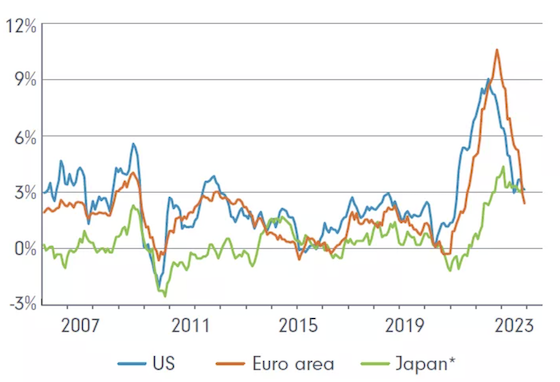
Both events significantly contributed to rising inflation and the subsequent reset in monetary policy brought a rapid rise of interest rates and bond yields. The Covid period saw the breakdown of global supply chains with many key ports effectively shut down, putting upward price pressure on everything from cars to computers. Inflationary pressures were further compounded by Russia’s invasion of Ukraine which saw commodity prices soar.

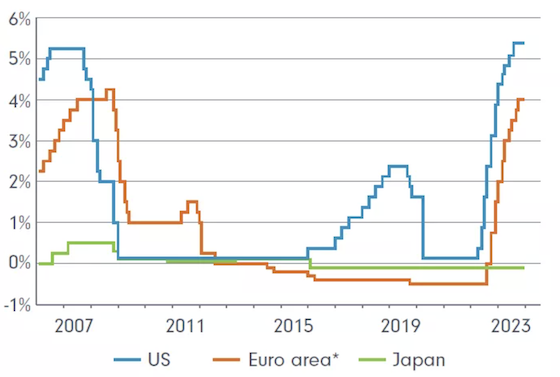
This rapid rise in inflation caused central banks around the world to hike rates aggressively and at speed. 

Chart 1. Inflation – advanced economies

*Excludes the effects of consumption tax increase in 2014.
Source: RBA; Refinitive.

Chart 2. Policy interest rates

*Main refinancing rate until the introduction of 3-year LTROs in December 2011; deposit facility rate thereafter.
Source: Central banks.

Rapid interest rate hikes had an adverse impact on asset prices as assets are generally priced against a risk-free rate such as US 10 Year Treasuries, generally considered to be risk free. Assets sensitive to changes in interest rates including infrastructure, property and notably bonds were all adversely impacted as inflation, interest rates and bond yields rose.

Bond investors couldn’t catch a break with several years of negligible returns, followed by a period of double-digit negative returns as inflation took hold and rates rose. Furthermore, bonds offered no protection from market volatility as the correlation between bonds and equities became positive, meaning both equities and bonds went down in value during periods of equity market sell offs. 

Chart 3. 2 year Rolling Correlation of US 10 Year Treasuries & the S&P 500

Source: US Federal Reserve

So why invest in bonds now?

1. Inflation

Globally, inflation levels have been easing from their peaks. In Australia inflation peaked in December 2022 at 7.8% and as at the end of September 2023 was 5.4%. Likewise, in the US inflation peaked at 9.06% in June 2022 and by the end of November last year was back to 3.14%.

While it’s too early to declare that the inflation genie has been put back firmly into the bottle, we’re arguably edging closer to the end of the interest rate tightening cycle, with key central banks pausing rate hikes as they monitor the efficacy of rate rises on curbing inflation. 

Should central banks begin easing interest rates once inflation is deemed to be under control, this would be positive for bond strategies exposed to duration risk such as government bonds or strategies benchmarked against the Bloomberg Global Aggregate Bond Index.

The extent of any potential rate cuts will depend on numerous factors. Our base case is that we are likely to experience a global cyclical recession in 2024 following a period where the market is pricing in a ‘soft landing’ scenario. Should this occur and we end up in a recession, central banks are likely to cut rates aggressively to avoid a deep recession. Such a scenario should be positive for bonds.

2. Bond Yields

Higher bond yields offer a more compelling investment case for holding bonds on a forward-looking basis, meaning you’re paid a higher yield for holding bonds. However, rising bond yields have impacted the capital return from bonds.

Bond yields have remained elevated partly due to the demand/supply dynamics impacting government bonds, notably US Treasuries as issuance has increased to fund the US deficit and demand has fallen as the government’s demand for bonds has deceased following the roll back of central bank QE programs.

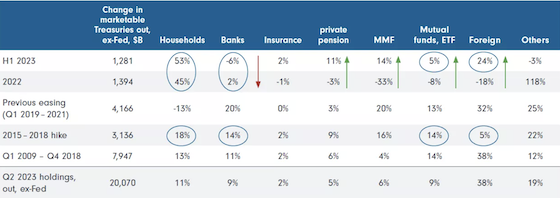
Fidelity believe that this demand/supply imbalance will regulate itself with other segments of the market such as households, taking up some of the excess demand and putting downward pressure on bond yields. In the interim, bond yields may remain elevated despite inflation moderating, as this demand/supply imbalance persists.

Household Demand for US Treasuries Rising


Source: US Federal Reserve, Macrobond

As inflation and demand/supply pressures ease our expectation is for bond yields to fall from current levels. While this will impact the yield offered to clients a fall in bond yields would have a positive impact on capital returns from bonds.

3. Diversification

Bonds have traditionally been a source of diversification within a portfolio. However as noted above, due to rising inflation and interest rates, bonds have not provided the portfolio diversification that investors would expect. The phenomenon where bonds and equities are highly correlated is typical in environments where there is a rapid regime shift in the inflation and interest rate environment – a move from low inflation and interest rates to high inflation and higher interest rates. 

As markets digests the change in market environment and we enter a more ‘normal’ rate cycle, we’d expect bonds to play an important diversification role in a portfolio as they’ve done traditionally.

There’s no doubt it’s been a bumpy journey for bond investors of late. The imbalances caused by aggressive QE, a global pandemic and geopolitical tensions have all contributed to turbulence in bond markets. However, as with all investment decisions, it’s important to look forward and understand how changing market conditions may impact asset class returns.

While there may still be a few bumps in the road, moderating inflation and a potential loosening in monetary policy should be positive for investors, reasserting bonds as an important pillar within a diversified portfolio.

Source:
Reproduced with permission of Fidelity Australia. This article was originally published at https://www.fidelity.com.au/insights/investment-articles/is-it-time-for-bonds-to-shine/

This document has been prepared without taking into account your objectives, financial situation or needs. You should consider these matters before acting on the information. You should also consider the relevant Product Disclosure Statements (“PDS”) for any Fidelity Australia product mentioned in this document before making any decision about whether to acquire the product. The PDS can be obtained by contacting Fidelity Australia on 1800 119 270 or by downloading it from our website at www.fidelity.com.au. This document may include general commentary on market activity, sector trends or other broad-based economic or political conditions that should not be taken as investment advice. Information stated herein about specific securities is subject to change. Any reference to specific securities should not be taken as a recommendation to buy, sell or hold these securities. While the information contained in this document has been prepared with reasonable care, no responsibility or liability is accepted for any errors or omissions or misstatements however caused. This document is intended as general information only. The document may not be reproduced or transmitted without prior written permission of Fidelity Australia. The issuer of Fidelity Australia’s managed investment schemes is FIL Responsible Entity (Australia) Limited ABN 33 148 059 009. Reference to ($) are in Australian dollars unless stated otherwise.
© 2024. FIL Responsible Entity (Australia) Limited.

Important:
This provides general information and hasn’t taken your circumstances into account. It’s important to consider your particular circumstances before deciding what’s right for you. Any information provided by the author detailed above is separate and external to our business and our Licensee. Neither our business nor our Licensee takes any responsibility for any action or any service provided by the author. Any links have been provided with permission for information purposes only and will take you to external websites, which are not connected to our company in any way. Note: Our company does not endorse and is not responsible for the accuracy of the contents/information contained within the linked site(s) accessible from this page.

We spend a lot of time online and don’t often think about the risks involved. Yet if we are not careful, we can make ourselves vulnerable to criminal activity such as hacking, phishing, and identity theft.

The annual Cyber Threat Report announced in 2023 a 23% year-on-year increase in cybercrimes in Australia, amounting to a cybercrime reported every six minutes.i And according to the recent Cybercrime in Australia report also published in 2023, 47% of survey respondents experienced at least one cybercrime that year, with half of all victims experiencing more than one instance.ii

One of the simplest ways to protect yourself online is to ensure you have secure login credentials and to update your passwords regularly. So, if you haven’t updated your passwords for some time, below are some tips to ensuring stay secure online.

Stronger password security

Vary your passwords

The most common vulnerability is passwords. We have passwords for many things we do online, protecting our bank accounts, inboxes, and social media accounts to name just a few.

With the need for so many passwords, it’s easy to see why we often become complacent and choose the same one for multiple accounts. A 2019 Google/Harris Poll study found that 52% of respondents use the same password for multiple accounts and 13% reuse the same password for all their accounts.iii Not only does this put your accounts at risk of being compromised, using the same password can lead to hackers utilising your credentials as a way of identifying as you.

Get creative

It’s no surprise that the most common passwords are 123456 and admin– they are easy to remember, however they are also easy for anyone to guess.iv

Choose a password that’s at least 12 characters long with a mix of uppercase and lowercase letters, numbers, and symbols. Some sites will need you to do this when you sign up, and it is good practice even when not required. Avoid using easily guessed information like birthdays, names, or common words (such as user or password).

Password management

Remembering your passwords, especially those which are a unique combination of letters and numbers, can be tricky. Use a centralised password management system to record passwords. There are many to choose from so look out for ones that are encrypted with a strong algorithm to prevent hacking.

Use 2-step verification

Another way to strengthen online security is to use 2-step verification. This adds additional security by asking you for further details, such as a number sent to you as a text message or email, or using an authenticator application to verify your identity when you log-in.

More ways to keep safe online

Using anti-virus software is wise as it’s designed to provide protection against the latest viruses and other types of malware. It updates automatically so you don’t need to worry as much about having to be on top of the latest cyber threats. It’s also worthwhile backing up any important data.

Not all our interactions online are protected, so be sure to use secure networks and be careful about public Wi-Fi, such as the one you might use in a café, airport, or library. Public Wi-Fi is convenient, however if you are using websites that aren’t encrypted, this information is at risk. Look out for the lock symbol near your browser’s location field and check that the site address starts with ‘https’ rather than ‘http’ to be on the safe side.

Lastly, it’s the simplest solution but one that bears mentioning – keep your personal information private. Don’t share your log-in information unless absolutely necessary and don’t display your passwords somewhere that’s easy to find (such as a label on your phone or laptop).

These preventative measures can help you stay safe online and away from the risks of cybercrime.

Common passwords in Australia

1. Banned — 2 minutes to crack

2. 123456 — less than a second to crack

3. Admin — less than a second to crack

4. password — less than a second to crack

5. qwerty123 — less than a second to crack

6. 12qwasZX — less than a second to crack

7. Starwars29 — 3 seconds to crack

8. welcome11 — 2 seconds to crack

i https://www.minister.defence.gov.au/media-releases/2023-11-15/release-annual-cyber-threat-report-2022-23
ii https://www.aic.gov.au/publications/sr/sr43
iii https://services.google.com/fh/files/blogs/google_security_infographic.pdf
iv https://nordpass.com/most-common-passwords-list/

Important: This provides general information and hasn’t taken your circumstances into account. It’s important to consider your particular circumstances before deciding what’s right for you. Although the information is from sources considered reliable, we do not guarantee that it is accurate or complete. You should not rely upon it and should seek qualified advice before making any investment decision. Except where liability under any statute cannot be excluded, we do not accept any liability (whether under contract, tort or otherwise) for any resulting loss or damage of the reader or any other person.

Any information provided by the author detailed above is separate and external to our business and our Licensee. Neither our business nor our Licensee takes any responsibility for any action or any service provided by the author. Any links have been provided with permission for information purposes only and will take you to external websites, which are not connected to our company in any way. Note: Our company does not endorse and is not responsible for the accuracy of the contents/information contained within the linked site(s) accessible from this page.