Experts use responses from people in more than 140 nations to rank the world’s ‘happiest’ countries in the World Happiness Report1. As Jon Clifton, CEO of Gallup, commented, “Our role in research on World Happiness is a natural fit with our longstanding mission: providing leaders with the right information about what people say makes life worthwhile.”

In 2024, Finland tops the overall list for the seventh successive year. Significantly, the United States of America (23rd) has fallen out of the top 20 for the first time since the World Happiness Report was first published in 2012, driven by a large drop in the wellbeing of Americans under 30. Afghanistan remains at the bottom of the overall rankings as the world’s least happy nation.

Serbia (37th) and Bulgaria (81st) have had the biggest increases in average life evaluation scores since they were first measured by the Gallup World Poll in 2013. This is reflected in the climb up the rankings between the World Happiness Report 2013 and this 2024 edition, of 69 places for Serbia and 63 places for Bulgaria.

Rankings are based on a three-year average of each population’s average assessment of their quality of life. Interdisciplinary experts from the fields of economics, psychology, sociology and beyond then attempt to explain the variations across countries and over time using factors such as GDP, life expectancy, having someone to count on, a sense of freedom, generosity, and perceptions of corruption. These factors help to explain the differences across nations, while the rankings themselves are based only on the answers people give when asked to rate their own lives.

For the first time, the report gives separate rankings by age group, in many cases varying widely from the overall rankings. Prof John F. Helliwell, a founding Editor of the World Happiness Report, said, “There is a great variety among countries in the relative happiness of the younger, older, and in-between populations.” Lithuania tops the list for children and young people under 30, while Denmark is the world’s happiest nation for those 60 and older.

Observing the state of happiness among the world’s children and adolescent population, researchers found that, globally, young people aged 15 to 24 report higher life satisfaction than older adults, but this gap is narrowing in Europe and recently reversed in North America.

In comparing generations, those born before 1965 are, on average, happier than those born since 1980. Among Millennials, evaluation of one’s own life drops with each year of age, while among Boomers, life satisfaction increases with age.

Further work examines the relationship between wellbeing and dementia, identified as a significant area of research in a globally aging population. Researchers highlight not only the impact of dementia on the wellbeing of individuals but also the demonstrable predictive power of higher wellbeing to reduce the risk of developing the disease in later life.

1 https://worldhappiness.report/

Australia’s average household debt was $261,492 in 2021-22, up 7.3% from the previous year (2020-2021). Meanwhile, the average household gross disposable income was $139,064, only up 3.7% from the previous year.

We might all agree that this is an interesting study. However, it is important to consider what can we do about it.

Combine high levels of debt with rising interest rates and a cost-of-living crisis, and it’s no surprise that Australian households are reaching out to debt management companies to help regain control of their finances.

Debt management companies are private organisations that can assist by:

  • consolidating and simplifying multiple debts,
  • helping to develop a sensible repayment plan,
  • negotiating with creditors to:
  • alleviate pressure on householders, and
  • satisfy creditors’ immediate payment concerns.

Sometimes, they repay your debts – to a specified limit – and you repay them under a single loan arrangement. Terms and payment amounts can be negotiated, offering a beacon of hope and a sense that you’re taking back control.

If this sounds like the perfect solution, remember that for every pro, there’s usually a con. For example:

  • Engaging a debt management company may affect your credit score. Though you’re making regular repayments, closing or restructuring accounts may be recorded unfavourably on your overall credit history.
  • Fees and charges apply. Debt management companies are not charities. Costs may include setup and monthly fees, usually calculated on the total debt being managed. Fees are added to the overall debt, which magnifies the financial difficulty.
  • Generally structured and inflexible, debt management plans require adherence to a strict payment schedule. This can be stressful if income fluctuates or unexpected financial situations arise.

While weighing the pros and cons of a debt management service, consider these do-it-yourself strategies.

Budgeting (aka Spending plan)

Creating a budget is a 3-step process.

  1. List your income and expenses (debts, rent/mortgage, food, medical, utilities, entertainment, eating out, etc.). For debts, include:
  2. amounts owed
  3. minimum monthly payments
  • due dates
  1. Categorise spending into a) Needs (needed to survive) and b) Wants (nice to have). Now, look for ways to reduce spending.

The government’s Moneysmart1 website lists easy ways of cutting back everyday spending.

  1. Allocate saved money to debts. Identify which one/s to pay first, e.g., prioritising those attracting higher interest, like credit cards.

Negotiating

Rather than customers defaulting, most banks and utilities companies prefer to negotiate repayment terms, sometimes even offering assistance programs.

The key is to reach out before it’s too late. Be upfront about your situation and willing to arrive at a mutually beneficial arrangement.

Remember, nobody wins when debts are not paid.

Government assistance

The Australian government provides a range of financial assistance packages and interest-free loans depending on circumstances. These include crisis payments for unexpected situations and income support payments for cost-of-living expenses.

Of course, there are conditions, but further information, including application criteria, is available from the MyGov2 website.

Financial counselling

Financial counsellors help you understand your financial position and assist you in navigating your way out of difficulty.

Some local communities offer free or low-cost financial literacy programs aimed at providing education about money and debt reduction.

Everyone’s financial situation is unique. There is no one-size-fits-all, so it’s important that your action plan is specific to your needs and that you’re 100% comfortable with any decisions you make.

What’s crucial is that you do something; being proactive is empowering and sets you on the path to financial recovery.

The information contained in this article is general information only. It is not intended to be a recommendation, offer, advice or invitation to purchase, sell or otherwise deal in securities or other investments. Before making any decision in respect to a financial product, you should seek advice from an appropriately qualified professional.  We believe that the information contained in this document is accurate. However, we are not specifically licensed to provide tax or legal advice and any information that may relate to you should be confirmed with your tax or legal adviser. 

1 https://moneysmart.gov.au/saving/simple-ways-to-save-money
2 https://my.gov.au/en/services/work/managing-the-cost-of-living/experiencing-financial-hardship/immediate-help-if-you-re-in-financial-hardship

Among all the voices analysing the Australian property market, you’ve probably heard many truisms about how to secure a home loan. The real truth is that there are lots of options.

We thought it was time to correct some frequent misconceptions we hear from our clients. Hopefully this will help you identify the path to home ownership that best suits your circumstances.

Beat the deposit treadmill

A common belief is that you need the holy grail of a 20% deposit before the banks will even look at you. It may be their ideal, but they also realise it’s out of reach for many – even with the help of mum and dad. The vast majority of lenders have a variety of deposit options. These include deposits as low as 5% and, if you qualify for a government guarantee, not having to pay mortgage insurance.

Guarantor home loans are becoming more common. These allow you to avoid stumping up a cash deposit by having a guarantor (usually a close relative) pledging their home equity to cover the equivalent of your 20% deposit.

You may also qualify for the Government Equity Scheme where the government pays 50% of your home loan. This lets you to enter the market with less deposit and reduces your repayments. However, it also means the government owns half the equity in your home.

When 30 years is too long

Most people want the longest mortgage possible as it means smaller monthly repayments. Of course, the downside to a 30-year mortgage is paying more interest over the long-term. For some situations, like if you want to increase your equity quickly, it might be better to opt for a shorter term where you pay more interest each month but less over entire the length of the loan. Knowing your timeline and expected cash flow will help decide what’s right for you.

The pros and cons of fixed rates

Now that there’s serious talk of interest rates falling, people are once again seeing the value of not locking in their interest rates for long periods. When deciding on a fixed or fluctuating mortgage you need to think about your long- and short-term financial goals and cash flow.

For example, at the time of choosing your mortgage, the fixed rate is usually higher than the fluctuating rate so you need to ask yourself if you can afford it. Many buyers decide to hedge their bets by splitting between the two. You can also fix rates for different time spans. Again, in general, the longer the ‘fix’, the higher the rate.

When interest-only makes sense

Getting an interest-only loan is often seen as risky and isn’t as popular as it once was. However, some people still find them useful, especially property investors. With an interest-only loan you just pay back the interest on your home loan and not any of the capital. This results in smaller monthly repayments but limits your equity growth in the property. Some people chose to start out interest-only so they can pay for renovations or get on top of their cash flow. They then switch to an interest and principal repayment structure later on.

Pre-approval is no guarantee

Estate agents love you to have ‘pre-approval’ for a home loan. It tells them you are serious about buying and that you know your limit. Pre-approval also speeds up the buying process because some of the basic paperwork has been submitted.

What it doesn’t do is guarantee that you will get the loan. Lenders still need to go through due diligence before approving you. You also need to be aware that pre-approvals last three months. After that, you have to apply to have it renewed.

With all the advice out there, identifying your individual path to home loan approval can appear tricky, but that’s only because you have options. There is no one size fits all. So, why not start the ball rolling by having a chat with us about your goals and options. We can arm you with the facts and help you set off on your property-owning path.

Important: This provides general information and hasn’t taken your circumstances into account. It’s important to consider your particular circumstances before deciding what’s right for you. Although the information is from sources considered reliable, we do not guarantee that it is accurate or complete. You should not rely upon it and should seek qualified advice before making any investment decision. Except where liability under any statute cannot be excluded, we do not accept any liability (whether under contract, tort or otherwise) for any resulting loss or damage of the reader or any other person.

Any information provided by the author detailed above is separate and external to our business and our Licensee. Neither our business nor our Licensee takes any responsibility for any action or any service provided by the author. Any links have been provided with permission for information purposes only and will take you to external websites, which are not connected to our company in any way. Note: Our company does not endorse and is not responsible for the accuracy of the contents/information contained within the linked site(s) accessible from this page.

The latest rise in the Age Pension rate still falls short of what many people may need to have a modest lifestyle in retirement.

Around 2.58 million Australians received a 1.78% government Age Pension payment boost on March 20 as part of Centrelink’s twice-yearly indexation review.

They included the 1.76 million people who receive a full Age Pension, according to Department of Social Services December 2023 quarterly data, and a further 806,670 who qualify for part pension payments based on them having passed either Centrelink’s “income” or “assets” pension means tests, or both.

The raise means the full Age Pension rate for singles has risen by $19.60 to $1,116.30 per fortnight, and for couples by $14.70 to $841.40 per fortnight each. These amounts equate to $29,023.80 and $43,752.80 per year, respectively.

Yet, with cost-of-living pressures continuing to mount, receiving only the full Age Pension without the benefit of other sources of regular income means that even having a modest lifestyle in retirement may be out of reach for many Australians.

Retirement costs have spiked

December 2023 quarterly data released by the Association of Superannuation Funds of Australia (ASFA) shows that rises in everyday living expenses had pushed up the amounts needed to fund a good standard of living in retirement to record levels.

Falling inflation levels should help to reduce some of these living costs, but certainly not all of them.

Weekly budgets for various households and living standards for those aged around 65 (December quarter 2023, national)

Household

Single Modest

Couple Modest

Single Comfortable

Couple Comfortable

Housing – ongoing only

$118.48

$133.61

$139.37

$145.49

Energy

$40.68

$54.64

$51.54

$63.92

Food

$109.64

$203.27

$141.76

$246.38

Clothing

$21.16

$40.21

$28.26

$52.63

Household goods and services

$39.40

$46.25

$85.24

$105.69

Health

$55.53

$107.50

$112.94

$211.63

Transport

$109.57

$116.71

$179.02

$193.91

Leisure 

$113.03

$117.47

$221.33

$332.71

Communications

 $18.29

$20.61

$22.88

$29.78

Total per week

$625.78

$900.27

$982.34

$1,382.15

Total per year

$32,666

$46,994

$51,278

$72,148

Source: ASFA

The annual cost for a single person aged between 65 and 84 to have a modest lifestyle in retirement was $32,665.66. This is about 12.5% above the new full Age Pension rate.

ASFA defines a modest retirement lifestyle income as one that enables retirees to afford basic health insurance and infrequent exercise, leisure and social activities with family and friends.

For couples, ASFA found that $46,994.28 per year was needed to have a modest retirement. This level is only about 7.4% above the new full Age Pension rate for couples.

Under the Age Pension income test, singles can also earn up to $204 per fortnight ($5,304 per year) and couples $360 per fortnight ($9,360 per year) before their fortnightly full Age Pension payments are reduced based on every dollar earned above these amounts.

But to have a comfortable retirement, which ASFA defines as being able to maintain a good standard of living without major spending restrictions, the association has calculated that single retirees will need an annual income of $51,278.30 and couples $72,148.19.

These levels are significantly above the full Age Pension rates and are much more likely to be achieved by individuals and couples who are able to generate higher account-based pension income from their accumulated retirement savings balances and other income-producing assets.

In doing so, they are more likely to fall outside of both the income test and assets test boundaries to actually qualify for the Age Pension (at least during the early phase of their retirement until their pension drawdowns over time bring them within Centrelink’s limits for receiving a full or part Age Pension).

The benefits of good retirement planning

The 2023 thematic review of the retirement income covenant by the Australian Prudential Regulation Authority (APRA) and the Australian Securities & Investments Commission (ASIC) into how super trustees are helping members enhance retirement outcomes concluded that more needs to be done to improve superannuation member outcomes in retirement.

Longevity risk – the risk of outliving savings – is a key concern for retirees in deciding how to draw down their superannuation during retirement.

“Most people rely on the Government for protection against longevity risk through the Age Pension, which provides a safety net for retirees who outlive their savings,” according to the Intergenerational Report 2023.

“Well-designed superannuation retirement products can assist retirees to make decisions to help smooth consumption over retirement – aligning income needs with expenditure needs – and draw down on their balances efficiently. This would also enable decision making early in retirement.”

Preparing well ahead for life in retirement is key. A good starting point for many Australians should be to seek out professional financial advice, especially in the context of retirement spending and understanding how the Age Pension may play an important role.

This article has been reprinted with the permission of Vanguard Investments Australia Ltd. Copyright Smart Investing™

GENERAL ADVICE WARNING
Vanguard Investments Australia Ltd (ABN 72 072 881 086 / AFS Licence 227263) (VIA) is the product issuer and operator of Vanguard Personal Investor. Vanguard Super Pty Ltd (ABN 73 643 614 386 / AFS Licence 526270) (the Trustee) is the trustee and product issuer of Vanguard Super (ABN 27 923 449 966).
The Trustee has contracted with VIA to provide some services for Vanguard Super. Any general advice is provided by VIA. The Trustee and VIA are both wholly owned subsidiaries of The Vanguard Group, Inc (collectively, “Vanguard”).
We have not taken your or your clients’ objectives, financial situation or needs into account when preparing our website content so it may not be applicable to the particular situation you are considering. You should consider your objectives, financial situation or needs, and the disclosure documents for the product before making any investment decision. Before you make any financial decision regarding the product, you should seek professional advice from a suitably qualified adviser. A copy of the Target Market Determinations (TMD) for Vanguard’s financial products can be obtained on our website free of charge, which includes a description of who the financial product is appropriate for. You should refer to the TMD of the product before making any investment decisions. You can access our Investor Directed Portfolio Service (IDPS) Guide, Product Disclosure Statements (PDS), Prospectus and TMD at vanguard.com.au and Vanguard Super SaveSmart and TMD at vanguard.com.au/super or by calling 1300 655 101. Past performance information is given for illustrative purposes only and should not be relied upon as, and is not, an indication of future performance. This website was prepared in good faith and we accept no liability for any errors or omissions.
Important Legal Notice – Offer not to persons outside Australia
The PDS, IDPS Guide or Prospectus does not constitute an offer or invitation in any jurisdiction other than in Australia. Applications from outside Australia will not be accepted. For the avoidance of doubt, these products are not intended to be sold to US Persons as defined under Regulation S of the US federal securities laws.
© 2024 Vanguard Investments Australia Ltd. All rights reserved.

A credit card balance transfer is when you move the amount you owe (the balance) to another credit card.

The new interest rate on the balance you transfer may be either 0% or a special low rate for a limited time.

If you can pay off the balance you transfer within that time, you may save money. But if you can’t, it may end up costing you more.

If you’re struggling with your credit card repayments, a balance transfer might not be right for you. There are better options to get your debt under control.

How to make a balance transfer work for you

If you’re considering a credit card balance transfer, here’s what to do to make sure it works for you.

Pay off the balance in time

The special low interest rate on the amount you transfer is called the balance transfer rate. It lasts for a limited time, usually between six months and two years.

After that, the interest rate goes up. The new rate may be higher than the interest rate on your original credit card. If you haven’t paid off the whole amount, whatever is left will attract this higher interest rate.

Be realistic about what you can afford to repay in that limited time.

Work out your monthly repayments to pay off the balance in time.

Limit spending on your new card

If you use your new credit card to buy things straight away, a different interest rate may apply. This interest rate — or ‘purchase rate’ — is usually much higher than the balance transfer rate.

Also, your repayments may go towards paying off the new purchases, instead of paying off the balance you transferred. This means you don’t get the full benefit of the transfer, and you add to your credit card debt.

Limit your spending so you can focus on paying off the balance faster.

Cancel your old card

If you decide to do a balance transfer, make sure you cancel your old card. That way, you’ll avoid the temptation to create more debt.

Protect your credit score

When you apply for a new credit card or do a balance transfer, it’s added to your credit report. If you apply several times in a short period of time, it can harm your credit score.

If you’ve transferred your balance before, it may be better to try to pay off your credit card than to transfer again.

Check how much you can transfer

Some cards set a maximum amount you can transfer, so you might not be able to transfer the full amount from your current card. If there’s still money owing on your current card after the transfer, you’ll have to pay interest and fees on that as well. It may not be worth paying interest and fees on two cards.

Compare balance transfers

Compare rates and fees so you get a balance transfer that will save you money, not cost you more later.

Compare credit card rates and fees

Balance transfer rate

  • the interest rate on the amount you transfer (the balance)

  • when it starts

  • how long it lasts (transfer period)

Balance transfer amount

  • how much you can transfer

Purchase (interest) rate

  • the interest charged on things you buy

  • if it changes after the transfer period

Interest-free days

  • the number of days you won’t be charged interest on purchases

  • when this starts (straight away, or once you’ve paid off the amount transferred)

Rewards programs

  • which programs are included

  • what the fees are

Annual fee

  • the amount you pay every year

  • when it starts (straight away or later)

Other fees

Any fees for:

  • the transfer to the new credit card

  • late repayments

  • cash advances (cash taken out)

  • going over your credit limit

  • using your credit card to shop or travel overseas

Comparison websites can be useful, but they are businesses and may make money through promoted links. They may not cover all your options. 

Set a payment reminder

If you go ahead with a credit card balance transfer, try your best to pay it off before the special interest rate ends.

Set a payment reminder in your calendar so you don’t forget.

Source:
Reproduced with the permission of ASIC’s MoneySmart Team. This article was originally published at https://moneysmart.gov.au/credit-cards/credit-card-balance-transfers

Important note: This provides general information and hasn’t taken your circumstances into account.  It’s important to consider your particular circumstances before deciding what’s right for you. Although the information is from sources considered reliable, we do not guarantee that it is accurate or complete. You should not rely upon it and should seek qualified advice before making any investment decision. Except where liability under any statute cannot be excluded, we do not accept any liability (whether under contract, tort or otherwise) for any resulting loss or damage of the reader or any other person.  Past performance is not a reliable guide to future returns.

Important
Any information provided by the author detailed above is separate and external to our business and our Licensee. Neither our business nor our Licensee takes any responsibility for any action or any service provided by the author. Any links have been provided with permission for information purposes only and will take you to external websites, which are not connected to our company in any way. Note: Our company does not endorse and is not responsible for the accuracy of the contents/information contained within the linked site(s) accessible from this page.

With interest rates likely to fall this year, borrowers could invest some or all of their mortgage repayment savings.

Inflation may be coming off its high, but the retail price of coffee isn’t likely to lose any monetary steam.

Depending on where you buy, the average cost across Australia of a regular-size takeaway cup of coffee is now around $5. For those needing a daily fix, that equates to $35 per week.

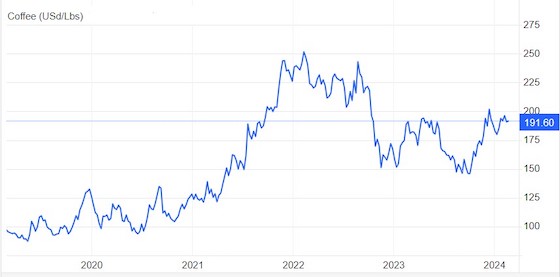
The chart below isn’t the Australian share market. It’s the wholesale price of coffee since the start of 2019.

The caffeine hit
Source: Trading Economics

The sharp rise in coffee prices has been the key driver behind a worldwide surge in coffee machine sales. Many coffee consumers are now choosing to reduce their intake of café takeaways by making their own at home or in the office. It’s a small way to reduce everyday living expenses.

Of course, coffee isn’t the only thing on an inflation-induced high. Average monthly mortgage payments have also effectively doubled for many households since the Reserve Bank began rapidly raising interest rates in May 2022.

But there’s a big difference. Unlike the price of a cup of coffee, borrowers should see a price reduction later this year based on forecasts that banks will start reducing their interest rates in the second half. Lower rates will add up to big cash injections for many borrowers as their monthly repayments fall.

And this raises an important question. Should borrowers continue paying down their home loan at the same, current higher repayment rate, or would it be better to redeploy some or all of those expected mortgage savings another way?

Paying extra off the mortgage

Borrowers generally have two choices when interest rates are reduced. They can choose to pay a lower monthly repayment rate based on their outstanding loan balance, or they can maintain their repayments at the previous rate.

For example, a borrower paying off a $400,000 principal and interest mortgage over 25 years would currently be making repayments of just over $2,701 per month based on a mortgage interest rate of 6.5% per annum.

A reduction in the mortgage interest rate to 6% would see monthly repayments fall to $2,577, a saving of $124 per month.

By maintaining repayments at $2,701 per month, a borrower would pay off their loan in 22 years and seven months, reducing their loan term by almost two-and-a-half years.

Reducing the amount owing on a loan will reduce monthly repayments, the interest charges on the outstanding balance and, most likely, the overall term of a loan.

On the other hand, investing additional funds into other areas can potentially offset the debt-servicing costs of a loan over time if the net returns from those investments are higher.

An alternative pathway

When interest rates do eventually begin to fall, an option for borrowers could be to invest some or all of their monthly mortgage repayment savings.

If the average interest rate on a variable rate owner-occupied home loan over its term was 5%, while the net returns from an investment over the same period of time was 9%, then one could build a case that investing surplus funds may be a better path.

The 2023 Vanguard Index Chart shows that the Australian share market, measured by the S&P/ASX All Ordinaries Total Return Index, returned an average of 9.2% per annum over the 30-year period from 1 July 1993 to 30 June 2023.

Over the 10 years from 1 January 2014 to 31 December 2023 the Australian share market, measured by the All Ordinaries Total Accumulation Index, achieved an average return of 8.2% per annum.

It should be noted that it is impossible to predict future share market returns, and past performance is not an indicator of future performance.

The following example is based on a hypothetical person having invested $124 per month from 1 January 2014, capturing the average return of the Australian share market to 31 December 2023.

Over the decade they would have made 120 monthly payments worth a total of $14,880.

However, factoring in the growth and income returns from the Australian share market over the decade, their balance would have surged to $22,829. That’s a total gain of around $8,000.*

Do your homework

There are a range of things to consider based on one’s personal circumstances before deciding whether to pay down debt or to direct extra money into investments. There is no one-size fits all approach.

Investment returns can be volatile, and some asset classes can deliver low or negative returns, resulting in a potential loss of income and the principal invested. As such, depending on the mortgage interest rate being paid, borrowers may not be able to achieve an investment return that is high enough to compensate for the additional interest being paid.

If in doubt, a financial adviser can take into account all your specific characteristics and help define the best course of action.

* Returns based on S&P/ASX All Ordinaries Total Return Index and do not make any allowance for fees, costs or taxes. Past performance information is given for illustrative purposes only and should not be relied upon as, and is not, an indication of future performance. The performance of an index is not an exact representation of any particular investment, as you cannot invest directly in an index.

This article has been reprinted with the permission of Vanguard Investments Australia Ltd. Copyright Smart Investing™

GENERAL ADVICE WARNING
Vanguard Investments Australia Ltd (ABN 72 072 881 086 / AFS Licence 227263) (VIA) is the product issuer and operator of Vanguard Personal Investor. Vanguard Super Pty Ltd (ABN 73 643 614 386 / AFS Licence 526270) (the Trustee) is the trustee and product issuer of Vanguard Super (ABN 27 923 449 966).
The Trustee has contracted with VIA to provide some services for Vanguard Super. Any general advice is provided by VIA. The Trustee and VIA are both wholly owned subsidiaries of The Vanguard Group, Inc (collectively, “Vanguard”).
We have not taken your or your clients’ objectives, financial situation or needs into account when preparing our website content so it may not be applicable to the particular situation you are considering. You should consider your objectives, financial situation or needs, and the disclosure documents for the product before making any investment decision. Before you make any financial decision regarding the product, you should seek professional advice from a suitably qualified adviser. A copy of the Target Market Determinations (TMD) for Vanguard’s financial products can be obtained on our website free of charge, which includes a description of who the financial product is appropriate for. You should refer to the TMD of the product before making any investment decisions. You can access our Investor Directed Portfolio Service (IDPS) Guide, Product Disclosure Statements (PDS), Prospectus and TMD at vanguard.com.au and Vanguard Super SaveSmart and TMD at vanguard.com.au/super or by calling 1300 655 101. Past performance information is given for illustrative purposes only and should not be relied upon as, and is not, an indication of future performance. This website was prepared in good faith and we accept no liability for any errors or omissions.
Important Legal Notice – Offer not to persons outside Australia
The PDS, IDPS Guide or Prospectus does not constitute an offer or invitation in any jurisdiction other than in Australia. Applications from outside Australia will not be accepted. For the avoidance of doubt, these products are not intended to be sold to US Persons as defined under Regulation S of the US federal securities laws.
© 2024 Vanguard Investments Australia Ltd. All rights reserved.


Memory loss can make it difficult to stay in control of your money. Things like checking bank statements or investments, or paying bills may become challenging.

If you’re starting to struggle, it’s time to put some safeguards in place. A few simple steps will help you and your loved ones protect your money and prepare for the future.

Start planning

It can be confronting to think about what may happen when you can no longer manage your own money. But it’s important to start planning.

Making a plan is the best way to have a say in things that will affect you. It also helps your loved ones if they have to make decisions for you in the future.

Dementia Australia has worksheets and information to help you plan, if you have signs of memory loss or dementia.

Appoint an enduring power of attorney

An enduring power of attorney lets you choose someone to make financial and legal decisions for you if you can’t make them yourself.

It’s important to choose someone you trust and who will act in your best interests. They will be looking after your bank account, paying your bills, and even selling your house if you need to move into aged care.

This person could be your partner, child, another relative or friend. Or it could be an independent person, such as the Public Trustee or your solicitor. You can appoint two people, but you need to be confident they will agree on your best interests.

No matter who you appoint, discuss it with your family so they know and understand your wishes.

Update your will

Take the time to review your will and make sure it’s up-to-date. If you don’t already have a will, it’s important to make one.

To make a valid will, you need to understand the decisions you make and the effect of those decisions. Being diagnosed with dementia doesn’t necessarily mean you’ve lost the ability to do this. But, if you’re concerned about memory loss, it’s better to make or update your will now.

Keep your will in a safe place and tell someone you trust where it’s kept.

Get your super in order

To make sure your super goes to the right people (beneficiaries) when you die, you need a binding nomination. You do this through your super fund — not through your will.

If you don’t nominate anyone, the super fund trustee will decide who your money goes to.

Or, you can nominate your estate as the beneficiary. This means your super becomes part of your estate and is paid out according to your will.

If you have more than one super fund, think about consolidating them. It’s easy to do and will make it easier to manage in the future.

If you have a self-managed super fund (SMSF), consider:

  • changing to a simpler, professionally managed fund

  • nominating someone you trust to take over your trustee role as your legal personal representative

Running an SMSF is complex. There may be serious financial consequences if you can no longer manage it properly.

Sort out your important documents

To make things easier — for you and your power of attorney — put your personal and financial information in one file. Keep duplicates in a safe place, such as a safe deposit box with your bank, or with your solicitor.

The important documents to include are:

Personal documents

  • birth certificate

  • marriage certificate

  • will

  • enduring power of attorney or guardian details

  • Tax File Number

  • Centrelink Customer Reference Number or Department of Veterans’ Affairs file number

  • list of your assets

House documents

  • house deeds

  • home and contents insurance

  • deeds and insurance policies for any other real estate you own

  • mortgage documents

Financial documents

  • bank account details

  • list of direct debits

  • superannuation papers

  • documents related to loans

  • investment documents (securities, share certificates, bonds)

  • prepaid funeral plans

Health documents

  • advance care directive (also called a living will)

  • Medicare card

  • medical or life insurance details

  • details of your My Health Record

  • pensioner concession card

Protect yourself from financial abuse

Older people can be more vulnerable to financial abuse. This is because they often depend on others for help with financial tasks and decisions. If you have memory loss or dementia, the risk is even higher.

It’s important that your friends and family don’t pressure you or try to influence your financial decisions.

See financial abuse for the signs to watch out for and where you can get help.

Source:
Reproduced with the permission of ASIC’s MoneySmart Team. This article was originally published at https://moneysmart.gov.au/living-in-retirement/memory-loss-dementia-and-your-money

Important note: This provides general information and hasn’t taken your circumstances into account.  It’s important to consider your particular circumstances before deciding what’s right for you. Although the information is from sources considered reliable, we do not guarantee that it is accurate or complete. You should not rely upon it and should seek qualified advice before making any investment decision. Except where liability under any statute cannot be excluded, we do not accept any liability (whether under contract, tort or otherwise) for any resulting loss or damage of the reader or any other person.  Past performance is not a reliable guide to future returns.

Important
Any information provided by the author detailed above is separate and external to our business and our Licensee. Neither our business nor our Licensee takes any responsibility for any action or any service provided by the author. Any links have been provided with permission for information purposes only and will take you to external websites, which are not connected to our company in any way. Note: Our company does not endorse and is not responsible for the accuracy of the contents/information contained within the linked site(s) accessible from this page.

A pause in super contributions can have long-lasting effects. Here’s how to plan ahead for super breaks.

There’s a host of reasons why people take career breaks.

Having and raising children, or taking an extended holiday or sabbatical, are the most common reasons.

Vanguard’s 2023 How Australia Retires study, based on a survey of more than 1,800 working and retired Australians, found that 2 in 5 current working-age Australians (40%) expected to take some form of extended break from work during their career, probably between their twenties and fifties.

Of those surveyed, 1 in 2 people under 35 years old expected to take parental leave, especially in their thirties.

Of course, in most cases, stopping work is likely to have some financial consequences. In the context of retirement specifically, taking a career break will probably result in reduced or paused employer superannuation contributions during that time and the same for personal super contributions.

However below are six steps that could be used to lessen the impact of a career break on a super balance. They could be taken beforehand, afterwards or both.

1. Make pre-tax contributions

All working Australians can contribute up to $27,500 per financial year into their super at a concessional tax rate of 15%. This includes employer and concessional personal contributions. An effective way to make extra contributions into your super is by setting up a salary sacrificing arrangement with your employer so extra payments are deducted from your pre-tax earnings.

2. Make after-tax contributions

If you’ve come into some extra money where the tax has already been paid, such as from an asset sale, you may be able to take advantage of after-tax contributions. The government allows non-concessional contributions of up to $110,000 each financial year. Also, under what’s known as the “bring-forward” rule, you may be able to make a non-concessional contribution of up to $330,000 in one financial year. This prevents any further non-concessional contributions for the next three financial years.

3. Make super catch-ups

You may be able to take advantage of unused pre-tax contributions you have from previous financial years, on a five-year rolling basis. This means you could potentially contribute more than the annual $27,500 concessional contributions limit in a single financial year. However, to do so, you would need to make concessional contributions in a financial year that exceed the annual limit, and your total super balance must be below $500,000 as at 30 June of the previous financial year.

4. Receive a government co-contribution

If you make a personal super contribution, you may be eligible for a matching contribution from the federal government of up to $500. For more information, check the Australian Tax Office’s (ATO) website.

5. Receive a low income super tax offset

The Low Income Superannuation Tax Offset, or LISTO, assists eligible workers earning $37,000 a year or less. It can be worth up to $500 per year and is paid automatically by the ATO into your super fund account.

6. Split superannuation with your spouse

The ATO allows couples to split up to 85% of their annual employer concessional contributions, as well as additional salary sacrifice and personal super contributions. The full guidelines around splitting, including eligibility and the application form that needs to be completed, are also available on the ATO’s website.

Superannuation and retirement planning is a complex area.

Take care to understand the contributions types and limits carefully as there are significant tax penalties for exceeding the applicable contributions caps.

If you’re unsure about your options and need some advice on how to maximise your retirement nest egg, consider consulting a licensed financial adviser who can provide you with personalised advice.

We’re here to help so speak to us today. 

This article has been reprinted with the permission of Vanguard Investments Australia Ltd. Copyright Smart Investing™

GENERAL ADVICE WARNING
Vanguard Investments Australia Ltd (ABN 72 072 881 086 / AFS Licence 227263) (VIA) is the product issuer and operator of Vanguard Personal Investor. Vanguard Super Pty Ltd (ABN 73 643 614 386 / AFS Licence 526270) (the Trustee) is the trustee and product issuer of Vanguard Super (ABN 27 923 449 966).
The Trustee has contracted with VIA to provide some services for Vanguard Super. Any general advice is provided by VIA. The Trustee and VIA are both wholly owned subsidiaries of The Vanguard Group, Inc (collectively, “Vanguard”).
We have not taken your or your clients’ objectives, financial situation or needs into account when preparing our website content so it may not be applicable to the particular situation you are considering. You should consider your objectives, financial situation or needs, and the disclosure documents for the product before making any investment decision. Before you make any financial decision regarding the product, you should seek professional advice from a suitably qualified adviser. A copy of the Target Market Determinations (TMD) for Vanguard’s financial products can be obtained on our website free of charge, which includes a description of who the financial product is appropriate for. You should refer to the TMD of the product before making any investment decisions. You can access our Investor Directed Portfolio Service (IDPS) Guide, Product Disclosure Statements (PDS), Prospectus and TMD at vanguard.com.au and Vanguard Super SaveSmart and TMD at vanguard.com.au/super or by calling 1300 655 101. Past performance information is given for illustrative purposes only and should not be relied upon as, and is not, an indication of future performance. This website was prepared in good faith and we accept no liability for any errors or omissions.
Important Legal Notice – Offer not to persons outside Australia
The PDS, IDPS Guide or Prospectus does not constitute an offer or invitation in any jurisdiction other than in Australia. Applications from outside Australia will not be accepted. For the avoidance of doubt, these products are not intended to be sold to US Persons as defined under Regulation S of the US federal securities laws.
© 2024 Vanguard Investments Australia Ltd. All rights reserved.

For most of us, our mortgage is our biggest financial burden – and one that’ll be with us for decades. However, it’s important to remember that the life of a home loan doesn’t need to be as long as the contract suggests; you’re free to pay it off faster and take that financial load off your shoulders sooner.

Chipping away at your mammoth mortgage takes a committed plan, so here are some savvy ways to be debt-free earlier than originally planned.

Consider making fortnightly payments

If you’re paying your mortgage off monthly, consider switching to fortnightly repayments. It may seem like a trivial move, but by paying half the monthly amount every two weeks you can actually make the equivalent of an extra month’s repayment each year. This small move will compound over the life of your loan, reduce the interest paid and allow you to pay off your principal sooner.

Case study

Peta and Alex have a new home loan of $500,000 at a variable interest rate of 6.66% per annum and they’ve chosen to repay principal and interest over a 30-year term. Their monthly repayments at that rate would be $3,213 (not including additional fees and charges).

But if the couple decide to make fortnightly repayments of half their original monthly repayment ($1,607) they would be paying more off their mortgage by the end of the year, i.e., less interest therefore saving them money.

In the long term, they’d pay off their loan more than six years sooner and save around $160,000 in interest (if their interest rate remained the same for the life of the loan).

Make a lump sum payment

A one-off lump sum payment like a redundancy cheque or inheritance as well as semi regular additional payments such as a tax return or work bonus – especially during the first few years of a typical mortgage – could carve years (and cash) off your mortgage and help you get debt-free faster.

It’s important to note that placing a lump sum payment on your mortgage won’t lower your repayments. However, it will help you save on the interest component and lower the total amount of time left on your home loan.

Look at refinancing

By giving your existing mortgage a health check, you could find there is a better rate, or even a better bank, out there for you. Just because you signed on the dotted line for 20, 25 or 30 years doesn’t mean you need to stick with the same lender.

Refinancing could get you a lower interest rate which would ease the hip pocket, but if you can manage to keep making the higher repayments moving forward, you’ll end up reducing the life of your loan.

If you have at least 20% equity in your home and a great credit score, you’ll have more bargaining power. Carefully read the fine print to be aware of hidden costs like annual fees or ‘honeymoon’ interest rates that could change after an introductory period, application fees, valuation fees and break fees.

Get into an offset account

You don’t need to keep your savings and your mortgage separate, in fact, they work better together. By putting your savings or even salary in an offset account with a redraw facility, you can reduce the amount of interest you pay but still have access to your funds if you need them.

Ultimately, the more money you keep in your offset account, the bigger the savings and the faster your loan will be paid off.

To work out how you could be mortgage-free sooner while shaving thousands off your home loan talk to us today.

NOTE: Interest rates, fees, regular repayments, and the potential savings will vary depending on your unique circumstances. All calculations have been calculated using the moneysmart.gov.au mortgage calculator.

Important: This provides general information and hasn’t taken your circumstances into account. It’s important to consider your particular circumstances before deciding what’s right for you. Although the information is from sources considered reliable, we do not guarantee that it is accurate or complete. You should not rely upon it and should seek qualified advice before making any investment decision. Except where liability under any statute cannot be excluded, we do not accept any liability (whether under contract, tort or otherwise) for any resulting loss or damage of the reader or any other person.

Any information provided by the author detailed above is separate and external to our business and our Licensee. Neither our business nor our Licensee takes any responsibility for any action or any service provided by the author. Any links have been provided with permission for information purposes only and will take you to external websites, which are not connected to our company in any way. Note: Our company does not endorse and is not responsible for the accuracy of the contents/information contained within the linked site(s) accessible from this page.

Planning is the key to successful investing. Creating a plan will help you find investments that fit your investing time frame and risk tolerance, to help you reach your financial goals sooner.

1. Review your finances

Before you invest, review your financial situation.

Write down what you owe (your debts) and what you own (your assets). For your assets include your:

  • super

  • home

  • savings

  • other investments

Our net worth calculator can help you record this. Writing down what you own and what you owe will help you see what savings you can invest. It will also help you see how you can diversify.

Then write down your income and expenses. Our budget planner can help you track what money is coming in and going out. This will help you see how much you can put toward investing regularly.

2. Set your financial goals

Write down your financial goals. For each goal include how much you’ll need and how long you have to reach it. For example, taking a $10,000 holiday in one year, or reaching $500,000 in superannuation before you retire.

Then divide your goals into:

  • short term (0 to 2 years)

  • medium term (3 to 5 years)

  • long term (5 years or more)

Setting and defining your financial goals will help you pick the right investment to reach each goal.

3. Understand investment risks

Investment risk is the likelihood that you’ll lose some or all the money you’ve invested. This can be due to your investment falling in value or not performing how you expected. All assets carry investment risks — some are riskier than others. 

Risks that can affect the value of your investment include:

Interest rate risk

Interest rate changes reduce your returns or cause you to lose money. This is a key risk for fixed interest investments.

Market risk

An investment falls in value because of economic changes or other events that affect the entire market.

Sector risk

An investment falls in value because of events that affect a specific industry sector.

Currency risk

Currency movements impact your investment and returns. This is a key risk for overseas investments, Australian companies with overseas operations and investments that have foreign currency in them.

Liquidity risk

You can’t sell your investment and get your money when you need to without impacting the price in the market.

Credit risk

A company or government you lend to will default on the debt and be unable to make the repayments.

Concentration risk

If your investments aren’t diversified, poor performance in one investment or asset class can significantly affect your portfolio.

Inflation risk

The value of your investments doesn’t keep pace with inflation. 

Timing risk

The timing of your investment decisions expose you to lower returns or loss of capital.

Gearing risk

Using borrowed money to invest can magnify your losses. Your investments may fall in value but you still have to pay the remaining loan balance and interest.

Risk and return

As a general rule, the higher the expected return on an investment, the higher the risk of the investment. The lower the expected return, the lower the risk. Lower risk means the returns are more stable and there is a lower chance you could lose money.

For example, a government bond is a low risk investment. It pays interest, and the value of the investment doesn’t change too much in the short term. Shares are a higher risk investment. The price of a share can move up and down a lot over a short amount of time.

The graph below shows the risk and return relationship for different asset classes. 

There are no shortcuts to investing success. The combination of high returns and low risk doesn’t exist.

Know your risk tolerance

Your risk tolerence depends on your ability to cope with falls in the value of your investment. Your age, capacity to recover from financial loss, financial goals and your health are some of the factors that may influence your risk tolerance. 

Ask yourself: how would I feel if I woke up tomorrow and found the value of my investments had dropped 20%?

If this drop would cause you to worry and withdraw your money, high risk investments are not for you.

Each investor’s risk tolerance is different and for different financial goals that have different investment time frames you may be willing to accept different levels of risk.

It’s important to understand your risk tolerance and find investments that are aligned to it.

4. Research your investment options

To find the right investments, you need to think about:

  • Return — what is the expected return on the investment? Does it come from income or capital growth?

  • Time frame — how long do you need to invest to get the expected return?

  • Risk — what types of risk does the investment involve? Are you comfortable to take on these risks?

  • Access to cash (liquidity) — how long will it take to sell the investment and get your cash out?

  • Cost to buy and sell — how much will it cost to buy and sell the investment?

  • Tax — how much tax will you pay on earnings (income and capital gains) from the investment?

Make sure the expected returns are realistic. If the returns look too good to be true, it could be an investment scam.

5. Build your portfolio

The way you structure your portfolio will depend on your financial goals, investing time frame and risk tolerance.

For short-term goals, lower-risk investment options are better. Consider investments like a savings account, term deposit or government bonds. These investments are lower risk as they’re less likely to fall in value and you can access your money.

For longer-term goals, investments with higher returns such as shares and property, can be better. These investments are higher risk but you’re investing long term, so you can ride out any short-term falls in value.

It’s important to make sure you diversify your portfolio across different asset classes and within each asset class. This protects you against losing too much if the value of one investment falls.

If you need help with investing

A financial adviser can help you work out your risk tolerance, set goals and choose the right investments. Speak to us.

6. Monitor your investments

It’s important to review your investments regularly to make sure they’re performing as expected. And check whether you’re on track to reach your financial goals. 

Source:
Reproduced with the permission of ASIC’s MoneySmart Team. This article was originally published at https://moneysmart.gov.au/how-to-invest/develop-an-investing-plan

Important note: This provides general information and hasn’t taken your circumstances into account.  It’s important to consider your particular circumstances before deciding what’s right for you. Although the information is from sources considered reliable, we do not guarantee that it is accurate or complete. You should not rely upon it and should seek qualified advice before making any investment decision. Except where liability under any statute cannot be excluded, we do not accept any liability (whether under contract, tort or otherwise) for any resulting loss or damage of the reader or any other person.  Past performance is not a reliable guide to future returns.

Important
Any information provided by the author detailed above is separate and external to our business and our Licensee. Neither our business nor our Licensee takes any responsibility for any action or any service provided by the author. Any links have been provided with permission for information purposes only and will take you to external websites, which are not connected to our company in any way. Note: Our company does not endorse and is not responsible for the accuracy of the contents/information contained within the linked site(s) accessible from this page.