When you’re planning to buy a home, the first step is to make sure you have a budget that you can stick to. Your budget will help you identify how much you can afford to spend and save, and give you some insights into where you are spending your hard-earned money. We have compiled some easy ways to tighten your spending so you can budget effectively, save for a home, and accelerate your financial wellbeing.

Have smart savings goals

Your savings goals should be SMART (specific, measurable, attainable, relevant and time based). Creating SMART goals will help you set yourself up for success.

  • Specific: Make sure you know what you are saving for. Whether it’s a house, a holiday or anything in between, having a clear vision of your savings goal will help you commit to it

  • Measurable: You should be able to measure the success of your goal. This might mean having a specific dollar amount you want to reach, or it could mean having a monthly savings target

  • Attainable: Be realistic about your savings goals. You should be able to reach your goal when considering your current income and expenses

  • Relevant: Your savings goals should be relevant to you. This means you should be saving for something you want or need, and not something you think you should save for or something others have told you to save for

  • Time based: You should have a clear idea of how long your savings goal should take to achieve. But this should also be flexible, to account for surprises such as car repairs or unexpected time off work.

Don’t pay the lazy tax

Every year you should re-assess your electricity, gas, phone and health insurance providers. Prices may rise every year and you might soon find yourself paying a lot more for your bills than you need to. Things to consider:

  • Use a comparison site or make a spreadsheet to compare which provider can give you the best deal

  • Find out if they have special prices for new customers and weigh up the one-off costs against the ongoing savings to decide if changing providers makes sense for you:

    • Will you need to restart any waiting periods before you can make a claim on your new insurance policy?

    • Will you need to pay any connection fees for your new electricity or gas provider?

    • Will you need to buy a new modem when changing internet providers?

Live by the 50/25/25 per cent rule

Managing personal finances can often feel like a juggling act, but with the 50/25/25 rule, you could find harmony between your needs, wants and savings. This simple guideline provides a roadmap for achieving financial balance and securing a brighter future. The rule is straightforward:

  • 50% of your after-tax income on needs and obligations like rent and bills

  • 25% on wants and entertainment

  • 25% going into your savings.

To implement the rule effectively, start by examining your current income and expenses. Track your monthly expenses with our budget tracker on the next page.

Stop buying your lunches at work

Are you tired of your hard-earned money vanishing on daily lunch expenses? With just a few simple changes, you can transform your lunchtime routine into a budget-friendly and delicious experience. Let’s break it down. If you spend an average of $15-$20 on lunch, three days a week, those expenses quickly add up. Over the course of a year with 48 working weeks, you could end up forking out a whopping $2,160 – $2,880 on lunches alone.

  1. Maximise the potential of leftovers: instead of letting them go to waste, enjoy a home cooked meal that’s ready to go.

  2. If cooking isn’t your forte or time is of essence, use meal delivery services or head down to your local supermarket.

There are multiple dishes available that are both convenient and affordable, while also enjoying the benefits of nutritious and portion-controlled meals.

Source: Helia

Download It’s my home magazine

This publication has been produced by Helia Group Limited (’Helia’). This publication may include content which is owned by third parties (’third party content owners’) and that has been provided to Helia for publication. Opinions expressed in this publication are of the writer or contributor and do not necessarily reflect the view of Helia or its affiliates. This publication covers a variety of topics including property, insurance and other financial products and services. Although some of the information involves tax, stamp duty, legal, accounting, financial or similar issues, Helia, its affiliates and the third-party content owners (as to their materials only) (‘we’) are not in the business of offering such advice and nothing in this publication constitutes a personal recommendation or advice. You must consult with your own professional advisers to examine the legal, tax, accounting or investment aspects of any information presented in this publication and how they may affect your particular situation.

The information also does not contain all of the applicable terms, conditions, limitations or exclusions of the products or services described. We expressly disclaim all responsibility and liability for any action or inaction by you in reliance or partial reliance on any material, information, opinion or advice in this publication or referred to in this publication. The information is current as at the date of publication but may change without notice. We are under no obligation to update the information or correct any inaccuracy which may become apparent at a later date. We do not take any responsibility for any reliance on the information contained in this publication or for its reliability, accuracy or completeness. Nothing in this publication is an offer by or on behalf of Helia or its affiliates to sell, or solicit an offer to buy, any security or financial product.

COPYRIGHT NOTICE All copyright in the contents of this publication belong to Helia, its affiliates and licensors or to third party content owners. All rights are reserved. To the extent permitted by law, no part of any materials in this publication may be reproduced or transmitted in any form without the express written consent of Helia.


Key points:

  • There are varying tenure types that can impact your rights over a property in a village

  • Make sure to understand all the costs and fees that are associated with taking a placement in a retirement village

  • Legislation and regulations differ depending on the State or Territory you live in

Generally, the deciding factor of whether you rent or buy is subject to your current financial situation.

However, you should also consider the retirement lifestyle you want to lead and whether ownership or renting will best assist in reaching those wishes and desires.

Retirement villages can be a really attractive option after you retire, encompassing a safe environment with a close-knit community of older people with similar interests and hobbies, and active social groups.

In most cases, moving into a retirement village is a great way to start downsizing your possessions and assets.

Ownership and legalities

There are different pros and cons when it comes to owning or renting a home in a retirement village.

For instance, if you rent a home, it can be less expensive depending on how long you live there. Whereas, if you buy, you don’t have to worry about any rental issues and have greater control over your home.

Either way, a retirement home will cut into your superannuation, along with additional costs and fees associated with living in a village.

Property ownership in retirement villages comes under slightly different legislation to normal homeownership.

They have different forms of legal title and occupancy rights, and other costs such as stamp duty may or may not apply.

Types of tenure

The various forms of occupation or ownership rights of retirement villages are referred to as ‘tenure’. They will include provisions for resident consultation about the management of the community and the use of the village facilities.

The legal forms of tenure for buying into retirement villages are:

Leasehold estates: The owner/developer continues to own the property, however, you pay the market value of the unit in exchange for a period of time (49 – 199 year lease). This is generally the most common form of tenure used by ‘for profit’ developers.

Licences to occupy: The village developer or owner gives you a licence to occupy your unit which means you are permitted to stay under certain conditions such as not altering the property or surrounding gardens. This form of tenure is generally the most common used by ‘not-for-profit’ developers.

Company share arrangement: The village is still owned by the retirement village developer who sells you shares which entitles you to live in your unit. Although some retirement villages do use this tenure, it is not a common form.

Strata title ownership: Similar to regular strata-title schemes where the property is divided into units, this operates as a direct ownership structure. You pay the agreed purchase price, are registered on the title deed and become a member of the owners’ corporation. However, unlike regular strata, the retirement village operator may have to approve you as a resident and you sign a management contract with the village owner.

This is not a common form of tenure for retirement villages.

Community title ownership: This is a very rare form of tenure for retirement villages and operates on a direct ownership structure similar to strata, except in community title, the land is divided into ‘Lots’.

Ongoing costs

Even though you have paid the market value for your property under the different tenures, you will still have ongoing costs and fees to pay in addition to your regular utility bills and in some villages, council tax.

These additional costs are sometimes known as service or maintenance fees and cover costs for the village management and maintenance.

Be across all the costs and fees that are involved with living in a village before you move in so you are not surprised by any unexpected fees.

Always read the resident’s handbook and take legal and financial advice so you fully understand what you are buying into and what your responsibilities are.

Rental units

Some residential villages do offer accommodation rental units, sometimes known as periodic tenancy, but these are generally reserved for people with limited financial resources and are usually income assessed.

Because of this, rental units are often in high demand and you may have difficulty finding one.

Where do I find a rental unit?

Rental units come in all shapes and sizes, and can be found in both small and large villages or retirement living complexes.

The main providers of rental accommodation for seniors are non-profit organisations such as religious, charitable and other benevolent organisations and local councils. However, the private sector is beginning to develop more purpose built rental accommodation for seniors.

How much is the rent?

You will generally be charged a rental that is a percentage of the age pension plus maximum rent assistance available from Centrelink (regardless of whether you are receiving the age pension or rent assistance).

What services do rental developments offer?

Rental developments may offer the following services:

  • Self contained units with quality fittings

  • The provision of all meals

  • Laundry services

  • Communal facilities

  • Social activities

  • Secure environment

  • Independent lifestyle

Government legislation

There is legislation to protect the rights of retirement village residents, but this is regulated by the individual States and Territories.

The legislation for each State and Territory Retirement Acts can be found by clicking on the following links:

ACT: Retirement Villages Act 2012 and Regulations

NSW: Retirement Villages Act 1999 and Regulations

NT: Retirement Villages Act 1995 and Regulations

QLD: Retirement Villages Act 1999 and Regulations

SA: Retirement Villages Act 2016 and Regulations

TAS: Retirement Villages Act 2004 and Regulations

VIC: Retirement Villages Act 1986 and Regulations

WA: Retirement Villages Act 1992 and Regulations

Some states and territories also have Resident Associations who can help with advocacy, legal aspects and also promote the rights of residents to all levels of government.

Source:
This article was originally published on https://www.agedcareguide.com.au/information/renting-or-owning
. Reproduced with permission of DPS Publishing.

Important:
This provides general information and hasn’t taken your circumstances into account.  It’s important to consider your particular circumstances before deciding what’s right for you. Although the information is from sources considered reliable, we do not guarantee that it is accurate or complete. You should not rely upon it and should seek qualified advice before making any investment decision. Except where liability under any statute cannot be excluded, we do not accept any liability (whether under contract, tort or otherwise) for any resulting loss or damage of the reader or any other person. 

Any information provided by the author detailed above is separate and external to our business. Our business does not take any responsibility for any action or any service provided by the author. Any links have been provided with permission for information purposes only and will take you to external websites, which are not connected to our company in any way. Note: Our company does not endorse and is not responsible for the accuracy of the contents/information contained within the linked site(s) accessible from this page.

As the end of financial year gets closer, some investors are thinking about the most effective ways to boost their super balance, particularly with an increase in the caps on contributions from 1 July.

The concessional contributions cap, which is the maximum in before-tax contributions you can add to your super each year without paying extra tax, is increasing to $30,000 from $27,500.i

The cap increases in line with average weekly ordinary earnings (AWOTE). 

It’s a good idea to keep track of your concessional contributions – which include any compulsory contributions made by your employer as well as salary sacrifice contributions – so that you don’t unintentionally exceed the cap. It is particularly important for those with more than one job or super fund because all of the contributions are added together and must not exceed the cap.

You can check your current balance at ATO online services. Log into your myGov account and link to the ATO to see all your details.

It is also useful to be aware of payment and reporting timelines. For example, your employer can make super guarantee contributions up until 28 July for the final quarter of the financial year and salary sacrifice contributions up until 30 June.

Any amounts showing on the ATO website for your account are based on when your fund reports to the ATO.

Carry forward unused amounts

If you haven’t made extra contributions in past years, you may have unused concessional cap amounts.

These can be carried forward, allowing you to contribute more as long as your super balance is less than $500,000 at 30 June of the previous financial year.

You can carry forward up to five years of concessional contributions cap amounts.

Getting close to exceeding the cap?

If you’re worried about going over the cap, you may wish to stop any further voluntary contributions based on an assessment of the extra tax you will pay.

For those with two or more employers, you may opt out of receiving the super guarantee from one of the employers.

Meanwhile, if special circumstances have caused you to exceed your cap, it’s possible to apply to the ATO for some or all of the contributions to be disregarded or allocated to the next financial year.

But, if all else fails and you have exceeded the cap, the excess contributions will be included in your assessable income and taxed at your marginal rate less a 15 per cent tax offset. The good news is that you can withdraw up to 85 per cent of the excess contributions from your super fund to pay your tax bill. Any excess contributions left in the fund will be counted towards your non-concessional contributions cap.

Timing is everything

The upcoming Stage 3 tax cuts, which commence on 1 July 2024, may affect the value of your concessional contributions. For some, tax benefits may be greater if contributions are made before the tax cuts begin.

Please check with us about your circumstances to make sure you make the most effective move.

Non-concessional cap also increased

The non-concessional contributions cap is the maximum of after-tax contributions you can make to your super each year without paying extra tax.ii

The non-concessional cap is exactly four times the amount of the concessional cap so from 1 July 2024 it increases from $110,000 to $120,000.

If you exceed the cap, you may be eligible to use the ‘bring forward rule’iii, which allows you to use caps from future years and possibly avoid paying extra tax. It means you can make contributions of up to two or three times the annual cap amount in the first year of the bring forward period.

If your total super balance is equal to or more than the general transfer balance cap ($1.9 million from 2023–24 and 2024-25) at the end of the previous financial year, your non-concessional contributions cap is zero for the current financial year.

We’d be happy to help with advice about how the changes in contribution caps might affect you and whether you are eligible for the bring forward rule.

Non-concessional contributions

Bring-forward cap first year (applying to 2023–24)

Total super balance on 30 June of previous year

Non-concessional contributions cap for the first year

Bring-forward period

Less than $1.68 million

$330,000

3 years

$1.68 million to less than $1.79 million

$220,000

2 years

$1.79 million to less than $1.9 million

$110,000

No bring-forward period, general non-concessional contributions cap applies

$1.9 million or more

nil

Not applicable

Speak to us if you have any questions regarding the above information. 

i, ii Understanding concessional and non-concessional contributions | Australian Taxation Office (ato.gov.au)

iii Non-concessional contributions cap | Australian Taxation Office (ato.gov.au)

Important: This provides general information and hasn’t taken your circumstances into account. It’s important to consider your particular circumstances before deciding what’s right for you. Although the information is from sources considered reliable, we do not guarantee that it is accurate or complete. You should not rely upon it and should seek qualified advice before making any investment decision. Except where liability under any statute cannot be excluded, we do not accept any liability (whether under contract, tort or otherwise) for any resulting loss or damage of the reader or any other person.

Any information provided by the author detailed above is separate and external to our business and our Licensee. Neither our business nor our Licensee takes any responsibility for any action or any service provided by the author. Any links have been provided with permission for information purposes only and will take you to external websites, which are not connected to our company in any way. Note: Our company does not endorse and is not responsible for the accuracy of the contents/information contained within the linked site(s) accessible from this page.

During the past couple of years property investors have been less active as interest rate rises began eating into their profits. However, as 2024 begins, it’s clear more investors are returning to the real estate market.

According to the ABS lending indicators report for October, new loan commitments for investors increased by 5% in one month, up 12.1% over the year.i

As market conditions slowly improve, vacancy rates remain extremely tight, and interest rates tipped to fall later this year, some savvy individuals are jumping back in before a new investor wave rolls around. However, before diving straight in there are some simple steps needed to test the waters first.

Before launching into a real estate investment, whether it’s your first or the next in your portfolio, be sure to figure out your property purpose. Are you seeking long-term capital growth or an immediate cash flow? Understanding your goals will help shape a successful investment strategy and will help guide your decision-making.

Capital growth versus positive cash flow

If it’s a steady passive income you’re after, a property with positive cash flow may be the right path. On the other hand, if you’re focused on long-term wealth accumulation, an investment with the possibility for substantial capital growth could be more suitable. The two don’t have to be mutually exclusive either, it can be possible to have both at the same time.

Deciding which strategy would work best for your personal financial circumstances is crucial and planning should start well before the house hunting does. By creating a detailed budget, you can ensure your investment aligns with any future income expectations. Crunch the numbers to find out what the personal pros and cons could be for either strategy.

Those investors prioritising capital growth may need to accept a negative cash flow in the short term with the expectation of substantial profits one day upon resale. Those taking the direction of positive cash flow may have to ride with rental market fluctuations and be prepared to pay income tax on their earnings.

Understand the positive versus the negative

Positive gearing occurs when rental income exceeds expenses, resulting in a profitable cash flow that is taxable income. On the flip side, negative gearing is when expenses such as home loan interest, maintenance, and council rates exceed any rental income leading to a tax deduction.

Setting up your investment to fit either scenario should be part of your forward planning. Understanding the ‘for’ and ‘against’ of each option is vital when deciding how to structure your investment portfolio. Therefore, it makes great financial sense to seek the advice of a professional who can provide valuable insights tailored to your specific situation.

Get to know the risks

Every investor has a different level of risk tolerance. It’s essential to assess your comfort level with certain financial risks before investing in real estate. Consider factors such as market volatility, rental vacancies – and the most recent challenge of interest rate fluctuations. Anyone with a low risk tolerance may want to lean towards those investments with a lower risk profile possibly meaning smaller returns but greater stability. Alternatively, if you’re comfortable with more risk, then explore properties with the potential for higher returns.

Do the homework on values and hidden costs

Thoroughly research the rental market in your desired location to estimate sale prices and the potential rental income. Then research where you believe local property prices and demand (by both tenants and future buyers) are headed so you’ll be able to get an idea of long-term capital growth.

Additionally, determine what your mortgage repayments will be while working in a buffer for any more interest rate movements and periods when the property could be sitting vacant. Carefully consider letting and property management fees, any strata costs, insurances, council rates, maintenance expenses, renovation budgets, as well as any other potential ongoing charges.

If you feel you’re ready to take the next step towards property investing, seek professional advice from your mortgage broker today.

i https://www.abs.gov.au/statistics/economy/finance/lending-indicators/latest-release

Important: This provides general information and hasn’t taken your circumstances into account. It’s important to consider your particular circumstances before deciding what’s right for you. Although the information is from sources considered reliable, we do not guarantee that it is accurate or complete. You should not rely upon it and should seek qualified advice before making any investment decision. Except where liability under any statute cannot be excluded, we do not accept any liability (whether under contract, tort or otherwise) for any resulting loss or damage of the reader or any other person.

Any information provided by the author detailed above is separate and external to our business and our Licensee. Neither our business nor our Licensee takes any responsibility for any action or any service provided by the author. Any links have been provided with permission for information purposes only and will take you to external websites, which are not connected to our company in any way. Note: Our company does not endorse and is not responsible for the accuracy of the contents/information contained within the linked site(s) accessible from this page.

With ample time left before 30 June, now could be a good time to catch up on super.

The early part of each year is often a good time to review your investing strategy for the calendar year ahead and beyond.

And, with less than six months to go before 30 June, it’s also a good time to consider shorter-term opportunities. Sometimes it can be a case of use them or lose them.

Take this financial year, for example. For some Australians, there’s a concessionally taxed superannuation investment opportunity specifically hinged to the 2018-19 financial year that will expire on 30 June this year. By 1 July it will be gone.

The catch-up opportunity

Working Australians are allowed to contribute a maximum of $27,500 into their super each financial year at a concessionally taxed rate of 15%.

It’s a capped amount that includes the mandated super payments made by your employer plus any additional personal super contributions you choose to make to your super fund. However, in any given financial year, many people are unable to take advantage of the full $27,500 concessionally taxed contributions limit.

Back in 2016-17 the then federal government announced that from the start of the 2018-19 financial year it would allow eligible Australians to carry forward any unused annual concessional contribution amounts they have for up to five financial years.

As such, the deadline for taking advantage of any unused concessionally taxed entitlements from the 2018-19 financial year is the end of 2023-24.

In many respects it’s a super free kick that’s there for the taking, at least for those Australians who are legally and financially able to do so.

Eligibility requirements

There are eligibility requirements for being able to take advantage of carry forward contributions from previous financial years.

To be eligible, you must:

  • have a total super balance of less than $500,000 at 30 June of the previous financial year.

  • have unused concessional contributions cap amounts available.

The good news is that if you are eligible, there’s nothing you really need to do. If you have the ability to make extra super contributions this financial year above the concessionally taxed $27,500 annual limit, any carry forward concessional cap amounts from previous financial years will be automatically applied by the Australian Tax Office (ATO).

If you haven’t used them already, the ATO will first apply any amounts from the 2018-19 financial year. It will then progressively apply any unused amounts from subsequent financial years.

A carry forward example

Let’s say you are still under the $500,000 total super balance and have some accumulated savings you’re willing to put into your super fund. Maybe you’ve recently sold an asset and now have some extra cash in the bank.

In the 2018-19 financial year you made $15,000 in concessional super contributions. Because the annual concessional contributions limit back then was $25,000, you would therefore have a $10,000 unused amount from that financial year. The annual concessional contributions limit wasn’t lifted to $27,500 until the start of 2021-22.

In each subsequent financial year you made $20,000 in concessional contributions, so you also have $10,000 from both 2019-20 and 2020-21, and $7,500 from both 2021-22 and 2022-23.

That gives you a grand total of $45,000 in unused concessionally taxed contributions spanning five financial years plus this financial year’s $27,500 limit..

If you were to exceed this financial year’s $27,500 by between $1 and $10,000, the extra contributions would be deducted from your 2018-19 carry forward amount. Any amounts over $10,000 would be deducted from 2019-20, and so on.

How do I find out if I have unused amounts?

You can easily check if you have unused concessional contribution amounts online via your myGov account by linking to the ATO.

After logging in, select Super – Information – Carry forward concessional contributions, and your unused balances by financial year should be viewable.

The caveats are that you must not have made concessional contributions in the financial year that exceeded your general concessional contributions cap and, as noted, your total super balance must be below $500,000 as at 30 June of the previous financial year.

Even though we’re now only around midway through the current financial year, it’s worth considering whether you can use this super free kick before 30 June 2024.

Consider an adviser

Super and retirement planning is a complex area.

Take care to understand the contributions types and limits carefully as there are significant tax penalties for exceeding the applicable contributions caps.

If you’re unsure about your super options before 30 June and need some advice, consider consulting a licensed financial adviser.

Source: Vanguard February 2024 – By Tony Kaye, Senior Personal Finance Writer 

This article has been reprinted with the permission of Vanguard Investments Australia Ltd. Copyright Smart Investing™ 

GENERAL ADVICE WARNING
Vanguard Investments Australia Ltd (ABN 72 072 881 086 / AFS Licence 227263) (VIA) is the product issuer and operator of Vanguard Personal Investor. Vanguard Super Pty Ltd (ABN 73 643 614 386 / AFS Licence 526270) (the Trustee) is the trustee and product issuer of Vanguard Super (ABN 27 923 449 966).
The Trustee has contracted with VIA to provide some services for Vanguard Super. Any general advice is provided by VIA. The Trustee and VIA are both wholly owned subsidiaries of The Vanguard Group, Inc (collectively, “Vanguard”).
We have not taken your or your clients’ objectives, financial situation or needs into account when preparing our website content so it may not be applicable to the particular situation you are considering. You should consider your objectives, financial situation or needs, and the disclosure documents for the product before making any investment decision. Before you make any financial decision regarding the product, you should seek professional advice from a suitably qualified adviser. A copy of the Target Market Determinations (TMD) for Vanguard’s financial products can be obtained on our website free of charge, which includes a description of who the financial product is appropriate for. You should refer to the TMD of the product before making any investment decisions. You can access our Investor Directed Portfolio Service (IDPS) Guide, Product Disclosure Statements (PDS), Prospectus and TMD at vanguard.com.au and Vanguard Super SaveSmart and TMD at vanguard.com.au/super or by calling 1300 655 101. Past performance information is given for illustrative purposes only and should not be relied upon as, and is not, an indication of future performance. This website was prepared in good faith and we accept no liability for any errors or omissions.
Important Legal Notice – Offer not to persons outside Australia
The PDS, IDPS Guide or Prospectus does not constitute an offer or invitation in any jurisdiction other than in Australia. Applications from outside Australia will not be accepted. For the avoidance of doubt, these products are not intended to be sold to US Persons as defined under Regulation S of the US federal securities laws.
© 2024 Vanguard Investments Australia Ltd. All rights reserved.
 

Here are some factors to consider before you join finances with a partner. 

While you’ve likely imagined what a future with your partner looks like, you may not have considered the financial implications of that future. Think: careers, kids, caring for aging parents, and even where you want to live and travel to. In reality, all these things have price tags attached.

Of course, every relationship is different and how each person approaches finances is highly personal. In any case, here are a few things to consider if you’re thinking of joining finances with a partner.

Identify assets and liabilities

Start by identifying your own assets and liabilities. Assets are things you own – your investments, property, salary – and liabilities are things you owe, like rent, mortgage and student loans. Have your partner do the same so you can both be transparent about your financial situation.

Define shared goals

Just as when you’re managing your personal finances and investments, it’s useful to think about your long-term goals and what matters most to you both. Having shared goals can help ensure you have a coordinated approach to saving and spending, and what you need to do to reach them.

Decide if you want to join accounts

There are several ways to join finances, from combining some of your money for shared expenses to combining everything, including income and investments. There’s no right one size fits all solution, but rather, it should be dependent on what you’re both comfortable with. Consider keeping some financial independence and making sure there’s equal control when managing money. If you’re unsure what arrangement suits you best, it’s always wise to consult a trusted financial adviser.

Decide on a budget

Once you understand your own financial situation, you can then decide on a budget together or at least have a rough idea of how much you can both afford to spend.

Begin by sorting your monthly spending into categories—housing, dining out, savings, etc. If you notice you’re not saving as much as you’d like, you may want to cut back on your spending in other areas.

Keep in mind that you and your partner will need discipline to implement a budget and stick to it, and this may require changes or sacrifices in your everyday life. But don’t be afraid to hold each other accountable. If you’re trying to save but notice shopping packages piling up on your doorstep, ask each other if you’re on the same page about what’s needed. The conversations might get tough, but remember this should never feel like it’s you versus them. You and your partner are a team working toward a goal.

Source: Vanguard May

This article has been reprinted with the permission of Vanguard Investments Australia Ltd. Copyright Smart Investing™


GENERAL ADVICE WARNING
Vanguard Investments Australia Ltd (ABN 72 072 881 086 / AFS Licence 227263) (VIA) is the product issuer and operator of Vanguard Personal Investor. Vanguard Super Pty Ltd (ABN 73 643 614 386 / AFS Licence 526270) (the Trustee) is the trustee and product issuer of Vanguard Super (ABN 27 923 449 966).
The Trustee has contracted with VIA to provide some services for Vanguard Super. Any general advice is provided by VIA. The Trustee and VIA are both wholly owned subsidiaries of The Vanguard Group, Inc (collectively, “Vanguard”).
We have not taken your or your clients’ objectives, financial situation or needs into account when preparing our website content so it may not be applicable to the particular situation you are considering. You should consider your objectives, financial situation or needs, and the disclosure documents for the product before making any investment decision. Before you make any financial decision regarding the product, you should seek professional advice from a suitably qualified adviser. A copy of the Target Market Determinations (TMD) for Vanguard’s financial products can be obtained on our website free of charge, which includes a description of who the financial product is appropriate for. You should refer to the TMD of the product before making any investment decisions. You can access our Investor Directed Portfolio Service (IDPS) Guide, Product Disclosure Statements (PDS), Prospectus and TMD at vanguard.com.au and Vanguard Super SaveSmart and TMD at vanguard.com.au/super or by calling 1300 655 101. Past performance information is given for illustrative purposes only and should not be relied upon as, and is not, an indication of future performance. This website was prepared in good faith and we accept no liability for any errors or omissions.
Important Legal Notice – Offer not to persons outside Australia
The PDS, IDPS Guide or Prospectus does not constitute an offer or invitation in any jurisdiction other than in Australia. Applications from outside Australia will not be accepted. For the avoidance of doubt, these products are not intended to be sold to US Persons as defined under Regulation S of the US federal securities laws.
© 2024 Vanguard Investments Australia Ltd. All rights reserved.


Living longer means more life to enjoy. If you’re retired, or planning to retire, here are some ways to help make your money go the distance.

Claim your government entitlements

You may be eligible for government benefits such as:

  • Age Pension

  • Pensioner concessions

  • Health care benefits

  • Tax offsets

See Age Pension and government benefits.

Keep working, reduce hours or retrain

Continuing to earn an income, even part-time, can help your retirement savings last longer. If you want to keep working, options include:

  • Transition to retirement — if you’re aged 55 to 60, you can access some of your super while working. And you can continue contributing to super

  • Retrain or change career (myskills) — explore your options to retrain or seek part-time work

  • Work Bonus — if you get the Age Pension, you can earn $300 per fortnight before it is reduced

Get senior concessions and discounts

Senior concession cards can give you discounts on things like public transport, prescriptions, health care, utility bills and insurance.

See concession cards for information on:

  • Pensioner Concession Card

  • Seniors cards

  • Commonwealth Seniors Health Card

Consider downsizing or renting out space

Downsizing your home could free up money to pay off your mortgage or invest for your retirement. Or you could consider staying in your home and renting out a room or taking in a boarder.

Before going ahead with any of these options, check the tax impact and whether it will affect your government benefits. 

Start volunteering

Staying active is good for your mental and physical health. Volunteering is one way of doing this — enriching your life and giving back to the community. It can also connect you to new friends with similar interests.

See Volunteer Australia’s GoVolunteer website to find out more.

Get help with money if you need it

Source:
Reproduced with the permission of ASIC’s MoneySmart Team. This article was originally published at https://moneysmart.gov.au/living-in-retirement/your-money-in-retirement

Important note: This provides general information and hasn’t taken your circumstances into account.  It’s important to consider your particular circumstances before deciding what’s right for you. Although the information is from sources considered reliable, we do not guarantee that it is accurate or complete. You should not rely upon it and should seek qualified advice before making any investment decision. Except where liability under any statute cannot be excluded, we do not accept any liability (whether under contract, tort or otherwise) for any resulting loss or damage of the reader or any other person.  Past performance is not a reliable guide to future returns.

Important
Any information provided by the author detailed above is separate and external to our business and our Licensee. Neither our business nor our Licensee takes any responsibility for any action or any service provided by the author. Any links have been provided with permission for information purposes only and will take you to external websites, which are not connected to our company in any way. Note: Our company does not endorse and is not responsible for the accuracy of the contents/information contained within the linked site(s) accessible from this page. 

If you need help to deal with debt or money problems, contact a financial counsellor — a free, confidential service.

Many women will need to do more to build up their super balances by the time they retire. 

There’s a plethora of data showing women, on average, earn less than males and have lower superannuation balances.

The federal government’s Workplace Gender Equality Agency (WGEA) released its latest gender pay gap update on 27 February, revealing a national average total remuneration gap of 21.7% in favour of men. On average, for every $1 earned by men in Australia, women earn 78 cents.

Meanwhile, Australia Tax Office data covering the 2020-21 financial year shows that, in the 60-64 age bracket, the average superannuation account balance for women was $318,203 versus $402,838 for men – a gap of 26.6%.

As well as a reflection of the gender pay gap, lower average super balances among women also reflects the fact that employers are not required to pay super to individuals taking parental leave. And Vanguard’s 2023 How Australia Retires study found that 61% of women aged under 35 expected to take, or had already taken, parental leave. This compared with 39% of men.

Addressing an ongoing challenge

The statistics above simply set the scene for what is an ongoing challenge for women, not just in Australia but in other developed countries. That is, women are generally at a significant financial disadvantage to men on a range of fronts.

And, of course, the demographic bottom line underneath all of these statistics is that, on average, Australian women are living longer than men by four years. According to the Australian Bureau of Statistics (ABS), in the 2020-2022 period, the life expectancy at birth for women was 85.3 years versus 81.2 years for men. The 2023 Intergenerational Report predicted average life expectancies will continue to rise.

In the most basic terms, this means many women will need to do more to build up their super balances by the time they retire or they risk having to rely totally on the government’s Age Pension for income.

Chunking things down

For some women, this probably all sounds quite overwhelming. But it doesn’t have to be. With good planning, and by taking some simple, early and achievable steps – making a few small changes in your life – it’s quite possible for women to improve their longer-term financial outcomes.

Let’s look at some calculations to illustrate this. ABS data released in February 2024 shows the national full-time adult average weekly total earnings for females at November 2023 was $1,768.10. The current compulsory 11% employer paid super component on this amount is $175.22 per week, or $9,111.29 per year.

Now, let’s use an example of a 30-year-old woman receiving the average income who has now accumulated $40,000 in her super account since first starting work. By age 67, assuming she takes no breaks from work, she will have an estimated super balance of about $550,731.

But, the thing is, most women do take extended career breaks at some stage. This is often to raise a family, and when they do return to work they do so on a part-time basis.

In the example being used, this woman is expecting a child and she is planning to take a full year off work from the start of 2025, returning 12 months later at the start of 2026. In doing so she will not receive super payments from her employer, and her estimated super balance at age 67 will therefore drop to about $533,142.

And here’s where some simple, early, and hopefully achievable steps could come into play. By salary sacrificing $25 per week into her super from now, and by continuing to salary sacrifice the same amount when she returns from parental leave, her super balance at age 67 would actually rise to over $593,420.

The impact on her net weekly income of making salary sacrifice (pre-tax) super contributions of $25 per week would be marginal – only $16 per week (a few cups of takeaway coffee).

When you budget week to week, I think people do that really well. It’s about making those trade off decisions. Putting $25 a week into your super could end up being an extra $50,000 in retirement.

Making small extra super contributions before taking parental leave is a perfect example of how women can plan ahead to dramatically improve their chances of having a successful retirement.

Taking the first steps

A lot of our research actually shows that many women make good investors. Generally speaking, they’re very disciplined, they’re great at planning, and they’re research intensive. Typically, they’re also not gamblers when it comes to making investment decisions.

That said, many women just don’t spend enough time on their financial planning.

Many of us have recently made New Year’s resolutions such as learning a new language or doing something challenging in the year ahead.

So, why not think about doing something that would have the most positive long-term financial impact on your life? For example, why not spend 20 minutes a day learning more about your finances, about what steps you should to be doing to become more financially secure?

If you do that every week for a year, the improvement will be massive. Often it’s just about taking that first step.

Once you build confidence you are likely to become more engaged in the process, and then the next step is going to be easier, and the next step after that is going to be even easier again.

Seeking out financial advice

More women should also consider getting some professional advice from a licensed financial adviser. It’s evident from research that not enough women seek our financial advice. But it can make a huge difference to long-term outcomes.

You don’t have to see an adviser every year for 30 years. You could go and see someone and get some once-off advice around things that are more complex on the tax side or the super side.

Think of it in the same way as choosing to make an appointment with a specialist. You do it for your health all the time. You do it at the gym all the time with a personal trainer, and this is no different.

It might be three financial problems that you need help with. How do I maximise my super and make some smart investment decisions over the next couple of years, or take some tax-effective steps?

And then you have an hour chat and you go away and you’ve got five things that you can do differently.

Seeking financial advice is all about achieving financial independence and freedom over the long term, and importantly greater peace of mind.

Source: Vanguard March 2024

This article has been reprinted with the permission of Vanguard Investments Australia Ltd. Copyright Smart Investing™

GENERAL ADVICE WARNING
Vanguard Investments Australia Ltd (ABN 72 072 881 086 / AFS Licence 227263) (VIA) is the product issuer and operator of Vanguard Personal Investor. Vanguard Super Pty Ltd (ABN 73 643 614 386 / AFS Licence 526270) (the Trustee) is the trustee and product issuer of Vanguard Super (ABN 27 923 449 966).
The Trustee has contracted with VIA to provide some services for Vanguard Super. Any general advice is provided by VIA. The Trustee and VIA are both wholly owned subsidiaries of The Vanguard Group, Inc (collectively, “Vanguard”).
We have not taken your or your clients’ objectives, financial situation or needs into account when preparing our website content so it may not be applicable to the particular situation you are considering. You should consider your objectives, financial situation or needs, and the disclosure documents for the product before making any investment decision. Before you make any financial decision regarding the product, you should seek professional advice from a suitably qualified adviser. A copy of the Target Market Determinations (TMD) for Vanguard’s financial products can be obtained on our website free of charge, which includes a description of who the financial product is appropriate for. You should refer to the TMD of the product before making any investment decisions. You can access our Investor Directed Portfolio Service (IDPS) Guide, Product Disclosure Statements (PDS), Prospectus and TMD at vanguard.com.au and Vanguard Super SaveSmart and TMD at vanguard.com.au/super or by calling 1300 655 101. Past performance information is given for illustrative purposes only and should not be relied upon as, and is not, an indication of future performance. This website was prepared in good faith and we accept no liability for any errors or omissions.
Important Legal Notice – Offer not to persons outside Australia
The PDS, IDPS Guide or Prospectus does not constitute an offer or invitation in any jurisdiction other than in Australia. Applications from outside Australia will not be accepted. For the avoidance of doubt, these products are not intended to be sold to US Persons as defined under Regulation S of the US federal securities laws.
© 2024 Vanguard Investments Australia Ltd. All rights reserved.

2024 is very much a story of how quickly and how sharply rates will start coming down.

Around the world, just like in 2023, financial markets, investors, and borrowers are firmly focused on what will happen to official interest rates.

But unlike last year, when rates were on the way up, 2024 is very much a story about how quickly and how sharply interest rates will start coming down.

Rising expectations around looming cuts to interest rates – a signal that central banks believe surging inflation levels are being brought back under control – provided a strong tailwind for share markets in December.

The Australian share market, when measured by the S&P/ASX 300, rose more than 7% over the final weeks of 2023. 

Higher for longer

The course of interest rates will remain a firm focus for most investors in 2024.

While the United States’ Federal Reserve Bank has indicated it expects to start cutting interest rates during this year, its December policy meeting minutes shed little light on when that process will begin. This will largely depend on the pace at which inflation levels continue to decline.

The Reserve Bank of Australia is in a similar boat. The RBA board will announce its next decision on interest rates when it meets for the third time this year on 7 May.

Vanguard’s just-released economic and market outlook for 2024 notes that “the persistence of positive real interest rates” will provide a solid foundation for long-term risk-adjusted investment returns over the next decade.

Vanguard forecasts that the spread between global equity and global bond returns is expected to be 0 to 2 percentage points annualised over the next 10 years. As such, we expect return outcomes for diversified investors to be more balanced over the next decade.

For those with an appropriate risk tolerance, a more defensive risk posture may be appropriate given higher expected fixed income returns and an equity market that is yet to fully reflect the implications of the return to sound money.

In the decade ahead, our forecast is for annualised earnings growth of 1.5% for Australian equities and 4.1% for global ex-Australia equities, supported by an expected growth rate in the U.S. that is well below that of past years but still higher than elsewhere.

Our bond return expectations have increased substantially. We now expect Australian bonds to return an annualised 4.3%-5.3% over the next decade, compared with the 1.3%-2.3% 10-year annualised returns we expected before the rate-hiking cycle began.

Similarly, for global bonds, we expect annualised returns of 4.5%–5.5% over the next decade, compared with a forecast of 1.6%-2.6% when policy rates were low or, in some cases, negative.

Diversification remains key

As always, having a diversified portfolio of investments is key because the returns from different asset classes and market segments vary from year to year.

Making tactical adjustments to a portfolio based on what’s happening on investment markets at any point in time, particularly when there’s a high level of turbulence, may seem logical.

Rather than making tactical changes, investors who stay aligned to their goals, who are well diversified, who minimise their costs, and who have the discipline to stay invested, even during periods of heightened volatility, have the best chance of investment success over the long term.

Source: Vanguard January 2024

This article has been reprinted with the permission of Vanguard Investments Australia Ltd. Copyright Smart Investing™

GENERAL ADVICE WARNING
Vanguard Investments Australia Ltd (ABN 72 072 881 086 / AFS Licence 227263) (VIA) is the product issuer and operator of Vanguard Personal Investor. Vanguard Super Pty Ltd (ABN 73 643 614 386 / AFS Licence 526270) (the Trustee) is the trustee and product issuer of Vanguard Super (ABN 27 923 449 966).
The Trustee has contracted with VIA to provide some services for Vanguard Super. Any general advice is provided by VIA. The Trustee and VIA are both wholly owned subsidiaries of The Vanguard Group, Inc (collectively, “Vanguard”).
We have not taken your or your clients’ objectives, financial situation or needs into account when preparing our website content so it may not be applicable to the particular situation you are considering. You should consider your objectives, financial situation or needs, and the disclosure documents for the product before making any investment decision. Before you make any financial decision regarding the product, you should seek professional advice from a suitably qualified adviser. A copy of the Target Market Determinations (TMD) for Vanguard’s financial products can be obtained on our website free of charge, which includes a description of who the financial product is appropriate for. You should refer to the TMD of the product before making any investment decisions. You can access our Investor Directed Portfolio Service (IDPS) Guide, Product Disclosure Statements (PDS), Prospectus and TMD at vanguard.com.au and Vanguard Super SaveSmart and TMD at vanguard.com.au/super or by calling 1300 655 101. Past performance information is given for illustrative purposes only and should not be relied upon as, and is not, an indication of future performance. This website was prepared in good faith and we accept no liability for any errors or omissions.
Important Legal Notice – Offer not to persons outside Australia
The PDS, IDPS Guide or Prospectus does not constitute an offer or invitation in any jurisdiction other than in Australia. Applications from outside Australia will not be accepted. For the avoidance of doubt, these products are not intended to be sold to US Persons as defined under Regulation S of the US federal securities laws.
© 2024 Vanguard Investments Australia Ltd. All rights reserved.

You can’t control what happens on financial markets. But you can control one factor to improve your returns.

When it comes to investing, there are things you can never control and things that you can.

You can’t control what happens on financial markets on a day-to-day basis or the market returns from your specific investments.

But you can control one of the most important things of all that ultimately affects your returns – the costs that you pay to invest.

Costs are a factor that many investors overlook.

“Investors need to understand not only the magic of compounding long-term returns, but the tyranny of compounding costs; costs that ultimately overwhelm that magic,” noted Vanguard founder John C. Bogle in his bestselling 2012 book The clash of the Cultures: Investment vs. Speculation.

In short, every dollar that you pay in costs is a dollar out of your investment return. Or, put the other way, lower investment costs mean more money will end up in your pocket over time.

How costs add up

When choosing any professionally managed investment product, it’s very important to be aware of the costs you’re being charged.

Higher costs on investment products don’t add up to better returns. It’s the opposite in fact. Over time, higher-cost products will give you lower returns because they’re taking away more cash from you.

Management fees are charged irrespective of the investment returns a product achieves and are deducted from your total investment return.

Product costs are usually referred to as the management expense ratio, or MER, and must be disclosed in a product disclosure statement and periodic statements.

A product’s MER includes management fees and other expenses such as transaction charges, account fees and other operating costs, and is normally shown as a percentage of every dollar invested.

For example, for a managed fund product with an annual MER of 0.1%, the base cost for every $10,000 invested is $10.

Compare that with a managed fund with a MER of 0.5%. The cost on the same amount invested is five times more – $50 a year.

Some investment products currently in the Australian market have MERs above 3% a year. A high percentage charge fees above 1.5% a year.

Keep in mind that your total cost of investing based on a product’s MER will compound as your investment grows over time.

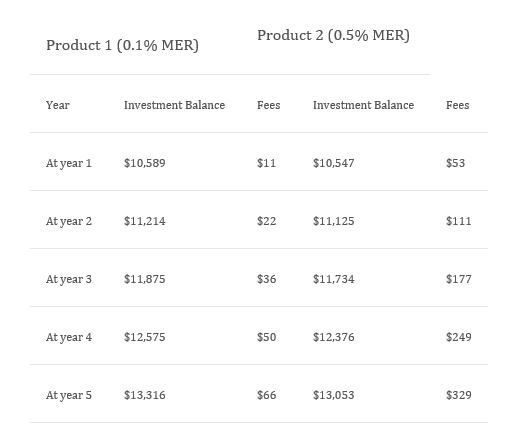
Again, using a $10,000 example and a five-year investment period, a managed fund product with a MER of 0.1% cent that achieves investment earnings of 6% a year would end up costing $66 in fees. At a 0.5% MER, your costs would be $329.

Fees increase as your investment value increases, reducing your investment balance over time.

Here’s how those calculations would look over the five years.


Source: Vanguard

See how, because of its lower fees, the investment balance on Product 1 after five years is more than $260 higher than that of Product 2.

On a 3% MER, the charges on a $10,000 investment over five years (also based on a 6% annual return) would be more than $1,800.

You should also be aware that some investment products charge performance fees on top of their standard management fees.

Products with performance fees charge them if they generate a positive return over a certain percentage level. Performance fees can be 20% of any excess profits that are made, or even higher in some cases.

Attitudes and approaches to investing

Vanguard surveyed more than 1,000 Australians aged over 18 on their attitudes and approaches to investing.

Asked whether they consider costs in their investment choices, 61% said they do each time while 29% said only sometimes. 10% said they never consider costs.

It’s Vanguard’s long held view that planning, discipline, keeping costs low and maintaining a long-term perspective are the key things that give investors their best chance for success.

While fees on investment products can’t be totally avoided, you can control which products you choose to invest in.

Do your research and, as part of that, look for comparable products that charge lower fees than others.

It’s important to compare apples with apples to ensure you’re getting the same investment coverage.

A few percentage points in costs may not seem like a lot.

But, on larger investments amounts and over longer time periods, those extra costs will really start to add up and reduce your investment returns.

Source: Vanguard November 2023

Tony Kaye, Senior Personal Finance Writer

This article has been reprinted with the permission of Vanguard Investments Australia Ltd. Copyright Smart Investing™

GENERAL ADVICE WARNING
Vanguard Investments Australia Ltd (ABN 72 072 881 086 / AFS Licence 227263) (VIA) is the product issuer and operator of Vanguard Personal Investor. Vanguard Super Pty Ltd (ABN 73 643 614 386 / AFS Licence 526270) (the Trustee) is the trustee and product issuer of Vanguard Super (ABN 27 923 449 966).
The Trustee has contracted with VIA to provide some services for Vanguard Super. Any general advice is provided by VIA. The Trustee and VIA are both wholly owned subsidiaries of The Vanguard Group, Inc (collectively, “Vanguard”).
We have not taken your or your clients’ objectives, financial situation or needs into account when preparing our website content so it may not be applicable to the particular situation you are considering. You should consider your objectives, financial situation or needs, and the disclosure documents for the product before making any investment decision. Before you make any financial decision regarding the product, you should seek professional advice from a suitably qualified adviser. A copy of the Target Market Determinations (TMD) for Vanguard’s financial products can be obtained on our website free of charge, which includes a description of who the financial product is appropriate for. You should refer to the TMD of the product before making any investment decisions. You can access our Investor Directed Portfolio Service (IDPS) Guide, Product Disclosure Statements (PDS), Prospectus and TMD at vanguard.com.au and Vanguard Super SaveSmart and TMD at vanguard.com.au/super or by calling 1300 655 101. Past performance information is given for illustrative purposes only and should not be relied upon as, and is not, an indication of future performance. This website was prepared in good faith and we accept no liability for any errors or omissions.
Important Legal Notice – Offer not to persons outside Australia
The PDS, IDPS Guide or Prospectus does not constitute an offer or invitation in any jurisdiction other than in Australia. Applications from outside Australia will not be accepted. For the avoidance of doubt, these products are not intended to be sold to US Persons as defined under Regulation S of the US federal securities laws.
© 2024 Vanguard Investments Australia Ltd. All rights reserved.