
The much debated tax on superannuation balances over $3 million is inching closer and those who may be affected should ensure they have considered the implications.

Although it is not yet law, the Division 296 tax should be taken into account when it comes to investment strategy and planning, particular in relation to any end-of-financial-year (EOFY) contributions into super.

Tax for higher account balances

The new tax follows a Federal Government announcement it intended to reduce the tax concessions provided to super fund members with account balances exceeding $3 million.

The draft Treasury Laws Amendment (Better Targeted Superannuation Concessions and Other Measures) Bill 2023 was introduced to Parliament on 30 November 2023.i

The legislation has been referred to the Senate Economics Legislation Committee, with its report due on 19 April 2024.

Once it passes through Parliament and receives Royal Asset, Division 296 will take effect from 1 July 2025.

Who Division 296 applies to

Division 296 legislation imposes an additional 15 per cent tax (on top of the existing 15 per cent) on investment earnings of a super account where your total super balance (TSB) exceeds $3 million at the end of the financial year.ii

The extra 15 per cent is only applied to the amount that exceeds $3 million.

When law, Division 296 will represent a significant change to the super rules, particularly for fund members with significant account balances.

Given the complexity of the new rules, it will be important to seek professional advice so you can make informed decisions about your super and wealth creation strategies in coming years.

How the new rules work

A crucial part of the new legislation is the Adjusted Total Super Balance (ATSB), which determines whether you sit above or below the $3 million threshold.

When assessing your ATSB, the ATO will consider the market value of assets regardless of whether or not this value has been realised, creating a significant impact if your super fund holds property or speculative assets. The legislation also introduces a new formula for calculating your ATSB for Division 296 purposes.

The legislation outlines how deemed earnings will be apportioned and taxed, based on the amount of your account balance over the $3 million threshold.

Negative earnings in a year where your balance is greater than $3 million may be carried forward to a future financial year to reduce Division 296 liabilities at that time.

If you are liable for Division 296 tax, you can choose to pay the liability personally or request payment from your super fund.

Strategic rethink may be needed

For many fund members, superannuation remains an attractive investment strategy due to its favourable tax treatment.iii

But those with higher account balances need to understand the potential effect of the Division 296 tax and check their investment strategies offer the best possible outcomes.

For example, you may need to consider whether high-growth assets should automatically be held inside super given the new rules.

Holding long-term investments that may be more difficult to liquidate, such as property, within super may be less attractive in some cases, because the new rules create the potential to be taxed on a gain that is never realised. This could occur where the value of an asset increases during a financial year but drops in value by the time it is actually sold.

For some, holding large commercial property assets (such as your business premises) within your SMSF may be less attractive.

Reconsider your investment vehicles

If you are likely to be affected by Division 296, an important issue will be to review the most tax-effective investment structures in which to hold assets.

Super has been the clear winner in the past but, once the new rules are in place, other vehicles such as companies or discretionary trusts may also be useful options.

It will also be important to balance asset protection against tax effectiveness. For some people, the asset protection provided by the super system may outweigh the tax benefits of other investment vehicles, such as a family trust.

Division 296 will require more frequent and detailed asset valuations, so you will need to balance this administrative burden with the tax benefits provided by super.

Estate planning implications

Your estate planning and the succession plan for your SMSF will also need to be revisited once Division 296 is law.

The tax rules for super death benefits are complex and will need to be carefully reviewed to ensure you don’t leave an unnecessary tax bill for your beneficiaries.

If you still have many years to go before retirement and decide to hold high-growth assets in your fund, you will need to closely monitor your super balance.

If you want to learn more about how Division 296 tax could affect your super savings, contact our office today.

Quick ways to grow your super

If your super balance is under $3 million, you will be unaffected by Division 296 and the current concessional tax rates continue to apply.

For most people, super remains the most attractive place to save for retirement and making additional contributions prior to EOFY is a sensible idea. Options to consider include:

  • Take advantage of any concessional cap amounts you have not used since 2018-19 to make a carry-forward contribution, if your total super balance is less than $500,000 at June 30 of the previous year

  • Make a personal tax-deductible contribution to give your account a boost and provide a tax deduction

  • Make a personal (non-concessional) after-tax contribution

  • Make a larger non-concessional contribution using a bring-forward arrangement

  • Talk to your employer and put in place a salary sacrifice arrangement to make pre-tax contributions

  • Make a contribution for your spouse (provided they are under age 75), which may also give you a tax offset of up to $540

  • Consider a downsizer contribution of $300,000 if you are aged 55 and over and plan to sell your current home.

Most contributions have eligibility criteria and annual caps you must not exceed, so talk to us before you make any contributions.

i https://www.aph.gov.au/Parliamentary_Business/Bills_Legislation/Bills_Search_Results/Result?bId=r7133

ii https://treasury.gov.au/sites/default/files/2023-09/c2023-443986-em.pdf

iii https://www.ato.gov.au/individuals-and-families/super-for-individuals-and-families/super/growing-and-keeping-track-of-your-super/caps-limits-and-tax-on-super-contributions/understanding-concessional-and-non-concessional-contributions

Important: This provides general information and hasn’t taken your circumstances into account. It’s important to consider your particular circumstances before deciding what’s right for you. Although the information is from sources considered reliable, we do not guarantee that it is accurate or complete. You should not rely upon it and should seek qualified advice before making any investment decision. Except where liability under any statute cannot be excluded, we do not accept any liability (whether under contract, tort or otherwise) for any resulting loss or damage of the reader or any other person. Any information provided by the author detailed above is separate and external to our business and our Licensee. Neither our business nor our Licensee takes any responsibility for any action or any service provided by the author. Any links have been provided with permission for information purposes only and will take you to external websites, which are not connected to our company in any way. Note: Our company does not endorse and is not responsible for the accuracy of the contents/information contained within the linked site(s) accessible from this page.

Adding to your super

You can boost your retirement savings by making voluntary super contributions, such as by:

Small changes you make now can make a big difference to your lifestyle in retirement.

Maximising your super

Consider maximising your super contributions at least 10-15 years before the age you plan to retire. This can make a significant difference to your final super amount.

You can use the MoneySmart retirement planner to work out what your retirement income could be and think about the small changes you can make to build your super, or contact us, we can help put a strategy in place to help you build your nest egg. You should consider how much money you will need to enjoy a comfortable lifestyle in retirement.

In adding to your super, keep in mind:

Keep track of your super and check that you receive all the super you’re entitled to from your employer under super guarantee.

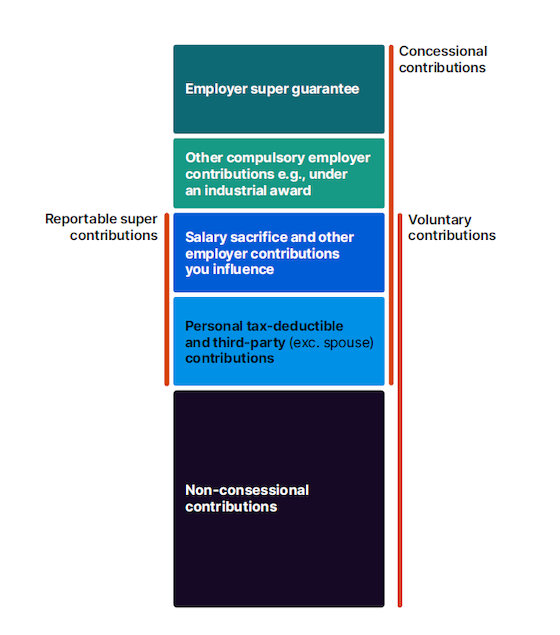
Reportable super contributions

Your reportable super contributions include any:

  • personal deductible contributions you make for which you claim an income tax deduction

  • reportable employer super contributions your employer makes for you where you influenced the amount or rate of super your employer contributes, such as

    • contributions made under a salary sacrifice agreement

    • additional amounts paid to your super fund (for example, you directed an annual bonus to be paid to super)

    • an increased super contribution as a part of your negotiated salary package.

Reportable super contributions don’t include any compulsory contributions by your employer made under:

  • super guarantee

  • an industrial agreement

  • the trust deed or governing rules of a super fund

  • a federal, state or territory law.

You must include reportable super contributions in your tax return.

If your employer makes reportable employer super contributions on your behalf, they must include the total amount of these contributions in the income information they report to us. Reportable contributions made by your employer are shown on your income statement in ATO online services or your payment summary from your employer.

If you make personal contributions for which you have notified your super fund you’ll claim a tax deduction, this will be reported to us by your super fund and pre-filled in your online income tax return.

Main categories of superannuation contributions

What reportable super contributions affect

Your reportable super contributions are not included in your taxable income, but they are added to your taxable income to work out if you meet the income tests for benefits, concessions and obligations we administer such as the:

  • Medicare levy surcharge threshold calculation

  • Medicare levy surcharge (lump sum payment in arrears) tax offset

  • net medical expenses tax offset (withdrawn from 1 July 2019)

  • invalid and invalid carer tax offset

  • zone tax offset when claiming for dependants

  • seniors and pensioners tax offset

  • Higher Education Loan Program (HELP) and Student Financial Supplement Scheme (SFSS) repayments

  • deduction of your non-commercial business losses

  • super co-contribution (income threshold does not include deductions for super contributions)

  • low income super tax offset (income threshold)

  • the spouse superannuation contributions tax offset (spouse’s income threshold does not allow for deductions, including super contributions)

  • income tax concessions available to participants in certain employee share schemes.

If you made a personal contribution and did not claim an income tax deduction for it, the amount is not a reportable super contribution.

As well as affecting benefits, concessions and obligations administered by the ATO, reportable super contributions also affect some payments or services administered by Services Australia.

Check your options for adding to and growing your super. or speak to us for more information.

Source: ato.gov.au August 2023
Reproduced with the permission of the Australian Tax Office. This article was originally published on https://www.ato.gov.au/individuals-and-families/super-for-individuals-and-families/super/growing-and-keeping-track-of-your-super/how-to-save-more-in-your-super/options-for-adding-to-your-super
.

Important:
This provides general information and hasn’t taken your circumstances into account.  It’s important to consider your particular circumstances before deciding what’s right for you. Although the information is from sources considered reliable, we do not guarantee that it is accurate or complete. You should not rely upon it and should seek qualified advice before making any investment decision. Except where liability under any statute cannot be excluded, we do not accept any liability (whether under contract, tort or otherwise) for any resulting loss or damage of the reader or any other person. 

Any information provided by the author detailed above is separate and external to our business and our Licensee. Neither our business nor our Licensee takes any responsibility for any action or any service provided by the author. Any links have been provided with permission for information purposes only and will take you to external websites, which are not connected to our company in any way. Note: Our company does not endorse and is not responsible for the accuracy of the contents/information contained within the linked site(s) accessible from this page.

Scammers are skilled at tricking you out of your money. Knowing the signs of a scam can help you identify when something doesn’t feel right.

Scamwatch, run by the National Anti-Scams Centre (NASC) says:

  • Stop – Don’t give money or personal information to anyone if unsure

  • Think – Ask yourself could the message or call be fake?

  • Protect – Act quickly if something feels wrong

If you think you’ve been scammed, act fast and see what to do if you’ve been scammed.

How to reduce the risk of financial scams

Here are some ways to help you to stay safe and reduce your risk of being scammed.

Protect your personal information

  • Use strong passwords.

  • Shred your personal documents.

  • Secure your devices with security software and use secure websites.

  • Monitor your bank transactions, credit card and online shopping accounts.

  • Check your credit report and your superannuation balance regularly.

  • Update privacy settings on your social accounts.

Do your own research

  • Check before you invest — Always check any investment opportunity to make sure it’s real, especially if approached through social media.

  • Ask questions — Be wary if someone avoids answering questions about the legitimacy of their offer.

  • Get advice — Get independent financial advice, speak to us before you invest.

Don’t rush into a quick decision

  • Don’t click — on any links in suspicious text messages or emails.

  • Be wary of unexpected contact — particularly if you’ve been contacted through social media. You don’t know who you’re dealing with.

  • Take your time — Don’t be pressured to make a quick decision with your money you may regret later.

  • Trust your instincts — If an offer sounds too good to be true, it probably is.

  • Ask someone — If you’re unsure about something, talk to someone you trust about it. They may see red flags that you don’t.

  • Check payments — Be suspicious if you’re asked to pay for something with gift cards or cryptocurrency.

How to spot a financial scam

Here are red flags to help you to identify a financial scam from something legitimate.

Remember, scammers are smart and know how to be convincing. Always be cautious when it comes to trusting someone with your money.

Signs of investment scams

An investment offer may be a scam if the person:

  • does not have an Australian financial services (AFS) licence or says they don’t need one

  • constantly contacts you (phone calls, texts or emails) and pressures you to make a quick decision

  • uses the name of a reputable organisation to gain credibility (for example, NASDAQ, Bloomberg)

  • has an investment prospectus that isn’t registered with ASIC

  • offers you very high investment returns

If you spot any of these signs, hang up the phone or delete the email. If you manage to record any of the scammer’s details, report them to ASIC. 

Signs of crypto scams

If you’re investing in crypto, watch out for these warning signs:

  • Unexpected contact — someone you don’t know contacts you with investment advice or offers.

  • Recommended by someone familiar — a fake celebrity endorsement, online influencer, online acquaintance or romantic partner.

  • Pressure to take action — to move your crypto, use crypto to pay for something, or pay to access your crypto.

  • Something feels off — strange tokens appear in your wallet or a crypto investment offers ‘guaranteed high returns’.

Signs of superannuation scams

Scammers can try to get access to your superannuation. For example, offers to help you get your super early or help you ‘control’ it by opening a self-managed super fund (SMSF). 

Signs of banking and credit scams

A bank will contact you if there are suspicious transactions on your account. But they will never ask you for sensitive information such as online banking passwords or codes. 

Signs of identity theft

If your identity has been stolen, you may not realise for some time. 

Check an investment is real

If you’re offered an opportunity to invest, check it’s legitimate by asking:

  • What is your name and what company do you represent?

  • Who owns your company?

  • Does your company have an AFS licence and what is the licence number?

  • What is your address?

  • Is your investing prospectus registered with ASIC?

Even if they can answer these questions, don’t rely on information given to you. Always verify any information through independent sources. To do your own research, check:

If you suspect a scam hang up the phone or do not respond to the email. Stop dealing with the person or delete and block them if it’s through social media.

Source:

Reproduced with the permission of ASIC’s MoneySmart Team. This article was originally published at https://moneysmart.gov.au/online-safety/protect-yourself-from-scams

Important note: This provides general information and hasn’t taken your circumstances into account.  It’s important to consider your particular circumstances before deciding what’s right for you. Although the information is from sources considered reliable, we do not guarantee that it is accurate or complete. You should not rely upon it and should seek qualified advice before making any investment decision. Except where liability under any statute cannot be excluded, we do not accept any liability (whether under contract, tort or otherwise) for any resulting loss or damage of the reader or any other person.  Past performance is not a reliable guide to future returns.

Important
Any information provided by the author detailed above is separate and external to our business and our Licensee. Neither our business nor our Licensee takes any responsibility for any action or any service provided by the author. Any links have been provided with permission for information purposes only and will take you to external websites, which are not connected to our company in any way. Note: Our company does not endorse and is not responsible for the accuracy of the contents/information contained within the linked site(s) accessible from this page.

If one of your goals is to buy your own home, then 2024 might just be your lucky year. It will see the launch of the Federal Government’s exciting new Help To Buy scheme.

Over the next four years, this initiative aims to help up to 40,000 low- and middle-income Australians finally buy a place they can call home. Here’s how it’s going to work.

Bringing home ownership within reach

The Help To Buy scheme is a shared equity scheme between home buyers and the Federal Government. It allows the Government to contribute to buying your home, so your initial and ongoing costs are significantly reduced.

The Government will contribute up to 40% of the price for a new home and up to 30% for an existing home. Your upfront costs are further reduced because you only need a minimum 2% deposit, with no lenders mortgage insurance payable, and you will only make repayments on your share of the mortgage. It’s all geared to get you buying a home sooner rather than later and making your ongoing repayments more manageable.

What’s more, the government will not charge any fees or interest on their investment. It’s like an interest-free loan that you only pay back if you sell. Plus, you can start buying back the government’s share after the two years.

Making sure you’re eligible

To be eligible, you must be an Australian citizen, at least 18 years of age, and with an annual income of not more than $90,000 for individuals, or $120,000 for couples.

Applicants don’t need to be first-home buyers, which is different to existing schemes. However, you must live in the home you buy, and you can’t own any other land or property in Australia or overseas while in the scheme.

Even though the required minimum deposit is just 2%, you must still be able to finance your share of the loan. This includes proving you can pay for all up-front mortgage costs like stamp duty and legal and lender’s fees. You will also be responsible for ongoing costs associated with the property such as maintenance, rates, strata, and utility bills.

All this is in line with the normal checks on a borrower’s suitability that your mortgage lender will carry out. And with our long list of lenders, we can make sure you are paired with one that suits your circumstances and is approved for government schemes.

Some things to keep in mind

Help to Buy will only be available once the state you live in has passed legislation supporting the scheme. But don’t worry, all Australian states and territories have agreed to pass legislation in early this year.

10,000 places every year will be allocated per capita across the states and territories, with approval given on a first come, first served basis. This effectively means there are caps on the number of approvals in any given area, which makes it very important to get your application in as early as possible.

Currently, the maximum eligible home price varies from state to state, and between capital cities and regions, and are expected to be in line with the similar schemes such as the First Home Guarantee. For example, the property price cap for Hobart is $600,000 with $450,000 for the rest of Tasmania. In Sydney and regional NSW cities, it’s $950,000 and $750,000 across the rest of the state.i

Say the government takes out a 30% share ($300,000) in your $900,000 home. If you sell, you’ll have to repay the $300,000 plus 30% of any capital gain the property has made. How any property improvement costs will be factored into this calculation will become clear once the state legislation is passed.

Helping you into your new home

Since you can’t apply until the Help To Buy scheme is approved by the State Government, we’ll keep you up to date with what’s happening as more information becomes available.

In the meantime, we can work with you to discuss your eligibility for this upcoming scheme and existing initiatives, and can help you start the process to prepare to buy in the future.

i https://www.abc.net.au/news/2023-08-18/rent-to-buy-housing-scheme-explained/102743694

It’s challenging buying property. It’s tough scraping together a deposit, it’s not easy dragging yourself to one open-for-inspection after another (especially if you’ve been doing it for a while!), and it can be soul destroying being pipped at the post when you have set your sights on a particular property.

Then there is getting the finance arranged – faced with a bewildering array of options and a load of paperwork to complete, the process is yet another part of home buying that can be hard yakka.

Let’s look at the ways we can lighten your load when it comes to the finance side of things, so you can focus on the search for your dream home – and the purchase.

Crunching the numbers

Many people put the cart before the horse when they start looking at property. It’s easy to get excited and start looking around as soon as you’ve decided to bite the bullet and buy, but unless the numbers have been crunched and you know how much you can borrow, you might be wasting your time.

That’s where a broker comes in handy as we can review your situation and let you know how much you are likely to be able to borrow. We’ll take the time to get to know you and your situation. Our depth of experience means we can assist even in complex circumstances. For example, you may not have a steady income or be running your own business, you may have an unusual employment situation, a poor credit history or other issues that might make applying for a loan more difficult.

Then once we’ve crunched the numbers, we can start looking at your finance options.

Making sense of the options

When it comes to loans, there is a myriad of products to choose from, which can add up to one big headache unless you have someone to help guide you in the right direction.

We can do all the legwork for you, to compare the different loans available. We have access to more deals and lending products than if you went to a single bank or provider, and we will outline the pros and cons of different loan options and work with you to determine the right finance option that suits your circumstances.

We can then help you obtain a prequalification so you have a clear picture of your borrowing power and can commence negotiations with confidence.

We are also experts in this area so we are up to date with all the government support currently available to home buyers and can help you make sense of all the schemes out there and decide if you are eligible and if so, which would be the best schemes to assist you.

Support through the process

The paperwork for a loan application can be complex and there is a danger of your application being rejected if you get anything wrong. That’s a situation you want to avoid, as every rejected loan or credit application puts a black mark on your credit history which can make it even harder to get a loan in future.

We can work with you to address any issues with the paperwork before you get to the application stage to maximise the chance of your application being successful.

It can be good to have an expert on your side through the process. We have relationships with all the lenders we work with and can get involved to negotiate on your behalf or do what we can to ensure an application is processed in a timely manner.

Seeing it through to the end – and out the other side

We’ll be with you through the entire process and celebrating with you on the other side. We are here for you at any point even after you’ve purchased, should you wish to review your loan or the terms of your loan, or look at refinancing.

Please feel free to contact us to talk about any aspect of your finance requirements – we are here to help.

Important: This provides general information and hasn’t taken your circumstances into account. It’s important to consider your particular circumstances before deciding what’s right for you. Although the information is from sources considered reliable, we do not guarantee that it is accurate or complete. You should not rely upon it and should seek qualified advice before making any investment decision. Except where liability under any statute cannot be excluded, we do not accept any liability (whether under contract, tort or otherwise) for any resulting loss or damage of the reader or any other person.

Any information provided by the author detailed above is separate and external to our business and our Licensee. Neither our business nor our Licensee takes any responsibility for any action or any service provided by the author. Any links have been provided with permission for information purposes only and will take you to external websites, which are not connected to our company in any way. Note: Our company does not endorse and is not responsible for the accuracy of the contents/information contained within the linked site(s) accessible from this page.

Understanding your retirement income options

How you organise your retirement income streams can make a huge difference to your quality of life. Here are some options you might want to consider.

What will you do with your super when you retire?

You have plenty of flexibility as there’s a wide range of options inside and outside superannuation. But this is a complex area, with tax and government entitlement implications, and your needs may change over time. It is always a good idea to talk to a professional financial adviser about things like tax on superannuation withdrawals before making any significant decisions.

Accessing your superannuation

When you reach your superannuation access age (or ‘preservation age’) and you’re eligible to withdraw your super, you have the option to leave it where it is and continue adding to it. If there’s been a downturn in the market, you might want to wait for it to improve. If you do, you could pay more tax on your earnings than if you invested the money in an income stream.

Retirement pension fund

Most people transfer their super balance into a pension account, as your pension and any earnings from it are usually tax-free after you turn 60.

Pension accounts pay a regular income to you on a monthly, quarterly, half-yearly or yearly basis. You can nominate the pension payment amount and vary it at any time. The only stipulation is that you withdraw at least the minimum amount specified by the government.

It’s important to understand that unless you have a guaranteed product, you may outlive your pension account. The balance can increase or decrease in response to market performance and other variables.

Investing in an annuity

Another option is an annuity, which gives you the peace of mind of knowing exactly how much your retirement income will be and how long the payments will continue. An annuity is paid by a life insurer in return for a lump sum, from a super fund or other savings. Again, payments can usually be paid monthly, quarterly, half-yearly or yearly and you can receive them for a certain period or for the rest of your life.

The main disadvantage is that your money is locked away, although there are now some products that allow you to make extra withdrawals.

Accessing superannuation

You can withdraw some or all of your super in one go – perhaps to pay off debts or invest elsewhere. It’s important to do your homework before investing outside your super as your earnings might be taxed.

Investments outside superannuation

There are many investment options for retirees outside super but many prefer to prioritise security. Diversification is very important as it can help to minimise your risk.

Capital growth investments

Capital growth investments, such as property and shares, can rise and fall in value but over the long term they usually outperform other types of investment. This makes them important for increasing the time your savings will last. They can also provide retirement income streams. Your time frame is key with growth investments and you should be prepared to invest them for a number of years.

  • Shares are more flexible than property as you can sell them off in small numbers if you need emergency cash. However, they are more volatile – their value can drop fast and hard.

  • Managed funds provide a diversified mix of investments that are managed by qualified investment professionals – though it’s still important to research which will be best for you.

If you invest most or all of your money in property, you lose the benefits of diversification. And, while property may be less volatile than shares, prices can fall. If you rely on rent for your income, there could also be a problem if you’re without a tenant for any length of time. Unlike shares, you can’t sell a portion of a property to free up your cash. The sale time is also much longer.

Interest-bearing investments

Savings accounts and term deposits are easy to open and there’s no risk of losing your initial investment. The trade-off is they usually pay a lower interest rate and there are no capital gains or tax benefits.

Speak to us today if you’d like to talk about your retirement.

Source: NAB


Reproduced with permission of National Australia Bank (‘NAB’). This article was originally published at https://www.nab.com.au/personal/life-moments/work/plan-retirement/plan-income

National Australia Bank Limited. ABN 12 004 044 937 AFSL and Australian Credit Licence 230686. The information contained in this article is intended to be of a general nature only. Any advice contained in this article has been prepared without taking into account your objectives, financial situation or needs. Before acting on any advice on this website, NAB recommends that you consider whether it is appropriate for your circumstances.

© 2022 National Australia Bank Limited (“NAB”). All rights reserved.

Important:
Any information provided by the author detailed above is separate and external to our business and our Licensee. Neither our business nor our Licensee takes any responsibility for any action or any service provided by the author. Any links have been provided with permission for information purposes only and will take you to external websites, which are not connected to our company in any way. Note: Our company does not endorse and is not responsible for the accuracy of the contents/information contained within the linked site(s) accessible from this page.

Give me the main points

  • The most important reason to consider taking out life insurance is to protect your family if you die or become unable to work.

  • There’s a good case for anyone with dependants or people who plan to have dependants to take out life insurance.

  • Life insurance policies can be bought through life insurance companies, financial advisers or brokers, or through superannuation funds.

  • The amount you roughly need is the gap between what your dependants require, and the value of your assets (not including your family home).

  • Whatever you choose, it’s important to reassess your life insurance cover against your needs as life changes.

Reasons to get life insurance

To protect your family and loved ones

If your loved ones depend on your financial support, then you should consider life insurance. It’s especially important if you have young children, or a partner or adult children who couldn’t maintain their standard of living without your income.

To leave an inheritance

Even if you don’t have any other assets, you can create an inheritance for your dependants, by buying a life insurance policy. You simply name them as beneficiaries in the policy.

To pay off debts and other expenses

It’s not just about providing income to your family to cover their everyday expenses. Life insurance policies will cover outstanding debts like mortgages, car loans, personal loans and credit card debt. You don’t want your dependants to be left with extra financial burdens. It could also cover the cost of your funeral, if you haven’t taken out funeral cover.

To bring you peace of mind

No amount of money can ever replace a person. But life insurance could provide you and your family with the peace of mind that if the unthinkable happens, they’ll be taken care of financially.

Different types of life insurance

Different types of cover fall under the broad heading of life insurance. Which one you’ll need depends on your situation.

  • Life cover – also known as term life insurance or death cover pays a set amount of money when you die. The money is paid to the people you name as beneficiaries in your policy.

  • Total and permanent disability (TPD) cover – pays a lump sum to assist with your rehabilitation and living costs if you become totally and permanently disabled. TPD is often bundled together with life cover.

  • Income protection – covers your lost income if you become unable to work because of injury or illness.

When to take out life insurance

You should think about life insurance when you get married, or have children or dependants who rely on you financially. Even if you don’t yet have dependants, you should consider taking out life insurance. That’s because insurance companies usually make you get a health and medical check before quoting your premium. It’s best to get those tests done when you’re younger and more likely to be in good health.

How much life insurance do you need?

The amount of life insurance you’ll need varies as your circumstances change. Let’s say you’re a 22-year-old with no dependants, you might only want enough insurance to cover the costs of a funeral.

But once you get married, have children and take on a mortgage; you’ll probably need more cover to provide for them. As you get older your superannuation builds up, your children become independent and you’ve paid off your mortgage, you may need less cover. You may not need any at all.

To help work out the level of insurance cover you should consider the following.

  • How much cash your family would have if you were to die or become disabled. You should include your super, shares, savings and existing insurance policies.

  • How much cash your family would need if the worst were to happen. Consider the size of your mortgage and any other debts, as well as childcare, education and other costs.

The difference between these is the amount of cover you should ideally get.

Other things to consider

Funerals can be expensive. According to Australian Securities Investment Corporation (ASIC) funerals can range vastly. They can range from $4000 for a basic cremation to around $14 000 for a more elaborate casket and burial.

If you have life insurance, this can be used to cover your funeral expenses, but if you don’t, you may want to consider some other options. There are a few different ways you can pay for a funeral including:

  • pre-paid funerals

  • funeral bonds

  • funeral Insurance

  • term deposit or savings account (this account would form part of your estate when you die, so make sure you tell your beneficiaries).

Talk to us to get a broader understanding about how you can plan for the future.

Source: NAB

Reproduced with permission of National Australia Bank (‘NAB’). This article was originally published at https://www.nab.com.au/personal/life-moments/family/life-insurance

National Australia Bank Limited. ABN 12 004 044 937 AFSL and Australian Credit Licence 230686. The information contained in this article is intended to be of a general nature only. Any advice contained in this article has been prepared without taking into account your objectives, financial situation or needs. Before acting on any advice on this website, NAB recommends that you consider whether it is appropriate for your circumstances.

© 2022 National Australia Bank Limited (“NAB”). All rights reserved.

Important:
Any information provided by the author detailed above is separate and external to our business and our Licensee. Neither our business nor our Licensee takes any responsibility for any action or any service provided by the author. Any links have been provided with permission for information purposes only and will take you to external websites, which are not connected to our company in any way. Note: Our company does not endorse and is not responsible for the accuracy of the contents/information contained within the linked site(s) accessible from this page.

If you’re lucky enough to have received a windfall, perhaps an inheritance or a retrenchment payout, your first decision will be what to do with it.

Assuming you have decided against a shopping splurge, finding the best place to invest a lump sum is all about the effect on your tax bill and how soon you will need access to the funds.

For those interested in investing their lump sum for a longer term, superannuation is one approach because of its tax benefits.

But be aware that, while super can be a tax-effective investment, there are limits on how much you can pay into your super without having to pay extra tax. These are known as contribution caps.

Different types of contributions

There are two types of super contributions you can make – concessional and non-concessional – and contribution caps apply to both.

Concessional contributions are paid into super with pre-tax money, such as the compulsory contributions made by your employer. They are taxed at a rate of 15 per cent.

Non-concessional or after-tax contributions are paid into super with income that has already been taxed. These contributions are not taxed.

So, the tax you pay depends on whether:

  • the contribution was made before or after you paid tax on it

  • you exceed the contribution caps

  • you are a high income earner (If your income and concessional contributions total more than $250,000 in a financial year, you may have to pay an extra 15 per cent tax on some or all of your super contributions.)

Investing after-tax income

There are many different types of after-tax contributions that can be made to your super including contributions your spouse may make to your fund, contributions from your after-tax income, an inheritance, a redundancy payout or the proceeds of a property sale.

Based on current rules, the annual limit for non-concessional or after-tax contributions is $110,000. You can also bring-forward two financial years’ worth of non-concessional contributions and contribute $330,000 at once but then you can’t make any further non-concessional contributions for two financial years. Note that are certain limitation on these types of contributions.

It is also useful to note that, under certain conditions, there are some types of contributions that do not count towards your cap. These include: personal injury payments, downsizer contributions from the proceeds of selling your home and the re-contribution of COVID-19 early release super amounts.

The Downsizer scheme allows the contribution of up to $300,000 from the proceeds of the sale (or part sale) from your home. You will need to be above age 55 but there is no upper age limit, the home must be in Australia, have been owned by you or your spouse for at least 10 years, the disposal must be exempt or partially exempt from capital gains tax and you have not previously used a downsizer contribution.

Giving your super a boost

A review of your super balance and some quick calculations about your projected retirement income might inspire you to give your super a boost but not everyone has access to a lump sum to invest.

A strategy that uses smaller amounts could include any amount from your take-home pay. These contributions will count towards your non-concessional or after-tax cap.

Alternatively, you add to your super from your pre-tax income using, for example, salary sacrifice. These types of concessional or pre-tax contributions attract a different contribution cap: $27,500 per year, which includes all contributions made by your employer.

If your super fund balance is less than $500,000, your limit may be higher if you did not use the full amount of your cap in earlier years. You can check your cap at ATO online services in your myGov account.

The rules for super contributions can be complex so give us a call to discuss how best to maximise your benefits while avoiding any mistakes.

Important: This provides general information and hasn’t taken your circumstances into account. It’s important to consider your particular circumstances before deciding what’s right for you. Although the information is from sources considered reliable, we do not guarantee that it is accurate or complete. You should not rely upon it and should seek qualified advice before making any investment decision. Except where liability under any statute cannot be excluded, we do not accept any liability (whether under contract, tort or otherwise) for any resulting loss or damage of the reader or any other person.

Any information provided by the author detailed above is separate and external to our business and our Licensee. Neither our business nor our Licensee takes any responsibility for any action or any service provided by the author. Any links have been provided with permission for information purposes only and will take you to external websites, which are not connected to our company in any way. Note: Our company does not endorse and is not responsible for the accuracy of the contents/information contained within the linked site(s) accessible from this page.

Understanding financial health

Financial health is an important part of our lives. When we take care of our financial health we can better manage financial stress and achieve our financial goals.  

Financial health is made up of three components: 

  • the ability to meet everyday commitments like paying your bills and making loan repayments

  • the resilience to cope with and recover from unexpected financial events, like your car breaking down or losing your job

  • putting yourself in a position to plan for the future and pursue your goals.

When we maintain good financial health we’re in a better position to handle life’s ups and downs.

How we can help

We can help you build your financial health and better understand your finances. 

Start saving

Once you know what you’re spending your money on, you can focus on saving. 

You can do this by setting up a savings goal using an app. 

If you’re just getting started, we can help you reach your savings goals.

Understand credit and your creditworthiness

If you’re considering credit, it’s important to understand what credit means, the different types of credit and how to manage it.

It’s also important to be aware of your credit rating and your creditworthiness. The better your creditworthiness, the more ways you’ll have to get ahead financially.  

Use your credit card effectively

Credit cards can be confusing, so make sure you understand how they work. It’s also important to know about your credit card limit, fees and interest.

You should set up a notification to let you know when you’re approaching your limit.

Buying a home

Buying your first home is a huge step. 

Use a borrowing calculator to estimate how much you could afford and what your repayments would be.

If you already have a home loan, here are some practical tips to help you pay off your home loan quicker.

What to do when you’re experiencing financial hardship

If you’re experiencing financial difficulty, there are ways to get back on top. We know it can be hard to pick up the phone – you might feel awkward, embarrassed or stressed. But we understand that sometimes things are outside your control, such as illness or suddenly losing your job. 

We’re not here to judge – we’re here to help. 

Source: NAB

Reproduced with permission of National Australia Bank (‘NAB’). This article was originally published at https://www.nab.com.au/personal/life-moments/manage-money/money-basics/financial-health

National Australia Bank Limited. ABN 12 004 044 937 AFSL and Australian Credit Licence 230686. The information contained in this article is intended to be of a general nature only. Any advice contained in this article has been prepared without taking into account your objectives, financial situation or needs. Before acting on any advice on this website, NAB recommends that you consider whether it is appropriate for your circumstances.

© 2023 National Australia Bank Limited (“NAB”). All rights reserved.

Important:
Any information provided by the author detailed above is separate and external to our business and our Licensee. Neither our business nor our Licensee takes any responsibility for any action or any service provided by the author. Any links have been provided with permission for information purposes only and will take you to external websites, which are not connected to our company in any way. Note: Our company does not endorse and is not responsible for the accuracy of the contents/information contained within the linked site(s) accessible from this page.

Bonds can provide a stable source of income and can protect the money you invest. They are considered less risky than growth assets like shares and property, and can help to diversify your investment portfolio.

What is a bond

When you invest in bonds, you’re lending money to a company or government. In return, you get regular interest payments, called coupon payments.

Bonds are generally viewed as a defensive asset and considered to be lower risk. They are still exposed to:

  • Interest rate risk – the risk that a change in interest rates could reduce the market value of the bond. If interest rates rise, bonds offering lower coupon payment rates become less attractive investments

  • Credit risk – the risk that the issuer could default or go insolvent

All bonds have a set value, called ‘face value’ when first issued. If you hold the bond until maturity, you get back the face value (or principal) of the bond.

If you sell a bond before maturity, you’ll get the market value. This could be lower than the face value. Market value is influenced by:

  • interest rate movements

  • credit risk of the issuer

  • level of liquidity, and

  • when the bond is due to be paid back

Watch out for imposter bond investment offers. Scammers pretend to be from well-known domestic or international financial service firms and offer high yield bond investments.

How to buy and sell bonds

The main issuers of bonds in Australia are the Australian Government and corporates. Always read the financial services guide and product disclosure statement (PDS) before you invest.

Government Bonds

There are two types of Government bonds: Australian Government Bonds (AGBs) and Semi Government Bonds (Semis).

Australian Government Bonds (AGBs)

AGBs (also known as Treasury Bonds) represent sovereign debt issued by the Australian government. They guarantee a rate of return if held until maturity.

Exchanged-traded Treasury Bonds (eTBs) give fixed interest payments. Exchange-traded Treasury Indexed Bonds (eTIBs) give interest payments linked to inflation.

You can buy and sell listed AGBs on the Australian Securities Exchange (ASX) at market value. You must pay any brokerage fees.

To find out more, take the ASX online Government Bonds course.

Semi Government Bonds (Semis)

Semis represent semi sovereign debt issued by Australian states and territories. They can only be bought and sold through state and territory treasury corporations.

Corporate bonds

A corporate bond is a way for a company to raise money from investors to finance its business activities. Corporate bonds are primarily issued and traded on the over-the-counter (OTC) market. The minimum amount required to buy corporate bonds is typically large, up to $500,000.

Consider the credit risk of corporate bonds before you buy. If the company goes out of business, you won’t get coupon payments and may not get your face value back.

Before you invest in a corporate bond

It is rare for corporate bonds to be issued to the retail market (allowing purchases below $500,000). If someone offers you a corporate bond be wary as it could be a scam.

For any corporate bond offer, check:

  • Is the prospectus lodged on ASIC’s offer notice board? If not, it is likely a scam.

  • Is the offer or prospectus from a legitimate source? If you’re not sure, go to the issuer’s website to download the prospectus and application form (with bank account details).

  • Is the bond available to you? Some bonds, such as green bonds are not available unless purchased in a managed fund. Be cautious if someone offers you these types of investments.

Scammers may pose as a corporate entity, like a bank, and offer ‘Treasury bonds’. This is a red flag that it’s a scam. Corporate entities issue bonds in their own name. Only the Australian Government can issue Treasury bonds.

Interest paid on bonds


Interest rate

What you get

Why choose

Fixed rate bond

set when the bond is issued and stays the same until maturity

fixed coupon payments and the face value back if you hold it to maturity

a stable, regular income stream and to diversify a portfolio

Floating rate bond

can go up or down over the term of the bond. The coupon rate is based on an underlying interest rate, plus a specified percentage or margin (for example, cash rate + 2%)

coupon payments which rise if interest rates go up, but fall if interest rates go down. You get the face value back if you hold it to maturity

a stable income and protected returns if interest rates rise, as the coupon payment rate adjusts

Indexed bond

returns are indexed against the consumer price index (CPI) which protects against rising inflation

both coupon payments and the face value increase in line with changes in the CPI

indexed bonds protect against inflation (which can reduce your returns) and diversify a portfolio

How to work out the value of a bond

Yield to maturity (YTM) is a useful measure of the value of a bond. It is also a good way to compare what you’ll get by investing in different bonds.

YTM calculates the average annual return of a bond from when you buy it (at market value) until maturity. It assumes that you reinvest coupon payments in the bond at the same interest rate the bond is earning.

Make sure you always balance the return against any risks before investing.

Source:
Reproduced with the permission of ASIC’s MoneySmart Team. This article was originally published at https://moneysmart.gov.au/investments-paying-interest/bonds

Important note: This provides general information and hasn’t taken your circumstances into account.  It’s important to consider your particular circumstances before deciding what’s right for you. Although the information is from sources considered reliable, we do not guarantee that it is accurate or complete. You should not rely upon it and should seek qualified advice before making any investment decision. Except where liability under any statute cannot be excluded, we do not accept any liability (whether under contract, tort or otherwise) for any resulting loss or damage of the reader or any other person.  Past performance is not a reliable guide to future returns.

Important
Any information provided by the author detailed above is separate and external to our business and our Licensee. Neither our business nor our Licensee takes any responsibility for any action or any service provided by the author. Any links have been provided with permission for information purposes only and will take you to external websites, which are not connected to our company in any way. Note: Our company does not endorse and is not responsible for the accuracy of the contents/information contained within the linked site(s) accessible from this page.