A cautionary tale.

Pete and Sue were thrilled when their son Josh announced that he and his partner Jenna had found their dream home.

They were all so caught up in the excitement that when Josh asked if they could help them with a deposit they readily agreed.

Josh and Jenna needed $98,000, and having recently retired, Pete and Sue withdrew the lump sum from their pension fund. It was a large amount, and of course they were a bit anxious, but Josh was so happy that we pushed our doubts aside.

They expected that reducing their investment capital would impact its earning capacity, but they really hadn’t considered the long-term impact that would have on how long their income may continue, and how sharply it would increase the likelihood we would outlive our retirement savings. Josh and Jenna bought the home, moved in and everything was great for a couple of years. Sadly, the relationship broke down.

When the house was sold and the mortgage paid out, there was money left over. Pete and Sue naturally assumed that our capital would be returned, but Josh and Jenna simply split the proceeds between them and went their separate ways.

When Pete and Sue asked Josh about their money, Josh became defensive and claimed it had been a gift.

They tried discussing it, but emotions ran high. The ensuing argument created such a rift that Pete and Sue had no contact with their son for nearly three years.

Pete and Sue’s retirement plans were thrown into disarray and their family was torn apart by a terrible misunderstanding. Yet, there were steps they could have taken to avoid it all.

We could have:

  1. Sought financial advice. Had they consulted a financial advisor, they would have better understood the impact such a withdrawal would have had on their retirement strategy.
  2. Consulted a solicitor and had a formal loan agreement drawn up. The agreement could have included a lien clause outlining that the property was collateral for the loan enabling them to claim the property or its proceeds if the loan was not repaid.

If Pete and Sue had, in fact, gifted the money, they could have set conditions through a legal document stating that the gift would be returned in full, or part, if the relationship ended.

Gifting money, however, may have tax implications, and potential complications if the gift is disputed and the matter goes to a family court. Gifting money may also impact the age pension.

Pete and Sue knew they couldn’t turn back the clock, so they were proactive in engaging a financial adviser to review their retirement portfolio and recommend adjustments that maximise the earning capacity of their savings.

Their adviser also helped prepare a budget so they could enjoy a reasonable lifestyle on reduced income.

All this grief could have been avoided if Pete and Sue had simply sought professional advice and had a formal agreement drafted right from the beginning.

Before you blindly jump in as the Bank of Mum and Dad for your family, call us to check what should be considered before you put your retirement plans in jeopardy. Proper planning could help deliver a win for all the family.

The information contained in this article is general information only. It is not intended to be a recommendation, offer, advice or invitation to purchase, sell or otherwise deal in securities or other investments. Before making any decision in respect to a financial product, you should seek advice from an appropriately qualified professional.  We believe that the information contained in this document is accurate. However, we are not specifically licensed to provide tax or legal advice and any information that may relate to you should be confirmed with your tax or legal adviser.

Achieving a high income is a significant accomplishment. You’ve put in the hard yards, climbed the ladder, and now you’re pulling in the big bucks!

But don’t be mistaken; a high income does not automatically equate to financial security. Just because the money is rolling in today doesn’t mean you’re protected from tomorrow’s uncertainties.

Assuming that a large salary guarantees long-term security without considering long-term financial planning, can be downright risky. So, before you get too comfortable, it’s time for a reality check.

When “more” becomes the norm

Earning more often leads to spending more, a phenomenon known as lifestyle inflation.

As your income grows, so does your desire for bigger and better things—a nicer house, a new car, dinners at fine restaurants. This lifestyle upgrade can feel deserved, but without careful planning, it can leave you no better off financially than when you earned less.

For instance, imagine a couple earning a combined income of $350,000 a year. On paper, that sounds like a strong financial position. But, between a large mortgage, car loans, private school fees, and regular international holidays, these expenses could easily absorb most of their income. If an unexpected event like a job loss or economic downturn were to happen, they’d find themselves in a precarious situation, with little financial buffer.

This is the danger of lifestyle inflation: it’s subtle and easy to justify, but it can undermine your ability to build real wealth.

High income ≠ Financial security

A high income can create the illusion of financial security. It’s easy to assume that as long as the money is rolling in, you’re set for life. But without the right safeguards, a high income can actually mask financial vulnerabilities.

Take Liam, for example.

Liam, a 34-year-old marketing executive in Sydney, earning $250,000 a year and living a pretty comfortable lifestyle. He assumed his high income meant he was financially secure. But when his job was made redundant, without an emergency fund or sufficient savings, Liam found himself in financial distress within months.

Liam’s story illustrates a key point: a high income is not a substitute for financial planning. If your finances aren’t structured to handle changes, even a hefty salary won’t protect you from financial uncertainty.

How to help future-proof your finances

Here are some strategies to help ensure you’re future proofing your finances, no matter how much you earn.

  1. Create a budget (spending plan) and stick to it

A budget or spending plan is just as important for high earners as it is for those with more modest incomes. Avoid the temptation to spend simply because you can. Instead, allocate funds towards savings, investments, and building an emergency fund.

  1. Build an emergency fund

Even high income earners need a safety net. A good place to start is having 3-6 months of living expenses in an emergency fund. This ensures that if something unexpected happens you’ll have the financial resources to cover your expenses without going into debt.

  1. Invest wisely

Don’t rely solely on your salary—make your money work for you by building a diversified investment portfolio. The earlier you start, the better, as even small investments can grow significantly over time thanks to compound growth. Don’t wait—time is your biggest asset when investing!

  1. Plan for the long term

Even if retirement seems far away, it’s never too early to start planning. Superannuation can be a tax-effective structure for building wealth and making contributions to super can be a tax-effective strategy for high-income earners!

  1. Don’t overlook insurance (your ability to earn may be your biggest asset)

Insurance might not be the most exciting part of financial planning, but it’s essential. Income protection, life insurance, and disability or trauma insurance are vital tools to safeguard your financial future.

Take control

While earning a high salary certainly opens doors to a more comfortable lifestyle, it also comes with the risk of complacency. The belief that you’re financially set simply because you’re earning more is dangerous. Lifestyle inflation, lack of an emergency plan, not having appropriate insurance in place and failure to invest wisely can all leave you vulnerable when life throws a curveball.

It’s not about depriving yourself of the things you enjoy—it’s about making conscious decisions to help ensure your financial future is secure, so you can continue enjoying life for years to come. Take proactive steps now to secure your financial future.

You’ve worked hard for that high income. Now it’s time for that income to work for you!  

The information contained in this article is general information only. It is not intended to be a recommendation, offer, advice or invitation to purchase, sell or otherwise deal in securities or other investments. Before making any decision in respect to a financial product, you should seek advice from an appropriately qualified professional.  We believe that the information contained in this document is accurate. However, we are not specifically licensed to provide tax or legal advice and any information that may relate to you should be confirmed with your tax or legal adviser.

Do you feel like you’re putting in your best effort at work but not receiving the financial rewards you deserve?

Asking for a pay rise can be intimidating, but with the right approach, you can make a compelling case for your value to the company.

Here’s your guide to articulating your worth, asking for a pay rise, and what to do if you get a big, fat “no.”1

Know Your Worth

Articulating Your Value
First things first, you need to know your value. Start by evaluating your specific contributions and achievements over the past year. Did you lead a project that saved the company money? Maybe you streamlined a process or boosted team morale. Quantifiable achievements are your best friends here.

Example: “In the past year, I spearheaded a project that increased our department’s efficiency by 20%, resulting in significant cost savings.”

Do Your Homework
Research is key. Resources such as Payscale2 and Seek3 offer salary research and comparison tools that can help you understand the typical pay range for your position.

Example: “I’ve noticed that similar roles in our industry offer a median salary of $X, which is above my current package.”

Confidence is Everything
If you don’t believe in your worth, it will be hard to convince others of it. Confident body language helps to reinforce your message, so make sure to prepare thoroughly, practice your pitch and be positive.

Tip: Maintain eye contact, sit up straight and use open gestures.

The Big Ask

Before the Meeting
Let your intentions be known by requesting a meeting with your manager specifically to discuss your salary.

Timing your request can make all the difference. Ideal times to ask for a raise include your work anniversary, after a successful project, or during budget planning periods.

During the Meeting

Start with the positives. Thank your manager for their time and highlight what you enjoy about your role and the company. Then, lay out your achievements and explain how they’ve benefited the organisation.

Keep emotions out of it. Approach the conversation with a business-like demeanour and avoid discussing personal reasons for needing a raise.

It’s all about articulating your worth and value to the company.

How to Handle a “No”

Sometimes, despite your best efforts, the answer might be no. But don’t let that get you down!

No Money for More Money

If a salary increase isn’t possible due to the business’s financial limitations, consider negotiating other forms of compensation, such as a performance-based bonus, additional leave (e.g. a 9-day fortnight), or some form of flexible working arrangement.

Seek Feedback
If your manager does not think a pay rise is currently justified, ask what specific goals you need to achieve in order to secure a raise. Then set a follow-up meeting in a few months to revisit the discussion.

Plan Your Next Steps
If there’s no room for negotiation, it might be time to evaluate if your current job aligns with your financial goals. Use this as an opportunity to explore other job options where your skills and contributions might be better valued.

Asking for a pay rise can be daunting, but with the right preparation and approach, you can make a compelling case for yourself. Remember, it’s all about articulating your worth and value to the company.  

And if the answer is no, don’t lose heart. There are always other ways to move forward and achieve your financial goals. So, go on – take charge and ask for that raise. After all, you’re worth it!

The information contained in this article is general information only. It is not intended to be a recommendation, offer, advice or invitation to purchase, sell or otherwise deal in securities or other investments. Before making any decision in respect to a financial product, you should seek advice from an appropriately qualified professional.  We believe that the information contained in this document is accurate. However, we are not specifically licensed to provide tax or legal advice and any information that may relate to you should be confirmed with your tax or legal adviser.

https://www.michaelpage.com.au/advice/career-advice/salary-negotiation

2 https://www.payscale.com/research-and-insights/

https://www.seek.com.au/

Forget about location, location, location being the key to a good investment outcome.  The key ingredient is time, time, time, which delivers the ‘magic’ of compounding.

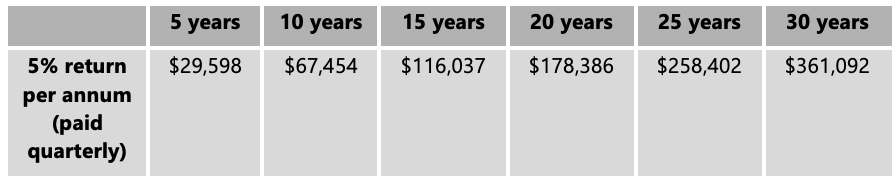
Over time, a regular savings plan can turn small amounts of money into a larger sum that brings you closer to achieving your goals, faster. For example, let’s see what happens to an investment starting with just $100 and adding $100 each week. The table below shows what the investment value would reach after each five years, up to thirty years. For simplicity, in this example, we have assumed that the investment pays a return of 5% per annum (paid monthly).

Table 1: Initial investment of $100 plus a Regular savings plan of $100 per week compounding monthly. (Returns do not account for any tax payable market fluctuations or product fees)1

Compounding is how a regular savings habit can turn small sacrifices into real outcomes. In return for this self-restraint you can see what can be achieved:

  • $29,000 in 5 years might go towards a deposit on your first home or an overseas holiday;
  • $67,000 in 10 years might contribute to a child’s secondary or tertiary education; or
  • $258,000 in 25 years might help you to retire more comfortably or earlier than you thought you could.

Any of these goals would seem to make your small sacrifices extremely worthwhile in the long run. Remember to write down your financial goals because it’s much easier to make better financial choices if you can visualise what they are helping you achieve.

Reducing expenses is not the only way to find a spare $100 each week. Another good time to start a savings plan is when you increase your income from a new job or a pay rise. Before you spend the extra money, have it automatically put away.

The trick is to start soon

Everyone’s ability to save is different. If you can’t save $100 every week, the above figures are still worthy of your attention. For example, if you can save $50 per week, halve the results in Table 1. Conversely, if your savings capacity is higher, then multiply the figures accordingly.

The results demonstrate the effect of time and compounding returns on the value of your investment.

Remember, the sooner you start, the less you need to save in order to achieve the same outcomes.

The difference 10 years can make!

Christine plans to retire in 20 years so she starts saving an extra $100 per week. Based on the above simple calculations and assumptions, she might expect to have an investment of around $178,000 to add to any other superannuation or retirement benefits she has at that time.

Christine’s twin Ben also plans to put down the tools in 20 years, but he is confident that he can save more money than his sister. So Ben ignores any type of retirement planning for the next 10 years. He then saves twice as much as Christine – $200 per week – for the last 10 years of his working life.

Assuming the same 5% return on the investment with interest being paid monthly, the difference is staggering. By starting 10 years earlier, Christine will have saved just over $178,000 compared to Ben’s outcome of $134,743.

Even though his regular savings amount totals exactly the same as his sister’s ($104,000 throughout the investment period), Christine has benefited from the compounding investment returns on her money over a longer period of time, earning an extra $44,000 in interest. Another way to look at it is that Ben would need to save $265 per week for the last 10 years of his working life (a total of $137,800) to end up with the same outcome as Christine.

Important to note…

The examples we have used here highlight the benefits of time when it comes to investing. To keep things simple, we have not accounted for other factors that will impact the outcomes you can achieve, such as taxation, fees, market fluctuations and differing investment returns.

These factors are nonetheless important and will need to be considered when you are deciding on the type of investment that best suits your needs. The type of investment that is best for you will depend on your own specific circumstances, including your goals, investment time frames and attitude to risk (volatility).

You can start a compounding savings plan on your own, or talk to us. We may be able to show you more options to help you achieve your goals even sooner.

The information contained in this article is general information only. It is not intended to be a recommendation, offer, advice or invitation to purchase, sell or otherwise deal in securities or other investments. Before making any decision in respect to a financial product, you should seek advice from an appropriately qualified professional.  We believe that the information contained in this document is accurate. However, we are not specifically licensed to provide tax or legal advice and any information that may relate to you should be confirmed with your tax or legal adviser.

1 https://moneysmart.gov.au/budgeting/compound-interest-calculator

Debt is a fact of life. Rarely is a home or expensive consumable purchased without finance of some kind.

Australians typically manage their financial obligations well, but higher interest rates, cost of living pressures and unexpected expenses can combine to stress a household budget.

In an increasingly cashless economy, it can be more difficult to keep track of spending, and before you can say, tap-and-go, the morning latte and muffin has maxed out the credit card.

Many can tighten the belt and get back on track. Unfortunately, others find themselves caught in a downward spiral that quickly gains momentum until they realise they’re in over their heads.

Failure to meet your financial obligations may result in you being contacted by a debt collection agency as creditors seek to recoup their losses.

While this is traumatic, keep your cool and remember that you have rights.

According to MoneySmart.gov.au1 a debt collector can only contact you:

  • by phone between 7:30 am and 9 pm Monday to Friday, up to 3 times per week or up to 10 times per month,
  • face-to-face only as a last resort, any day between 9 am and 9 pm
  • by email or social media if they are sure no one else has access to your private messages.

Debt collectors may:

  • request payment or ask why you haven’t met a payment plan,
  • offer to make or review a payment plan,
  • advise consequences for non-payment,
  • repossess goods for which you owe money.

Debt collectors cannot:

  • trespass on your property,
  • bully, mislead, harass or abuse you,
  • deceive or take unfair advantage of you.

If you believe a debt collector or agency they represent has acted outside of their boundaries, you are within your rights to take action.

Violent or threatening behaviour is never acceptable; immediately contact the police.

Alternatively, if the collectors are intimidating or harassing you, write to them or their agency to report the behaviour and request it be stopped.

If this doesn’t work, reach out to the Australian Financial Complaints Authority on 1800 931 678 for advice.

Debt collectors aside, you must take action to manage your debt. No debt ever went away because it was ignored, but there are ways to dial down the pressure.

Here are some steps you can take today to get started:

  1. Make a list of all your obligations. Scary, sure, but knowing what you owe is the first rung on the ladder out of the red and into the black.
  2. Contact your mortgagee – seriously! Nobody wins if you can’t pay your mortgage; they really will help you set up a manageable payment plan until you’re back on your feet.
  3. Contact your utility companies. Again, they’ll help you set up a payment plan and going forward, may allow you to make monthly payments at a set amount. Bye-bye bill shock!
  4. Seek help via the National Debt Helpline (1800 007 007) or through the government’s MondaySmart.gov.au website.

You can also seek professional assistance from a qualified financial adviser. They’ll work with you to create a budget and/or a realistic strategy for managing your expenses and guide you in developing a plan to move forward and eliminate debt.

Debt can be debilitating and seem overwhelming, but by understanding your rights, knowing where you stand financially and seeking professional advice and support, you can take back control of your finances and look towards a comfortable financial future.

The information contained in this article is general information only. It is not intended to be a recommendation, offer, advice or invitation to purchase, sell or otherwise deal in securities or other investments. Before making any decision in respect to a financial product, you should seek advice from an appropriately qualified professional.  We believe that the information contained in this document is accurate. However, we are not specifically licensed to provide tax or legal advice and any information that may relate to you should be confirmed with your tax or legal adviser.

https://moneysmart.gov.au/managing-debt/dealing-with-debt-collectors

Marcus and Fleur, both in their 40s, led active, healthy lives with two teenage kids. Their financial plan was straightforward: work hard until their mid-50s, then retire at 60 and travel the world. That all changed one weekend. While heading to their kids’ sports event, Marcus suddenly felt unwell—dizzy, pale, and struggling to catch his breath. A coach with first-aid training noticed something was wrong and called an ambulance. Marcus was rushed to the hospital, where he was diagnosed with a pulmonary embolism (a blood clot blocking his lungs). Despite being young and fit, Marcus faced a life-threatening condition. He spent a week in the hospital and was prescribed lifelong blood thinners.

During his recovery, Marcus had time to reflect. He realised that while their financial plan was solid, it was built around the assumption that they’d always have time. His health scare forced him to reconsider what was most important now — spending time with family and enjoying life, not just waiting for retirement.

Reassessing financial priorities

Their key priority was clear: they didn’t want to sacrifice the future, but they also didn’t want to miss out on life now. As a financial adviser, we often help families and individuals reassess their financial goals when life changes. In instances such as Marcus and Fleur’s, we can help make some strategic adjustments to accommodate these new priorities.

Key strategies could include:

  • Reviewing their investment portfolio: Shifting the focus from purely long-term growth investments to a more balanced approach, allowing for both future security and flexibility in the short term.
  • Revising their savings and spending: By refining their savings strategy and reallocating some of their spending towards experiences they value, like family travel, to enable more enjoyment now, without jeopardising retirement goals.
  • Building in flexibility

Financial Planning for Life’s Unexpected Turns

This experience reinforced that life can change in an instant. As financial advisers, we encourage our clients to review their financial plans regularly, especially after major life events.

You don’t have to choose between living for today and planning for tomorrow—you just need the right advice and a tailored plan.

Financial advisers can help navigate life’s uncertainties, offering solutions that allow you to enjoy life now while ensuring a secure future.

The information contained in this article is general information only. It is not intended to be a recommendation, offer, advice or invitation to purchase, sell or otherwise deal in securities or other investments. Before making any decision in respect to a financial product, you should seek advice from an appropriately qualified professional.  We believe that the information contained in this document is accurate. However, we are not specifically licensed to provide tax or legal advice and any information that may relate to you should be confirmed with your tax or legal adviser.

Do you or someone in your care have a permanent incapacity and receive the Disability Support Pension?

As you approach Age Pension age, you (or they) will be invited to transfer to the Age Pension 13 weeks before reaching age 67.

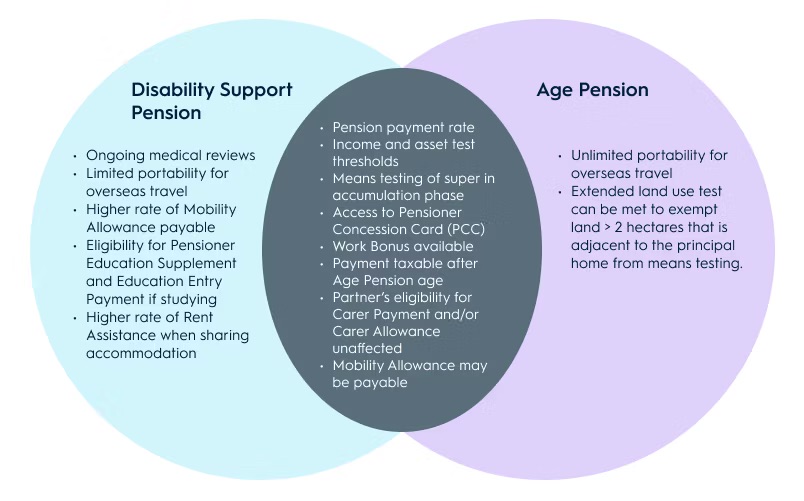
While there are commonalities between the two payments, notably the payment rates and means testing thresholds, the key differences relate to the continuity of the payment when overseas and the requirement for ongoing medical reviews.

The attached diagram provided by AMP’s technical team TapIn, outlines the key points of comparison between the payments which can help you decide whether to remain on the Disability Support Pension in your retirement or transfer to the Age Pension.

Everyone’s circumstances differ; however, it will always be useful to discuss these options with your financial planner.

Irrespective of your decision, you will need to provide Centrelink with details of any superannuation held in the accumulation phase which becomes assessable from age 67.

The information contained in this article is general information only. It is not intended to be a recommendation, offer, advice or invitation to purchase, sell or otherwise deal in securities or other investments. Before making any decision in respect to a financial product, you should seek advice from an appropriately qualified professional.  We believe that the information contained in this document is accurate. However, we are not specifically licensed to provide tax or legal advice and any information that may relate to you should be confirmed with your tax or legal adviser.

According to the Australian Competition and Consumer Commission (ACCC), in 2023 financial scams cost Australians around $2.7 billion.

Financial fraudsters deceive, manipulate and exploit victims into making financial transactions or investments, or sharing sensitive information for illegal profit, money laundering, or even funding terrorism activities.

Regardless of who you are, cyber-attack is a daily threat. And as our dependence on connectivity expands across our daily activities, our vulnerability to financial scams also increases.

Could you spot a potential threat? Would you know what to do if you were targeted? How much do you know about financial scams?

Take our quiz to find out.

Q1: I avoid technology so I’m not likely to be scammed.

  1. True
  2. False

Q2: Financial scams can target you via which of the following? (Multiple responses).

  1. Text
  2. Dating websites
  3. Social media

Q3: An email from a trusted source contains a link. Should you click the link?

  1. It’s from a friend, and it’s just a link.
  2. You never click links in emails, even from friends.
  3. It depends. Were you expecting the email? Is the email legitimate?

Q4: You’ve become close to someone you met online. When they ask you to buy goods to send to them, you…

  1. Do your research and if in doubt, break off all communication.
  2. Tell them you’ll think about it and continue the relationship.
  3. You agree to buy the goods – they’re not asking for money, so there’s no danger in it.

Q5: A friend sends a text to say they have changed their number. What do you do?

  1. Enter their new number in your contacts.
  2. Block the text.
  3. Message the new number with a question only your friend would know.

Q6: You can trust the websites of well-known brands.

  1. True
  2. False

Q7: What is credential stuffing?

  1. When your identification documents are used to create fake websites or passports.
  2. When someone fraudulently uses your data after a data breach.
  3. When you lose your wallet and the finder keeps your credit cards, driver’s licence etc.

Q8: Think you’ve been scammed? Which of the following should you do? (Multiple responses)

  1. Review what happened and consider how you can protect yourself in future.
  2. Contact your financial institutions, change passwords, and report the scam to Scamwatch.
  3. Don’t tell anyone. You’re angry, embarrassed, and feel very foolish.

ANSWERS

Q1: I avoid technology so I’m not likely to be scammed.

  1. True
  2. False

If you don’t use the internet, you must still be wary.

Unsolicited door-knockers are known to do the rounds of neighbourhoods, claiming to be collecting donations for charity or offering goods or services for payment. Others may ask you to complete a genuine-looking survey to get your details.

There are ways to protect yourself. For example:

  1. Don’t feel pressured to allow strangers into your home.
  2. Ask for identification and look up the organisation’s phone number yourself, then call it to confirm the door-knocker’s credentials.
  3. Never, ever, evaah! make a payment to a door-to-door salesperson.

However, some door-knockers are legitimate. In recent years, the government has run low-energy light bulb exchange programs where contractors visit homes and offer to install free LED bulbs.

If you’re unsure, ask for the person’s identification and follow the advice in point b above.

Q2: Financial scams can target you via which of the following? (Multiple responses).

  1. Phone, Text or SMS
  2. Dating websites
  3. Social media

If you selected all of the options, you’re correct. Cyber criminals will attempt to swindle you out of your money by any means possible, so the list is even more extensive than this.

According to the government’s Scamwatch website, financial scams can be any of the following:

·   Text/SMS/Phone ·   Romance
·   Email ·   Investment
·   Social media ·   Product/Service
·   Website ·   Threats/Extortion
·   In-person ·   Employment
·   Impersonation ·   Unexpected money

Q3: An email from a trusted source contains a link. Should you click the link?

  1. It’s from a friend and it’s just a link.
  2. You never click links in emails, even from friends.
  3. It depends. Were you expecting the email? Is the email legitimate?


There are times when you’re expecting an email containing a link. In these circumstances, and if you’re certain the email is genuine, it’s reasonable to click the link.

Remember, though, that emails, even from trusted sources, can be dodgy. Scammers can hack into email accounts and impersonate businesses, friends and family.

If you weren’t expecting the email, consider the following:

  • Does the email look legit?
  • Does the sender’s address appear correct?
  • Have you been addressed correctly by name in the email?
  • Is the email written with correct spelling and grammar?

Finally, hover your mouse over the link. This reveals where the link leads. Does that look right to you?

If you’re uncertain about any of these points, phone the person/company the email purports to come from and confirm that the email is genuine.

Q4: You’ve become close to someone you met online. When they ask you to buy goods to send to them, you…

  1. Do your research, and if you are in doubt, break off all communication.
  2. Tell them you’ll think about it and continue the relationship.
  3. You agree to buy the goods – they’re not asking for money so there’s no danger in it.

Scammers work hard to convince you that their intentions are genuine. They trawl through social media, gaming apps, dating websites etc, and connect with unsuspecting people.

They often create fake profiles with photos and identities stolen from other websites. They may even impersonate famous people.

Once they have built your trust, they ask you to do things for them, such as,

  • purchasing goods to send to them,
  • opening accounts and depositing money they send you (this could be money laundering potentially incriminating you),
  • send money to them,
  • pay for them to visit you (after they arrive they disappear).

Protect yourself by:

  • asking lots of questions and noting inconsistencies,
  • Googling their name and the word ‘scam’ together,
  • not sharing information about yourself, friends, family, your job, etc.,
  • never sending intimate photos of yourself (they can be used to blackmail you),
  • never sharing bank or credit card details, your passport or other identity documents.

Q5: Your friend sends a text to say they have changed their number. What do you do?

  1. Enter their new number in your contacts list.
  2. Block the text.
  3. Message the new number with a question only your friend would know.

A common ruse of fraudsters is copying the phone number and/or sender ID of businesses you know or friends and family and sending messages that appear genuine.

Raise the red flag if the message requests urgent action, e.g., your account has been hacked, there’s a problem with a delivery, a service is about to be stopped because a payment hasn’t been received, etc.

Whether the required action is to send money, click a link, call a provided number, supply passwords or other sensitive information, this should alert you that something is off!

Never click links, call numbers, send information or take any other action the message requests. Instead, reach out to the person or business via a number you have sourced. If the message is a scam, use your phone’s BLOCK and/or REPORT AS SCAM functions.

Q6: You can trust the websites of well-known brands.

  1. True
  2. False

Scammers regularly create fake websites that look and feel like the real thing. They have been known to impersonate famous people, display shonky banners and pop-ups and even include fake reviews to convince you to trust them.

Before buying from these sites, check the website’s URL. Dodgy websites use domain names that, at a quick glance, look similar to legitimate ones. Check the address bar. There should be a padlock icon on the left and the URL should use ‘https//’, indicating a secure connection.

Further, most Australian websites will end in .com.au, .au or .org.au for a charity or community organisation. When buying from an overseas website, ensure you know the correct format for that country, e.g., British websites end in .co.uk.

Be wary if:

  • products are offered at significantly lower prices than usual,
  • payment options seem strange. Scammers may request Bitcoin or gift cards and don’t offer more secure payment methods such as PayPal,
  • there are no negative reviews,
  • advertised items contain words like ‘no risk’,
  • you are urged to ‘be quick’ or ‘don’t miss out’.

A final word on websites: fake investment companies set up fancy websites and even create slick brochures to download! They’re very difficult to spot, which is why you should always seek professional advice from a qualified, licensed adviser.

Q7: What is credential stuffing?

  1. When your identification documents are used to create fake websites or passports.
  2. When someone fraudulently uses your data after a data breach.
  3. When you lose your wallet and the finder uses your credit cards, driver’s license etc.

Credential stuffing is a scam that occurs when an organisation suffers a data breach, and the cyber criminals involved use the stolen information to buy goods and services from another business.

There is little you can do to protect yourself from this kind of financial scam. Consequently, the government imposes severe penalties on businesses that fail to protect their customers’ personal data.

Cybercrime carries little risk for scammers who can create a web of dead-end leads, making it difficult for them to be tracked.

Despite companies investing large sums in cyber security, it seems that almost every day we’re learning about another corporate attack.

If you’re notified of a data breach, immediately:

  • close accounts, cancel cards etc,
  • change passwords,
  • set up two-factor authentication where possible,
  • stay up-to-date with news and information provided by the company involved.

Q8. Think you’ve been scammed? Which of the following should you do? (Multiple responses)

  1. Review what happened and consider how you can protect yourself in future.
  2. Contact your financial institutions, change passwords, and report the scam to Scamwatch.
  3. Don’t tell anyone. You’re angry and embarrassed and feel very foolish.

It’s understandable that you’ll be angry and embarrassed after being scammed, but ‘a’ and ‘b’ are the correct responses.

Learning from the experience, thinking about what happened and what to look out for in future are important.

More importantly, take action. Contact financial institutions and have cards cancelled, transactions blocked, and accounts frozen. Change passwords on social media, email, all online accounts – don’t forget those streaming services! Set up two-factor authentication wherever possible.

Finally, report the scam to Scamwatch to help prevent the scam from spreading and affecting others.

If you need further support, reach out to iDCare This organisation provides assistance to individuals or businesses that have been targeted by identity theft and cyber-attack.

So, how did you go?

The Australian government has legislated that businesses deemed ‘critical infrastructure’ must develop a risk management program to manage cyber security.

However, like these organisations, the crooks have access to the latest technology. This means we must all stay ahead of the game, whether we’re individuals or businesses.

It’s a constant challenge; even the smallest, most innocuous mistake can be costly.

In summary, stay safe by:

  • contacting businesses and/people on phone numbers and websites you have found yourself,
  • verifying people and business credentials,
  • never providing money to unsolicited visitors, messages, emails, phone calls etc.,
  • using a phrase instead of a password, e.g. TimTamsAreMyGoTo@99,
  • ensuring your antivirus software is kept up to date,
  • never clicking links from unknown or unsecured sources.

Above all, stay vigilant to identify potential threats, recognise scams and minimise risk.

For further information about online security, see the government’s eSafetyCommissioner website.

The information contained in this article is general information only. It is not intended to be a recommendation, offer, advice or invitation to purchase, sell or otherwise deal in securities or other investments. Before making any decision in respect to a financial product, you should seek advice from an appropriately qualified professional.  We believe that the information contained in this document is accurate. However, we are not specifically licensed to provide tax or legal advice and any information that may relate to you should be confirmed with your tax or legal adviser.

When considering how much super you should have, it’s important to understand that the amount you need is deeply intertwined with your unique circumstances. Your age, income, lifestyle expectations, and retirement goals are important in helping determine how much super is sufficient for you. While there are general guidelines available, there’s no one-size-fits-all answer.

How much Superannuation do I need to retire?

Your superannuation is purpose-built to help support you during your retirement, so understanding how much you’ll need is crucial.

Many people limit their retirement plans to what they think they can afford instead of starting with what they truly desire. So, to accurately answer how much super I should have, use this information as a general guide and take the time to assess your personal needs and circumstances.

How much super you’ll need in retirement depends on the lifestyle you want. According to the government’s MoneySmart website, if you own your home, the rule of thumb is that you’ll need two-thirds (67%) of your current income each year to maintain the same standard of living.

You can also use the Retirement Standard from the Association of Superannuation Funds of Australia (ASFA), which estimates how much the average Australian would need to retire. This standard assumes that you retire at age 67, own your home (no mortgage), and are relatively healthy.

Super Balance by Age

Understanding average super by age can give you a decent indication of how much you should have saved at different stages of your life.

The latest data from ASFA helps us see where the average Australian super balance is at different stages of life. How does your current balance compare?

Age Average balance (Men) Average balance (Women)
Under 18 $11,710 $7,455
18-24 $8,148 $7,328
25-29 $25,981 $23,429
30-34 $56,344 $46,289
35-39 $95,937 $75,785
40-44 $139,431 $107,538
45-49 $190,716 $142,037
50-54 $246,955 $182,167
55-59 $316,457 $236,530
60-64 $402,838 $318,203
65-69 $453,075 $403,038
70-74 $509,059 $451,523
75 and over $507,556 $436,865

Source: The Association of Superannuation Funds of Australia, June 2021

Is your balance on track?

According to the Super Guru’s Super Balance Detective, here’s what super balance you should be aiming for based on your age. This is the approximate amount of super a person should have now to reach a ‘comfortable’ retirement by age 67, according to the Association of Super Funds of Australia (ASFA).

25 years        $18,500

30 years        $59,000

35 years        $101,500

40 years        $156,000

45 years        $213,000

50 years        $281,000

55 years        $361,000

60 years        $453,000

65 years        $549,000

Source: Super Guru’s Super Balance Detective1, (May 2024).

What if you’re affected by the gender super gap?

On average, superannuation for women starts with a balance 50% lower than men’s, and women retire with 23% less (ATO, 2022 ) but live 4-5 years longer in retirement (ABS, 2021). This gender super gap can be because of many reasons, such as being paid less, part-time employment, or having to take time out from the workforce as a parent or carer without receiving spouse contributions2. But some strategies can help you close the super gap.

What if your balance is lower?

Don’t feel bad if your balance is lower than you would like. You can usually do something to improve your finances, such as adding extra money to your super or receiving the government’s co-contribution. You may also be able to supplement your super with the Age Pension (if eligible).

What if your balance is on track?

Congratulations on having a solid super balance already. Of course, how much you should have depends on your personal goals, so you might be able to add a little extra, keeping in mind your yearly limit for super contributions.

It’s all about finding the right balance that fits your financial position and retirement goals. We have helped many individuals like you determine how much super they would need based on their goals and situations.

Working with a financial adviser can help you to get more from your super and investments, so you can feel confident you’re on track to live the lifestyle you want in retirement.

The information contained in this article is general information only. It is not intended to be a recommendation, offer, advice or invitation to purchase, sell or otherwise deal in securities or other investments. Before making any decision in respect to a financial product, you should seek advice from an appropriately qualified professional.  We believe that the information contained in this document is accurate. However, we are not specifically licensed to provide tax or legal advice and any information that may relate to you should be confirmed with your tax or legal adviser.

1 https://www.superguru.com.au/calculators/super-detective
2 https://www.australianretirementtrust.com.au/lp/how-much-super

In 1996, total superannuation assets were $245 billion. By 2007, they had surpassed $1 trillion and had exceeded GDP. Today, Australia’s superannuation system as a collective is nudging a staggering $4 trillion, underscoring the system’s growth and importance.

Whilst our compulsory employer contribution scheme ensures a steady stream of funds into retirement savings, there are some simple steps you can take to help secure your future financial security for a super retirement.

The younger you start, the easier it is. Superannuation is not just for the distant future; it’s vital to ensuring financial security throughout your life.

Making superannuation contributions may have the potential for you to pay less tax and, therefore, have more funds to invest, while growing your super balance faster thanks to the power of compounding.

You need to keep in mind that there are limits to the amount you can contribute, whether concessional (before tax) or non-concessional (after tax) to super each year. Always keep an eye on the contribution caps for both concessional and non-concessional contributions to avoid extra tax. If you’re ever uncertain, it’s wise to seek expert advice before making any super contributions.

Key factors in selecting a superannuation fund

Choosing the right superannuation fund is crucial for securing a comfortable retirement, with three essential factors.

  • When choosing a super fund it is always important to consider fees, performance and whether you have any existing insurance in place.
  • While past performance is not an indicator of future returns, it can indicate a fund’s investment capabilities and is, therefore an important consideration when choosing a fund.
  • It is important to understand how your money is invested and whether your investment mix is appropriate for you as you age.

In addition, you need to know whether you already have existing insurance within your super fund, as you will lose this insurance if you switch to another fund.

Making the most of your investments

It’s important to understand your time horizon when determining your investment strategy.

Often people underestimate their time horizon for investments. If you’re 55 and thinking you will retire at 65, you might think you have a 10-year time horizon. However, depending on your financial situation and health, you might have a longer time horizon. This longer time frame allows for a higher risk tolerance, leading to potentially greater returns.

Investment markets can be complicated. If you’re going to try and manage your super fund yourself via a Self-Managed Super Fund (SMSF), you need to make sure that you’re putting in a lot of time and effort to understand how markets and investments work, and the ins and outs of operating an SMSF. This also includes ensuring you are sufficiently diversified so you are not overexposed to certain asset classes.

Proactive measures for boosting your retirement savings

Proactively contributing to your superannuation can significantly enhance retirement savings. Even small additional contributions can make a big difference over time due to the power of compounding. Super contributions can also offer tax benefits, potentially allowing for more funds to be invested and grow.

Contributing to your spouse’s super may be a beneficial strategy, particularly in a couple where one of them isn’t working, or if one person earns considerably more than the other. The person who contributes may be able to claim a tax offset of up to $540 for the contribution.

It may be useful to assess what level of concessional (before tax) contributions you’ve made. If your super balance is under $500,000 and you haven’t made a tax-deductible contribution, the concessional cap may be a great way to top your super up.

Another potential strategy, depending on your age and eligibility is the downsizer contribution, which allows individuals over 55 to contribute up to $300,000 from the sale of their home.

As you can see there are several strategies you may wish to take advantage of to help grow your superannuation. Give us a call to help get you on track to a super retirement.

The information contained in this article is general information only. It is not intended to be a recommendation, offer, advice or invitation to purchase, sell or otherwise deal in securities or other investments. Before making any decision in respect to a financial product, you should seek advice from an appropriately qualified professional.  We believe that the information contained in this document is accurate. However, we are not specifically licensed to provide tax or legal advice and any information that may relate to you should be confirmed with your tax or legal adviser.