In the quiet suburbs of Weesp, Netherlands, a revolutionary approach to elder care has taken root. Hogeweyk, widely recognised as the world’s first “Dementia Village,” has fundamentally transformed how we envision dignified aging for those experiencing cognitive decline.

Beyond Traditional Care Models

Unlike conventional nursing homes with clinical environments and restrictive routines, Hogeweyk offers its residents something remarkable: normalcy. Residents can visit grocery stores, enjoy local cafés, stroll through gardens, and participate in community activities – all within a secure environment specifically designed for their unique needs.

What makes this model truly exceptional is how it balances safety with autonomy. Discreetly supervised by trained staff (many dressed in everyday clothes rather than uniforms), residents experience the freedom to make choices about their daily activities. This preserves their sense of independence and dignity, critical psychological factors often overlooked in traditional care settings.

A Global Movement

The success of Hogeweyk has inspired similar projects worldwide. Rethinking dementia care isn’t merely an architectural challenge – it’s a profound reconsideration of how society values its aging members.

The preventative health benefits of improved mental wellbeing, increased physical activity, and reduced medication needs frequently translate to lower overall healthcare costs. Additionally, these environments can reduce staff burnout, improving retention rates in a sector often plagued by high turnover.

Innovative approaches like these represent progress toward creating societies where aging with dignity is possible for everyone.

The information contained in this article is general information only. It is not intended to be a recommendation, offer, advice or invitation to purchase, sell or otherwise deal in securities or other investments. Before making any decision in respect to a financial product, you should seek advice from an appropriately qualified professional.  We believe that the information contained in this document is accurate. However, we are not specifically licensed to provide tax or legal advice and any information that may relate to you should be confirmed with your tax or legal adviser.

Dementia affects approximately 500,000 Australians today, with this number projected to increase to over 1.1 million by 2058, according to Dementia Australia. It’s now the second leading cause of death among Australians and the leading cause of death for Australian women.

Key Signs to Watch For

  • Memory Changes: Forgetting recent information, repeating questions, or increasingly relying on memory aids.
  • Difficulty with Familiar Tasks: Trouble following recipes, managing finances, or navigating to familiar locations.
  • Language Problems: Struggling to follow conversations or find the right words.
  • Disorientation: Confusion about time, dates, or locations.
  • Misplacing Items: Putting things in unusual places and inability to retrace steps.
  • Mood and Personality Changes: Becoming confused, suspicious, or withdrawing from social activities.

Strategies to prevent or reduce the risk

  • Heart Health: Managing blood pressure, cholesterol, and diabetes is crucial. Nearly 80% of Australians living with dementia have at least one other chronic disease.
  • Physical Activity: Aim for 30 minutes daily. Studies show that regular exercise may reduce the risk of dementia by up to 30%.
  • Balanced Diet: Follow a Mediterranean-style diet rich in fruits, vegetables, whole grains, and healthy fats.
  • Mental Stimulation: Challenge your brain with reading, puzzles, and learning new skills.
  • Social Connection: Stay engaged with family, friends, and community. Social isolation increases dementia risk by about 60%.
  • Quality Sleep: Aim for 7-8 hours nightly. Poor sleep is linked to higher risk.
  • Stress Management: Practice relaxation techniques to reduce chronic stress.

When to See a Doctor

If you notice concerning changes in yourself or someone else, consult a GP promptly. Early diagnosis is crucial—currently, it takes Australians an average of 3 years from first symptoms to diagnosis.

Remember, not all memory problems indicate dementia. With early intervention and healthy lifestyle choices, we can work toward better brain health as we age.

The information contained in this article is general information only. It is not intended to be a recommendation, offer, advice or invitation to purchase, sell or otherwise deal in securities or other investments. Before making any decision in respect to a financial product, you should seek advice from an appropriately qualified professional.  We believe that the information contained in this document is accurate. However, we are not specifically licensed to provide tax or legal advice and any information that may relate to you should be confirmed with your tax or legal adviser.

Most people are familiar with the idea of working hard for their money. But financially savvy people have a different and more strategic mindset. They make their money work hard for them.

You too can use any surplus from your employment income, or side hustle to create passive income streams and valuable assets. Once you have mastered the tools and the techniques, you’ll be able to watch both your income and your capital grow consistently.

Money begets money in passive investment income streams

Whenever you have spare cash, instead of blowing it on instant gratification, you can use it to empower your future. Wisely invested, even a relatively small amount of money can continue to grow, delivering extra income that, when reinvested, can develop into a sizeable asset over the years.

Depending on your financial goals and resources, you have a range of investment options, including:

  • High-interest savings accounts. Ideal for the risk-averse who also need an emergency cash buffer.
  • Term deposits. Lock in a higher interest rate by agreeing not to touch your cash for a fixed period – say from 12 months to five years – also reducing the temptation to withdraw your cash and spend it.
  • Shares, ETFs and managed funds. An investment in equities such as shares and ETFs listed on stock exchanges, or in managed funds with a professional manager and specific investment objectives, can generate dividends or distributions as well as an increase in capital value.
  • Real estate investment. While not totally passive, a long-term investment in either commercial or residential real estate can provide net rental income and growing asset value. Appointing a property manager will increase costs but reduce stress and time commitment.

The financial magic of compounding

Remember those compound interest sums at school? Who knew that something so ostensibly boring could turn into such an appealing concept for delivering wealth?

Compounding is at the heart of all passive investment income. While you are sleeping (or awake and thinking about other things), your bank deposit or asset investment is generating a return, which, if automatically reinvested, produces an income and asset value that grows over time.

For example, a $1,000 deposit at 5% per annum, with interest compounding daily and credited monthly, would grow into approximately $1,647 at the end of 10 years1. The same principle applies to equities, where, even if dividends are paid, some funds are retained for reinvestment to improve income and asset value. Compounding is the ultimate ‘set and forget’ method of wealth accumulation.       

The power of diversification, risk management and patience

Reliably building income and wealth from investments requires a well-balanced, disciplined approach rather than simply choosing high-yield assets.

Diversification – the spreading of your capital across different asset classes – is a recognised way of reducing risk and protecting the capital from market volatility in one area.

Risk management involves assessing the potential downsides of your investments, tailoring them to your risk appetite and income needs, and regularly reviewing your portfolio.

And last but not least: patience. “The stock market is a mechanism for transferring wealth from the impatient to the patient”, and “Time in the market, not timing the market” are quotes attributed to that most successful of investors, Warren Buffett2. A long-term perspective is most effective when investing.       

Put a financial expert on your team

There’s a lot to think about when it comes to making your money work just as hard as it can. The ideal approach is to get tailored advice from a professional with the expertise to deliver the best results for your particular needs. Make an appointment with your financial adviser to discuss the ultimate way to secure your financial future.   

The information contained in this article is general information only. It is not intended to be a recommendation, offer, advice or invitation to purchase, sell or otherwise deal in securities or other investments. Before making any decision in respect to a financial product, you should seek advice from an appropriately qualified professional.  We believe that the information contained in this document is accurate. However, we are not specifically licensed to provide tax or legal advice and any information that may relate to you should be confirmed with your tax or legal adviser.

1 https://moneysmart.gov.au/budgeting/compound-interest-calculator
2 https://www.forbes.com/sites/johnbuckingham/2024/09/26/warren-buffett-has-it-righttime-in-the-market-trumps-market-timing/

If you’re approaching retirement during today’s roller-coaster stock market, you might feel anxious about your financial future. With super balances fluctuating and economic uncertainty making headlines, many pre-retirees wonder if their retirement dreams are still within reach.

Pre-Retiree concerns

Market volatility can be particularly stressful when you’re heading toward retirement. You’ve spent decades building your nest egg, and seeing it decline can trigger very real worries:

“Will I have enough to retire comfortably?”

“Should I postpone my retirement plans?”

“What if another market crash happens just as I retire?”

These concerns are completely natural. Unlike younger investors with decades to recover from market downturns, pre-retirees have less time to bounce back from significant losses.

How a Financial Planner can make a difference

This is where a qualified financial planner becomes invaluable. Here’s how we can help you navigate these challenging times:

  1. Creating a tailored retirement strategy

A financial planner will develop a plan based on your unique situation, rather than generic advice from headlines or well-meaning friends. They’ll assess your super, investments, potential Age Pension entitlements, and expected lifestyle needs to create a realistic roadmap for your retirement.

  1. Stress-testing your retirement plan

Quality financial advice includes running your retirement plan through various market scenarios. Your planner can show you how different economic conditions might impact your finances, giving you confidence that your retirement strategy isn’t simply built on best-case assumptions.

  1. Adjusting your investment mix

As retirement approaches, your investment strategy often needs recalibration. A financial planner can help ensure you’re not taking excessive risks while still positioning your portfolio for the growth needed to fund your retirement decades.

  1. Providing perspective during volatile times

When markets tumble, emotions can lead to poor decisions. Your financial planner offers an objective voice of reason, helping you avoid panic selling and keeping your long-term goals in focus.

  1. Identifying tax-effective strategies

From contribution strategies to retirement income streams, financial planners can help structure your finances to reduce tax impacts and potentially add thousands to your retirement savings.

Peace of mind is priceless

Perhaps the greatest benefit of working with a financial planner is the confidence that comes with having a professional in your corner. While market volatility isn’t going away, having a clear strategy and trusted guidance can transform retirement planning from a source of stress to an exciting new chapter.

Don’t let market uncertainty derail your retirement dreams. As your financial planner, we can help you navigate today’s challenges while keeping your long-term goals in sight.

The information contained in this article is general information only. It is not intended to be a recommendation, offer, advice or invitation to purchase, sell or otherwise deal in securities or other investments. Before making any decision in respect to a financial product, you should seek advice from an appropriately qualified professional.  We believe that the information contained in this document is accurate. However, we are not specifically licensed to provide tax or legal advice and any information that may relate to you should be confirmed with your tax or legal adviser.

1 July 2025 marks a significant milestone for Australian workers’ retirement savings. The superannuation guarantee rate has increased from 11.5% to 12%, representing the final step in the gradual increases that have been building your retirement nest egg over recent years.

What could this mean for you?

This 0.5% increase might seem small, but it translates to real money in your pocket, or rather, your super fund. Employers must now contribute 12% of ordinary time earnings to your super fund, which means more money working for your future retirement from every pay.

For someone earning $80,000 per year, this increase means an additional $400 annually going into their super, money that will compound over the decades. Over a typical working career, this seemingly modest increase can add tens of thousands of dollars to your final retirement balance.

What happens if your salary package includes super?

Not everyone will see the same direct benefit from this increase. If you have a salary package where your super contributions are part of your total package, the increase in the super guarantee rate may slightly reduce your take-home pay, as more of your package is now directed to super.

While this might feel like a short-term reduction in your cash flow, it’s important to remember that this money is still yours; it’s simply being directed toward your future rather than your present.

Why you should talk to your financial adviser

While the change is automatic and your employer will handle the compliance side, there are several ways you can potentially make the most of this:

  • Salary sacrifice opportunities: With your employer now contributing more, you might want to review your salary sacrifice arrangements. Your adviser can help you determine if it makes sense to contribute extra pre-tax dollars to super while staying within contribution caps.
  • Investment strategy review: More money flowing into your super means it’s a good time to review your investment strategy. Are you in the right investment option for your age, risk tolerance, and retirement timeline?
  • Contribution caps and planning: This increase will bring you closer to the annual non-concessional contributions cap, as this cap remains unchanged for the 2025/26 income year. Your adviser can help ensure you’re not inadvertently exceeding the cap, especially if you’re also making voluntary contributions.
  • Retirement planning: With higher super contributions, your retirement outcome will improve. It’s worth updating your retirement plan to see how this affects your expected retirement income and whether you need to adjust your savings strategy.
  • If your total salary package includes super: You will notice a slight reduction in your take home pay. However, the reason for this is that your super contributions have increased. Your financial adviser can help you understand how this trade-off affects your overall financial position and whether you might want to adjust other aspects of your budget or savings or annual super contribution strategy to compensate.

Take Action Today

Taking an active approach to your super can be beneficial. You may want to contact us to discuss:

  • How this increase affects your personal retirement projections.
  • Whether your current super fund and investment options are still the best fit.
  • Opportunities to review your voluntary contributions and/or your cashflow needs if your salary package includes super contributions.
  • Whether any changes are needed to your broader financial strategy.

Your future self will thank you for taking an active interest in your superannuation today. The combination of higher employer contributions and smart financial planning can significantly boost your retirement outcomes.

Remember: This increase is just one piece of your retirement puzzle. Professional financial advice can help you make the most of this opportunity and ensure you’re on track for the retirement you want.

The information contained in this article is general information only. It is not intended to be a recommendation, offer, advice or invitation to purchase, sell or otherwise deal in securities or other investments. Before making any decision in respect to a financial product, you should seek advice from an appropriately qualified professional.  We believe that the information contained in this document is accurate. However, we are not specifically licensed to provide tax or legal advice and any information that may relate to you should be confirmed with your tax or legal adviser.

  • Evaluate your current situation

You can use a retirement calculator, such as MoneySmart1 to roughly estimate how much money you could have when you retire. Consider all your retirement income streams, including your super, employment, and other investments.

Also, consider whether you have any outstanding debts or multiple super accounts. Having multiple super accounts can result in higher fees and negatively impact your retirement savings. Before you consider consolidating your super, check for any existing insurance policies within your super.

  • Decide what kind of retirement you want

Do you want a modest retirement, a comfortable retirement, or do you want to enjoy even more freedom? You can use the ASFA guidelines2 to get an idea of what lifestyle different superannuation balances can equate to in retirement.

  • Make a plan

If you’re not on track to meet your goals, there are several things you can do to boost your retirement wealth. For example, topping up your super savings. This can be an effective way to get you closer to your goals. Making voluntary contributions to your super or setting up salary sacrifice are two ways to build up your super savings.

Working part-time is another option. But if you’re eligible for the Age Pension, you’ll need to consider how much you’d like to earn working part-time. If you own property or have other investments like shares, you need to consider whether to keep or sell them.

You’ll also need to think about the tax impact of these decisions and how it might affect your eligibility for other benefits.

  • Nominate beneficiaries

To ensure your money goes to your loved ones in the event of your death, you can nominate someone to receive your super. However, there are various conditions that apply, and talking to a financial adviser can help in making an informed decision.

  • Set up income streams

Even if you’ve accumulated a large amount of super over the years, you need to think about the most cost‑effective and tax effective way to access it. Setting up an income stream, for example through an account-based pension, can be more tax-effective than simply withdrawing lump sums and can provide a reliable, ongoing payment. However, there is a lifetime cap on how much can be transferred to a tax free income stream and penalties can apply if the cap is exceeded.

You’ll also want to understand what government benefits you might be eligible to receive – for example the Age Pension, or other  concessions.

  • Review your insurance cover

When you originally opened your super account, insurance might’ve been added automatically. It could also have been arranged outside of your super. It’s important to review your level of insurance as your circumstances change. For example, you might get married or divorced. Keeping your insurance up to date could make a significant difference to you and your loved ones.

  • Action your plan

Do you need to consolidate your super accounts? Set up an income stream for your super savings? Pay off existing debts? Update your insurance cover? Once your goal is clear and your plan is in place, you need to take action. As always, talking to a financial adviser can help with this.

The information contained in this article is general information only. It is not intended to be a recommendation, offer, advice or invitation to purchase, sell or otherwise deal in securities or other investments. Before making any decision in respect to a financial product, you should seek advice from an appropriately qualified professional.  We believe that the information contained in this document is accurate. However, we are not specifically licensed to provide tax or legal advice and any information that may relate to you should be confirmed with your tax or legal adviser.

1 https://moneysmart.gov.au/retirement-income/retirement-planner

2 https://www.superannuation.asn.au/consumers/retirement-standard/

With World Environment Day on June 5, many Aussie investors are considering whether environmentally conscious investing is a worthwhile aspect of their financial strategy. Whether you’re younger and new to investing or eyeing retirement in the coming decade, understanding the pros and cons of ‘green investing’ could impact both your returns and your conscience.

The upside of green investing

Let’s face it: environmental concerns are more than simply trendy talking points. Climate change, resource scarcity, and pollution have real economic impacts that savvy investors cannot ignore. Companies that fail to adapt to environmental challenges may struggle in the long run, while those that embrace sustainability often demonstrate stronger risk management and innovation.

For younger investors, environmentally aware investing offers a chance to grow wealth while supporting the world you inherit. Many environmental investment options have delivered competitive returns compared to traditional investments, challenging the old myth that you must sacrifice performance for principles.

Meanwhile, pre-retirees may find that green investments offer portfolio diversification that can help mitigate market volatility. As governments around the world enforce stricter environmental regulations, companies that are ahead of the compliance curve may avoid costly penalties and disruptions that could affect your retirement nest egg.

Potential pitfalls

Despite the positives, green investing isn’t without challenges. The ‘greenwashing’ phenomenon, where companies exaggerate their environmental credentials, makes it difficult to identify truly sustainable investments. Without proper research or guidance, you might end up backing enterprises that don’t align with your values.

There’s also the issue of sector concentration. Environmental portfolios often lean heavily towards certain industries like renewable energy or technology, potentially creating an imbalance in your investment strategy. This concentration could expose you to specific market risks, rather than spreading them across diverse sectors.

Older investors nearing retirement need to ensure that environmental investments fit within their risk tolerance and income needs, rather than simply following a feel-good trend.

Working for you and the planet

The good news? You don’t need to choose between financial performance and environmental values. With proper research and professional guidance, you can incorporate green investments that complement your broader financial goals and timeline.

Whether you’re looking to start small with a green portion of your portfolio or want to align your investments with environmental values comprehensively, as your financial adviser, we can help navigate the increasingly sophisticated landscape of sustainable investing options.

Ready to explore how environmental investment might fit into your financial plan? Contact us today for a personalised discussion about making your money work for both you and the planet.

The information contained in this article is general information only. It is not intended to be a recommendation, offer, advice or invitation to purchase, sell or otherwise deal in securities or other investments. Before making any decision in respect to a financial product, you should seek advice from an appropriately qualified professional.  We believe that the information contained in this document is accurate. However, we are not specifically licensed to provide tax or legal advice and any information that may relate to you should be confirmed with your tax or legal adviser.

Key points

In contrast to last year, the major themes dominating markets in 2025 are:

  • Slowing global economic growth as forecast by the International Monetary Fund, mainly due to President Trump’s global tariff war.
  • Investor sentiment is low, with many expecting a US recession in 2025, and returns are expected to remain volatile.
  • A shift in investor appetite to defensive stocks, bonds and gold away from high growth stocks and riskier assets.
  • Opportunities appearing away from the US, e.g. Australia, Europe, the UK, Japan and emerging markets.
  • Active managers are finding opportunities as market dynamics change.

The year so far

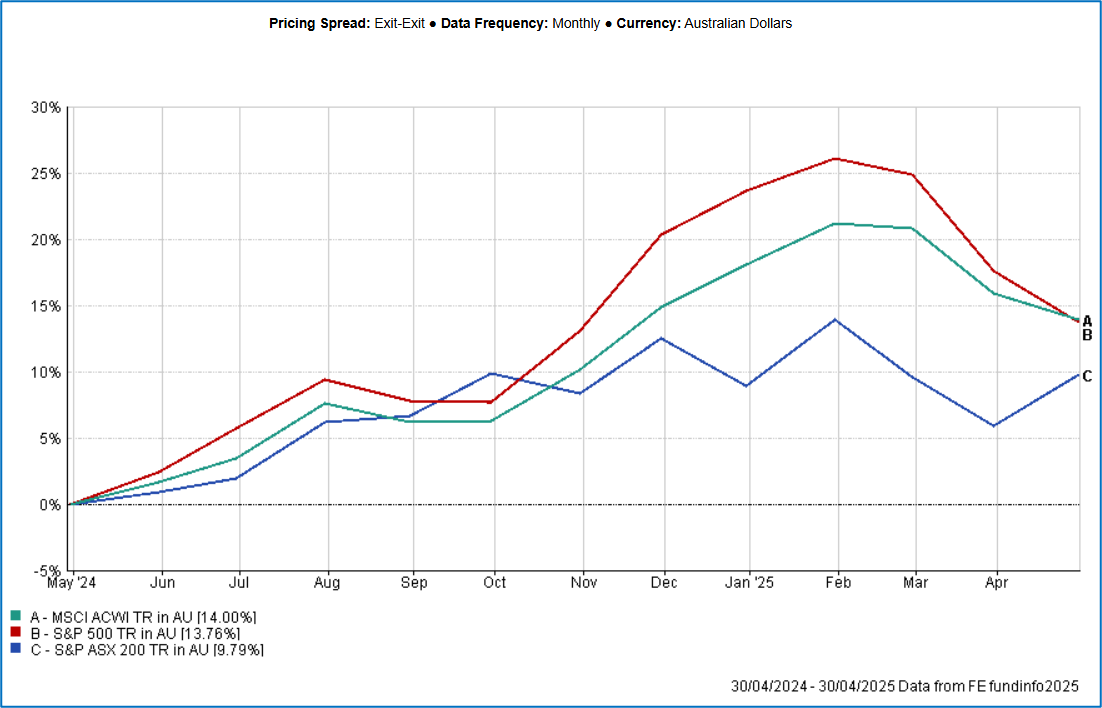
The chart below shows the performance over 1 year to 30 April 2025 for the US stock market (in red); global shares (in green) and Australian shares (in blue). 

Share market performance 1 year to 30 April 2025

The theme coming into 2025 was one of US stock market exceptionalism, reflecting both the growth prospects of Artificial Intelligence (AI) related stocks and what was broadly viewed as a pro-growth US Administration.

As the chart starkly shows, this all changed at the end of January when Chinese company DeepSeek unveiled a new AI model, which caused a tech stock rout, followed by the announcement of initial tariffs in early February, which continued into April. 

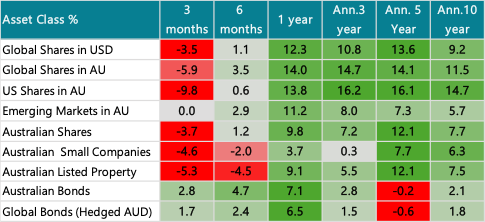
The table below shows negative returns on all share markets over the last 3 months, with global shares down 6% and US Equities (S&P 500) down 10%. Emerging markets have done comparatively well but are quite volatile due to the tariff environment.

The Australian equity market outperformed global markets in April, due to the relatively low impact of US tariffs on Australia and a March Quarter inflation report indicating that inflation has cooled and is under control.

One year returns on growth assets are good except for Australian resources, which did poorly given concerns over China’s growth prospects and falling commodity prices. Bond returns have been volatile but consistently positive across all periods of up to three years.

Returns of major asset classes to 30 April 2025

Outlook for economies and markets

Our base case is that uncertainty will continue to drive market performance in the short term, with returns differing significantly by region or country. Poor investor sentiment is likely to result in modest levels of broad market index returns, as it becomes increasingly difficult for many companies to forecast earnings or make significant investments.

The good news is that there are positive signs for a broadening out of the returns beyond the large cap stocks globally.  Australian stocks should benefit as interest rates are predicted to fall further, and especially if the Chinese Government stimulates its economy.

This environment provides opportunities for active managers.

Quality fixed income assets offer reasonable returns at low risk.

Conclusion

Our preferred approach in times of uncertainty is:

  • Remain diversified by asset classes
  • Ignore short-term noise and stick with your investment strategy
  • Active management over passive.
  • Bonds and high-quality credit for income and stability.
  • Regular rebalancing to maintain target allocations.

The key is to remain invested.  While short-term volatility can be uncomfortable, maintaining a long-term perspective and diversified approach remains the best strategy for most investors.

The information contained in this article is general information only. It is not intended to be a recommendation, offer, advice or invitation to purchase, sell or otherwise deal in securities or other investments. Before making any decision in respect to a financial product, you should seek advice from an appropriately qualified professional.  We believe that the information contained in this document is accurate. However, we are not specifically licensed to provide tax or legal advice and any information that may relate to you should be confirmed with your tax or legal adviser.

“I don’t have enough assets to worry about a will.”

“I’m too young to think about estate planning.”

“I’ll get around to it later.”

Does this sound familiar?  If so, you’re not alone. According to a Finder survey1, almost 60% of Australians don’t have a Will or an Estate Plan in place.

But if you don’t take control of your future, who will?

Many assume that estate planning is only for the wealthy or elderly, but the reality is that everyone – young or old, single or married – needs to have their legal affairs in order. Life is unpredictable, and while no one likes to think about what happens when they pass away or become incapacitated, failing to plan can leave your loved ones burdened with legal battles, financial stress, and uncertainty.

When you consider the potential financial and emotional impact on loved ones left to navigate unclear legal affairs, it’s easy to see why creating or updating a Will and other key legal documents is so crucial.

Why Estate Planning Matters

If you don’t make key legal decisions, someone else will, and it may not be who you’d want. Without a valid will:

  • Your assets may not go to the people you intended.
  • If you have a de facto partner, they may need to fight for recognition of their rights.
  • Courts decide who will take care of your children if you pass away unexpectedly.
  • Family members may dispute inheritance, leading to costly legal battles.
  • The government may take control of your estate if no close relatives exist.

Essential Legal Documents Everyone Should Have

Estate planning isn’t just about writing a will it’s about ensuring every aspect of your personal, financial, and medical affairs is protected. There are three key documents every Australian should have in place:

  1. Will – Who Gets What?

A will is a legally binding document that outlines how you want your assets (property, savings, investments, and possessions) to be distributed after you pass away. Without one, the government decides who gets what, which may not align with your wishes.

Why It’s Important:

  • Ensures your assets go to the right people, not just next of kin by default.
  • Avoids family disputes and legal battles over inheritance.
  • Lets you nominate a guardian for minor children, ensuring their care is in trusted hands.
  1. Power of Attorney – Who Manages Your Affairs?

A Power of Attorney (POA) allows you to appoint someone you trust to make financial and legal decisions on your behalf if you become unable to do so yourself (e.g., due to illness, injury, or mental incapacity).

Why It’s Important:

  • Ensures your bills, mortgage, and financial commitments continue to be managed.
  • Prevents the need for costly court-appointed administrators if you become incapacitated.
  • Can be tailored to cover temporary or long-term decision-making authority.
  1. Advance Care Directive – Who Decides Your Medical Treatment?

An Advance Care Directive (or Living Will) is a legal document that outlines your preferences for medical care and treatment if you’re unable to communicate them yourself. It ensures doctors and family members respect your wishes regarding life support, palliative care, and other treatments.

Why It’s Important:

  • Gives clear guidance to doctors and loved ones about your medical preferences.
  • Prevents family disagreements over healthcare decisions.
  • Ensures your values and beliefs are respected in medical treatment.

When Should You Review Your Estate Plan?

Estate planning isn’t a “set and forget” task. You should review your documents every 3 to 5 years and update them after significant life events, such as:

  • Marriage, divorce, or separation – Marriage can revoke a will, and divorce may require updates.
  • Birth of a child or grandchild – Ensure they’re included in your inheritance plan.
  • Buying property or acquiring wealth – Your assets need to be accounted for.
  • Starting a business – Plan for business succession if you become incapacitated.
  • Major health diagnosis – Ensure your medical wishes are documented.
  • Death of a beneficiary or executor – You may need to appoint someone new.

Take Action Now

Estate planning is about more than just preparing for the inevitable – it’s about protecting your loved ones and ensuring your wishes are honoured.

If you’re not sure of the next step, we can help put you in touch with a lawyer or estate planner today.

The information contained in this article is general information only. It is not intended to be a recommendation, offer, advice or invitation to purchase, sell or otherwise deal in securities or other investments. Before making any decision in respect to a financial product, you should seek advice from an appropriately qualified professional.  We believe that the information contained in this document is accurate. However, we are not specifically licensed to provide tax or legal advice and any information that may relate to you should be confirmed with your tax or legal adviser.

1 https://www.finder.com.au/news/australians-have-no-estate-plans

May 1 is World Password Day and serves as a timely reminder to reset your passwords regularly to help keep yourself safe online. Cybercrime can be hard to identify and difficult to stop once it is underway. That’s why it’s more important than ever that we protect ourselves.

Here’s a handy list of what you can do to help protect yourself from cybercrime and what to do if you suspect you may have been compromised1.

What you can do to protect yourself

  • Purchase and install high-quality software on your computer to detect and prevent viruses, spyware and malware. When you purchase security software, you will receive updates, including patches for your security system. It is extremely important you update when prompted and do not ignore, as the ‘patch’ includes any latest threats to your operating system.
  • Never click on links in emails or text messages.
  • Do not open attachments unless you are sure of the source.
  • Take precautions when accessing free wi-fi, such as using a virtual private network (VPN).
  • Where possible, use biometrics like fingerprint or face recognition to restrict access to your mobile phone.
  • Do not give out personal information unless you are sure it is secure. This includes social media.
  • Limit social media connections to people you know in real life.
  • Review your financial statements often and ensure all the transactions are yours.
  • Never share usernames or passwords – and never record them anywhere.
  • Ensure your passwords are not easy to guess and use a combination of letters and numbers.
  • Use different passwords for different systems and applications.

If you have been compromised, here’s what to do:

  • Contact your bank or financial services provider immediately to understand what steps can be taken and what protection they may offer. Consider reducing payment limits as an example. Or consider asking for your account to be blocked. Have measures added to your accounts. Your bank can have your account stopped, reset your passwords and security questions and set alerts on transactions to protect you from loss.
  • Change the passcodes for your devices.
  • Change the passwords for your accounts.
  • Consider replacing your credit cards.
  • Have your personal devices cleaned by a professional if you suspect malicious software has been installed.
  • Report the compromise to law enforcement.
  • Check your credit report and subscribe to credit alerts that let you monitor changes to your credit file.
  • Contact ID Care, Australia and New Zealand’s national identity and cyber support service. ID Care is a free service that helps victims of ID fraud.

Remember to always be vigilant, and together we can work to help keep your hard-earned investments safe.

The information contained in this article is general information only. It is not intended to be a recommendation, offer, advice or invitation to purchase, sell or otherwise deal in securities or other investments. Before making any decision in respect to a financial product, you should seek advice from an appropriately qualified professional.  We believe that the information contained in this document is accurate. However, we are not specifically licensed to provide tax or legal advice and any information that may relate to you should be confirmed with your tax or legal adviser.

1 BT Cyber and financial crime resources