
Share markets are renowned for taking unexpected downturns, and while history shows that markets eventually recover, this rebound in value can occasionally take time. Investors concerned about this risk, or those who no longer have a regular income, might consider a stronger focus on income-generating investments in their portfolio.

Income-generating investments can range from those with no potential to lose capital value to those with a higher risk of capital loss. Outlined below are some options.

Investments with no ‘growth’ component

Online savings accounts Interest on these accounts can vary substantially between providers and there can be enticing offers of extra or bonus interest for new customers or if you maintain a certain balance. The best advantage of these accounts is that you have access 24/7 to your funds.

Cash management trusts (CMT) are investment products that pool the deposits of other unit holders for investment in cash securities. Interest is calculated daily. There are no entry fees, but most charge management fees. They frequently have minimum withdrawal amounts and may require notice to withdraw funds. However, the trustee can decide to restrict withdrawals if it deems this is necessary in the best interests of the trust investors. CMTs are good for holding cash that is not needed for everyday living and offer easier access than term deposits.

Term deposits can pay a higher interest rate than cash management trusts, although in more recent years, rates on term deposits are close to those offered for online savings accounts. The downside is that your funds are unavailable for the term of investment and penalties can apply if you withdraw your money before the term expires. Terms range from one month to several years so you can choose the timing to suit your needs. Income can be paid regularly or at the end of the term.

Annuities can pay guaranteed income for a certain period of time or for the rest of investor’s life. The amount invested in an annuity can be used to supplement the income being drawn or can be preserved and returned back to the investor upon maturity. Income can be paid regularly or yearly. However, access to the capital is generally restricted for the term of annuity. 

Investments that adjust in value to interest rates in the market:

Fixed interest managed funds invest in bonds and bank bills, known as debt securities. Like cash management trusts, they pool investors’ funds to provide access to investments at the big end of the market. These are often used as the fixed interest component in a portfolio. They can have a wide range of fees depending on the underlying investments and may have a small growth component.

Convertible notes are offered by companies and unit trusts. They can offer a good interest rate, and at the end of the specified term, the investor can choose to convert the notes to shares in the company or get their cash back. These are frequently traded on the stock exchange. The sale price depends on the market interest rates and market attitude to the company.

Hybrid securities are investments that combine the elements of debt and equity. They are offered by companies that borrow from their investors and pay back the interest. However, if the company disappoints the market, the underlying value can reduce. These securities generally have long terms (e.g. 50 years) and can only be sold on the stock exchange if there is demand.

Investments that have a growth component plus good income potential:

Some Australian shares regularly offer fully franked dividends and also give you access to the tax benefits of imputation credits. To get the most from shares they should be held for the long term.

Listed and unlisted property trusts are investments that pool investors’ funds to purchase real estate, usually commercial property. Depending on the types of property investments held, they can provide a higher level of income, some of which may be tax-free or tax-deferred. Listed property trusts are traded on the Australia Stock Exchange and provide more liquidity than unlisted trusts.

A balanced portfolio

For many investors the best solution is to have a ‘balanced’ portfolio – that is, a selection from each of the different market sectors. This should be tailored to the individual’s needs, providing the level of income required at an appropriate level of risk.

If you’re unsure what income-generating investments may be best suited for your circumstances and needs, give us a call to find out more.

The information contained in this article is general information only. It is not intended to be a recommendation, offer, advice or invitation to purchase, sell or otherwise deal in securities or other investments. Before making any decision in respect to a financial product, you should seek advice from an appropriately qualified professional.  We believe that the information contained in this document is accurate. However, we are not specifically licensed to provide tax or legal advice and any information that may relate to you should be confirmed with your tax or legal adviser.

A key financial priority for many of us is supporting the education of our children.

We are lucky in Australia to have a strong education system, and whether you choose public, private or independent schooling or are looking at supporting their tertiary education, the goal is the same: to set your children (or grandchildren) on the path to a bright and rewarding future.

Education costs are broader than school fees alone, with outside tuition, school camps, transport, uniforms, electronic devices, and sports equipment all adding up.

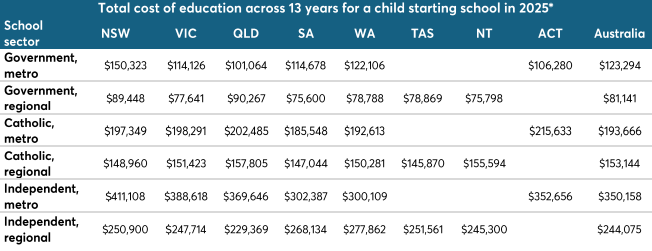
Total estimated cost of education for a child starting school in 2025

*Estimates of future long-term education costs projected over a 13-year period are provided as a guide only and are population-weighted. Being estimates, the actual cost of education for a particular child or school sector or period cannot be guaranteed.

Each choice involves a much different financial investment. What you choose will come down to your own view of what is best for your children. Regardless of your choice, a range of financial options and savings are available to support your children’s education needs.

Weighing up your options

The golden rule for most financial plans is to establish and implement your plan as soon as possible. More time will help you maximise your returns and boost your savings. With that in mind, here are five options you might consider:

  1. Take advantage of a home loan offset account

An offset account is a bank account linked to your home loan. Using it to save for your children’s education can be tax-effective and reduce the interest paid over the term of your loan.

Effectively, any money saved in the account earns an after-tax interest rate equal to the home loan rate, which is usually substantially higher than interest received taxed at your marginal income tax rate, as offered on term deposits or similar.

Self-discipline is the big challenge in using an offset account.

  1. Investment or education bonds

Investment bonds are investments through which you lend money to a government or company for potential capital growth and tax benefits . There is usually a minimum amount you must invest. The tax rate on investment bond earnings is up to 30%, which is advantageous for higher-income earners. Usually, subject to certain rules, if you hold investment bonds for at least 10 years, your entire investment earnings will be ‘tax-paid’, and withdrawals after this date will be free of personal tax.

Education bonds are a special type of investment bond that must be intended for the purpose of saving for education. Education bonds include the features and tax advantages of conventional investment bonds plus additional educational tax advantages, estate planning features, and the freedom to designate numerous beneficiaries.

  1. Term deposits

Term deposits are one of the most well-understood and simplest ways of earning interest on savings.  They offer a fixed interest rate over a specified period, typically for one or two years. On termination, you can choose to roll them over into a new term deposit, understanding that a new interest rate will apply, which may be lower. 

  1. Managed or Exchange Traded Funds (ETFs)

Investing in a managed fund could be a reasonable option if you want to invest over a reasonable term, say three to ten years.

You could invest in a managed fund with exposure to the share market, property or fixed-income assets, or a diversified asset allocation. They generally require you to have a minimum amount of money already available to invest, and you may incur an establishment fee. There are also ongoing investment management fees.

Some managed funds are listed on the Australian Stock Exchange (ASX) and are known as Exchange Traded Funds (ETFs). They can be bought and sold like other ASX shares, meaning you can easily increase your holding as you can afford it, or sell if needed.

Capital Gains Tax (CGT) is usually applicable when you sell.

You should read and understand the risks and returns expected from these investments over the timeframe you’re planning to invest.

  1. Invest tax-effectively

If you’re investing with a partner, it might be worth considering in whose name you should invest your funds. It can be more effective to invest in the name of the person paying the lowest rate of income tax.  You should note to monitor and review this should a job change or promotion alter your relative tax situations or if your relationship changes.

Setting up for success

If you’re starting early, saving for education will be a medium to long-term effort, so some of the investment options listed above may experience periods of negative returns. This possibility suggests that reducing risk while optimising your savings over a five to 10-year timeframe might call for some diversification of your investment portfolio – allocating your savings across several types of investment.

We can help you work through the options available and put together a plan to put you on track towards comfortably funding the education you choose for your children.

The information contained in this article is general information only. It is not intended to be a recommendation, offer, advice or invitation to purchase, sell or otherwise deal in securities or other investments. Before making any decision in respect to a financial product, you should seek advice from an appropriately qualified professional. We believe that the information contained in this document is accurate. However, we are not specifically licensed to provide tax or legal advice and any information that may relate to you should be confirmed with your tax or legal adviser. 

The operations of most small businesses rely on at least one or two pivotal people: usually the owner and perhaps a valued employee. If one of these key people were to experience a major illness or injury, or perhaps die, there is a good chance that the business would struggle and perhaps even fail.

Putting the right plans in place

Small businesses are usually structured as a sole trader, partnership or company. In each case, the owners should put plans in place to ensure the business can survive the temporary or permanent loss of a critical person.

This contingency planning involves two elements:

  • documenting how business ownership is to be transferred if certain events occur, and
  • taking out insurance to provide the business with the financial resources to continue operations.

The right documentation

Documenting how and when an owner’s share is to be transferred following serious illness, injury or death prevents many problems and disputes, especially with multiple owners. Having a succession strategy and buy-sell agreements in place will help the business to continue to operate without interruption.

A succession strategy involves identifying potential future owners of the business and preparing them for that role. Buy–sell agreements detail what happens to an owner’s share of a business if a specific event occurs. Common events include death, divorce, long-term disability, retirement, and bankruptcy. In most cases, the outgoing owner (or their estate) will sell their share to the continuing or surviving owners.

The right insurance

Most buy-sell agreements are funded using an insurance policy with cover for death, total and permanent disability, and trauma. However, it may also be appropriate to take out other forms of insurance to fully protect the business.

Business revenue, profit, and potentially its value will be affected if an owner or an important employee is unavailable to work in the business. Taking out Keyperson insurance, income protection insurance, and business overheads insurance can provide additional funds for business expenses and help ensure it continues to operate in the short and long term.

Here’s one example…

Scott is a plumber and runs his own business as a sole trader. He employs Daniel part-time to look after the office administration, schedule work and organise orders. He has an apprentice, Riley, who is in the second year of his trade and still requires extensive supervision. Scott’s business turned over $470,000 last year and he received a personal income of $80,000.

On the advice of his financial adviser, Scott put a comprehensive insurance plan in place last year. This proved to be a wise decision because during his annual ski trip he tore his anterior cruciate ligament. The injury required extensive surgery and rehabilitation.

Scott was unfit to work as a plumber for four months. After his elected waiting period expired, Scott’s personal income protection policy paid him a replacement income of $5,000 each month he couldn’t work.

Scott’s business overheads insurance policy provided a monthly payment that covered ongoing expenses such as Daniel’s salary, rent for the business premises, utilities and phone. It even enabled Scott to employ a qualified plumber on a temporary basis to supervise Riley and complete outstanding jobs.

Taking out the right insurance meant Scott’s business could continue operating without him rather than collapsing under financial pressure.

And one more…

Gary and George run a catering business as a partnership. The business has grown substantially in recent years and now employs three full-time and one part-time staff and turns over more than $3.5 million annually.

Gary suffers a serious heart attack. Although he recovers well and remains physically capable of working in the business, he decides it’s the right time for him to leave. He wants to spend more time with his family and perhaps find work with less pressure and stress.

Gary and George have a buy–sell agreement and have a funding plan that includes insurance. The trauma insurance policy covers Gary’s medical condition and pays out a lump sum, which is used to fund George’s purchase of Gary’s share in the business. As a result of this planning, the business can continue operating with minimal disruption.

Ensuring your business’s continuity through unexpected events requires careful planning, documentation, and insurance. Each business is unique, so for tailored solutions, seek guidance from a financial adviser.

As financial planners, we can help implement a contingency plan that safeguards your business and provides peace of mind. Don’t leave your business’s future to chance —contact your financial adviser today.

The information contained in this article is general information only. It is not intended to be a recommendation, offer, advice or invitation to purchase, sell or otherwise deal in securities or other investments. Before making any decision in respect to a financial product, you should seek advice from an appropriately qualified professional.  We believe that the information contained in this document is accurate. However, we are not specifically licensed to provide tax or legal advice and any information that may relate to you should be confirmed with your tax or legal adviser. 

It’s not realistic to put a dollar sign on the cost of your child’s or grandchild’s future. But calculating the cost of education can help you draw a close enough estimate particularly in relation to the type of schooling you want to be able to afford them.

If you’re considering private school options, school fees are a major cost and have trended faster than the rate of inflation. Additionally, there’s uniforms, textbooks, extra-curricular activities and trips – that also need to be factored throughout the 13-year school journey. It’s also worth considering how the costs compare across school sectors if you are in two minds about school type.

Source: Futurity Investment Group Planning For Education Index 2025

It doesn’t stop there though. Post-secondary pathways could see your child or grandchild consider a slew of avenues ranging from University through to vocational training where course duration and costs vary depending on course type. Although the HECS-HELP study assistance loan is an option to delay payment of the core course fees, consideration to short-term study expenses such as textbooks and possible accommodation relocation requirements need to be given. There’s also the long-term impact HECS- HELP debt could have on your child or grandchild pursuing future goals and life events such as home ownership.

It sounds overwhelming and probably is, given that it might not be something that you’re even considering but planning and building a strategy to help you fund the costs and adequately cater for in your cashflow and budget.

Know your options

An obvious bit of advice is to do your due diligence and weigh up the benefits and downsides of various strategies.

Investing in a child’s name is generally not a sensible option – as any income (over $416) will be heavily taxed.

Another common strategy is to establish a share portfolio or savings account, with a parent acting ‘as trustee for’ their child. Interest/dividend income earned though is generally required to be declared in the name of the adult taxpayer, and when the time comes to accessing the investment for the educational purposes it was intended to serve, capital gains tax can represent a significant financial cost.

An often-over-looked option is the structure of an education bond. Designed to facilitate the entirety of an individual’s educational journey, education bonds can be contributed to by anyone and are taxed internally at the company tax rate of 30%.

Education Bonds: tax – effective product to fund education costs

A type of investment bond that if acquired through a friendly society or life insurer is classed as a ‘scholarship plan’ under Australian tax law. It enables the provider to receive a tax deduction for certain educational expenses, which the bond owner will receive in the form of a rebate when withdrawals are made to cover education costs.

Additionally, the capital invested is not locked in for educational purposes only. If circumstances change and other needs arise, funds are accessible for any purpose at any time, and control over how and where the money is invested is retained until it is withdrawn. Another feature is the estate planning benefits – the nature of the structure requires a beneficiary to be nominated, and in the event that the bond owner passes away, benefits can still be maintained via bond guardian.

Achieving peace of mind

Educational expenditure isn’t generally regarded as an activity that can be managed in a tax-effective manner, but it can be done and can allow you to re-allocate capital to other priorities is added bonus.

If you have any questions about how you can better prepare for the total cost of education, whether for your kids or grandkids, please get in touch.

The information contained in this article is general information only. It is not intended to be a recommendation, offer, advice or invitation to purchase, sell or otherwise deal in securities or other investments. Before making any decision in respect to a financial product, you should seek advice from an appropriately qualified professional.

We believe that the information contained in this document is accurate. However, we are not specifically licensed to provide tax or legal advice and any information that may relate to you should be confirmed with your tax or legal adviser.

While the standard of living is constantly improving in Australia, economic disruptions, stagnant wage growth and continually increasing house prices are putting more and more people under financial stress.

That niggling feeling that you’re not in control of your financial situation can keep you up at night. It may be as simple as being unsure whether you will have sufficient savings in super to retire in the way you want. Many people haven’t put aside the time to understand their financial position, and the constant pressure of earning money and paying bills can feel overwhelming.

A good place to start is completing this Three-Minute Financial Check-Up.

Your Three Minute Financial Check-Up

Action

YES

NO

Do you pay all your credit cards off in full by their due date?


Do you sleep easy knowing all your bills will be paid when they fall due?


Do you have a budget?


Do you stick to your budget?


Are you making all your loan repayments on time?


Do you know exactly how much your home loan is today?


Do you know what you would do financially if you lost your job tomorrow?


Are you confident about your children’s financial future?


Do you have appropriate life and total and permanent disability insurance in place?


Do you have income protection in place?


Do you know how much you have in super?


Are you and your partner in agreement about your finances?


Do you feel confident about your overall financial position?


If you’ve answered ‘no’ to any of these questions, then you could benefit from speaking with a financial planner. As a financial planner, we will be able to tell you how you can take steps immediately to improve your financial position and help you get back on track, so you feel more in control.

This will allow you to move into the new year with confidence and peace of mind, and you can embrace life with more enthusiasm and gusto.

The information contained in this article is general information only. It is not intended to be a recommendation, offer, advice or invitation to purchase, sell or otherwise deal in securities or other investments. Before making any decision in respect to a financial product, you should seek advice from an appropriately qualified professional. We believe that the information contained in this document is accurate. However, we are not specifically licensed to provide tax or legal advice and any information that may relate to you should be confirmed with your tax or legal adv

Does your money mindset have your back? Or… Does it hold you back? 

If you’ve never really thought about it, you’d be forgiven. When it comes to our financial success, we tend to focus on things like income, investments, and expenses. It makes sense to put our financial position down to how much we earn or spend, or the performance of our investments. But what about the role of your money mindset?

What is a money mindset?

A money mindset is your set of beliefs and attitudes about money. It shapes how you make financial decisions, how you perceive wealth, and react to financial challenges. Understanding your money mindset is important because it can either support you in achieving financial success or hold you back.

There are various types of money mindsets, but they often fall into two broad categories:

Abundance Mindset vs. Scarcity Mindset

Abundance Mindset: An abundance mindset is the belief that ample opportunities exist to earn, grow, and enjoy wealth. People with this mindset see the world as full of potential and possibilities. They tend to be optimistic about their financial future and are willing to take calculated risks.

Scarcity Mindset: A scarcity mindset, on the other hand, is the belief that resources are limited and difficult to obtain. People with this mindset often focus on what they lack rather than what they have. This can lead to fear, anxiety, and a reluctance to take risks.

Fixed Mindset vs. Growth Mindset

Fixed Mindset: A fixed mindset in a financial context means believing that your financial abilities and knowledge are static and unchangeable. People with a fixed mindset might think they are either ‘good’ or ‘bad’ with money and that this cannot be altered.

Growth Mindset: A growth mindset is the belief that financial skills and knowledge can be developed through effort and learning. Individuals with a growth mindset see financial challenges as opportunities to improve and grow.

Money Mindsets in Everyday Life

Having explored the concepts of abundance vs. scarcity and fixed vs. growth mindsets, let’s look at how these money mindsets might manifest in everyday life.

Abundance and Fixed Mindset:
Taylor is optimistic about her financial future and believes in plenty of opportunities. However, she thinks her financial skills are unchangeable. She sticks to familiar, low-risk investments and dismisses new strategies, missing out on potentially higher returns.

Abundance and Growth Mindset:
Kylie believes there are many ways to grow her wealth. She takes an online investing course, consults a financial adviser, and starts a diversified investment portfolio. She views market fluctuations as learning experiences and opportunities for growth.

Scarcity and Fixed Mindset:
Jacob believes he will never be good with money and that financial success is reserved for others. He avoids investing due to fear of losing money and prefers to keep his savings in a low-interest account. He often feels stressed about his financial future and is reluctant to seek advice.

Scarcity and Growth Mindset:
Oscar grew up believing money is scarce and financial security is hard to achieve. Despite this, he commits to improving his financial situation through education. He starts with low-risk investments to build confidence and gradually diversifies his portfolio, overcoming his fears over time.

Strategies to shift a negative Money Mindset

If you’ve identified that your money mindset might be holding you back, don’t worry! The following strategies can be used to help you to shift your mindset to a more positive one.

  1. Set realistic and achievable financial goals – Start with small, manageable goals and gradually increase their complexity. Achieving these goals will build confidence and encourage a positive mindset.
  2. Educate yourself on financial management and investing – Understanding financial principles and investment strategies can help reduce fear and build a sense of control over your finances.
  3. Practice mindfulness and emotional intelligence – Mindfulness can help you stay present and make thoughtful financial decisions. Emotional intelligence will enable you to manage financial stress and maintain a positive outlook.
  4. Seek professional advice – Professional financial planners can provide valuable insights and strategies tailored to your unique situation. They can help you navigate complex financial decisions and create a roadmap for achieving your goals.

Your money mindset plays a crucial role in your financial success… it should have your back, not hold you back!

By identifying and overcoming negative financial beliefs, you can create a healthier relationship with money and achieve your financial goals. Take the first step today by reflecting on your financial mindset and seeking professional advice to guide you on your journey.

The information contained in this article is general information only. It is not intended to be a recommendation, offer, advice or invitation to purchase, sell or otherwise deal in securities or other investments. Before making any decision in respect to a financial product, you should seek advice from an appropriately qualified professional.  We believe that the information contained in this document is accurate. However, we are not specifically licensed to provide tax or legal advice and any information that may relate to you should be confirmed with your tax or legal adviser.

As cost-of-living increases, many of us look for obvious ways to cut expenses, like cancelling streaming services, dining out less, and skipping extras in our shopping baskets.

But what about the less obvious ways?

Sneaky fees and charges can increase our day-to-day living expenses without us realising it. 

Here are some hidden or avoidable costs that could be draining hundreds from your annual household budget.

  1. Service fees

Do you check restaurant bills before paying? You might read over the items, but what about the fine print?

Some restaurants and cafes include an automatic service fee. Not a card payment fee or public holiday surcharge, but an additional fee, sometimes up to 12%.

When queried, it may be explained as a discretionary tip to service staff. This means you have a choice – ask to be sure – but remember the business owner is struggling to survive too.

Be aware though, that if the fee is for service staff, then you tip your server on top, you could be paying way more than you should.

Check all charges on your restaurant bill and question anything you don’t understand.

  1. Travel insurance

An absolute necessity for all travellers, but if you haven’t kept up to date with your credit card’s T&Cs (and who does?), you may be doubling up.

Competition among credit providers has resulted in many offering complimentary travel insurance provided you pay for your travel using their credit card.

Read the fine print to ensure you meet the qualifying conditions, the policy is underwritten by a reputable company and covers what you need. Understand the claims process and make sure the company has an emergency contact line easily accessible from overseas locations.

Additionally, many policies cover car-hire excess. This excess can be costly if purchased through the car hire company and unnecessary if it’s already covered in your travel insurance. Double-check your policy!

  1. Bonuses that aren’t

Warrantees on purchases where, for a small additional charge, you get extra cover, can be unnecessary or over-priced. Take a close look and cancel or downsize if required.

Subscriptions with free trial periods can be traps ready to spring the very second the trial ends.

Ensure you:

  • understand the cancellation procedure before signing up,
  • set a reminder on your device for a day before the trial ends then cancel if need be.
  1. Ad-free apps

Many apps are free provided you can put up with advertisements. Try free versions first, then if ads become annoying, upgrade to the ad-free version later.

  1. Life insurance

Life insurance is designed to pay your debts and support your dependents if you or your spouse dies, becomes ill, or disabled.

So, if you’ve paid off your home, you’re debt-free and kid-free – or at least they’ve flown the coop – should you still be paying for life insurance?

Your financial adviser can help you answer this question.

  1. App store audit

Google Play, Amazon Appstore, Apple App Store, are just a few app stores available.

Check your devices for one or more of them. Open the app, navigate to the Payments and Subscriptions menu and open Subscriptions. You may be surprised by the things you’re paying for.

It’s easy to lose track of everything we, or family members, have signed up for. Asking the right questions, checking the fine print and auditing subscriptions and apps, can add up to some serious annual savings.

Similarly, your financial advisor can help you reduce costs by reviewing and consolidating insurance policies, savings and superannuation investments.

It’s tough out there and everyone is seeking ways to increase revenue and reduce running costs. Your household is no different – it’s in your hands and it’s do-able.

The information contained in this article is general information only. It is not intended to be a recommendation, offer, advice or invitation to purchase, sell or otherwise deal in securities or other investments. Before making any decision in respect to a financial product, you should seek advice from an appropriately qualified professional.  We believe that the information contained in this document is accurate. However, we are not specifically licensed to provide tax or legal advice and any information that may relate to you should be confirmed with your tax or legal adviser.

Do you know Olivia? Perhaps she reminds you of someone you know.

Olivia always known that saving for her first home would require a bucket-load of discipline and sacrifice. And when she thought about the amount needed for a deposit…well, it all seemed too hard. 

Whether it was a weekend away with friends, or the latest can’t-live-without gadget, Olivia was too easily distracted and couldn’t seem to control her spending.

The problem, she believed, was that long-term savings goals felt so unattainable that she saw no reason to go without the things she wanted – now.

In short, Olivia lacked motivation.

 Olivia often expressed with her friends how frustrated she was by a seemingly unreachable sum required to buy a home, and her seeming inability to save. That’s when her friend Emma told her about loud budgeting. Loud budgeting, explained Emma, is a goal-oriented mindset, in which you make your frugal mindset obvious. It begins by saying, out loud, that healthy management of your money is something you value more than mindless consumption and the curated, unrealistic lifestyles portrayed in social media1. It starts with being willing to share your savings goals with trusted friends and family and being accountable to them.

For Olivia, it was like a light came on. This was the opposite of how Olivia’s parents managed their money; for them, discussing one’s finances was strictly taboo.  But with the transparency of loud budgeting is its driver, this would definitely help when politely declining invitations to dinner or the movies, etc.

So, after talking it through with Emma, Olivia decided to try loud budgeting. They discussed how much Olivia would need for a home deposit and Emma guided Olivia through these simple steps:

  1. Review income and expenses and draft a realistic budget.
  2. Set a savings target, broken into smaller, manageable milestones.
  3. Create a large colourful chart to plot progress and keep it in a prominent place.
  4. Utilise technology; many banks offer savings tracker apps. Additionally, the government has a range of savings and budget calculators at gov.au.
  5. Invite feedback and provide updates to the people around you – take them on the journey with you, their support is invaluable.
  6. Stay focussed by visualising yourself achieving your goal, for example, unpacking boxes in your newly purchased home.

Loud budgeting became part of Olivia’s weekly routine. Each movement of her tracker pin along my chart was incredibly satisfying, and there was the sense of empowerment with every milestone achieved.

Olivia learned that loud budgeting is more than just a savings concept. Loud budgeting is all about being every bit as vocal and transparent about what you are doing to spend less and meet your money saving goals2. It’s even more than being accountable.

It was about sharing your dreams with loved ones. It was about celebrating each milestone with them.

So while loud budgeting may not work for everyone, it definitely worked for Olivia .

Perhaps it could work for you too.

The information contained in this article is general information only. It is not intended to be a recommendation, offer, advice or invitation to purchase, sell or otherwise deal in securities or other investments. Before making any decision in respect to a financial product, you should seek advice from an appropriately qualified professional.  We believe that the information contained in this document is accurate. However, we are not specifically licensed to provide tax or legal advice and any information that may relate to you should be confirmed with your tax or legal adviser.



1 https://money.com/what-is-loud-budgeting/
2 https://lifehacker.com/money/what-is-loud-budgeting-and-how-to-do-it


For many Australians, particularly young Australians, the dream of home ownership is often accompanied by the reality of carrying student loans, known as HECS-HELP debt. Understanding the impact of HECS debt on your ability to secure a home loan can help you plan for and navigate the home loan process.

Example

Sarah, is a 32-year-old marketing professional from Melbourne. She has a stable job with a steady income and has managed to save a decent deposit for her first home. However, like many Australians, Sarah carries a HECS debt from her university education.

What is HECS-HELP debt?

HECS-HELP is a loan offered by the Australian government to pay for studies at a university or approved higher education provider. Once a person earns above the compulsory repayment threshold, loan repayments are automatically deducted from their pay through the Australian Tax Office. There is no interest on the loan, but the debt is annually indexed against inflation.

Sarah’s home loan goals

Sarah’s goal is to purchase a two-bedroom apartment close to the city. She is aiming to take out a $450,000 home loan, considering her savings and the property prices in her desired area. Sarah is concerned about how her HECS debt will affect her home loan application and how she can maximise the amount she can borrow.

The application process and the potential impact of student loans

When Sarah approached a mortgage broker to discuss her home loan options, she learned that her HECS debt, while interest-free, would still impact her borrowing capacity.

Sarah’s potential lenders must consider her ability to meet all financial obligations, including her HECS repayments. This could potentially lower the loan amount Sarah qualifies for, as lenders assess her debt-to-income ratio.

Strategies and Solutions

Sarah’s mortgage broker advised that there are several strategies she can consider to enhance her borrowing capacity despite her student debt:

  1. Pay off the HECS-HELP loan: Sarah may be able to borrow more if she were able to erase the HECS debt.
  2. Reduce other debts: clearing or minimising other debts, such as credit card balances or personal loans, would improve Sarah’s debt-to-income ratio.
  3. Consider government grants or incentives: Sarah could still apply for government assistance such as the First Home Owner Grant or the First Home Loan Deposit Scheme, even with HECS debt.
  4. Increase her deposit: by saving more and increasing her deposit, Sarah could reduce the loan amount she needs.
  5. Choosing the right lender: different lenders have varying policies regarding HECS debt. Choosing a lender more lenient towards student loans can enhance her chances of approval.

Outcome

By proactively managing her finances, seeking professional advice, and implementing strategies to manage her HECS debt, Sarah was able to strengthen her home loan application. The impact of student loans on home loan applications is a significant consideration for many young Australians. But the good news is that there are steps you can take to minimise the impact of HECS-HELP debt. Doing so enhances the chances of securing a home loan and empowers you to make informed decisions on your financial journey.

The information contained in this article is general information only. It is not intended to be a recommendation, offer, advice or invitation to purchase, sell or otherwise deal in securities or other investments. Before making any decision in respect to a financial product, you should seek advice from an appropriately qualified professional.  We believe that the information contained in this document is accurate. However, we are not specifically licensed to provide tax or legal advice and any information that may relate to you should be confirmed with your tax or legal adviser.

Since the earliest days of commerce, industries have looked for ways to reduce costs. For many, this meant designing business models around a lean workforce. Yet, seasonal peaks and troughs and operational pressures exposed a flaw in this thinking. Cue the gig economy worker, or freelancer.

While freelancing has been around for years, it really gained momentum the 90s as the internet went mainstream and opened opportunities for contract workers with specialist skills. With the emergence of online freelance platforms, recent years saw a boom in the gig economy. These days it’s thriving, boosted by sophisticated remote technology and, of course, the COVID-19 pandemic which normalised work-from-home arrangements.

While it can be a great lifestyle, freelancing is not without its risks. Freelancers sacrifice job security, and the benefits of permanent employment for higher rates of pay and the freedom to choose when and for whom they work.

Then, there’s employment uncertainty and the constant need to be hunting down the next assignment along with the lack of steady income and all the inherent budgeting problems that engenders.

Depending on a person’s life stage, the lack of income surety can be a deal breaker.

But it doesn’t have to be!

By following five simple steps, it is possible to minimise the impact of an uncertain income.

  1. Create a budget and emergency fund
    Good financial management begins with a realistic budget. Assess your average monthly income and monthly expenses. Consider essential expenses first, then look at discretionary spending. Understand needs vs wants – be honest with yourself. Next, build an emergency fund; enough to cover around six months of living costs. If you’re thinking of leaving a permanent role to join the gig industry, it’s advisable to build an emergency fund before handing in your notice.
  2. Diversify your sources of income
    You know that saying about eggs and baskets? It’s as true for the gig worker as the investor. Maximise and diversify your work opportunities by:
    – joining multiple freelance organisations
    – joining professional associations and networking groups
    – being active on social media platforms like LinkedIn and X (Twitter)
    – asking friends and family for referrals and recommendations.
  3. Tax management
    Tax is a fact of life so be prepared. Set aside a portion of your income for tax and superannuation. Tax mistakes, however innocently made, can be costly. It’s recommended that you consult a tax professional to understand your obligations and entitlements, including what records you must keep and whether you’re required to register for GST.
  4. Invest in yourself
    Gig workers are hired for what they know and their experience. Ensure you stay up-to-date with technology, regulations and trends in your industry. Increase your marketability and access to higher-paying work by subscribing to industry publications, taking online courses and regularly updating your skills and knowledge.
  5. Insure yourself and your future

Staying fit for work is crucial, but accidents and illness happen. Ensure you have appropriate insurance in place to cover you if you become unable to work.

As your financial adviser we can help you develop an appropriate insurance strategy. And don’t neglect your retirement plans. Financial security in retirement requires a long-term view and we can help with this as well.

There’s no doubt that the flexibility afforded by gig work is attractive, but it comes with its fair share of pitfalls.

With preparation, planning and professional advice, it is possible to enjoy the freedom of freelance working without sacrificing your financial security.

 The information contained in this article is general information only. It is not intended to be a recommendation, offer, advice or invitation to purchase, sell or otherwise deal in securities or other investments. Before making any decision in respect to a financial product, you should seek advice from an appropriately qualified professional.  We believe that the information contained in this document is accurate. However, we are not specifically licensed to provide tax or legal advice and any information that may relate to you should be confirmed with your tax or legal adviser.