Many business owners start out as sole traders. As a sole trader, you – the business owner – are the business. You have a registered business name, an Australian Business Number (ABN), and if turnover exceeds $75,000 p.a., you are registered for GST, writes Rolf Howard, Managing Partner at Owen Hodge Lawyers. 

You still only file your personal income tax return, albeit with the business schedule supplement, and you pay tax on the profits from your business at the standard personal income tax rates.

You are the business entity. You are totally responsible, and completely liable – even your personal assets, including your home in joint names, are at risk if things go bad.

Being a sole trader is a straightforward and relatively simple place to start. But a successful and expanding business will outgrow that structure.

Here are a few options available to sole traders looking to shift to a more mature business structure

Partnership

A partnership is a structure whereby two or more people co-own and operate the business. This can be with a colleague with complementary skills and ambitions, or a partner or spouse. Income (and losses) can be shared, and risk can be somewhat diversified. A written partnership agreement is highly advisable as verbal arrangements can be fraught.

While a partnership is perhaps a step in the right direction, for a successful and expanding business, the next step may be to form a company.

Company

A company is a legal entity in its own right and will have its own ABN. You cannot transfer your current ABN. It will also have a business name, but your current sole trader business name can be transferred and owned by your new company.

A company needs to be registered with and overseen by ASIC, and there are several requirements, essentially:

  • Establish a registered office and place of business.

  • Appoint director(s).

  • Create and maintain your business name.

  • Keep appropriate financial records.

  • Keep ASIC advised of any changes.

  • Pay ASIC fees (which are not onerous).

Most small companies are established as Proprietary Limited companies, which is to say that the ownership (proprietary) of the company is limited to 50 non-employee shareholders. Further, the company has limited liability and therefore provides a layer of protection between you and third parties.

Small companies are required to have a minimum of one director, and in the first instance, that will be you. As a company director you will have responsibilities and liabilities. These are really just common-sense requirements for good governance, but it is important that directors comply with the rules, as failure to do so can have ramifications.

Since the company is the business, it must submit its own tax return, and will pay tax at the company tax rate. Currently, the standard rate is 30%, though in some circumstances this may be reduced.

A company structure:

  • Enables ready access to expansion with like-minded investors.

  • Provides credibility with banks and financiers, clients, and suppliers – the Pty. Ltd. label

  • Opens opportunities to contracts that are only available to companies.

  • Limits personal liability to the owners.

  • May well reduce the tax payable.

  • Provides tax offsets for some R&D and other activities.

  • Provides easier succession planning – the company will continue to exist until wound up.

When it comes to changing your company structure, with an experienced company lawyer to advise you and an astute accountant to provide appropriate support where needed, you will be able to get on with what you do best – keep your business trajectory on track towards the next stage. 

If you’d like more information on the structure of your small business, call us on Phone: 07 5641 4134.

Source: Flying Solo September 2021

This article by Rolf Howard is reproduced with the permission of Flying Solo – Australia’s micro business community. Find out more and join over 100K others https://www.flyingsolo.com.au/join.

Important: This provides general information and hasn’t taken your circumstances into account. It’s important to consider your particular circumstances before deciding what’s right for you. Any information provided by the author detailed above is separate and external to our business and our Licensee. Neither our business, nor our Licensee take any responsibility for any action or any service provided by the author. Any links have been provided with permission for information purposes only and will take you to external websites, which are not connected to our company in any way. Note: Our company does not endorse and is not responsible for the accuracy of the contents/information contained within the linked site(s) ac www.flyingsolo.com.au > Logo file is here: https://bit.ly/flying-solo-logo

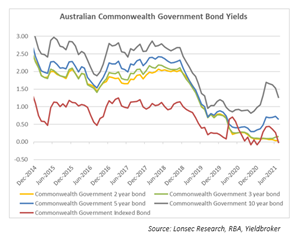
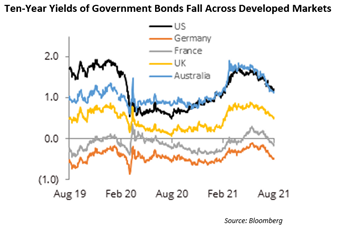
According to a report in Bloomberg recently, while Vanguard data show a portfolio with 60 equities/fixed income mix returned an average 9.1% a year from 1926 to 2020, JP Morgan Asset Management recently estimated it will return just 3.7% over the next decade. Why? In a world where 85% of developed-market government bonds are yielding below 1%, the likely returns from the fixed income component of the portfolio has plunged, as shown in Figures 1 and 2.

Figure 1

Figure 2


So, this raises a question that we are getting asked by our clients – why even bother having fixed income within my portfolio?

When answering this question, it is important to think about what the reasons were for including fixed income in your portfolio in the first place.

At Lonsec, we believe that fixed income generally can play three roles in a portfolio:

  1. As a diversifier to equities – bonds dampen overall portfolio volatility when held in a portfolio with riskier assets such as equities;

  2. As a defensive asset that “will not go down” – so may be suitable for the risk averse investor with a primary objective being the preservation of capital; and

  3. As a provider of a steady income stream – regular income payments from bonds provide a stable income stream for retirees

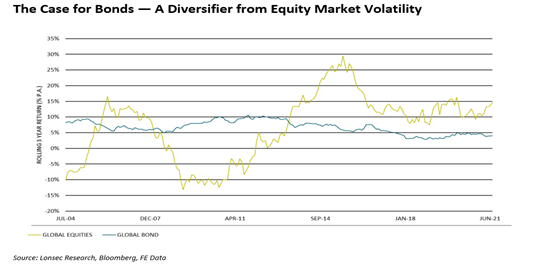
Figure 3 shows the rolling three year returns for global equities and global bonds and serves to highlight the relatively low volatility of global bonds compared to global equities.

Figure 3

However, when faced with the prospect of challenging returns, the reasons for inclusion tend to fall by the wayside and we start to focus on where to find better returns. As a result, we have seen many investors move out of fixed interest securities, especially longer term government bonds, in favour of equities or a taking a bar bell approach by investing in the extremes of lower quality investment grade bonds and short duration cash like securities. This is a dangerous proposition especially for those in retirement.

Becoming a victim of short-termism and negative momentum can shift your portfolio greatly to one that effectively eradicates each of those objectives we listed above. Why?

  1. When we increase our allocation to equities or riskier assets, we are reducing our diversification. This will significantly increase the volatility of the portfolio.

  2. Whilst the short duration assets will act has a buffer during times of market volatility, we have seen time and time again, that lower quality investment bonds will typically have their correlation to equities rise to 1 during periods of market stress and produce a very significant negative return that effectively wipes out any ‘buffering’ that the short duration assets may have provided.

  3. During periods of economic stress, the stability of income from equities can change quickly. We saw this last year when many banks cut their dividends for a short period of time to ensure their books were able to withstand the changing economic landscape.

  4. For retirees, unless the income provided through dividends and higher yielding fixed income securities is sufficient enough to live on, the impact of falling markets when in drawdown can be catastrophic to the long term viability of a retirement portfolio.

The question around the validity of longer duration bonds in portfolios is a valid one. Fund managers have been able to lean on these as performance enhancers as dovish central banks have overseen 20 years of falling interest rates. This, coupled with the relentless demand for safe haven assets from investors, especially during times of equity market stress, has seen abnormally high returns being achieved in this end of the market.

A fact that we all quickly forget about volatility is that with riskier assets not only do you have a greater probability of producing higher returns, you also have a greater probability of producing lower returns.

Whilst historically it has been easy to forget about fixed interest as the asset class has taken a backseat to the action packed excitement of the sharemarket, we cannot do this anymore, especially if you are approaching or in retirement. This is the stage where preservation of capital with a guaranteed income stream becomes the most important goal.

For those especially, bond investors now have three choices:

  1. Take on more risk to generate higher yields;

  2. Lower return expectations for the short to medium term; or

  3. Accept low rates as something they cannot change.

If you have any questions regarding your investment mix, call us today on Phone: 07 5641 4134.

Source: Lonsec

Reproduced with the permission of Lonsesc. This article by was originally published at https://www.lonsec.com.au/2021/09/09/with-rates-close-to-0-why-bother-with-fixed-income/

Important:
This provides general information and hasn’t taken your circumstances into account. It’s important to consider your particular circumstances before deciding what’s right for you. Although the information is from sources considered reliable, we do not guarantee that it is accurate or complete. You should not rely upon it and should seek qualified advice before making any investment decision. Except where liability under any statute cannot be excluded, we do not accept any liability (whether under contract, tort or otherwise) for any resulting loss or damage of the reader or any other person.

Any information provided by the author detailed above is separate and external to our business and our Licensee. Neither our business nor our Licensee takes any responsibility for any action or any service provided by the author. Any links have been provided with permission for information purposes only and will take you to external websites, which are not connected to our company in any way. Note: Our company does not endorse and is not responsible for the accuracy of the contents/information contained within the linked site(s) accessible from this page.

Insurance can help cover costs if your pet gets sick or hurt. Make sure you know it will cover your pet’s needs and the full costs before you take out a policy.

Types of pet insurance

The different types of pet insurance and how they work.

Accident-only insurance

Covers vet costs if your pet is in an accident. Consider whether accident-only cover is the most appropriate for your pet. You may not need this type of cover if you walk your pet on a leash and keep them contained during the day.

Accident and illness insurance

Covers your pet if it’s in an accident or if it gets sick. Most insurers won’t cover pre-existing medical conditions. This is a condition your pet showed signs and symptoms of before being insured. Check the product disclosure statement (PDS).

Comprehensive insurance

Covers your pet for accidents, illness, preventative care and some routine vet checks such as vaccinations and worming.

Home and contents insurance

Some home and contents insurance providers offer pet insurance as an optional extra. Review the PDS carefully. This type of add-on insurance may not be as comprehensive as a stand alone policy.

The person you buy your pet from must wait four days after your purchase before selling you pet insurance. This gives you time to consider if you need it. You do not have to buy it. If they don’t wait before selling you the insurance, you have the right to cancel it and get a full refund.

Choosing a pet insurance policy

Before you choose an insurer and policy, think about:

Your budget

Work out how much you can afford. Consider the upfront costs of signing up, as well as the ongoing payments. Most insurers make you pay the vet fee in full and submit a claim after treatment.

Waiting periods

Most pet insurance policies will have a waiting period before you can claim on treatments. This is a specified amount of time you must wait between signing up and claiming. Check the PDS to find out the specific waiting periods. for different types of treatments.

Pre-existing conditions

If your pet has any pre-existing medical conditions it’s important to tell the insurer. If you don’t and your pet has an injury or illness, you may not be covered.

If you’re thinking about switching policies take care. Anything previously claimed for would be considered a pre-existing condition to the new insurer.

Benefit caps

Check the policy to see what the annual limit is on benefits that your insurer will pay.

Breed and age of pet

Some breeds have health risks and characteristics that mean insurance for them is either expensive or unavailable. The insurance is most effective if you insure your pet while they’re young and keep the cover throughout the life of your pet.

Insurers may also charge different premiums based on the age of your pet. The health needs of your pet will likely change as they get older. This means it can be difficult to get insurance for older pets. If you already have a policy, make sure the level of cover is appropriate for your pet’s age. Check if the level of coverage changes as your pet gets older.

Policy exclusions

Read the PDS to find out what the policy exclusions are. Common exclusions include:

  • bilateral conditions (a pre-existing condition that affects a body part that has a ‘left’ or ‘right’ version such as eyes and ears)

  • costs of elective treatments (such as orthodontics or de-sexing)

  • treatment for illnesses that occur during the waiting period

  • treatment for diseases where there is a known vaccine

Check the policy for less-common exclusions such as skin conditions and tick bites to avoid missing out when making a claim.

An exclusion may be temporary or permanent. For example, if your pet fully recovers from an acute issue, your insurer could agree to reinstate cover for it.

Alternatives to insurance

Pet insurance may not cover the costs for everything your pet needs. It can also amount to thousands of dollars in premiums over the life of your pet. Think about setting money aside in a savings account each pay to put towards the cost of treatments. This may be a better option for you and your pet.

Making a claim

If something unexpected happens to your pet, you may need to cover all vet costs up front. You then lodge a claim with the insurer.

Most insurers use a digital claims process. You can upload receipts and any supporting documentation for the insurer to assess. If it’s your first claim, check if you need to provide any extra documents.

Complain about pet insurance

Contact the provider’s internal dispute resolution department if:

  • you think the insurance was sold to you unfairly

  • from 5 October 2021, the person you bought your pet from did not wait four days after your pet purchase before selling you this insurance, or

  • your insurer rejects your claim.

If you can’t reach an agreement, contact the Australian Financial Complaints Authority (AFCA) to make a complaint and get free, independent dispute resolution.

For tips on making a complaint, see how to complain.

Caring for your pet is important, call us on Phone: 07 5641 4134 if you’d like more information on Pet Insurance.

Source: moneysmart.gov.au
Reproduced with the permission of ASIC’s MoneySmart Team. This article was originally published at https://moneysmart.gov.au/pet-insurance

Important note: This provides general information and hasn’t taken your circumstances into account.  It’s important to consider your particular circumstances before deciding what’s right for you. Although the information is from sources considered reliable, we do not guarantee that it is accurate or complete. You should not rely upon it and should seek qualified advice before making any investment decision. Except where liability under any statute cannot be excluded, we do not accept any liability (whether under contract, tort or otherwise) for any resulting loss or damage of the reader or any other person.  Past performance is not a reliable guide to future returns.

Important
Any information provided by the author detailed above is separate and external to our business and our Licensee. Neither our business nor our Licensee takes any responsibility for any action or any service provided by the author. Any links have been provided with permission for information purposes only and will take you to external websites, which are not connected to our company in any way. Note: Our company does not endorse and is not responsible for the accuracy of the contents/information contained within the linked site(s) accessible from this page.

Rental yield – essentially the rate of rental income returned against the costs of an investment property is a great indicator of a property’s investment potential. But you need to keep things in perspective when you factor it into your decision to purchase property.

Calculating rental yield 

A good first step in examining rental yield’s impact on the investment potential of a property is to recognise that there are two types of rental yields, gross and net, and they are calculated differently. 

In property, gross rental yield is calculated by dividing the annual rental income you receive by the property value, and then multiplying this figure by 100. 

For example, if you collect $20,800 rent annually ($400 per week) and your property value is $450,000, it will look like this: 

$20,800 (annual rent) / $450,000 (property value) = 0.0462 
0.0462 x 100 = 4.622 
The gross rental yield is therefore expressed as 4.622%

Presumably, the higher the rental yield percentage, the better, as it suggests a more efficient return on your investment – more bang for your buck.

Knowing a property’s gross rental yield is a quick way to make a rough comparison of how its rental returns fare with others in an area, but it does not give a full picture of the investment potential a property offers.

But the gross rental yield can be misleading.

Net rental yield, on the other hand, offers a more detailed picture of a property’s rental return. To calculate net rental yield, you also factor in the costs and expenses you incur in addition to your property’s value. 

The list of costs and expenses is extensive and can include stamp duty, legal costs, building inspections and recurring expenses such as maintenance and repair work, council rates and loan interest repayments. 

If you deduct $5,000 for annual costs and expenses from the annual rental income in the gross rental yield scenario in the example above, the net rental yield is 3.5%.

Of course, the credibility of net rental yield is dependent on the accuracy of assumptions you make about the cost of repairs, the property’s market value and the property’s occupancy rate.

A building inspection might reveal dormant issues that will drastically increase future repairs and maintenance expenses. Rental yield might be high for those properties occupied in the neighbourhood, but that doesn’t mean the property you have in mind will be occupied all year-round – vacancies in one street can vary from the next, too.

Rental yield is only one factor to consider

Calculating rental yield should only be part of your assessment of a property’s investment potential. To do due-diligence and ensure you’re making the right investment, it’s also important to consider the resale value, investigate market reports, demographics, sales and rentals history in an area, planning and infrastructure, and the story of the building.

We can help you further evaluate the benefits and the issues to consider when purchasing your investment property, speak to us on Phone: 07 5641 4134.

Source: MFAA https://www.mortgageandfinancehelp.com.au/investing/rental-yields-what-you-need-know/

Reproduced with the permission of the Mortgage and Finance Association of Australia (MFAA)

Important:
This provides general information and hasn’t taken your circumstances into account.  It’s important to consider your particular circumstances before deciding what’s right for you. Although the information is from sources considered reliable, we do not guarantee that it is accurate or complete. You should not rely upon it and should seek qualified advice before making any investment decision. Except where liability under any statute cannot be excluded, we do not accept any liability (whether under contract, tort or otherwise) for any resulting loss or damage of the reader or any other person.  Past performance is not a reliable guide to future returns.

Any information provided by the author detailed above is separate and external to our business and our Licensee. Neither our business nor our Licensee takes any responsibility for any action or any service provided by the author.

Any links have been provided with permission for information purposes only and will take you to external websites, which are not connected to our company in any way. Note: Our company does not endorse and is not responsible for the accuracy of the contents/information contained within the linked site(s) accessible from this page.

By Robin Bowerman, Head of Corporate Affairs, Vanguard Australia

Anyone with a healthy superannuation balance heading into retirement in February 2020 would have felt relatively confident that they were both mentally and financially ready for the next chapter in life. But fast forward a few weeks and that confidence might have been shaken somewhat as financial markets dipped into negative territory overnight.

Few forecasters could have foreseen the impact of COVID-19 and the rapid drop in markets, leaving most investors with losses that diminished almost a third of their investment portfolio. And without a regular pay check to contribute to an investment portfolio and make up for losses, retirement can indeed seem to be a risky business.

But it does not have to be so.

At Vanguard, we are very fond of reminding our investors to stay the course, particularly during a market downturn. And for good reason. While staying the course might sound like doing nothing to many, that actually isn’t the case. On a practical level, staying the course means sticking to the investment plan that you put in place pre-retirement, and periodically re-evaluating your asset allocation to ensure that it is aligned to your goals, time horizon and risk appetite.

And while past performance is no guarantee of future results, hindsight has time and again taught us that those who moved to cash immediately after the March 2020 market crash then missed the subsequent rebound a month later. Investors might have experienced relief at having exited the market’s volatile swings, but that temporary emotional reprieve would have locked in those paper losses and then barred the investor’s portfolio from experiencing the ensuing market recovery, forfeiting the opportunity portfolio values to be restored.

At the time of writing this article, the ASX has well and truly recovered from last year’s low and is currently breaking all-time records. But rather than resting on your laurels and assuming that everything is back to normal, now is the time to think about the risks that retirees (or those about to enter retirement) face and seek out strategies to mitigate them.

Market risk

As a retiree without a regular income to help make up for capital losses, market volatility undoubtedly delivers a heavier punch. But this is where rethinking discretionary spending could help. While it isn’t an ideal solution, in a situation where you can control neither the market nor what it returns, your spending is an aspect that you can control. Reducing your spending slightly in step with your reduced portfolio balance might help ease financial stress and help navigate through the crisis. Once markets settle then spending plans can be revisited.

Inflation risk

With the prospect of rising interest rates on the horizon, inflation is a quite a hot topic in the financial news at the moment, but inflation risk is nothing new. Assuming that the cost of living increases by 3% year on year for the next 30 years, your expenses will double in that time frame. As such, planning for inflation as part of your investment strategy and using ‘real returns’ rather than ‘nominal returns’ when looking at investment returns is key.

Longevity risk

As medical advancements and technology improves, so has our quality of life and life expectancy. The average Australian can now expect to live to their mid-eighties and if you’re lucky, until 111 like Australia’s oldest person, Dexter Kruger. Knowing this, factor in that if you retire at 67, your retirement savings may need to last you a minimum of 16 years and possibly up to 30 years and more. And to adjust your time horizon accordingly if you’re retiring before you turn 67. Also, you should plan for the possibility of health issues as you age, and direct discretionary expenses previously allocated to hobbies and travelling towards healthcare expenses.

Emotional risk

As mentioned earlier in the article, the best course of action during periods of market volatility is to tune out the noise of everyday headlines and staying the course. If the March 2020 volatility was too much for you to bear, perhaps your tolerance for market risk is not as high as you thought. Now would be a good time to reassess your risk tolerance and consider a tilt towards more defensive products such as bonds, to help protect your portfolio from the next inevitable dip.

And if doing this on your own sounds too hard, consider seeking out the advice of a financial adviser. The value of a good financial adviser is most evident during periods of market volatility and not solely because of your portfolio returns. The emotional support provided during a period of anxiety is invaluable and should not be measured purely in dollar terms.

Finally, with the prospect of low yields and muted returns for the foreseeable future, it can be tempting to allocate more of your investment portfolio to equities, in a bid to meet your spending needs. But consider that you will be greatly elevating your portfolio risk at what is probably the most conservative phase of your investment journey. Instead of tilting your portfolio towards value stocks, perhaps consider the use of a total returns approach instead of relying on dividends to deliver income.

2020 rewarded disciplined investors for remaining invested in the financial markets despite troubling headlines and a challenging environment. It would be prudent to maintain this discipline and long-term focus for the years ahead.

The total returns approach

The alternative to an income-oriented strategy is the total returns approach, where a portfolio’s asset allocation is set at a level that can sustainably support the spending required to meet those goals and encourages the use of capital returns when necessary.

It is a strategy that looks at all sources of return from your portfolio, both income and capital –first assessing an individual or household’s goals and risk tolerance, and then setting the asset allocation at a level that can sustainably support the spending required to meet those goals.

Unlike an income-oriented strategy which generally utilises returns as income and preserves capital, the total-return approach encourages the use of capital returns when necessary.

During periods where the income yield of a portfolio falls below an investor’s spending needs, the capital value of the portfolio can be spent to make up the shortfall. As long as the total return drawn from the portfolio doesn’t exceed the sustainable spending rate over the long term, this approach can smooth out spending during the volatile periods for markets which inevitably occur.

Of course it may also require the discipline to reinvest a portion of the income yield during periods where the income generated by the portfolio is higher than the sustainable spending rate.

It should be noted that while capital returns – best represented by the price movement of shares – can be a volatile component of this strategy, taking a long-term view is paramount.

If you’d like to find out more about your retirement strategies, we can help. Call us on Phone: 07 5641 4134 today.

An iteration of this article was first published in Your Life Choices in August 2021.

Source: Vanguard August 2021

Reproduced with permission of Vanguard Investments Australia Ltd

Vanguard Investments Australia Ltd (ABN 72 072 881 086 / AFS Licence 227263) is the product issuer. We have not taken yours and your clients’ circumstances into account when preparing this material so it may not be applicable to the particular situation you are considering. You should consider your circumstances and our Product Disclosure Statement (PDS) or Prospectus before making any investment decision. You can access our PDS or Prospectus online or by calling us. This material was prepared in good faith and we accept no liability for any errors or omissions. Past performance is not an indication of future performance.

© 2021 Vanguard Investments Australia Ltd. All rights reserved.

Important:
Any information provided by the author detailed above is separate and external to our business and our Licensee. Neither our business nor our Licensee takes any responsibility for any action or any service provided by the author. Any links have been provided with permission for information purposes only and will take you to external websites, which are not connected to our company in any way. Note: Our company does not endorse and is not responsible for the accuracy of the contents/information contained within the linked site(s) accessible from this page.

Buying and selling a home at the same time – it’s the ultimate chicken and egg scenario. At the best of times, it is a juggling act, but in the current market where prices are rising, listing numbers are low and days on market are shrinking the “which comes first?” dilemma is real.

Traditionally, homeowners tend to sell first so they know how much cash they have to play with, then go and buy their next home. In fast-moving markets, however, some upgraders and downsizers choose to snag a new property first, before sticking the sold sign out the front of their current one.

Whichever path you take, there are certain steps that can help tip the balancing act in your favour.

Read the current market

By studying the market, both where you’re selling and buying into, you can form a better understanding of how to navigate the road ahead.

A sellers’ market

Conventional real estate wisdom says in a rising market it makes sense to buy first, sell second. The simple reasoning is you can secure your purchase at one price and, with a little luck, sell your current home for a stronger price as values continue to increase.

If you sell before buying in a rising market you’ll be cashed up, but the pressure will be on to purchase with settlement day looming, so you don’t end up paying two mortgages.

A buyers’ market

In a cooling market the general consensus is to sell first, buy later. Not only will you avoid paying two home loans, but you also reduce any pressure to accept a low-ball offer on your original home. The only hiccup is if you find a buyer before a new home you might need an in-between rental.

Work with your team

Lean on the expertise of those around you to time the transactions in your favour. When choosing a selling agent and conveyancing lawyer, don’t let their fees be the only part of the conversation. If they know you’re seeking a replacement property, then they’ll be prepared.

Your agent and potentially the selling agent of your future home can bring both parties together in a way that works for everyone, alternatively consider engaging a buyer’s agent to broker the deal for you.

Stretch out settlement

In the current climate some settlements are extending beyond 12 months. Such extensions can be used to varying success, but it all comes down to the willingness of both parties.

If selling first, your buyer would need to accept an extended settlement as a condition of sale. If buying first, you have the option of making an offer subject to an extended settlement which may (or may not) work for the vendor.

Buy under one condition

Making an offer “subject to completion of sale” is another way to balance the transition. It means, as a buyer, you have added a caveat into the contract of sale saying your offer is only valid once you’ve sold your home. This can take a lot of negotiation from the outset and when buying in a hot seller’s market, the ball isn’t really in your court to make such demands.

Seal the deal with a deposit

Deposit guarantees can help buyers fund a purchase before selling their current home. A financial agreement that can be used in place of a cash down payment, a deposit guarantee is a promise on paper that the buyer will pay the full deposit on an agreed date. Before considering a deposit guarantee, do your homework. They may not be right for every situation and do accrue fees.

Consider a bridging loan

Another way to straddle the gap is to obtain a bridging loan. Such loans are often interest-only, albeit usually at a higher rate than a standard home loan and are taken out on top of an existing mortgage. To qualify for a bridging loan, applicants typically need a significant amount of equity in their property, we can crunch the numbers to assess whether a bridging loan will work for you.

Although the idea of a second mortgage might sound scary, it could be the best option if you consider the costs of potentially moving into a temporary rental, two moving days and runaway property prices. Ultimately, it could also take the pressure off accepting any offer just to offload your old home.

If you are trying to navigate the path between selling and buying, reach out on Phone: 07 5641 4134 and we can discuss the most suitable move for you.

By Balaji Gopal, Head of Personal Investor

1. Evaluate where you’re at financially

Before beginning your investment journey, it’s important to sit down and map out your financial position and goals so that you know where you are and exactly what you’re working towards.

Start by looking at your savings, income, living expenses and personal debts – this will paint a clear picture of your financial position and what funds you have available to invest.

A common misconception when it comes to investing is that you need a large sum of money to start building your portfolio. Research by Vanguard Australia recently revealed that seven-in-10 Australians believed they needed more than $1,000 to start investing, while three-in-10 believed they needed more than $10,000. Not so, you’ll be surprised to know Vanguard Australia has investment options that start from just $500.

2. Create clear goals

It’s important to plan your goals clearly when you invest to give yourself the best chance of success.

Without a plan, it’s easy to get distracted by daily headlines or rattled by short-term share market bumps. You may end up trying to time the market, chasing unrealistic investment returns and missing out on long-term gains. Make sure your goals are clear, you have a plan and you know where you’re heading.

Write down your financial goals in weeks, months and years. Keeping your goals front of mind will help you create an investment plan and stick to it.

3. Diversify your assets

Diversification is an investment strategy that lowers your portfolio risk and helps you get more stable returns.

Diversification lowers your portfolio’s risk because different asset classes do well at different times. An important decision for every investment portfolio is how much to allocate to different types of investments. This mix of investments such as shares, bonds, property or cash is referred to as your asset allocation.

What this essentially means is that if one business or sector fails or performs badly, you won’t lose all your money. Having a variety of investments with different risks will balance out the overall risk of a portfolio.

4. Do your research

A national survey by Vanguard Australia recently revealed where Australians seek their investing information. Gen Z (47%) and Millennials (36%) sought the opinion of friends and families the most, while Gen X looked to the media (21%), and social influencers (11%) for information.

While talking to a financial planner is the most effective way to manage your personal finances, there are other ways to do your own initial research as a jumping-off point. Beginner investors can consider reputable podcasts, seminars and investment company websites for general information.

Having the right information at hand before you begin investing will allow you to make considered decisions.

5. Keep your eyes on the prize

While it’s tempting to impulse buy a new outfit or order takeaway three times a week, make sure to exercise some financial discipline. A useful way to stay on top of your spending is to create a realistic budget. If you know you will buy a coffee every single day, add this to your budget – you need to be transparent and honest with yourself about where your money is going.

Above all, stay focused on your end goal and what you’re hoping to achieve. This will be the biggest motivating factor for you to maintain your discipline. 

Speak to us if you’d like to find out more. Call us on Phone: 07 5641 4134.

Source: Vanguard June 2021

Reproduced with permission of Vanguard Investments Australia Ltd

Vanguard Investments Australia Ltd (ABN 72 072 881 086 / AFS Licence 227263) is the product issuer. We have not taken yours and your clients’ circumstances into account when preparing this material so it may not be applicable to the particular situation you are considering. You should consider your circumstances and our Product Disclosure Statement (PDS) or Prospectus before making any investment decision. You can access our PDS or Prospectus online or by calling us. This material was prepared in good faith and we accept no liability for any errors or omissions. Past performance is not an indication of future performance.

© 2021 Vanguard Investments Australia Ltd. All rights reserved.

Important:
Any information provided by the author detailed above is separate and external to our business and our Licensee. Neither our business nor our Licensee takes any responsibility for any action or any service provided by the author. Any links have been provided with permission for information purposes only and will take you to external websites, which are not connected to our company in any way. Note: Our company does not endorse and is not responsible for the accuracy of the contents/information contained within the linked site(s) accessible from this page.

By Tony Kaye, Senior Personal Finance Writer, Vanguard Australia

When it comes to investing, nothing speaks louder than actual results.

The 2021 Vanguard Index Chart shows what investors would have achieved over 30 years from a starting balance of $10,000 invested into different asset types.

The dollar returns are based on the measured returns of those assets and assume all the income received from them over time was reinvested back into the same asset type. But the returns don’t take into account buying costs (primarily brokerage fees) or any taxes.

The tables below relate specifically to the performance of the Australian share market since 30 June 1991.

The 30-year average annual return for the broad index of Australian shares to 30 June 2021 was 9.7 per cent per annum.

Table 1 shows the growth of an initial $10,000 investment at five-year intervals for an investor who made no additional contributions over the entire time except for reinvesting their income distributions back into the whole Australian share market.

This would have been achieved by investing through a managed fund or an exchange traded fund (ETF).

After one year the Australian market, combined with income distributions, had delivered a return of around $1,300.

By five years the starting investment had grown to more than $17,000, and by 10 years it had trebled to more than $30,000.

By 20 years the original $10,000 had increased by more than 550 per cent, and by 25 years it had grown to over $92,000.

Then, at the end of June this year, that initial $10,000 would have been worth more than $160,000, showing an impressive total return since mid-1991 of more than 1,500 per cent.

Table 1

Year

Reinvestment of income

distributions only

Compound % growth

1

$11,304.33

13.0

5

$17,267.29

72.7

10

$32,076.07

220.8

15

$57,445.51

474.5

20

$65,354.35

553.5

25

$92,963.09

829.6

30

$160,498.17

1,505.0

Based on All Ordinaries Accumulation Index monthly returns from 30 June 1991 to 30 June 2021.

Results with a regular contributions strategy

There’s no denying the 30-year return from the Australian share market, based on a $10,000 starting investment with no extra contributions, is strong.

Yet the numbers are even more compelling using an example of someone who started with the same $10,000 investment amount but who had decided to make extra regular contributions of $500 per month and reinvest their income distributions.

It’s only when you compare the results side by side that the full return picture becomes much clearer.

An initial contribution combined with a regular investment savings strategy and the reinvestment of distributions will deliver much higher long-term results.

Investing the same amount of money at set intervals is known as dollar-cost averaging. That means you’re averaging out the cost of your investments through incremental investing – regardless of whether market prices are up or down.

At year one table 2 below shows that there was little difference in compound growth between someone making no additional contributions versus a person who added a further $6,000 in contributions over the first 12 months.

Table 2

Year

Reinvestment of income

distributions only

Contributions of $500 per month plus

reinvestment of income distributions

1

$11,304.33

$17,577.36

5

$17,267.29

$57,072.67

10

$32,076.07

$147,406.84

15

$57,445.51

$312,052.84

20

$65,354.35

$386,774.68

25

$92,963.09

$586,285.33

30

$160,498.17

$1,052,982.13

Based on All Ordinaries Accumulation Index monthly returns from 30 June 1991 to 30 June 2021.

But after five years the gap began to widen. After making $30,000 in extra contributions on top of their initial $10,000, an investor would have achieved a balance of almost $60,000.

After a decade and $60,000 in contributions, the balance would have grown to around $150,000, and after 20 years (by 2011) to more than $380,000.

At the end of June this year that starting balance of $10,000, based on the monthly returns of the All Ordinaries Accumulation Index and $180,000 in total contributions, would have been worth more than $1.05 million.

The overall comparison numbers really tell the story.

In addition to the benefits of long-term market returns and reinvesting income distributions, having the discipline to make investment contributions on a regular and structured basis really pays off.

That’s the true power of compounding returns.

To learn more, call us on Phone: 07 5641 4134.

Source: Vanguard August 2021

Reproduced with permission of Vanguard Investments Australia Ltd

Vanguard Investments Australia Ltd (ABN 72 072 881 086 / AFS Licence 227263) is the product issuer. We have not taken yours and your clients’ circumstances into account when preparing this material so it may not be applicable to the particular situation you are considering. You should consider your circumstances and our Product Disclosure Statement (PDS) or Prospectus before making any investment decision. You can access our PDS or Prospectus online or by calling us. This material was prepared in good faith and we accept no liability for any errors or omissions. Past performance is not an indication of future performance.

© 2021 Vanguard Investments Australia Ltd. All rights reserved.

Important:
Any information provided by the author detailed above is separate and external to our business and our Licensee. Neither our business nor our Licensee takes any responsibility for any action or any service provided by the author. Any links have been provided with permission for information purposes only and will take you to external websites, which are not connected to our company in any way. Note: Our company does not endorse and is not responsible for the accuracy of the contents/information contained within the linked site(s) accessible from this page.

Time management for businesses means understanding where and how your employees spend their time. How are you tracking time and productivity?

Even before COVID-19, industry pundits had been predicting the rise of remote work and, given our current environment, it looks like it’s here to stay.

For businesses seeking to maintain and improve their productivity, understanding how employees spend their time is of utmost importance — and doubly so when that work is increasingly being delivered in a decentralised framework.

That’s where good time management comes in.

No matter what size or stage of business you’re managing, having the right processes and systems in place to manage time will allow you to improve productivity. To help get you there, this article will cover the following points:

  1. What is time management?

  2. Why is time management important?

  3. How does time management relate to productivity?

  4. How can I start to improve time management?

  5. What time tracking tools are available?

1. What is time management?

Time management is the way an organisation collects information on, and organises, the time its employees spend on work and leave.

On a more advanced level, time management allows a business to assess which tasks are the most resource-intensive, to plan ahead for scheduled projects, and even help in planning when to scale up or scale down capacity according to seasonal business requirements.

2. Why is time management important?

Time management is important for both the analysis of current performance and for forecasting future needs. Understanding time management, and how to improve it, will help a business support its staff in reaching their potential.

Examples of time management for businesses include:

  • Analysing time spent in meetings versus time spent ‘doing the work’

  • Improving or streamlining workflows to remove inefficient processes

  • Identifying high performing staff members to complete time-sensitive work

3. How does time management relate to productivity?

Time is a key variable in any equation that attempts to measure productivity. Therefore, a thorough understanding and application of time management will have direct impacts on a business’s productivity.

That’s because productivity is considered as the output of work completed (usually products or services) delivered per unit of time.

For businesses, productivity is generally measured in two broad ways:

  1. Workforce productivity: Economists and business leaders measure workforce productivity as the output of an organisation as a whole per unit of time

  2. Business productivity: Workforce managers look closely at business productivity, as it measures productivity on an individual level and is useful for comparing productivity among staff members and business units

4. How can I start to improve time management in my organisation?

The first step to improving any organisation’s time management is to gather detailed information regarding the time employees spend on any given task, and to make that information available for analysis, ideally in real-time.

For a small business with limited types of workers, this may be as simple as analysing existing rosters or timesheets and defining the various tasks and processes staff spend time on each day. But for larger organisations employing many different types of workers, this will require a more complex system.

No matter what camp you’re in, the first thing you’ll need to get right is to acquire the correct workforce management and time tracking tools for your needs.

5. What tools are available today?

At its most basic, time tracking can be as simple as a detailed work roster, but trying to maintain such a system in a growing business is both cumbersome and fraught with potential disaster, as it leaves you open to error and employee fraud in the form of time theft.

Some more contemporary solutions include the need for third-party hardware or software to recreate the ability for staff to ‘clock in and out’, however many are delivered as standalone products, leading to time and money lost to integration issues.

Think cloud-first

In contrast, cloud-based, digital time management tools are currently available as part of existing MYOB solutions for businesses of all sizes. Being cloud-based means the workforce maintains flexibility, and the system is readily able to scale with future growth, while delivering security and reporting intelligence to management.

Workforce management for bigger business

For more complex organisations, workforce management solutions include the time tracking tools and more required to offer capabilities such as automated reporting insights for optimising rosters and identifying workflow problems to solve. Retailers can even gain insights into the sales cost efficiency of each shift worked with this type of workforce management feature.

Look for security

With MYOB solutions, data is stored securely offsite and away from prying eyes or potential tampering. The end result? The business receives full oversight of key productivity figures without having to continually service on-premise data security.

Time to get equipped

Smaller businesses of up to 20 full-time employees will gain the benefit of enhanced time management, as well as the ability to onboard new staff, create timesheets and payslips online.

Find out more about time tracking by calling us on Phone: 07 5641 4134.

Source: MYOB July 2021

Reproduced with the permission of MYOB. This article by MYOB Team was originally published at https://www.myob.com/au/blog/time-management-for-businesses-all-sizes/

Important:
This provides general information and hasn’t taken your circumstances into account. It’s important to consider your particular circumstances before deciding what’s right for you. Although the information is from sources considered reliable, we do not guarantee that it is accurate or complete. You should not rely upon it and should seek qualified advice before making any investment decision. Except where liability under any statute cannot be excluded, we do not accept any liability (whether under contract, tort or otherwise) for any resulting loss or damage of the reader or any other person.

Any information provided by the author detailed above is separate and external to our business and our Licensee. Neither our business nor our Licensee takes any responsibility for any action or any service provided by the author. Any links have been provided with permission for information purposes only and will take you to external websites, which are not connected to our company in any way. Note: Our company does not endorse and is not responsible for the accuracy of the contents/information contained within the linked site(s) accessible from this page.

Negotiating the best property price isn’t a matter of swindling a seller. It’s about doing your homework, knowing what you want, knowing the market and making sensible offers.

When you are buying property, getting the best price can mean the difference between being able to afford it and having to settle for second best. And, of course, a purchaser is often negotiating with a seasoned professional, so any time spent brushing up on negotiating skills is well spent.

But we’re getting ahead of ourselves. For a first-class property price negotiation, the homework starts well before you even let the agent know you are interested.

The first thing to do, says a buyer’s agent, is get a good understanding of your requirements and circumstances. Aside from the location and type of house you are looking for, this understanding involves finance, of course.

“One of the first things I would be wanting to find out is whether a purchaser will be borrowing to finance the property, and how much they are looking to borrow,” the agent explains. “If someone is relying on finance as part of the property purchase process, I would always recommend they go and get pre-approval, because if you don’t have pre-approval, it doesn’t really put you in a strong position against the rest of your competition.”

Aside from meaning that when you do eventually make an offer it will be taken seriously by the seller or their agent, having finance sorted out means that you can be sure of what your stamp duty and associated costs are, and exactly what price range you can consider.

“We can start to work out what an offer range might be, and then it’s just a matter of ascertaining the market,” the agent says.

“This means doing lots and lots of research – seeing the prices other similar properties are listed on the market, checking recent sell prices for other properties that fit the criteria, comparing as much as we can like-for-like, so then you know that you’re not paying too much.”

The buyer agent initially looks at online resources such as realestate.com.au or Domain. She also uses RP Data reports, but notes that the general public doesn’t usually have access to these (agents, valuers and finance brokers usually do).

“The reports give us a little more insight into properties that have sold, and background on the circumstances and situations leading up to a property coming on the market, how long they’ve been on the market and whether they have switched agents,” the agent says.

Above all, the best thing a buyer can do is get out and look at properties, and speak to the agents to build contacts. 

“I inspect properties and go to auctions just to keep in touch with the area, to see what the market is doing,” the buyer’s agent says. “If you go to an auction and there was a lot of hype around the property, but then you find that there was really only one person interested in bidding, it tells a different story.” 

Once you have your finance sorted and you’ve found that special property, get the building and pest inspections done as soon as you can so that if you do make an offer, you are prepared to move quickly. This can give you the edge on your competitors.

“If you have your homework done – your due diligence reports, your finance – you know exactly the position you’re in and you’re ready to go, and letting the agent and vendor know that is actually a good thing,” says the agent. “An agent wants to look for all those signs to see who is the most serious buyer. So being able to make an offer, possibly with no cooling off, will put you ahead of anyone else, because the agent knows that you’re going to start talking about dollars and, once you agree, it’s a done deal.”

Finally, it’s time to talk dollars, and you are well armed by the time you reach this point. Most agents will make buying guides available at inspections, so you will have a good idea of the vendor’s expectations; you will have a certain budget in mind because your finance is locked in; and you will have a good idea of the value of the property from all the preparation you have done (if you are still unsure here, you can have a professional run a valuation or engage a buyers’ agent).

So what should you offer? “I tend to not start too low because the agent won’t take you seriously,” the agent says. “You have to get that balance right. You might want to start five per cent below a realistic opinion of the value of the property, and go from there. It also depends on your budget. Certainly start below your maximum, and work up to that. Every dollar you get the property under your budget is a bonus for you.”

One exception to this is when a property has been on the market for a long time and there is not much interest in it. “That might be the case where you can get something at a heavily discounted price because the property is stale,” the agent says. The key to knowing whether this is the case, of course, is all that thorough research you’ve done.

If you have any questions about negotiating for a property, give us a call on Phone: 07 5641 4134.

Source: MFAA

Reproduced with the permission of the Mortgage and Finance Association of Australia (MFAA)

Important:
This provides general information and hasn’t taken your circumstances into account.  It’s important to consider your particular circumstances before deciding what’s right for you. Although the information is from sources considered reliable, we do not guarantee that it is accurate or complete. You should not rely upon it and should seek qualified advice before making any investment decision. Except where liability under any statute cannot be excluded, we do not accept any liability (whether under contract, tort or otherwise) for any resulting loss or damage of the reader or any other person.  Past performance is not a reliable guide to future returns.

Any information provided by the author detailed above is separate and external to our business and our Licensee. Neither our business nor our Licensee takes any responsibility for any action or any service provided by the author.

Any links have been provided with permission for information purposes only and will take you to external websites, which are not connected to our company in any way. Note: Our company does not endorse and is not responsible for the accuracy of the contents/information contained within the linked site(s) accessible from this page.