
Australia’s aged care system is incredibly complex, and making the wrong decisions can have a high cost, both financially and emotionally. Being aware of the common traps to avoid can help your family save time, money and stress.

Mistake 1: Making aged care decisions in a crisis

Sadly, many aged care decisions are made in hospital hallways and car parks after some catastrophe. This results in making rushed decisions that can end up seeing your loved one ripped off and short-changed by the system.

That’s why it’s so crucial to get the whole family involved as early as possible to make informed decisions that get the best outcomes for your loved ones.

We recommend that the best time to start these meaningful conversations is about the same time decisions are being made about retirement. This provides an opportunity to structure assets correctly to give you maximum support for aged care needs down the track. It is also a good time to get an Advanced Care Plan/Directive completed.

The next key time to open up the conversation is when care needs start to change, or maybe there have been some minor health events, a fall, a change or worsening of a medical condition.

The great thing about having a proactive conversation at this point is that the family can understand their expected roles and prioritise what is important.

Mistake 2: Getting the wrong assessment from the ‘My Aged Care’ call

When it comes to accessing government-funded aged care services, you must first contact My Aged Care to be assessed.

Either a RAS (Regional Assessment Service) or ACAT (Aged Care Assessment Team) will be triggered based on the information provided in the My Aged Care call. Getting the wrong assessment can lead to lengthy delays in getting the right care.

When it comes to the My Aged Care call, we see a common problem that can create significant issues down the track. Often when asked how one is going at home, the common response is to downplay any trouble; “I’m doing well”, “ I can do x,y and z”, even if that is not necessarily true.

This will generally mean that a RAS will be triggered, and that means your loved one won’t get access to the needed home care package services.

Mistake 3: Missing out on in-home aged care services

There is a diverse range of services available to keep people at home longer. However, it is not a particularly equitable system, and what is available will depend to an extent on where you live and what resources you have.

Services to keep people at home longer include:

Government-funded aged care services:

  • Home Care Packages (HCPs)

  • Commonwealth Home Support Program (CHSP).

  • Short Term Restorative Care (STRC)

  • Transition Care programs

State-based health services

These services are usually accessed by a referral from a doctor or following a hospital admission:

  • Hospital in the home

  • Community nursing

  • Wound care services

Private services

There is an increasing number of platforms now available to connect carers directly with those requiring care and ensures all the compliance and safety checks are completed, so you have confidence that you are not letting random people into your parents’ home.

Mistake 4: Entering a granny flat arrangement without a formal agreement

It’s becoming increasingly common for older Australians to enter into arrangements to live with their family, helping defer entry to residential aged care for as long as possible.

Granny flats can include more than the typically known and traditional separate building on a piece of land.

Special rules apply for granny flats It can affect eligibility or rate of payment for the Age Pension. It is recommended that a formal written agreement is drawn up that clearly sets out the terms of the granny flat interest.

Mistake 5: Selling the family home without seeking advice

When moving into a residential aged care facility, assets and income will be assessed to determine the fees. The outcome of this assessment will be whether someone is a fully-supported or partially-supported resident or a full market price payer.

Fully supported residents are not expected to pay for their room, as the Federal Government covers this cost on their behalf. Partially supported residents or a full market price paying residents are expected to pay for their room or make a contribution towards it. 

Your parent or loved one does not have to sell their home to pay for residential aged care. The choice is up to them.

Sometimes, the decision is purely financial, such as renting out the home for income or holding onto the home as a legacy to leave to the family. There are also emotional factors, such as leaving the long-time family home, which may not be that easy to do.

The choice about the family home may impact the cost of care and the amount and eligibility for the age pension.

It is essential to make sure, whatever the decision, that there is enough cash flow to pay aged care fees and meet any other living expenses.

Seeking independent guidance on what options are available to assist in making a good decision can be beneficial from a time, money-saving and stress level perspective.

When it comes to aged care, preparation is the key to avoid being short-changed by the system. Empower yourself with as much information as possible to get the care your parents are entitled to.

If you’d like to find out more about Aged Care, contact us on Phone: 07 5641 4134.

Reproduced with permission of Family Aged Care Advocates

Download 10 aged care traps to avoid for your ageing parents

No specific person’s personal objectives, needs or financial situations were taken into consideration when creating the content for this article. Family Aged Care Advocates Pty Ltd (ABN 77 642 454 484) are aged care specialists. You should seek qualified financial planning, taxation and legal advice before making any decisions that are unique to your circumstances. This article was prepared in good faith and we accept no liability for any errors or omissions.

Important:
Any information provided by the author detailed above is separate and external to our business and our Licensee. Neither our business nor our Licensee takes any responsibility for any action or any service provided by the author. Any links have been provided with permission for information purposes only and will take you to external websites, which are not connected to our company in any way. Note: Our company does not endorse and is not responsible for the accuracy of the contents/information contained within the linked site(s) accessible from this page.


Written by Tony Kaye, Senior Personal Finance Writer

The Australian Bureau of Statistics had some good news to share earlier this month, with new data showing average life expectancies in Australia are now at a record high and among the highest in the world.

The data showed that the average male life expectancy at birth had reached 81.2 years in 2018-2020, increasing from 80.9 in 2017-2019.

The average female life expectancy had also increased to 85.3 years, from 85 years.

Around 30 years ago (1990), the average life expectancy at birth in Australia was 73.9 years for males and 80.1 years for females, a gap of 6.2 years. That gap has now narrowed to 4.1 years.

The financial side of living longer

Of course, there are generally two sides to every story, even when it comes to living longer.

From a financial perspective, a key question for most of us is whether we’ll have enough money to last all the way through our retirement years?

In fact, it’s such a common question that in financial circles the prospect of running out of retirement money before death is officially known as “longevity risk”.

Longevity does certainly have a potential financial risk. Research conducted earlier this year by the Association of Superannuation Funds of Australia (ASFA) found most Australians will spend all their superannuation in retirement.

ASFA used data from the Australian Tax Office and Australian Prudential Regulation Authority (which both regulate segments of Australia’s $2.1 trillion superannuation sector) together with Household, Income and Labour Dynamics in Australia (HILDA) survey results.

The research found that:

  • the proportion of the population with superannuation drops sharply with increasing age.

  • 80 per cent of people aged 60 and over who died in the period 2014 to 2018 had no super at all in the period of up to four years before their death.

  • for those aged 80 plus, over 90 per cent had no super in the four-year period before their death.

  • for the age 80 plus group, only 5 per cent of that group had more than $110,000 in superannuation in the period of up to four years before their death.

  • even in the case of those who died aged 60 to 69, less than half had any super at all.

  • men are more likely to have superannuation than women. For those who died in the period 2014 to 2018 only 15 per cent of females aged 60 plus at death had any superannuation compared to around 25 per cent of men.

How much do you need?

The million dollar (or more) question for many of us is how much accumulated superannuation money do you actually need to last through retirement?

Unfortunately, there’s no straightforward answer. It varies from person to person and couple to couple.

The ASFA Retirement Standard is of some help. It benchmarks the minimum annual cost of a comfortable or modest standard of living in retirement for singles and couples.

As at the end of the September quarter, it calculates that based on the current cost of living a single person needs $45,239 a year to live a comfortable retirement and a couple needs $63,799.

To live a modest retirement, a single needs $28,775 a year and a couple needs $41,446.

The above figures are based on the average person and do not take into account your unique circumstances and lifestyle, which might be substantially different. They don’t differentiate between whether the money needed per year comes from your superannuation savings, other investments, the Age Pension, or a combination.

That’s not really that relevant, although money from superannuation does have obvious advantages.

That’s because any income earned on money held within the superannuation regime, once converted into an account-based pension, will be tax-free in retirement. Income on money held in an accumulation account will be concessionally taxed.

In any event, generating the sort of annual income needed to match ASFA’s Retirement Standard calculations will ultimately depend on your investment strategy.

Staying financially active

Taking an active role in your investments, to ensure you have the best chance of protecting and growing your capital, is just as important in retirement as it is before you stop working.

For many retirees, low-risk assets such as cash and government-backed bonds are often seen as the safest ways of protecting capital over the long term.

Yet, depending on your broad retirement goals and tolerance for risk, putting all your eggs into one or two asset classes will most likely expose you to investment hazards over the long term.

That’s because asset classes perform differently from year to year. What you may see as a safe investment strategy today could easily become the opposite over time.

Investing across a range of asset classes during pension drawdown phase, including more volatile growth assets such as shares and listed property, will help smooth out poor returns from other asset classes from year to year.

While there’s no guarantee your retirement savings will last until you die, a diversified investment strategy will inevitably deliver steadier, tax-effective long-term returns.

To learn more, speak to us on Phone: 07 5641 4134. 

Source: Vanguard November 2021

Reproduced with permission of Vanguard Investments Australia Ltd

Vanguard Investments Australia Ltd (ABN 72 072 881 086 / AFS Licence 227263) is the product issuer. We have not taken yours and your clients’ circumstances into account when preparing this material so it may not be applicable to the particular situation you are considering. You should consider your circumstances and our Product Disclosure Statement (PDS) or Prospectus before making any investment decision. You can access our PDS or Prospectus online or by calling us. This material was prepared in good faith and we accept no liability for any errors or omissions. Past performance is not an indication of future performance.

© 2021 Vanguard Investments Australia Ltd. All rights reserved.

Important:
Any information provided by the author detailed above is separate and external to our business and our Licensee. Neither our business nor our Licensee takes any responsibility for any action or any service provided by the author. Any links have been provided with permission for information purposes only and will take you to external websites, which are not connected to our company in any way. Note: Our company does not endorse and is not responsible for the accuracy of the contents/information contained within the linked site(s) accessible from this page.
Australia’s thriving property market has recovered so swiftly since the brief pandemic-induced recession of 2020, that authorities have stepped in to pull the reigns on runaway real estate prices. 


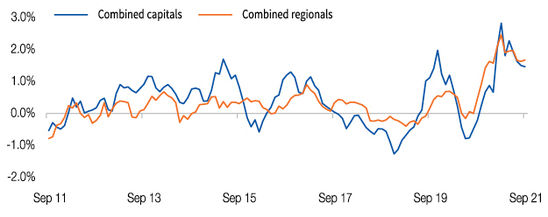
Nationally, dwelling values are up 20.3% higher over the past 12 months, every capital city experiencing significant growth across the board. Melbourne, despite ongoing lockdowns dampening the market, still increased by 15%.

That’s where the Australian Prudential Regulation Authority (or APRA) comes in. On October 6, it wrote to lenders announcing an increase to the minimum interest rate ‘buffer’ it requires them to use when assessing the serviceability of home loan applications. APRA told lenders that from November 1, they must assess new borrowers’ ability to meet loan repayments at an interest rate at least 3 percentage points above the loan product rate – a 0.5 per cent increase to the previous 2.5 per cent buffer.

Month-on-month change in dwelling values

Source: Core Logic – Hedonic Home Value Index October 2021

What are macro-prudential measures?

This is a big picture measure taken by one of the regulators [the Council of Financial Regulators includes; APRA, the Australian Securities and Investments Commission (ASIC), the Reserve Bank of Australia (RBA) and The Treasury] to secure financial stability for both lending institutions and borrowers. If APRA, in this instance, thinks the current lending system is unsustainable then it will step in to protect banks’ profits and the stability of the whole banking system, while also not letting borrowers get in over their heads.

Why did APRA do it?

The early October announcement by APRA was a “targeted and judicious action” designed to reinforce the stability of the financial system according to chairman Wayne Byres. “In taking action, APRA is focused on ensuring the financial system remains safe, and that banks are lending to borrowers who can afford the level of debt they are taking on – both today and into the future,” he wrote in a letter to lenders.

“While the banking system is well capitalised and lending standards overall have held up, increases in the share of heavily indebted borrowers, and leverage in the household sector more broadly, mean that medium-term risks to financial stability are building,” he added.

More than one in five new loans approved in the June quarter were in excess of six times the borrowers’ income and APRA’s fear has clearly been that housing credit growth will run ahead of household income growth. “With the economy expected to bounce back as lockdowns begin to be lifted around the country, the balance of risks is such that stronger serviceability standards are warranted,” Mr Byres said.

What difference will it make to you?

Overall, such a small tweak will probably not make a huge difference to average borrowers who may not have been borrowing at their full capacity anyway. However, for those who are stretching their borrowing budgets to almost the last dollar, such as first-home buyers struggling to meet rising prices, this move could be significant.

Ultimately, APRA has stated that the change will cut the maximum amount available to a typical borrower by approximately 5 per cent.

  • Borrowers who were previously approved for a $500,000 loan would now be able to borrow $475,000

  • Anyone with the green light to take out a $1 million mortgage would now be looking at $950,000

The impact this will have on prices or the current sky-high demand throughout most markets is yet to be determined as anyone who obtained a three-month pre-approval towards the very end of October would be under the previous 2.5 per cent serviceability buffer well into the new year. These changes will affect investors and owner occupiers in differing ways.

The changes are likely to have more of an impact on the investment segment of the market, as investor rates are higher than owner occupier mortgage rates. APRA also highlighted in their announcement that investors tend to borrow at higher levels of leverage and often have other existing debts, which would also be subject to the increased serviceability assessment.

What other changes are on the horizon?

Although APRA’s recent announcement will unlikely make a huge impact on demand for credit or even push down prices, it may well be a sign of future changes. While the announcement may seem like a subtle change to housing lending conditions, there may be more tightening to come as the level of housing credit and household debt are monitored, the high debt-to-income ratios being a focus.

In his letter to lenders, Mr Byres highlighted that if new home loan lending led to high debt-to-income ratios, a statistic expressing a borrower’s pre-tax income divided by their total debt levels, APRA “would consider the need for further macro-prudential measures”.

If you’d like to speak to us about your finances, get in touch with us today on Phone: 07 5641 4134.

Important:
Any information provided by the author detailed above is separate and external to our business and our Licensee. Neither our business nor our Licensee takes any responsibility for any action or any service provided by the author. Any links have been provided with permission for information purposes only and will take you to external websites, which are not connected to our company in any way. Note: Our company does not endorse and is not responsible for the accuracy of the contents/information contained within the linked site(s) accessible from this page.

Succession planning is common in the business world.

Last week, the United States investment group Berkshire Hathaway announced the appointment to its board of Susan Buffett (68).

She’s the daughter of the company’s billionaire founder Warren Buffett (91), who’s still the chairman and chief executive.

While it’s unlikely Susan will succeed her father in those roles, her joining the board is a sure sign that Warren Buffett’s children will play a role in Berkshire Hathaway’s future.

Another Buffett already on the company’s board is Howard (66) and, together, the trio are effectively the custodians of the family’s remaining shareholding in Berkshire Hathaway.

At current values, that stake is worth a tidy US$103 billion.

But what’s most interesting is that Warren Buffett doesn’t plan to pass on his huge personal fortune to any of his children when he dies.

A large amount of it will be gone by then. Once the richest man in the world, he now ranks ninth.

And the main reason for that is because, over the last 15 years, he’s donated US$41 billion of his shares in Berkshire Hathaway to select foundations including the Bill and Melinda Gates Foundation.

Buffett, who draws no salary and lives a relatively frugal life, has stated publicly on numerous occasions that he’ll donate his remaining company shares in the same way.

“The easiest deed in the world is to give away money that will never be of any real use to you or your family,” he said in a statement in June. “The giving is painless and may well lead to a better life for both you and your children.”

The importance of estate planning

Beyond accumulating wealth over time, planning your financial legacy is probably one of the most important aspects of estate planning.

Of course, how you intend to have your accumulated wealth distributed, is a very personal choice.

The next 20 to 30 years will see the biggest family wealth handover in history.

The largest part of this great wealth transfer will be between members of the “Baby Boomer” generation (people born just after the end of World War II through to 1964) and their children and other heirs.

This will include homes, investment properties, superannuation money, direct shares, life insurance payouts, and a wide range of other financial and non-financial assets.

Inheritance planning, unlike business succession planning, is an area that’s rarely discussed at the family level.

Most families regard subjects such as death and the future division of wealth as unpleasant, and potentially sensitive when multiple heirs are involved.

But there’s a lot to be said for having open discussions within your family about the intended treatment of assets and future inheritances.

Why you need a will

Creating a valid will, and specifically documenting how you want your assets to be managed and divided after your death, should be a key step in the inheritance planning process.

Dying without a will (intestate) will invariably create complications, because your estate will be passed over to the state or territory in which you live to administer.

This can result in your assets not being distributed to your surviving family members in the way you would have preferred.

Residential real estate and superannuation, which combined make up more than three quarters of total household assets, are the largest components of most financial legacies.

Federal Treasury also estimates that assuming there’s no change in how most retirees draw down their superannuation balances, superannuation death benefit payouts will increase from around $17 billion to just under $130 billion by 2059.

Ensuring that any superannuation you have left over at the time of your death is distributed according to your wishes requires you to complete a binding death benefit nomination form provided by your super fund.

It’s important to be aware of any potential tax implications. For example, while superannuation distributed to a surviving spouse or dependent children is generally tax free, non-dependents (including adult children) may be required to pay tax on amounts they receive.

That comes down to how much of your super is made up from pre-tax and after-tax contributions.

Capital gains tax does not apply if someone inherits direct shares or other financial securities, but tax may apply if they later dispose of them.

Any unapplied capital losses that could be used to offset capital gains tax cannot be transferred to beneficiaries.

Estate planning can be complex. Contact us on Phone: 07 5641 4134 to help you and your intended beneficiaries map out an inheritance framework that also identifies issues such as potential tax liabilities is a prudent step.

Source: Vanguard October 2021

Reproduced with permission of Vanguard Investments Australia Ltd

Vanguard Investments Australia Ltd (ABN 72 072 881 086 / AFS Licence 227263) is the product issuer. We have not taken yours and your clients’ circumstances into account when preparing this material so it may not be applicable to the particular situation you are considering. You should consider your circumstances and our Product Disclosure Statement (PDS) or Prospectus before making any investment decision. You can access our PDS or Prospectus online or by calling us. This material was prepared in good faith and we accept no liability for any errors or omissions. Past performance is not an indication of future performance.

© 2021 Vanguard Investments Australia Ltd. All rights reserved.

Important:
Any information provided by the author detailed above is separate and external to our business and our Licensee. Neither our business nor our Licensee takes any responsibility for any action or any service provided by the author. Any links have been provided with permission for information purposes only and will take you to external websites, which are not connected to our company in any way. Note: Our company does not endorse and is not responsible for the accuracy of the contents/information contained within the linked site(s) accessible from this page.

To choose the best credit card for you, consider your spending habits and how you will pay it off.

If you’re struggling to pay your bills, a new credit card may not be the best move. See managing debt for other options.

How to get the best credit card for you

Thinking about how you will use your credit card will help you compare the options and get the best card for you.

Work out how much you can pay off each month

Knowing this will help you choose the best-value credit card.

If you can pay the full balance each month

Consider a credit card with more interest-free days. This means you won’t pay interest as long as you pay the balance within a set number of days (for example, 55 days). These cards may have a higher interest rate and an annual fee, but that could be worth it.

If you can’t pay the full balance each month

Look for a no-frills card with a low or no-interest rate and a low annual or flat monthly fee.

Use our credit card calculator

Work out how much you would need to pay each month.

Set a credit limit you can afford

When you apply for a credit card, your bank or credit provider will offer you a credit limit. This is the maximum amount they’ll lend you, and it is based on your ability to pay it back within three years.

If you’re worried about overspending, you don’t have to take the full amount offered. Think about your spending habits and how much you can comfortably afford to pay back.

Weigh up the pros and cons of card options

Store cards

Store cards can be an expensive way to shop. You can only use them in that store, and they may have higher interest rates. Check if the benefits are worth the higher rate.

If a store offers an interest-free deal, check when the deal ends. Also check the interest rate on new purchases (called the ‘purchase rate’), as it may be higher than for other credit cards.

Rewards programs

Credit card reward programs sound good — you get something back simply by spending on your card. For example, you could earn points you can use to buy movie tickets or flights.

But cards with rewards programs often have higher interest rates and extra fees. They could cost you more than you get back. Check if the benefits you get are worth the higher cost.

Extras like travel insurance

Some credit cards come with ‘complimentary’ extras like travel insurance for overseas trips. Be aware that extras are usually not free. The cost may be covered by higher interest or fees.

Other cards offer ‘cash back’ (credit on your account) or discounts on goods or services. Weigh up if what you will get back is worth you paying more in interest or fees.

Smart tip: Consider the pros and cons of transferring your credit card balance to make sure it’s the right move for you.

Compare credit cards

Compare credit cards from different companies to find the one that suits your needs.

Comparison websites can be useful, but they are businesses and may make money through promoted links. They may not cover all your options. See what to keep in mind when using comparison websites.

Compare credit card rates and fees

Honeymoon (or introductory) interest rate

  • the interest rate offered for a limited period of time at the start of a new credit card

Purchase (interest) rate

  • the interest rate on things you buy (purchases) after the honeymoon period ends

Interest-free days

  • the number of days you won’t get charged interest on purchases

Annual or monthly fee

  • fee you will pay every year or every month

Rewards program fee

  • fee for using the rewards program

Other fees

  • late repayment fees

  • cash advance fees (for cash taken out)

  • fees if you go over your credit limit

  • fees for using your credit card to shop or travel overseas

Case Study

Georgia is thinking about joining a credit card rewards program. She’ll earn one reward point for every dollar she spends. She can redeem points for flights, gift cards, movie tickets and other goods.

She works out how much she has to spend to earn rewards. The rewards program costs $30 a year to join and she would have to spend $5,700 to get a $25 gift card.

Georgia decides not to go ahead. It would take a long time to earn points, and she’d end up paying more than the rewards are worth.

Speak to us today if you’d like to talk about your financial situation on Phone: 07 5641 4134.

Source: moneysmart.gov.au
Reproduced with the permission of ASIC’s MoneySmart Team. This article was originally published at https://moneysmart.gov.au/credit-cards/choosing-a-credit-card

Important note: This provides general information and hasn’t taken your circumstances into account.  It’s important to consider your particular circumstances before deciding what’s right for you. Although the information is from sources considered reliable, we do not guarantee that it is accurate or complete. You should not rely upon it and should seek qualified advice before making any investment decision. Except where liability under any statute cannot be excluded, we do not accept any liability (whether under contract, tort or otherwise) for any resulting loss or damage of the reader or any other person.  Past performance is not a reliable guide to future returns.

Important
Any information provided by the author detailed above is separate and external to our business and our Licensee. Neither our business nor our Licensee takes any responsibility for any action or any service provided by the author. Any links have been provided with permission for information purposes only and will take you to external websites, which are not connected to our company in any way. Note: Our company does not endorse and is not responsible for the accuracy of the contents/information contained within the linked site(s) accessible from this page.

You’ll have heard the old, almost grandmotherly adage that ‘every dollar counts’. But guess what – it’s true.

Voluntary after tax super contributions (also called non-concessional contributions), refer to any payments you make to your super fund out of your take-home pay. Making after-tax super contributions is an easy way to boost your retirement savings on your own schedule.

Your super money jar

Setting up small, automatic after-tax payments is a simple and effective way to add a little extra every month. In the same way people empty their coins into a change jar at the end of a day, making small contributions to your super is like putting your coins into your super savings, which you can access when you retire.

Saving when you can adds real value

One of the great things about making small contributions is that you only have to contribute what you can afford. Whether it’s an extra $5 a month, or an extra $50, even small amounts can add up to make a big difference.

If automatic after-tax contributions aren’t your style, you can make one-off contributions whenever you have spare money. You can also consider looking into salary sacrifice, which is often the most tax effective option. Depending on your financial circumstances, these could be great options for you to make a big difference to your retirement savings.

You can make after-tax contributions to your super any time but you should ensure you do not exceed the superannuation cap of $27.500.

Call us today if you’d like to find out more about contributing to your super Phone: 07 5641 4134

Source: NAB

Reproduced with permission of National Australia Bank (‘NAB’). This article was originally published at https://www.nab.com.au/personal/life-moments/work/plan-retirement/after-tax-contributions

National Australia Bank Limited. ABN 12 004 044 937 AFSL and Australian Credit Licence 230686. The information contained in this article is intended to be of a general nature only. Any advice contained in this article has been prepared without taking into account your objectives, financial situation or needs. Before acting on any advice on this website, NAB recommends that you consider whether it is appropriate for your circumstances.

© 2021 National Australia Bank Limited (“NAB”). All rights reserved.

Important:
Any information provided by the author detailed above is separate and external to our business and our Licensee. Neither our business nor our Licensee takes any responsibility for any action or any service provided by the author. Any links have been provided with permission for information purposes only and will take you to external websites, which are not connected to our company in any way. Note: Our company does not endorse and is not responsible for the accuracy of the contents/information contained within the linked site(s) accessible from this page.

Envision your ideal retirement: Are you relaxing on a beach? Starting a new hobby? Or finally taking that trip to Paris?

A comfortable retirement looks different for everyone, but most investors share some common goals. We’ve broken those down into 4 key categories to help you start planning. Determining how you prioritise these goals is the first step in creating a road map to financial security in retirement.

Basic necessities

Paying for food, clothing, and shelter must always come first. Health care expenses also fall under this category. Necessities are considered a “cash flow” goal, meaning they often require income from various sources, such as government benefits. These routine expenses are typically less costly than your other expenditures but occur more frequently. Because this category allows for the lowest amount of investment risk, it may be helpful to overestimate your future spending in this area.

“Just in case” savings

At some point in retirement, you’ll probably have a surprise expense, such as car repairs or a new roof. Having a rainy day fund can be reassuring when the unexpected pops up. Unlike necessities, this type of expense is an “asset reserve” goal, so you’ll want sufficient savings to cover these potential costs. Helpful tip: Maintain liquid investments that you can quickly turn into cash (or save cash itself) for these expenses.

Fun stuff

Consider hobbies and activities you want to enjoy in retirement. Even if it’s just an occasional meal at your favourite restaurant or a quick getaway, you should factor these types of expenses into your plan. Like necessities, this is considered a cash flow goal, so prepare to set aside a few dollars from different income sources.

Your legacy

Someday you may want to transfer your wealth to heirs or charities. For many investors, this goal is the lowest priority. If you do decide to share your money, those savings (like other asset reserve goals) are best kept in liquid investments for easier transfer of assets. Remember: You can always contribute to your legacy in non-financial ways too—like with your time.

Retirement may not be far away, but there’s still time to make a solid plan, either independently or with the help of a trusted financial adviser. Saving for—and prioritising—these goals can help put you on the road to financial security. After all, isn’t the ultimate goal of retirement to enjoy it?

Speak to us today on Phone: 07 5641 4134 if you’d like to start planning for your retirement.

Source: Vanguard October 2021

Reproduced with permission of Vanguard Investments Australia Ltd

Vanguard Investments Australia Ltd (ABN 72 072 881 086 / AFS Licence 227263) is the product issuer. We have not taken yours and your clients’ circumstances into account when preparing this material so it may not be applicable to the particular situation you are considering. You should consider your circumstances and our Product Disclosure Statement (PDS) or Prospectus before making any investment decision. You can access our PDS or Prospectus online or by calling us. This material was prepared in good faith and we accept no liability for any errors or omissions. Past performance is not an indication of future performance.

© 2021 Vanguard Investments Australia Ltd. All rights reserved.

Important:
Any information provided by the author detailed above is separate and external to our business and our Licensee. Neither our business nor our Licensee takes any responsibility for any action or any service provided by the author. Any links have been provided with permission for information purposes only and will take you to external websites, which are not connected to our company in any way. Note: Our company does not endorse and is not responsible for the accuracy of the contents/information contained within the linked site(s) accessible from this page.

With significant demographic shifts occurring around the world, one useful approach for investors is to use demographic themes and trends as a compass for future investing. 

Focusing on companies that will benefit from slow moving, long duration and highly predictable demographic trends can help investors predict areas of future opportunity.

There are three main themes that stand out – an aging population, population growth, and a growing middle class. The long-term implications of all three are far-reaching.

Longevity and aging population

A quick look back at history offers a guide to how much older society is becoming, and how quickly. During the Roman empire, the average life expectancy was only 25 years. Life expectancy then increased to 33 years in the Middle Ages, with a big jump to 55 years in the 19th century.

More recently, the average life expectancy across the globe has increased to 72 years, with the Western world at 80 years and Japan at 84. Dutch scientists expect that in 50 years’ time, life expectancy might reach over 125 years.

At the same time, the overall population itself is becoming, on average, older. For the first time in human history, people older than 60 will soon outnumber 15-year-olds and younger. This has very profound implications on how people are spending, which in turn has repercussions for what industries and companies will succeed over the longer term.

Population growth and shifts

There are also noticeable shifts within this population growth. We are at a point where, for the first time in human history, the number of people in the middle class will make up the majority of the population. From an investment perspective, this means that the level of household wealth is, on average, rising globally.

This increase in household wealth is noticeable in Australia, particularly due to the effects the pandemic and Australia’s reaction to it, with household savings levels reaching historically high levels. The US and China are still the two largest economies in the world, but even with the pandemic downturns in 2020, Australia is now the 13th largest economy in the world, overtaking the likes of much bigger countries such as Spain. Australia is still a country with just 25 million people, making it comparatively rich on a per capita basis.

Another shift that is a direct result of the pandemic is the significant change in where people choose to live. For many decades there has been a one-way movement from regional and country areas into Australia’s cities. However over the past 18 months there has been a trend of younger people, particularly millennials moving away from the cities and into the regions, creating a property boom in these areas.

Younger people are looking for a lifestyle change and prioritising more space for their young families. Some potentially are wanting to get away from the spread of Covid in the higher-density city areas, which of course bring more lockdown measure. Regional housing is also cheaper for younger people and “working from home” measures have allowed younger people and families to work from the regions, rather than just commuting to the city.

Opportunities for investors

Some of the industries that are set to grow from these demographic shifts include healthcare, technology and logistics, which will offer attractive opportunities for investors.

For example, since more people are working from home and living outside of the cities, the warehousing and logistics sector is set to grow even further. Although shops are closed, people are buying just as much as ever, but consumption is moving online, driving demand for more warehouses and delivery services. Therefore, quality logistics and freight companies that have a good geographic range through warehousing and distribution centres, along with a wide range of delivery capabilities, display a good pipeline of growth.

Another industry set to grow is healthcare, specifically technological advancements in healthcare due to the aging population.

As people age, they have different healthcare needs, ranging from hearing aids, hip replacements, glasses, certain drugs, or heart operations. For example, eyesight declines with age, so the eyecare sector is likely to grow. The increased use of screens and electronic devices is also having a negative impact on eyesight. Out of a global population of 7.6 billion, it is estimated that 60 per cent of people need eye correction, but only 40 per cent are getting it done. So, the opportunity here is set to expand. For investors this means finding healthcare opportunities that seek to improve patient care through leading niche technologies that are already out in the market.

The aging population creates more people needing more surgery. This is where technology advancements in healthcare come in through the likes of robotic surgery. The use of robotic surgery allows for treatment in a minimally invasive manner. The benefits of this are greater accuracy, lower complication rates, and ultimately, reduced days in hospitals, which saves the healthcare system money.

And of course, due to the Covid-19 pandemic, the healthcare industry is expected to innovate more to get ahead of any future variants and other viral infections. Innovation in the case of Covid-19 and other viral infections can open a new world of opportunities for investors. Investors can put money behind companies to help accelerate these treatments, while allowing these companies to bolster their cash flows, in turn, creating a solid investment.

Therefore, there is ample amounts of opportunity to invest in a more dynamic future through changing demographics. Industries of healthcare, technology, and logistics, along with many more, will thrive from these demographic trends.

For investors, a good place to start is with those companies where a significant proportion of value creation comes from demographic factors. Assess the quality of the business model, look at whether there is opportunity for sustainable growth, consider the likelihood high returns, and ask if the cashflow generation strong. And finally, assess the upside opportunities to come up with a portfolio of attractive companies.

Contact us if you’d like to find out more about investing in the future. Call us on Phone: 07 5641 4134.

Source: Fidelity October 2021
Reproduced with permission of Fidelity Australia. This article was originally published at https://www.fidelity.com.au/insights/investment-articles/shaping-investments-for-the-future/

This document has been prepared without taking into account your objectives, financial situation or needs. You should consider these matters before acting on the information. You should also consider the relevant Product Disclosure Statements (“PDS”) for any Fidelity Australia product mentioned in this document before making any decision about whether to acquire the product. The PDS can be obtained by contacting Fidelity Australia on 1800 119 270 or by downloading it from our website at www.fidelity.com.au. This document may include general commentary on market activity, sector trends or other broad-based economic or political conditions that should not be taken as investment advice. Information stated herein about specific securities is subject to change. Any reference to specific securities should not be taken as a recommendation to buy, sell or hold these securities. While the information contained in this document has been prepared with reasonable care, no responsibility or liability is accepted for any errors or omissions or misstatements however caused. This document is intended as general information only. The document may not be reproduced or transmitted without prior written permission of Fidelity Australia. The issuer of Fidelity Australia’s managed investment schemes is FIL Responsible Entity (Australia) Limited ABN 33 148 059 009. Reference to ($) are in Australian dollars unless stated otherwise.
© 2021. FIL Responsible Entity (Australia) Limited.

Important:
This provides general information and hasn’t taken your circumstances into account. It’s important to consider your particular circumstances before deciding what’s right for you. Any information provided by the author detailed above is separate and external to our business and our Licensee. Neither our business nor our Licensee takes any responsibility for any action or any service provided by the author. Any links have been provided with permission for information purposes only and will take you to external websites, which are not connected to our company in any way. Note: Our company does not endorse and is not responsible for the accuracy of the contents/information contained within the linked site(s) accessible from this page.

If you’ve ever changed your name, address or job, you may have lost track of some of your super.

Finding your lost super and bringing it all together saves on fees and makes it easier to manage.

Find your super

Your lost super may be held by your super fund or by the Australian Taxation Office (ATO). It’s easy to find your lost super online through the ATO:

  • Go to my.gov.au.

  • Log in or create an account.

  • Link your myGov account to the ATO.

  • Select ‘Super’.

This will allow you to:

  • see details of all your super accounts, including any you’ve lost or forgotten about

  • find any ATO-held super — this is held on your behalf when your super fund, your employer or the government can’t find an account to deposit your super into

  • consolidate your super into a single fund

If you’ve recently opened a new super account, it may take up to six months to appear on myGov.

You can also find lost super using a paper form. See searching for lost super on the ATO website.

Combining your super accounts

Having more than one account means paying more fees. Combining your super into one account will save you money.

You need to know which one of your super funds you will consolidate your super into. See tips on consolidating your super or call us on Phone: 07 5641 4134. 

Source: Moneysmart.gov.au
Reproduced with the permission of ASIC’s MoneySmart Team. This article was originally published at https://moneysmart.gov.au/how-super-works/find-lost-super

Important note: This provides general information and hasn’t taken your circumstances into account.  It’s important to consider your particular circumstances before deciding what’s right for you. Although the information is from sources considered reliable, we do not guarantee that it is accurate or complete. You should not rely upon it and should seek qualified advice before making any investment decision. Except where liability under any statute cannot be excluded, we do not accept any liability (whether under contract, tort or otherwise) for any resulting loss or damage of the reader or any other person.  Past performance is not a reliable guide to future returns.

Important
Any information provided by the author detailed above is separate and external to our business and our Licensee. Neither our business nor our Licensee takes any responsibility for any action or any service provided by the author. Any links have been provided with permission for information purposes only and will take you to external websites, which are not connected to our company in any way. Note: Our company does not endorse and is not responsible for the accuracy of the contents/information contained within the linked site(s) accessible from this page.

There are really only two types of businesses; those that are growing and those that are shrinking, writes Fred Wilson.

Many business owners often ask themselves how much faster they may have been able to achieve their success if they had only been better prepared and more aware of the business mistakes they were making without realising.

Top 5 business mistakes and the steps you can take to avoid them

1. Failing to plan is a major mistake

Some smart Alec once came up with a little ditty that goes along the lines of “fail to plan and you plan to fail.” Whilst we have no idea where this little gem of wisdom originated, it does (as these things so often prove) have a certain logical ring of truth about it.

While it can be quite exhilarating for you as a business owner to experience early successes and to see cash flowing into your bank account, there is plenty that can go wrong. Investing some time in seeking helpful advice and formulating a business plan or at least an outline strategy will help you to avoid losing your way. This often happens when the business landscape changes or business owners come up against unanticipated problems.

2. Underfunding your business is a mistake

Even for businesses that have invested time and effort into planning, underfunding or undercapitalisation as it is also known, can creep up on them. This often happens to newer businesses that are experiencing a surge in sales and everything is looking rosy. That is until they attempt to’ramp up’ inventory, manufacturing, or the resources they need to provide their services to an expanding customer base.

It is at this point that the cash coming into the business is then unable to keep pace with the investment needed to keep the supply chain flowing. Borrowing money from banks and investors takes time to organise and the interest rates that such funds bring with them have an uncanny habit of knocking the stuffing out of your previously healthy profit margins.

By making sure that your follow our next tip about scalability, you will also ensure that you have a tighter and better-informed handle on the funding of your business.

3. Failing to understand the principle of scalability

The very real ‘knock on’ effect of messing up on numbers one and two is that your business will either flounder through lack of planning or become starved of cash through expanding quicker than you are able to fund that growth.

This leads directly to problem number three which is a lack of scalability. From having the manpower and funds to the technology and systems that can grow with your business, they are all major considerations of scalability.

In some ways, there is a very real danger of your business becoming a victim of its own success and this often happens in the absence of scalability. Through planning for and scaling growth in a controlled way, your business can ensure that capital, resources, and technologies are able to keep pace with the business and expand with it as it grows.

4. Ignoring the competition

Whether you have chosen to make it your business to discover everything you can about your competitor’s businesses or not, you can be assured of one thing; they are already making it their business to know all about yours.

It is surprising just how many business owners get their ‘heads down’ and bury themselves so deeply in their own businesses that they fail to seize the opportunities available through learning from the competition.

By putting yourself in their shoes, you will not only be able to see how the competition views your business but you are also highly likely to see it in a new and fresh way too.

5. Failing to move forward

Moving forward in business, planning, improving on your competition, and sustaining scalable growth are all important factors, however, in many cases, the total reverse can happen. Even in today’s fast-paced business world, there are business owners who believe they can operate on the traditional Mom and Pop principle.

The sometimes harsh reality is that there are really only two types of businesses; those that are growing and those that are shrinking.

There is no room for standing still in business and if you don’t seize the opportunities you can rest assured that your competitors will.

This article originally appeared on Flying Solo n Nov 21 2018 and was updated October 11 2021.

Source: Flying Solo October 2021

This article by Fred Wilson is reproduced with the permission of Flying Solo – Australia’s micro business community. Find out more and join over 100K others https://www.flyingsolo.com.au/join.

Important:
This provides general information and hasn’t taken your circumstances into account. It’s important to consider your particular circumstances before deciding what’s right for you. Any information provided by the author detailed above is separate and external to our business and our Licensee. Neither our business, nor our Licensee take any responsibility for any action or any service provided by the author. Any links have been provided with permission for information purposes only and will take you to external websites, which are not connected to our company in any way. Note: Our company does not endorse and is not responsible for the accuracy of the contents/information contained within the linked site(s) ac www.flyingsolo.com.au