Here is a practical approach to creating a retirement plan that will help enable financial peace of mind.

Many investors concentrate on building their nest egg during their working lives to pay or help pay for their retirement but fail to give enough attention to planning for a retirement that may last 25 years or longer.

A lack of retirement planning makes retirees more financially vulnerable than necessary in numerous ways including the possibility of outliving your retirement savings, overreacting to market volatility, not planning for unexpected costs and holding a portfolio that isn’t properly diversified.

Some retirees who have not properly planned for retirement may have underestimated the amount required to finance their anticipated lifestyles, while others may be living too frugally given their financial needs.

By following a practical approach for creating a retirement plan that aligns with retirees’ often-unique goals while mitigating risk, retirees may gain greater confidence that savings will match with your future financial needs.

Step 1: Determine your retirement goals

These goals typically include having enough income to pay for basic living expenses, a contingency reserve (such as for medical treatment, home repairs and aged care) and discretionary spending (such as eating out and holidays). And you may plan to leave an inheritance. Once your goals are listed, you can prioritise their importance.

Step 2. Understand your risks

These include market risk, health risk, longevity and mortality risk, event risk (again such as medical treatment, home repairs and aged care), and tax and policy risk (changes to government policies and health care coverage). The research suggests that these risks should be addressed in the context of their impact on achieving their retirement goals.

Step 3: Assess your available financial resources

This will help ensure that your capital is used as efficiently as possible. Financial resources include super and non-super savings, age pension if eligible, annuities, insurance, housing wealth, insurance, and any additional income if planning to work in retirement.

Step 4: Develop a plan to achieve your goals and mitigate your risks

This is a matter of bringing together the various elements of your retirement planning. The right mix of resources should be tailored to your individual circumstances. It should take into account the relative importance of competing goals and the risks that a retiree may be susceptible or sensitive to.

The ultimate retirement goal

In the end, peace of mind may be the ultimate retirement goal bearing in mind this phase of life may represent at least a quarter of our lives.

If you’d like to start planning for your retirement, contact us today on Phone: 07 5641 4134.

Source: Vanguard

Reproduced with permission of Vanguard Investments Australia Ltd

Vanguard Investments Australia Ltd (ABN 72 072 881 086 / AFS Licence 227263) is the product issuer. We have not taken yours and your clients’ circumstances into account when preparing this material so it may not be applicable to the particular situation you are considering. You should consider your circumstances and our Product Disclosure Statement (PDS) or Prospectus before making any investment decision. You can access our PDS or Prospectus online or by calling us. This material was prepared in good faith and we accept no liability for any errors or omissions. Past performance is not an indication of future performance.

© 2022 Vanguard Investments Australia Ltd. All rights reserved.

Important:
Any information provided by the author detailed above is separate and external to our business and our Licensee. Neither our business nor our Licensee takes any responsibility for any action or any service provided by the author. Any links have been provided with permission for information purposes only and will take you to external websites, which are not connected to our company in any way. Note: Our company does not endorse and is not responsible for the accuracy of the contents/information contained within the linked site(s) accessible from this page.

 Sustainable investing is not new, but in recent years it’s moved from the green fringes into the mainstream. From climate change to animal rights and gender diversity, more people are interested in aligning their money with their values.

Last year alone, Australia’s sustainable investment market increased 20 per cent to a record $1.5 trillion. According to its 2022 benchmark report, the Responsible Investment Association Australasia (RIAA) found sustainable investments now represent 43 per cent of total professionally-managed funds.

In addition to traditional shares and fixed interest you can buy sustainable investments in a wide range of assets, including property, alternatives such as forestry and farmland, infrastructure, private equity and cash.

These days, most big super funds offer a sustainable investment option and some even offer this as their default option. You can also buy sustainable managed funds, including a growing list of exchange-traded funds (ETFs).

So what are sustainable investments and how can you tell?

Focus on people and planet

Sustainable investing is also known as ethical, responsible and ESG (environmental, social, governance) investing. But whatever the name, the focus is on people, society and/or the environment instead of an exclusive focus on financial returns.

Sustainable investments are selected using a variety of screening methods, including:

  • Positive screening selects the best investments in their class

  • Negative screening excludes harmful sectors, companies or activities such as arms, gambling, animal testing, tobacco and fossil fuels

  • Norms-based investing screens for minimum standards of relevant business practices

  • Impact investing has the explicit intention of generating positive social or environment impacts.i

Increasingly, the term ESG investing is used when a fund or company commits to sustainable investing in these three areas:

  • Environmental, including air and water pollution, biodiversity and climate change

  • Social, including child labour and labour standards, ethical product sourcing, gambling and human rights

  • Governance, including board diversity, corruption, business ethics, corporate culture and whistle-blower schemes.

While climate change is a strong theme these days, the RIAA report found gender diversity and women’s empowerment are gaining popularity.

Yet despite the focus on making the world a better place, sustainable investing is not all warm and fuzzy. Performance still matters.

Performance gains

In the early days, sustainable investing often came at the expense of returns but that is no longer necessarily the case.

The RIAA report compared the performance of what it terms responsible investment funds and mainstream investments funds (on average and net of fees) over the past 10 years to December 2021.

As the table shows, responsible multi-sector growth funds consistently outperformed mainstream funds and their benchmark over 1, 3, 5 and 10 years. Responsible Australian share funds generally outperformed or were on par with mainstream funds. Only responsible international share funds disappointed, underperforming mainstream funds across all timeframes.

Performance of responsible investment funds vs mainstream funds and benchmarks

Fund categories/benchmark

1 Year

3 Year

5 Year

10 Year

Responsible investment multi-sector growth funds

16.1%

14.0%

10.6%

10.9%

Morningstar category: Australia multi-sector growth

14.1%

10.9%

7.9%

8.8%

Responsible investment international share funds

18.1%

17.3%

12.3%

11.3%

Morningstar category: Australia Equity World Large Blend

24.6%

18.1%

13.4%

15.1%

Responsible investment domestic shares (Aus/NZ)

16.6%

14.8%

11.8%

11.2%

Morningstar category: Equity Australia Large Blend

18.3%

13.7%

9.3%

10.1%

S&P/ASX 300 Total Return

17.5%

14.0%

9.9%

10.8%

Source: RIAA Responsible Investment Benchmark Report Australia 2022

Watch out for greenwashing

Not surprisingly, increased investor demand for sustainable investments has led to a rapid increase in the number of products available. The rush to cash in on the trend has sometimes led to what is known as ‘’greenwashing”.

The Australian Securities and Investments Commission (ASIC) describes greenwashing as the practice of misrepresenting the extent to which a financial product or investment strategy is environmentally friendly, sustainable or ethical.

ASIC warns investors to look beneath the green label at the fine print. For example, a fund might describe itself as ‘’no gambling” but the product terms say it may invest in companies that earn less than 30 per cent of revenue from gambling.

It’s also important not to rely on vague language such as “considers”, “integrates” or “takes into account” sustainability-related factors, but to look for a clear explanation of how the product will achieve its aims.

Australian companies lifting their game

It’s not just super funds and managed funds taking sustainable investing more seriously. For investors who like to invest directly in shares, Australian listed companies are also adapting to changing investor preferences and regulatory environment.

In a recent analysis of ESG reporting by Australia’s top 200 listed companies, PwC found the bar has been raised following the formation of the International Sustainability Standards Board (ISSB) in 2021, but there is still work to be done.

PwC found a 13 per cent increase in companies declaring a commitment to net zero emissions. However, only 55 per cent of those disclosed a transition plan or activities that will enable them to reach net zero.

There was also a 10 per cent increase in companies disclosing climate risks and opportunities, and a 30 per cent increase to 77 per cent of companies now disclosing a gender diversity policy.

For investors seeking sustainability along with financial returns from their investments, momentum and choice is growing. So please get in touch if you would like to discuss your investment options.

i https://responsibleinvestment.org/wp-content/uploads/2022/09/Responsible-Investment-Benchmark-Report-Australia-2022-1.pdf

Important: This provides general information and hasn’t taken your circumstances into account. It’s important to consider your particular circumstances before deciding what’s right for you. Although the information is from sources considered reliable, we do not guarantee that it is accurate or complete. You should not rely upon it and should seek qualified advice before making any investment decision. Except where liability under any statute cannot be excluded, we do not accept any liability (whether under contract, tort or otherwise) for any resulting loss or damage of the reader or any other person.

Any information provided by the author detailed above is separate and external to our business and our Licensee. Neither our business nor our Licensee takes any responsibility for any action or any service provided by the author. Any links have been provided with permission for information purposes only and will take you to external websites, which are not connected to our company in any way. Note: Our company does not endorse and is not responsible for the accuracy of the contents/information contained within the linked site(s) accessible from this page.

Until recently, financial abuse was often kept secret, especially where it occurred within the family. Thankfully that’s changing with public awareness campaigns and help becoming more readily available.

The emotional and economic damage caused by financial abuse can be far reaching and devastating. A recent Australian report calculates that in 2020 alone, financial abuse victims lost $5.7 billion while the cost to the broader economy was $5.2 billion.i

Nearly one in 30 women and one in 50 men suffer financial abuse each year, according to the Deloitte Access Economics report The Cost of Financial Abuse in Australia, 2022. These figures are almost certainly an underestimate, the report adds.

There are no typical victims of financial abuse: those affected are of all ages and means. Sadly, the abuser is often a friend, carer, partner or family member.

What is financial abuse?

Financial abuse is when someone uses your money without your permission, prevents you from getting access to money or takes charge of your financial decisions.

These days, financial abuse is considered a form of domestic and family violence, taking away your independence and leaving you feeling vulnerable and anxious. Victims may also suffer physical violence and emotional abuse.

The most common type of financial abuse is withholding income or controlling how it is spent, according to the Deloitte report. But there are other forms of abuse that can be equally harmful such as making a partner liable for a joint debt, preventing someone from working, refusing to contribute to household expenses and refusing to contribute to the costs of raising a child.

Many victims also suffer flow-on effects of the abuse such as financial hardship and stress, leading to mental health issues. Some may also lose their home.

In some cases of family violence, one partner takes control of the couple’s finances, preventing the victim from leaving the relationship. In others, where the victim does manage to leave, the abuser may continue their abuse using tactics such as expensive legal action or disrupting the victim’s work or business.

Recognising the signs

Victims of financial abuse may not be aware of the abuse for some time, allowing perpetrators to empty bank accounts, deplete investments and incur large debts in the victim’s name.

The federal government agency, Services Australia says the warning signs include:

  • taking or using your money without your permission

  • not being allowed to work

  • having to account for how you spend your money

  • withholding financial information from you

  • spending any government payments you receive without your consent.ii

Incurring debts in your name is another form of financial abuse. Your partner may spend more than you agree on your credit card, pressure you into co-signing a loan with them, or take out a loan in your name, according to Australian Family Lawyers.iii They may also limit your educational opportunities by, for example, preventing you from enrolling in studies that could advance your career.

Older people and those living with disability can be particularly vulnerable to financial abuse if they rely on others for help and advice. Financial abusers may take money from their bank accounts or wallets, ask an older person to change their Will, take jewellery or other valuable items from their home, or take control of their decisions using a Power of Attorney when they are still capable of making their own decisions.

Where to go for help

If you or someone you know is suffering financial abuse, a number of free and confidential resources are available.

The MoneySmart website provides information about free legal advice at community legal centres or legal aid centres, and a number of suggestions if you need urgent help with money.

You can also find free and confidential counselling for family violence, abuse and sexual assault at: 1800RESPECT (24 hours a day, seven days a week)
1800 737 732

For crisis support, contact Lifeline (24 hours a day, seven days a week)
13 11 14

We understand that it can be difficult reaching out for support if you feel you or someone you love is being taken advantage of financially, especially if a family member is involved. Please call us on Phone: 07 5641 4134 if you would like a confidential discussion about safeguarding your finances.

i https://www.commbank.com.au

ii https://www.servicesaustralia.gov.au/what-family-and-domestic-violence?context=60033#a8

iii https://www.australianfamilylawyers.com.au/information-centre/signs-of-financial-abuse

It’s easier to make a claim on your life insurance if you gather the right information for your insurer.

Who to contact to make a claim

To make a claim on your insurance, speak to the person or company you bought the policy from.  

If you bought insurance through: 

  • an insurer — contact the insurance company 

  • an insurance broker or financial adviser — speak to them first

  • a superannuation fund — contact your fund

  • an employment arrangement — speak to your employer

Ask how the claims process works and what forms you need to fill out. Make sure you have your policy number available. If you’re struggling physically or emotionally, ask a trusted friend or family member for help with the claims process. 

What information you need to provide

The insurer will ask for information to support your claim. Depending on the type of insurance, you may have to provide: 

  • medical reports and medical test results from your doctor

  • details of your work duties, including physical requirements, and the number of hours you work each week

  • payslips and tax returns, or financial statements if you are self employed 

  • if a person has passed away, a death certificate or medical report listing the cause of death

Your insurer may ask for permission to contact your doctor about your claim. You may also have to go to an independent medical examination with a specialist, who then reports to the insurer. 

If illness or injury continues to affect your ability to earn an income, you may need to have regular assessments and complete progress claim forms. 

How long the claims process takes

Depending on the circumstances, an insurer will let you know their decision for: 

  • income-related claims — within 2 months of being notified about your claim, or 2 months after the waiting period has expired

  • other claims — within 6 months of being notified about your claim, or 6 months after the waiting period has expired

To find out the average time your insurer takes to finalise a claim, see the life insurance claims comparison tool.

The Life Insurance Code of Practice sets out what insurers should do when handling your claim, including timeframes for making a decision and keeping you updated. If they do not meet these standards you can complain to the insurer.

Complain about an insurer’s claims process or decision

If you’re not satisfied with the claims process or decision, make a complaint to the insurer or super fund. Do this as soon as you can.

If you can’t reach an agreement, contact the Australian Financial Complaints Authority (AFCA) to make a complaint and get free, independent dispute resolution. 

Urgent financial help

If you need urgent financial help while a claim is being assessed, speak to the insurer or super fund. They will consider your circumstances and may be able to:

  • speed up the assessment and decision about the claim

  • make an advance payment to help you

You will have to provide your insurer with documents that support your need for urgent financial help. These could include bank statements or Centrelink statements. Payments for urgent financial help may reduce your claim payout.

Contact us to find out more. Call on Phone: 07 5641 4134.

Source:
Reproduced with the permission of ASIC’s MoneySmart Team. This article was originally published at https://moneysmart.gov.au/how-life-insurance-works/making-a-life-insurance-claim

Important note: This provides general information and hasn’t taken your circumstances into account.  It’s important to consider your particular circumstances before deciding what’s right for you. Although the information is from sources considered reliable, we do not guarantee that it is accurate or complete. You should not rely upon it and should seek qualified advice before making any investment decision. Except where liability under any statute cannot be excluded, we do not accept any liability (whether under contract, tort or otherwise) for any resulting loss or damage of the reader or any other person.  Past performance is not a reliable guide to future returns.

Important
Any information provided by the author detailed above is separate and external to our business and our Licensee. Neither our business nor our Licensee takes any responsibility for any action or any service provided by the author. Any links have been provided with permission for information purposes only and will take you to external websites, which are not connected to our company in any way. Note: Our company does not endorse and is not responsible for the accuracy of the contents/information contained within the linked site(s) accessible from this page.

Refinancing can be a great way to save money if you believe you are paying too much for your loan, but there is more to it than just finding a loan with a lower interest rate and making the change. Before making the switch, ensure the savings you could make outweigh the fees involved. Here are the different exit costs to consider:

Exit fee

Although loans taken out after 1 July 2011 are not subject to deferred establishment, or exit, fees, those taken out prior may still be. Also known as ‘early termination’ or ‘early discharge’ fees, they can sometimes be paid by your new lender but are normally applied to an early contract exit.

Establishment fee 

Also known as ‘application’, ‘up-front’ or ‘set-up’ fees, these cover the lender’s cost of preparing the necessary documents for your new home loan. They are payable on most new loans, and the alternative to not paying this particular fee is being charged higher ongoing fees for the life of the loan.

Mortgage discharge fee 

Covering your early legal release from all mortgage obligations, this fee is not to be confused with an exit fee. Also known as a ‘settlement’ or ‘termination’ fee, its purpose is to compensate your lender for the revenue it may lose due to the contract break.

Lender’s mortgage insurance (LMI) 

The non-transferrable premium means that if you hold less than 20% equity at the time of your refinance, you may have to pay LMI even if you paid it on the original loan. Extra care is also needed here because, whether or not you hold 20% of the original valuation of the property, you may not if the property’s value has decreased and; while LMI may not have been a consideration at all in the original loan, it may be payable on the refinance.

Stamp duty

If your purpose for making the switch is to increase your loan amount, for example to fund renovations, then stamp duty will apply only to the difference between the original loan amount and the refinanced loan amount. Different rules apply in different states, so it’s worth speaking to your broker to see if this charge applies. 

Other government charges

Fees are applied for the registration and deregistration of a mortgage so that all claims on a property can be checked by any future buyers. Varying from state to state, these can potentially add up to $1000 or more.

Break fee

If you were on a fixed rate loan, your lender is likely to charge you a fee for ‘breaking’ out of the loan term. This fee varies depending on the amount owed, the interest rate you were locked into, the current interest rate and the duration of your loan.

Although some of these fees can be negotiated by a broker, the total cost can be substantial. An MFAA accredited finance broker can ensure that refinancing will help you achieve your goals while maintaining your capacity to service the debt. A finance broker can also ensure you are only paying the relevant fees for your unique circumstance. 

Call us today if you are considering refinancing your home loan. Contact us on Phone: 07 5641 4134.

Source: MFAA

Reproduced with the permission of the Mortgage and Finance Association of Australia (MFAA)

Important:
This provides general information and hasn’t taken your circumstances into account.  It’s important to consider your particular circumstances before deciding what’s right for you. Although the information is from sources considered reliable, we do not guarantee that it is accurate or complete. You should not rely upon it and should seek qualified advice before making any investment decision. Except where liability under any statute cannot be excluded, we do not accept any liability (whether under contract, tort or otherwise) for any resulting loss or damage of the reader or any other person.  Past performance is not a reliable guide to future returns.

Any information provided by the author detailed above is separate and external to our business and our Licensee. Neither our business nor our Licensee takes any responsibility for any action or any service provided by the author.

Any links have been provided with permission for information purposes only and will take you to external websites, which are not connected to our company in any way. Note: Our company does not endorse and is not responsible for the accuracy of the contents/information contained within the linked site(s) accessible from this page.

When it comes to investing in real estate, equity is a key concept to wrap your head around. The Successful Investor’s Michael Sloan explains what equity is, and how you can use it to your advantage.

Benefits of property investment

Property is a reasonably secure, long-term investment. You can potentially earn rental income that covers your real estate loans.

You can also benefit from capital gains if you decide to sell down the track, and get extra financial benefits through taxation and gearing.

Investing in property can be a great way to build equity in your home loan. You can expand and diversify your portfolio, and reduce your risk – especially if you have other investments in cash, shares or managed funds.

Understanding the risks

Like any investment, property can carry risks. For example:

  • The income from rent might not meet your expectations, or cover your loan repayments.

  • The value of your property could go down, and you may end up with less money than you started with.

  • Getting quick access to your money can prove tricky.

  • You might earn lower returns than other types of investments.

It’s important to remember that investment properties are long-term ventures – and you’ll need to prepare for the highs and the lows.

Knowing your strengths and weaknesses

Investing in real estate often requires certain skills. It can help if you’re a business manager, marketing specialist, accountant, tax adviser, product developer, handyperson, customer service rep, inspector, or people manager.

If this doesn’t sound like you, it’s worth paying for professional help, or thinking about another investment strategy.

Investment property research

By doing some solid property research, you can help reduce the risks of investing.

As a general rule, you should always buy in sought-after locations, close to transport, schools and amenities. This means you’re less likely to have problems finding tenants, and more likely to win with capital gains down the track.

Whether you invest in a house or a unit, it’s important to buy a property that suits your budget, cash flow, and the location.

Other types of investments

Shares

Investing in shares is considered a growth investment because their value can rise. You can make money by selling shares for a higher price than you initially paid for them.

If you own shares, you can also get income from dividends – portions of a company’s profit paid out to its shareholders.

Keep in mind the value of shares can fall below the price you paid for them. That’s why they’re best suited to long-term investors who are comfortable dealing with the daily ups and downs in the market.

Cash

Cash is a conservative investment. This means that it generates regular income (through interest payments), as opposed to growing in value over time.

Cash investments include high-interest savings accounts and fixed-interest investments like term deposits, government bonds and corporate bonds.

Talk to an expert

Before making any big decisions, it’s worth talking to a us Phone: 07 5641 4134. They can help you decide if property investment, or other strategies, works best for you.

Source: NAB

Reproduced with permission of National Australia Bank (‘NAB’). This article was originally published at https://www.nab.com.au/personal/life-moments/home-property/invest-property/deciding

National Australia Bank Limited. ABN 12 004 044 937 AFSL and Australian Credit Licence 230686. The information contained in this article is intended to be of a general nature only. Any advice contained in this article has been prepared without taking into account your objectives, financial situation or needs. Before acting on any advice on this website, NAB recommends that you consider whether it is appropriate for your circumstances.

© 2022 National Australia Bank Limited (“NAB”). All rights reserved.

Important:
Any information provided by the author detailed above is separate and external to our business and our Licensee. Neither our business nor our Licensee takes any responsibility for any action or any service provided by the author. Any links have been provided with permission for information purposes only and will take you to external websites, which are not connected to our company in any way. Note: Our company does not endorse and is not responsible for the accuracy of the contents/information contained within the linked site(s) accessible from this page.

The fees you pay on your super could have a material impact on how you retire, which is why it’s important to understand how they work.

A quick internet search of the term “super fees” turned up other questions people ask, including “what fees are charged on superannuation?”, “do all super (funds) have fees?” and “how do you calculate super fees?”.

While highly unscientific, this little experiment illustrates an issue that many Australians grapple with when it comes to trying to understand what fees they are charged on their superannuation investments.

But before we break down the various aspects of fees that you should be aware of, perhaps the more vital point to understand here is why fees matter in the first place.

The short answer is that the fees you pay on your super could have a material impact on how you retire. Analysis by the Productivity Commission found that an increase in fees of just 0.5 per cent can cost a typical full-time worker around 12 per cent of their super balance – or $100,000 – by the time they reach retirement. It is not an insignificant amount and given that it is one of the largest assets you will have in your lifetime, it is really important to understand exactly what you are paying for.

Types of fees

There are different types of fees that make up the overall fee you pay but generally, your total fees comprise of an administration fee, an investment fee and a transaction fee. Another fee that you should be aware of are the costs you incur when you make a contribution to your account, switch between investment options and make a withdrawal. These are costs typically associated with buy/sell spreads incurred for the buying or selling of underlying investments and depending on the fund, are usually deducted from your returns. And while this is not a fee, do note that there are tax implications to consider when making an additional contribution, particularly if you’ve exceeded your concessional limit.

One way of checking what you currently pay is by taking a look at the Product Disclosure Statement (PDS) of your super fund, or by checking your annual statement. You can also use the ATO’s YourSuper comparison tool to compare the fees you’re currently paying against other funds, or you can call us on Phone: 07 5641 4134.

Another ‘fee’ or cost to consider is that of insurance premiums, which are typically deducted from your super balance. Most funds automatically provide you with life cover (also known as death cover) and total permanent disability (TPD) while it is an opt-in for others. Some funds also automatically provide income protection insurance while others don’t. Always consider what you need before deciding to keep or cancel your insurance.

Last but not least, another fee you could be charged relates to advice. Your super fund could provide specific types of financial advice if you ask for it, and charge a fee if certain criteria for the provision of advice are met. This fee is non-ongoing (ie charged only when you require the service) and your consent is required before it is deducted.

Comparing like for like

When comparing fees between super funds, it is also important to understand if you are comparing products in the same category. For instance, just like comparing the cost of a bicycle and the cost of a motorcycle would not make sense even though both are vehicles that can get you from point A to point B, comparing fees of products from different categories would not be meaningful.

If you are currently invested in an Australian equities fund, comparing the fees you’re paying with another fund’s cash investment option is unlikely to be useful. Rather, assessing fees between funds that have similar investment styles and asset allocation mixes would be closer to a like for like comparison.

Is it right for you?

While knowing how much you’re paying for a fund is important, knowing what you’re paying for and whether it is right for you is even more so. While the fees of a fund mostly invested in equities (typically labelled a High Growth fund) might be low, the risks of investing in said fund might be inappropriate for a member looking to balance income and capital growth because they are transitioning into or already in retirement. Therefore, the discussion around low fees for such a product would likely be moot for this member.

Similarly, looking at the fees of a single sector fund may be a good starting point but if your investment goals and strategy involves investing in a mix of asset classes, then don’t overlook the multiple sets of fees that are incurred when investing in multiple single sector options.

Every dollar contributed to your super is money you’ve worked hard for – that, and the fact that it will likely constitute a large component of your overall wealth and a critical component in funding your retirement, is reason enough to pay more attention to the what, how and whys of super fund fees.

Talk to us to find out more about your superannuation. Call us on Phone: 07 5641 4134.

Source: Vanguard

Reproduced with permission of Vanguard Investments Australia Ltd

Vanguard Investments Australia Ltd (ABN 72 072 881 086 / AFS Licence 227263) is the product issuer. We have not taken yours and your clients’ circumstances into account when preparing this material so it may not be applicable to the particular situation you are considering. You should consider your circumstances and our Product Disclosure Statement (PDS) or Prospectus before making any investment decision. You can access our PDS or Prospectus online or by calling us. This material was prepared in good faith and we accept no liability for any errors or omissions. Past performance is not an indication of future performance.

© 2022 Vanguard Investments Australia Ltd. All rights reserved.

Important:
Any information provided by the author detailed above is separate and external to our business and our Licensee. Neither our business nor our Licensee takes any responsibility for any action or any service provided by the author. Any links have been provided with permission for information purposes only and will take you to external websites, which are not connected to our company in any way. Note: Our company does not endorse and is not responsible for the accuracy of the contents/information contained within the linked site(s) accessible from this page.

If you’re invited to join an employee share scheme, you may be able to buy shares at a discount on the current market rate. Schemes vary, so check the offer terms and consider the pros and cons before you sign up.

How an employee share scheme works

In an employee share scheme, you get shares or can buy shares in the company you work for. This is also known as an employee share purchase plan, share options or equity scheme.

Companies use share schemes to attract, retain and motivate employees. They also align employee interests with those of shareholders.

There are different ways of paying for shares, such as:

  • salary sacrifice over a set period (say, 6 months)

  • dividends received on shares

  • a loan from your employer

  • full payment up front

You may be eligible to receive shares as a performance bonus, or as remuneration instead of a higher salary.

Larger companies typically offer ‘ordinary shares’, which give an equity invesment in the company. In a smaller company, you may get dividends only, which means you don’t get other shareholder rights, such as a vote at the annual general meeting.

What to check before you sign up

Research the company to see how well it’s doing and whether the shares are likely to increase in value. See choosing shares to buy for guidance on how to do this.

Each share scheme is different, so look at the terms and conditions of the offer. Check:

  • when you can buy or sell the shares

  • if you will receive dividend payments

  • what happens to your shares if you leave the company

  • the tax benefits (see employee share schemes on the Australian Taxation Office website)

Ask questions if there’s anything you’re unsure about.

Consider your personal circumstances and financial goals. Can you afford to buy shares at this point? Or do you have other priorities like paying off your mortgage faster or contributing extra to super?

If you decide to go ahead, think about how you can diversify to spread your investment risk. What if your shares fall in value? Or the company you work for goes out of business?

If you need professional advice, talk to us on Phone: 07 5641 4134.

Pros and cons of employee share schemes

Pros

  • You benefit financially if the company performs well.

  • It could motivate you to stay longer with the company.

  • You may be able to buy shares at a discount to current market price.

  • You may not have to pay a brokerage fee when you buy or sell shares.

  • You could get tax benefits, depending on the features of the share scheme and your financial situation.

Cons

  • There are likely to be limitations on when you can buy or sell shares.

  • If you’re paying for a share package over time, you might have to pay it off before you can sell the shares.

  • You may have to give back or sell your shares when you leave the company.

  • Your share package could come with restrictions. For example, you may have to meet performance targets, or stay with the company for a certain number of years.

  • You could lose money if your shares go down in value or the company goes out of business.

Costa buys shares in his company

Costa works for a large Australian company. Each year the company offers permanent employees an opportunity to buy up to $1,000 worth of shares. The shares can be bought at market rate with pre-tax income through a salary sacrifice arrangement.

Costa checks the terms and conditions of the share offer. It says he cannot sell any shares for a period of three years from the purchase date. If he leaves the company within that time, he has to sell the shares and may have to pay extra tax.

The company is performing well and Costa intends to stay there for the next few years. He thinks the shares will be a good investment. By buying with pre-tax income, he can buy more shares than he could with after-tax income. He decides to go ahead and accept the full share offer.

Of course, we are here to assist you when it comes to your personal finances and your investment strategy so give us a call today on Phone: 07 5641 4134.

Source:

Reproduced with the permission of ASIC’s MoneySmart Team. This article was originally published at https://moneysmart.gov.au/shares/employee-share-schemes

Important note: This provides general information and hasn’t taken your circumstances into account.  It’s important to consider your particular circumstances before deciding what’s right for you. Although the information is from sources considered reliable, we do not guarantee that it is accurate or complete. You should not rely upon it and should seek qualified advice before making any investment decision. Except where liability under any statute cannot be excluded, we do not accept any liability (whether under contract, tort or otherwise) for any resulting loss or damage of the reader or any other person.  Past performance is not a reliable guide to future returns. ImportantAny information provided by the author detailed above is separate and external to our business and our Licensee. Neither our business nor our Licensee takes any responsibility for any action or any service provided by the author. Any links have been provided with permission for information purposes only and will take you to external websites, which are not connected to our company in any way. Note: Our company does not endorse and is not responsible for the accuracy of the contents/information contained within the linked site(s) accessible from this page.

Retirement is often a massive life change for the majority of people who experience it. Most of us will have mixed emotions around the end of our working life and the beginning of our ‘second half’. For some it will be a relief, and something they have long planned for and are looking forward to, but for others it will be a source of anxiety. This anxiety could be due to many factors including, but not limited to, concerns around the potential for running out of money, feelings associated with a lack of confidence or a lack of control and other factors we will discuss here.

While individuals’ wealth and health are obviously important for anyone heading into retirement, but we have found there are other factors that are usually more important in determining the life satisfaction for retirees.

Surprising results on retirement happiness

“Retirement: The now and the then” a survey of over 1,500 Australians over the age of 50 by Fidelity International, drilled into the many factors driving happiness for retirees, with some surprising results.

The survey found that the top four drivers of overall life satisfaction for experienced retirees – i.e. those with more than 10 years living in retirement – were:

  • purpose

  • control

  • confidence, and

  • emotional experience.

Emotional experience relates to the sense of optimism and contentment that retirees feel. It was the strongest driver of overall life satisfaction and significantly more important that health and wealth.

Positive emotional experiences often correlate with retirement journeys that have been well considered and planned, or ones in which despite retirees’ plans not having worked out but in which they already had a Plan B or a backup plan. Negative emotional experiences are often felt by those people who may not have planned adequately and may have been forced into retirement through job loss or other factors out of their control.

Emotional roller coaster

This chart is a useful illustration of what range of emotions are possible during a retirement journey.
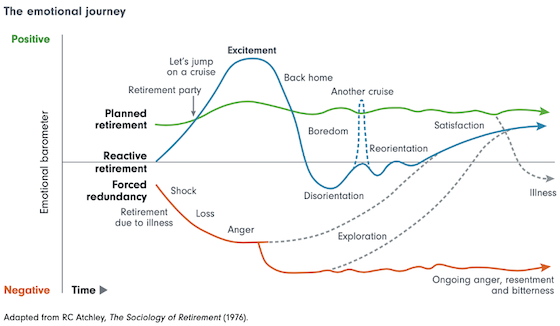
 

The green line shows that the emotional experience of a well-planned and prepared retiree is usually fairly steady with low stress levels and a generally positive emotional experience.

In contrast, the journey of the reactive retirement is much more variable where the lack of planning can lead to significant swings in lived emotional experience.

The journey of the person forced into retirement through an unplanned redundancy is much more unpredictable and can be a difficult period from an emotional perspective. However, it can also be turned around with the right mindset and often with the help of a good financial planner, as the alternative paths highlight.

Promoting a good life

In thinking about how best to prepare for a long and fulfilling retirement, we believe that there are six key building blocks that are important elements of any plan.

We call these the six Cs:

Firstly, there is capability, which is the agency and ability to act and adapt to optimise a good life trajectory. If a retiree has the capability, they have the potential to turn a negative emotional experience into a more positive one.

Then there is confidence, or the peace of mind and optimism to keep looking forward to a good life while still enjoying your existing life. We may all wish we had a bit more confidence sometimes, but this is more about inner confidence and the belief that you have made the right choices and are living, and will continue to live, a good life.

Control is another C. This is about feeling like the master of your destiny while avoiding the pain of uncertainty and failed expectation. Obviously being forced into retirement through a job loss or redundancy is a lack of control but having a plan B already in place can help regain that sense of control.

Circumstance is how we like to bundle health and wealth together. These are critical components for enjoying a good life. A major health problem can derail an otherwise planned retirement but if the other Cs are all there, the overall experience will be better.

Character refers to self-esteem and a person’s resilience. These factors can ensure a positive inner narrative which is important for a good life. Again, having the character and discipline to have a plan B already in place, to have a flexible disposition and a positive outlook significantly helps build resilience to life’s unexpected turns.

And finally, there is connection, which refers to a sense of connection with family and the community. Quality relationships and being able to look beyond, or transcend, a purely inward focus are central pillars of a good life. It turns out thinking of others is also good for us too.

Lessons from the ‘elders’

There is a lot to be learned from those that have journeyed before us and retirement is no different. Our survey asked experienced retirees about lessons learnt and challenges did they not anticipate.

Many said they underestimated the emotional impact of retirement, such as their sense of loss of purpose and their personal identity when they retired.

Many also said that due to unexpected life events – such as losing a partner, health and mobility issues or dealing with homecare and aged care needs – they needed to be flexible and had to adapt and change their plans during retirement. Some downsized their homes or returned to work, to do more in retirement.

The two most important pieces of advice that late retirees can give to pre-retirees are not financial but emotional.

First, having a positive and optimistic outlook on life received the joint highest vote in our survey at 64% of respondents.

Second, also from 64% of respondents, investing in your health, and do it early, don’t leave it until too late.

Being flexible and adaptable was the next most popular at 61%, followed by finding purpose beyond work at 58% and taking control early with 55% of the vote. Always having a plan B was also important with 52% of the vote.

Plan beyond wealth

We hope that pre-retirees can incorporate some of these insights into their retirement plans. It’s not just about wealth, the size of retirement savings and how to build that over time. There are more important factors that can build a satisfying and happy retirement.

The survey showed that having a positive outlook with a sense of confidence, taking control and forming a sense of connection with friends, family and community are significant in building and maintaining a happy retirement. 

Call us today to discuss your retirement planning strategy. Contact us on Phone: 07 5641 4134.

Source:
Reproduced with permission of Fidelity Australia. This article was originally published at https://www.fidelity.com.au/insights/investment-articles/retirement-planning-its-not-all-about-the-money/

This document has been prepared without taking into account your objectives, financial situation or needs. You should consider these matters before acting on the information. You should also consider the relevant Product Disclosure Statements (“PDS”) for any Fidelity Australia product mentioned in this document before making any decision about whether to acquire the product. The PDS can be obtained by contacting Fidelity Australia on 1800 119 270 or by downloading it from our website at www.fidelity.com.au. This document may include general commentary on market activity, sector trends or other broad-based economic or political conditions that should not be taken as investment advice. Information stated herein about specific securities is subject to change. Any reference to specific securities should not be taken as a recommendation to buy, sell or hold these securities. While the information contained in this document has been prepared with reasonable care, no responsibility or liability is accepted for any errors or omissions or misstatements however caused. This document is intended as general information only. The document may not be reproduced or transmitted without prior written permission of Fidelity Australia. The issuer of Fidelity Australia’s managed investment schemes is FIL Responsible Entity (Australia) Limited ABN 33 148 059 009. Reference to ($) are in Australian dollars unless stated otherwise.
© 2022. FIL Responsible Entity (Australia) Limited.

Important:
This provides general information and hasn’t taken your circumstances into account. It’s important to consider your particular circumstances before deciding what’s right for you. Any information provided by the author detailed above is separate and external to our business and our Licensee. Neither our business nor our Licensee takes any responsibility for any action or any service provided by the author. Any links have been provided with permission for information purposes only and will take you to external websites, which are not connected to our company in any way. Note: Our company does not endorse and is not responsible for the accuracy of the contents/information contained within the linked site(s) accessible from this page.


If you have a poor credit score or an error in your credit report, it may affect loans or credit you apply for. You have a right to get errors fixed for free, and you can arrange this yourself.

What you can get fixed (for free)

Here are some of the typical errors in credit reports. You can get these fixed for free.

Errors by the credit reporting agency

The credit reporting agency may have reported your information wrongly. For example:

  • your name, date of birth or address needs updating

  • a debt is listed twice

  • the amount of a debt is wrong

To fix this kind of error, contact the credit reporting agency. They may be able to fix it straight away or help you get it changed.

Errors by the credit provider

A credit provider may have reported information wrongly. For example, they:

  • incorrectly listed that a payment of $150 or more was overdue by 60 days or more

  • did not notify you about an unpaid debt

  • listed a default (an overdue debt) while you were in dispute about it

  • didn’t show that they had agreed to put a payment plan in place or change the contract terms

  • created an account by mistake or as a result of identity theft

To fix this kind of error:

  • Contact the credit provider and ask them to get the incorrect listing removed.

  • If the credit provider agrees it’s wrong, they’ll ask the credit reporting agency to remove it from your credit report.

If you can’t reach an agreement, contact the Australian Financial Complaints Authority (AFCA) to make a complaint and get free, independent dispute resolution.

If you’re struggling to get something fixed, feel free to contact us on Phone: 07 5641 4134.

What you can’t change or remove

You can’t change or remove any information on your credit report that is correct — even if it’s negative information.

For example:

  • All payments you’ve made during the last two years — on credit cards, loans or bills, whether you paid on time or not.

  • Payments of $150 or more that are overdue by 60 days or more — these stay on your report for five years, even after you’ve paid them off.

  • All applications for credit cards, store cards, home loans, personal loans and business loans — these stay on your report for five years.

For a full list, see what’s in your credit report.

Check before you use a credit repair company

You may see ads from credit repair companies offering to fix errors on your credit report about credit products (like credit cards).

Before you go ahead, check the credit repair company is licensed on ASIC’s website. Choose ‘Credit Licensee’ or ‘Credit Representative’ in the drop-down menu when you search.

Only deal with a licensed credit repair company.

You don’t need to pay a credit repair company to clean up errors in your credit report. They may charge you high fees for things you can do by yourself for free. Paying a credit repair company may not improve your credit score.

How to improve your credit score

If your credit score is low, there are steps you can take to help improve it. You can:

  • lower your credit card limit

  • limit how many applications you make for credit

  • pay your rent or mortgage on time

  • pay your utility bills on time

  • pay your credit card on time each month — either pay in full or pay more than the minimum repayment

As you do these things, your credit score will start to improve. So you’ll be more likely to be approved next time you apply for a loan or credit.

If you’re struggling to pay bills and are getting into more debt, talk to us on Phone: 07 5641 4134. They can take you through the options and help you make a plan.

Source:
Reproduced with the permission of ASIC’s MoneySmart Team. This article was originally published at https://moneysmart.gov.au/managing-debt/credit-repair

Important note: This provides general information and hasn’t taken your circumstances into account.  It’s important to consider your particular circumstances before deciding what’s right for you. Although the information is from sources considered reliable, we do not guarantee that it is accurate or complete. You should not rely upon it and should seek qualified advice before making any investment decision. Except where liability under any statute cannot be excluded, we do not accept any liability (whether under contract, tort or otherwise) for any resulting loss or damage of the reader or any other person.  Past performance is not a reliable guide to future returns.

Important
Any information provided by the author detailed above is separate and external to our business and our Licensee. Neither our business nor our Licensee takes any responsibility for any action or any service provided by the author. Any links have been provided with permission for information purposes only and will take you to external websites, which are not connected to our company in any way. Note: Our company does not endorse and is not responsible for the accuracy of the contents/information contained within the linked site(s) accessible from this page.