
Interest rates are an important financial lever for world economies. They affect the cost of borrowing and the return on savings, and it makes them an integral part of the return on many investments. It can also affect the value of the currency, which has a further trickle-down effect on other investments.

So, when rates are low they can influence more business investment because it is cheaper to borrow. When rates are high or rising, economic activity slows. As a result, interest rate movements are also a useful tool to control inflation.

The cash rate or headline rate you hear mentioned regularly in the media is the interest rate on unsecured overnight loans between banks. The Reserve Bank of Australia (RBA) sets the rate and meets every month, except January, to consider whether it should move up, down or stay the same. This rate then usually flows through to market interest rates causing, for example, mortgage rates to rise or fall.

Rising steadily

For the past few years, interest rates have been close to zero or even in negative territory in some countries, but that all started to change in the last year or so.

Australia lagged other world economies when it came to increasing rates but since the rises began here last year, the RBA has introduced hikes on a fairly regular basis. 

Australian Cash Rate Target
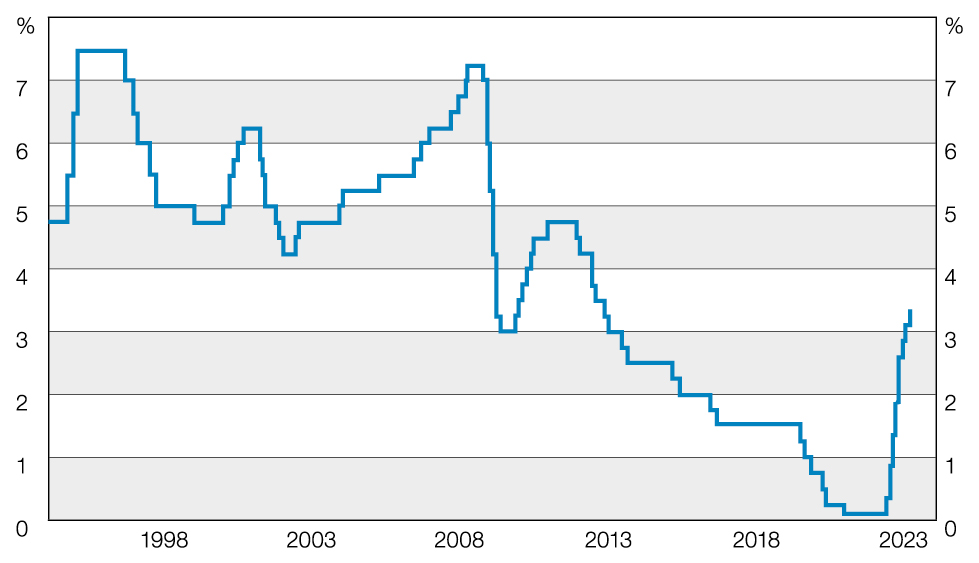
Source: RBA

The key reason for the rises is the need to dampen inflation. The RBA has long aimed to keep inflation between the 2 and 3 per cent mark. Clearly, that benchmark has been sharply breached and now the consumer price index is well over the 2 and 3 per cent a year mark.

While interest rates are the key monetary policy weapon to control inflation and dampen the economy, there can be a risk of taking it too far and causing a recession. Economic growth is forecast to slow to around 1.5 per cent this year as high inflation, low consumer confidence and rising rates take their toll.i

Winners and losers

There are two sides to rising interest rates. It hurts if you are a borrower, and it is generally welcomed if you are a saver.

But not all consequences of an interest rate rise are equal for investors and sometimes the extent of its impact may be more of a reflection of your approach to investment risk. If you are a conservative investor with cash making up a significant proportion of your portfolio, then rate rises may be welcome. On the other hand, if your portfolio is focussed on growth with most investments in say, shares and property, higher rates may start to erode the total value of your holdings.

Clearly this underlines the argument for diversity across your investments and an understanding of your goals in the short, medium, and long-term.

Shares take a hit 

Higher interest rates tend to have a negative impact on share markets. While it may take time for the effect of higher rates to filter through to the economy, the share market often reacts instantly as investors downgrade their outlook for future company growth. 

In addition, shares are viewed as a higher risk investment than more conservative fixed interest options. So, if low risk fixed interest investments are delivering better returns, investors may switch to bonds. 

But that does not mean stock prices fall across the board. Traditionally, value stocks such as banks, insurance companies and resources have performed better than growth stocks in this environment.ii Also investors prefer stocks earning money today rather than those with a promise of future earnings. 

Fixed interest options

Fixed interest investments include government and semi-government bonds and corporate bonds. If you are invested in long-term bonds, then the outlook is not so rosy because the recent interest rates increases mean your current investments have lost value.

At the moment, fixed interest is experiencing an inverted yield curve which means long term rates are lower than short term. Such a situation reflects investor uncertainty about potential economic growth and can be a key predictor of recession and deflation. Of course, this is not the only measure to determine the possibility of a recession and many commentators in Australia believe we may avoid this scenario.iii

What about housing?

House prices have fallen from their peak in 2022, which is not surprising given the slackening demand as a result of higher mortgage rates.

Australian Bureau of Statistics data showed an annual 35 per cent drop in new investment loans earlier this year.iv The consequent reduction in available rental properties has put upward pressure on rents which is good news if you have no loan, a small loan or a fixed interest loan on the property.

The changing times in Australia’s economic fortunes can lead to concern about whether you have the right investment mix. If you are unsure about your portfolio, then give us a call to discuss.

i https://www2.deloitte.com/au/en/pages/media-releases/articles/business-outlook.html
ii https://www.ig.com/au/trading-strategies/what-are-the-effects-of-interest-rates-on-the-stock-market-220705
iii https://www.macrobusiness.com.au/2023/02/inverted-yield-curve-predicts-australian-recession/e.
iv https://www.abs.gov.au/statistics/economy/finance/lending-indicators/latest-release

Important: This provides general information and hasn’t taken your circumstances into account. It’s important to consider your particular circumstances before deciding what’s right for you. Although the information is from sources considered reliable, we do not guarantee that it is accurate or complete. You should not rely upon it and should seek qualified advice before making any investment decision. Except where liability under any statute cannot be excluded, we do not accept any liability (whether under contract, tort or otherwise) for any resulting loss or damage of the reader or any other person.

Any information provided by the author detailed above is separate and external to our business and our Licensee. Neither our business nor our Licensee takes any responsibility for any action or any service provided by the author. Any links have been provided with permission for information purposes only and will take you to external websites, which are not connected to our company in any way. Note: Our company does not endorse and is not responsible for the accuracy of the contents/information contained within the linked site(s) accessible from this page.


You’re nearly there. After a lifetime of toil – of digging, building, thinking, manufacturing, planting, helping and nurturing – it’s time for you to enjoy your Golden Years. If you’re an Australian resident, you’re entitled to an age pension and a Seniors Card. Here’s what you need to do next.

Age Pension Eligibility

To claim the age pension you must meet certain criteria.

Age requirements

  • With a couple of exceptions—see the Centrelink page for more—you must be 65.

  • From July 1, 2019, the qualifying age for the pension increased to 66. It’ll then go up by six months every two years until it reaches 67 on July 1, 2023.

Income test

  • You can earn up to $174 a fortnight (or $308 as a couple) without any reduction to your payment.

  • If you earn more than this, your pension will be reduced by 50c for each extra dollar you earn.

  • Again, there are variations and exceptions to this such as the income test for Transitional Rate pensioners. Check Centrelink for more details.

Assets test

  • Your assets—your business, your super investments, your cars and boats and caravans etc.—can affect your eligibility for the pension. Note your principal home is excluded.

  • This is pretty detailed stuff—it’s best you work through Centrelink’s exhaustive list.

Residency requirements

You must meet the following residency requirements.

  • You must be an Australian resident when you lodge your claim and be physically present in the country when you do so.

  • You also need to have been an Australian resident for 10 years straight, or for a number of periods that exceed 10 years (with one of these being five years or more).

  • There are some exceptions, for example if you are a refugee or former refugee. Centrelink has the details.

Australia also has reciprocal pension agreements with 29 other countries which might help you if you haven’t met all the requirements above.

Claiming the Pension 

Centrelink’s website has all the information you need. It’s straightforward and well-organised. You can:

  • submit your claim online

  • call Centrelink on 13 23 00 (Monday to Friday, 8:00am to 5:00pm AEST/AEDT) for a claim pack

  • pick up one up from your nearest service centre.

You can submit your claim up to 13 weeks before you are eligible for the pension.

Seniors card 

You may also be eligible for a Seniors card.

Each state and territory has its own scheme—and each offers its own mix of transport concessions and discounts. There are various reciprocal arrangements in place so you can use your card when you’re interstate.

To be eligible, you must be a resident of a state or territory, be 60 years or over, and not work more than a set number of hours per week in paid work.

Commonwealth Seniors Health Card 

Once you reach age pension age, you qualify for a Commonwealth Seniors Health Card. This offers discounts on prescription medicines and other services including bulk billed GP appointments, out-of-hospital medical expenses, and concessional rail travel on epic Great Southern Rail services (eg. The Indian Pacific, The Ghan and The Overland).

The card is subject to an income test. You must have an annual adjusted taxable income of less than:

  • $54,929 for singles

  • $87,884 for combined couples

  • $109,858 for combined couples separated due to ill health, or when one partner is in prison.

This limit’s increased by $639.60 for each dependent child you might care for.

For more info check out the Commonwealth Seniors Health Card page on Centrelink’s website.

Source: NAB

Reproduced with permission of National Australia Bank (‘NAB’). This article was originally published at https://www.nab.com.au/personal/life-moments/work/plan-retirement/age-pension

National Australia Bank Limited. ABN 12 004 044 937 AFSL and Australian Credit Licence 230686. The information contained in this article is intended to be of a general nature only. Any advice contained in this article has been prepared without taking into account your objectives, financial situation or needs. Before acting on any advice on this website, NAB recommends that you consider whether it is appropriate for your circumstances.

© 2022 National Australia Bank Limited (“NAB”). All rights reserved.

Important:
Any information provided by the author detailed above is separate and external to our business and our Licensee. Neither our business nor our Licensee takes any responsibility for any action or any service provided by the author. Any links have been provided with permission for information purposes only and will take you to external websites, which are not connected to our company in any way. Note: Our company does not endorse and is not responsible for the accuracy of the contents/information contained within the linked site(s) accessible from this page.

Rising interest rates

Before 2022, few of us gave much thought to rising interest rates. After all, they’d been falling steadily for 14 years.

That changed when the Reserve Bank began lifting the official cash rate to combat inflation. Now most of us are only too aware of how much interest rates can change and go up at the worst possible time – when everyday household prices are also rising.

So what can you do about it? And, most importantly, is there a way to manage your finances without putting your future plans on hold?

Take control of your finances

You’ll ultimately be better off if you pro-actively manage your finances to make the most of any opportunities out there.

Take higher interest rates. While they may mean higher repayments on your home loan, they can also mean higher returns on your savings. By understanding your options, you can help make your money work for you. 

The same goes for higher everyday household prices. With a little bit of know-how, you can take control of your budget and stretch your dollar further. 

Why inflation matters

It’s useful to understand why prices and interest rates have risen so much, and why they might do so again.

It’s linked to inflation – the rate at which the cost of goods and services goes up. Since the pandemic these costs have surged in Australia and overseas, thanks to a range of issues. Some of the reasons for the increasing inflation rate are strong consumer spending, supply constraints and higher shipping costs.

Many of us are already feeling the effects of rising prices. People on higher wages – or those who have flexibility to adjust their spending – might not have noticed the effects as much. However, the damage inflation does to our economy means eventually everyone may feel its impact.

For example, your local cafe might start to struggle if customers choose to make coffee at home in a bid to trim spending. They’re also likely to hurt financially from an increase in the cost of ingredients – even as they hold off upping their prices to encourage the return of their customers.

This is why the Reserve Bank has been lifting the cash rate target. It’s the main method the Reserve Bank has to help bring prices back under control. The idea is that people are less likely to borrow or spend as their home loan repayments rise, making it more likely that the economy will slow and with it, eventually, inflation.

Managing your home loan interest rate

When it comes to your home loan, it’s never too early to decide what kind of loan suits you. For example, if your family budget has little room to move, you may want to consider fixing the interest rate on your home loan. This not only protects you against a further rise in interest rates for the duration of that fixed rate period, it also gives you certainty when it comes to your repayment amount, helping you to better plan your budget each month.

If your finances are more flexible, you may be interested in sticking to a variable interest rate. 

You could also consider an offset account. This is a type of transaction account where you can deposit or withdraw money anytime you like. The big advantage is that the money in the account ‘offsets’ your total home loan amount – thereby reducing the amount of interest you’re charged that month. This can make a difference to the overall interest you pay over the life of your loan, potentially savings you thousands of dollars while also shortening the life of your loan.

Enjoy higher interest on your savings

Then there are your savings to think about. In a high interest rate environment, there can be big benefits to using a savings account. 

Create a budget

Taking time to create a budget can be empowering, give you more control over your finances, and help you stay on top of the rising cost of living. Just knowing what you’re spending each month can go a long way to reducing worries around your current financial situation.

A smart place to start is to take a closer look at your bank statement, to find out just how much money is going in and out over the month. You can check this easily with the expense tracker app.

If you find your expenses are winning hands down over your income, the next step is to go through these costs line by line to decide which are ‘must haves’ and which are ‘nice to haves’. The nice to haves – takeaways and regular trips to the movies, for instance – might have to be trimmed.

Help when you need it

If you’re nervous about your finances you’re not alone. According to a recent Consumer Insights Survey, 4 in 10 Australians are currently experiencing some form of financial hardship. 

If you’re facing financial difficulties reach out to us before things get too overwhelming. Find out how we can help you if you’re dealing with financial hardship.

At the end of the day, what’s most important is that you get on top of your finances so you can make the most of your future and we are always here to help.

Source: NAB

Reproduced with permission of National Australia Bank (‘NAB’). This article was originally published athttps://www.nab.com.au/personal/life-moments/manage-money/how-to-manage-changing-interest-rates

National Australia Bank Limited. ABN 12 004 044 937 AFSL and Australian Credit Licence 230686. The information contained in this article is intended to be of a general nature only. Any advice contained in this article has been prepared without taking into account your objectives, financial situation or needs. Before acting on any advice on this website, NAB recommends that you consider whether it is appropriate for your circumstances.

© 2022 National Australia Bank Limited (“NAB”). All rights reserved.

Important:
Any information provided by the author detailed above is separate and external to our business and our Licensee. Neither our business nor our Licensee takes any responsibility for any action or any service provided by the author. Any links have been provided with permission for information purposes only and will take you to external websites, which are not connected to our company in any way. Note: Our company does not endorse and is not responsible for the accuracy of the contents/information contained within the linked site(s) accessible from this page.

The ranks of Australians receiving the Age Pension are increasing. It’s important to understand who is eligible and its role in retirement planning.

Just days before the 2023 Federal Budget was handed down on 9 May, the Australian Bureau of Statistics released a new report including data on the number of Australians receiving the Age Pension.

The report, New Census insights on income in Australia using administrative data, has largely flown under the public radar so far.

But it contains some interesting retirement insights compiled from the 2021 Census, most notably that “nearly half of Australians aged 65 years and older receive most of their income from the Age Pension (47.8% or 2,029,000 persons)”.

That’s a powerful statistic, especially when taking into account the “Support for Seniors” expense numbers detailed a week later in the Federal Budget’s Statement 6: Expenses and Net Capital Investment.

Support for Seniors (the Age Pension) has been costed in the latest Budget at $54.87 billion for the 2022-23 financial year, rising progressively on forward estimates to $67.32 billion in 2026-27.

A growing reliance on the pension

One of the key findings from How Australia Retires study, released in May, is that the Age Pension features most prominently among Australians who are still working and who have not taken purposeful steps to prepare for their retirement, and who are more likely to say the Age Pension is part of their retirement.

These steps include having a well-documented and detailed financial plan, ideally prepared by a professional financial adviser, and making extra contributions to superannuation over time.

Australians who have low confidence about their retirement generally have low expectations about the amount of income they’ll likely receive during retirement and believe the Age Pension will form the biggest component of their retirement plan.

The number of Australians receiving the Age Pension is continuing to rise, and has actually increased significantly since the 2021 Census data that the ABS has used in its recent Census insights report.

The Department of Social Services (DSS) Expanded DSS Benefit and Payment Recipient Demographics – December 2022 data shows 2,565,870 people were receiving the Age Pension at the end of last year.

This included 1,783,980 people receiving full pension payments, 393,365 people receiving part pensions as a result of the “income test”, and a further 385,525 people receiving part pensions as a result of the “assets test”.

Under the income test, individuals can earn a maximum of $190 in income per fortnight (and couples $336 per fortnight) from other sources before their pension is reduced by 50 cents for every dollar above the respective allowable limits.

Under the assets test, individuals and couples are assessed on whether they do or don’t own a home. They can hold up to a certain value of financial and other assets before their pension is incrementally reduced for every dollar above the respective allowable limits.

Single homeowners can have up to $280,000 in assets, and non-homeowners up to $504,500, before their full Age Pension starts to reduce. The Age Pension cuts out completely once singles reach maximum asset limits of $634,750 (homeowners) and $859,250 (non-homeowners), with higher cut off points for singles who receive rent assistance.

The same rules apply to couples receiving the Age Pension, but the limits are higher.

Couple homeowners can have up to $419,000 in assets, and non-homeowners up to $643,500, before their full Age Pension starts to reduce. The Age Pension cuts out completely once couples reach maximum asset limits of $954,000 (homeowners) and $1,178,500 (non-homeowners).

The growing role of the Age Pension

The DSS’s demographics data shows that there just under 400,000 Australians aged 66 to 69 that were receiving a full of part pension as of December 2022 – roughly about 15% of the total Age Pension population.

Keep in mind that this is the youngest Age Pension cohort, as individuals can potentially qualify to receive a full or part Age Pension from the age of 65 years and six months, depending on the year they were born.

The largest cohort of pension recipients (about 51%) was aged 70 to 79.

For most Australian retirees, the Age Pension forms a meaningful portion of their retirement income, and for all retirees it should be considered as part of the retirement planning process.

Two key features of the Age Pension – it is payable until one’s death, and it adjusts for inflation over time – make the Age Pension a very valuable benefit as well.

Given this, a thorough understanding of how the Age Pension works, what benefits should be expected, and its role in planning for retirement is critical.

For retirees who meet the eligibility criteria, the Age Pension can act like an inflation-protected, lifetime-income safety net.

This means that Australian retirees who are eligible for the Age Pension can expect to receive a fortnightly pay packet that maintains its purchasing power for as long as they are alive and as long as they continue to meet the assets test, income test and residency rules.

If available, it is a great resource to help meet “basic living expenses” in retirement.

To find out more, contact us today. 

Source: Vanguard May 2023

Reproduced with permission of Vanguard Investments Australia Ltd

Vanguard Investments Australia Ltd (ABN 72 072 881 086 / AFS Licence 227263) is the product issuer. We have not taken yours and your clients’ circumstances into account when preparing this material so it may not be applicable to the particular situation you are considering. You should consider your circumstances and our Product Disclosure Statement (PDS) or Prospectus before making any investment decision. You can access our PDS or Prospectus online or by calling us. This material was prepared in good faith and we accept no liability for any errors or omissions. Past performance is not an indication of future performance.

© 2023 Vanguard Investments Australia Ltd. All rights reserved.

Important:
Any information provided by the author detailed above is separate and external to our business and our Licensee. Neither our business nor our Licensee takes any responsibility for any action or any service provided by the author. Any links have been provided with permission for information purposes only and will take you to external websites, which are not connected to our company in any way. Note: Our company does not endorse and is not responsible for the accuracy of the contents/information contained within the linked site(s) accessible from this page.

Take some of the guesswork out of planning for the future. Work out how much super you’ll have when you retire, and if it will be enough to fund the lifestyle you want.

It’s never too soon to start planning for a better financial future.

Estimate how much super you’ll have

You probably know how much super you have now, but do you know how much you’ll have when you retire?

Use the Moneysmart retirement planner to estimate:

  • how much money you’ll have to spend each year once you retire

  • how fees, investment options and contributions will affect your retirement income

You can also use the planner to test out different scenarios and work out how to grow your super.

Use the retirement planner

Estimate how much super you’ll have when you retire.

How much super you’ll need when you retire

The amount of super you’ll need when you retire depends on:

  • your big costs in retirement, and

  • the lifestyle you want

Most people can now expect to live well into their eighties. This means that if you stop working at 65, you’ll need retirement income for 20 years or more.

Your big costs in retirement

Think about any big costs that might be part of your retirement plans. For example:

  • paying off your mortgage

  • rent

  • renovating your home

  • travel

  • medical costs

The lifestyle you want

There are a few different ways to work out how much super you need for the lifestyle you want in retirement.

If you’re close to retiring use the budget planner to estimate how much money you expect to spend when you stop working. 

If you own your own home, a rule of thumb is that you’ll need two-thirds (67%) of your pre-retirement income to maintain the same standard of living in retirement.

Some organisations provide information on retirement spending:

  • Super Consumers Australia has a set of retirement savings targets for people aged 55-59 and 65-69. They estimate how much you’ll need based on low, medium and high spending.

  • The Association of Superannuation Funds of Australia provides an ASFA retirement standard. This estimates how much money you’ll need, based on a modest or comfortable lifestyle in retirement. 

Build up your super

Many things contribute to your income in retirement, including investments outside of super and assets such as your home, especially if you downsize.

How much Age Pension you are eligible for also has an impact on how much super you need. 

If you decide it is important to build your super, there are some actions that can make a big difference over time. Think about:

If you don’t have as much as you’d like, start taking steps to build up your super to boost your retirement savings.

Throughout your working life, check your super at least annually. Check your fund has the correct personal details and tax file number (TFN). Review your employer’s contributions, and your account fees, investment options and insurance. If you’re not satisfied or don’t understand any details about your fund, call them and ask questions.

If you need financial advice

Planning for your retirement is complex, and everyone’s situation is different. Speak to us today about getting personalised advice to help you plan ahead. 

Source:
Reproduced with the permission of ASIC’s MoneySmart Team. This article was originally published at https://moneysmart.gov.au/grow-your-super/how-much-super-you-need

Important note: This provides general information and hasn’t taken your circumstances into account.  It’s important to consider your particular circumstances before deciding what’s right for you. Although the information is from sources considered reliable, we do not guarantee that it is accurate or complete. You should not rely upon it and should seek qualified advice before making any investment decision. Except where liability under any statute cannot be excluded, we do not accept any liability (whether under contract, tort or otherwise) for any resulting loss or damage of the reader or any other person.  Past performance is not a reliable guide to future returns.

Important
Any information provided by the author detailed above is separate and external to our business and our Licensee. Neither our business nor our Licensee takes any responsibility for any action or any service provided by the author. Any links have been provided with permission for information purposes only and will take you to external websites, which are not connected to our company in any way. Note: Our company does not endorse and is not responsible for the accuracy of the contents/information contained within the linked site(s) accessible from this page.

Good ways to budget

In this article, we look beyond the basics and focus more on what it takes to stick to your budget. Here are five tips to help you stick to your budget.

1. Stocktake. Spending more than you earn?

Subtract your total weekly expenses from your total weekly income. How’s it looking? Ideally, you’ll have more coming in than going out. Over time you’ll be able to save and build up your reserves.

First, you want a buffer in case things go wrong. It was recommended to have six month’s spare cash in the bank. When this seemed out of reach for most, it was reduced to three months in reserve—but many people struggle to even have one.

Living month to month is stressful enough; living week to week even more so. Getting your finances into a stable and sustainable place is the goal. Properly accounting for income and outgoings is the first step.

2. Cut costs

Realistically, the quickest way to improve your personal bottom line is to cut costs – to curb unnecessary spending.

Go through your expenditure. You’ll find there are fixed costs (e.g. rent or mortgage payments) you can do little about, and other areas where you could cut but it’d be unwise to do so (e.g. insurance).

Unfortunately, the areas where you can make the greatest savings (your discretionary spending) are often the things that are most fun – like going to the movies, or big Friday nights out.

Once more, the crucial consideration is ‘balance’. You can draft an extreme austerity plan, but you’d be unlikely to stick to it.

Be realistic. Don’t introduce cuts across the board or take $20 off food without knowing what you can (and will) give up or change.

3. Have a plan

It’s easier to keep to a budget if you have a goal you’re working towards. It might be something humble like a pair of shoes or cast-iron wok.

It could be bigger ticket items like a car, an overseas trip, or your first home deposit. Perhaps you’ve just got debts you want to pay off.

Whatever it is, having a plan is the best way to keep focused and ensure spend-ups and blowouts don’t happen too often.

4. Sort your day-to-day money management

Set up a system that makes saving automatic—and limits your ability to spend more than you’ve budgeted. It’s a good idea to set up several bank accounts, with direct debits into (or out) of each.

For instance, you might have a general account where your wages are paid into. Each week, money is diverted from here into a designated ‘House’ savings account (for your home deposit).

Don’t touch this. You might have another couple of accounts—a smaller one where you trickle money in for that trip to New Zealand, another to fund big, occasional bills (e.g. vehicle maintenance).

Your goal? Each month your overall financial position should be stronger than the month before.

You may also want to consider a Term Deposit to help you reach your savings goal.

5. Track your progress

Check your finances each month to see if your savings and spending plans are on track. If you’re extra organised, fill out your own Statement of Financial Position in Excel.

Don’t just look at the bottom line. Where are you over? Where are you under? What little fixes could bring things back into line? Are your targets realistic?

Remember, the best budgets are regularly reviewed and refined – and evolve over time.

Reproduced with permission of National Australia Bank (‘NAB’). This article was originally published at https://www.nab.com.au/personal/life-moments/manage-money/budget-saving/stick-to-budget


National Australia Bank Limited. ABN 12 004 044 937 AFSL and Australian Credit Licence 230686. The information contained in this article is intended to be of a general nature only. Any advice contained in this article has been prepared without taking into account your objectives, financial situation or needs. Before acting on any advice on this website, NAB recommends that you consider whether it is appropriate for your circumstances.

© 2023 National Australia Bank Limited (“NAB”). All rights reserved.

Important:
Any information provided by the author detailed above is separate and external to our business and our Licensee. Neither our business nor our Licensee takes any responsibility for any action or any service provided by the author. Any links have been provided with permission for information purposes only and will take you to external websites, which are not connected to our company in any way. Note: Our company does not endorse and is not responsible for the accuracy of the contents/information contained within the linked site(s) accessible from this page.

If you need help in your home, or can no longer live independently, the Australian Government provides a range of aged care services.

These services are subsidised, but you need to contribute to the cost if you can afford to.

Where to start

The first thing to do is think about what you need. You might want to stay in your own home, but need some help with domestic chores. Or you might be ready to start looking at options for longer-term residential care.

Talk to your family or friends about what you want. This will help you get the right care when the time comes.

Once you have an idea of your needs, contact My Aged Care. They will:

  • check your eligibility

  • assess your care needs

  • assess your financial situation

It’s important to plan ahead, as this process can take time. There are waiting lists for some services.

To discuss your options, speak to us or speak to an Aged Care Specialist Officer (ACSO) at a Services Australia service centre. 

Care and help at home

To help you stay in your own home for as long as possible, the government provides subsidised home care. This is to help with everyday tasks like shopping, cooking and transport, as well as with personal and nursing care.

There are two types of home care:

What you pay

If you can afford to do so, you may have to pay:

  • a basic daily fee — a standard amount that everyone has to pay

  • an income-tested fee — an amount that will vary depending on your income and assets

If you can’t afford to pay, you may be able to get financial hardship assistance.

Check My Aged Care’s fee estimator to see how much you might have to pay for home care.

Residential aged care

If you can no longer live at home, you may choose to move to an aged care home (sometimes called a nursing home or residential aged care facility). Care is available 24 hours a day. This can be a short-term stay or a permanent move.

What you pay

If you can afford to do so, you may have to pay:

  • a basic daily fee — a standard amount that everyone has to pay

  • an income tested fee — an amount that will vary depending on your income and assets

  • accommodation payment — an amount for your room, based on its quality, location and features

The accommodation payment is the biggest cost. You can pay this as a:

  • bond or lump sum up-front, which is refundable (called a Refundable Accommodation Deposit, or RAD)

  • daily amount (called a Daily Accommodation Payment, or DAP)

  • combination of RAD and DAP

If you can’t afford to pay, you may be able to get financial hardship assistance.

Check My Aged Care’s fee estimator to see what accommodation payment you might have to pay.

Selling or keeping your family home

You may be thinking of selling the family home to pay the bond (RAD). Or maybe you’re wondering whether it’s better to rent it out to help pay the daily amount (DAP)?

You have 28 days after you go into aged care to decide how to pay for your accommodation. You must pay the DAP until the RAD is paid:

  • if you decide to pay a RAD within those 28 days, you have 6 months to pay the RAD

  • if you decide to pay a RAD after those 28 days, it is due as agreed between you and the provider

You may need professional financial advice to work out whether selling or renting your home is the best option, so call us today and we can discuss this option with you.

Either way, be aware that what you choose to do with the family home may affect the Age Pension assets test.

If you sell the home, its value will count towards the Age Pension assets test.

If you rent out the home, its value may count towards the Age Pension assets test, depending on when you moved into aged care.

If you keep the home without renting it out, it is exempt from the Age Pension assets test for two years from the date that you moved into aged care. (This may vary if you are, or were, a couple when you moved into aged care.)

Speak to a Services Australia Financial Information Service (FIS) officer for more information.

Short-term help

Short-term help is available, either in your own home or in an aged care home. There are different types of care:

  • transition care (or after-hospital care) — for when you’ve been in hospital and need help with your recovery

  • respite care — for when you or your carer needs a break (for a few hours, a few days, or longer)

  • short-term restorative care — for when you’ve had a setback and want to get your independence back

Private retirement accommodation

As well as government subsidised aged care homes, there are many private retirement accommodation options. For this kind of accommodation, you pay the full amount yourself.

The Australian Competition and Consumer Commission has information about types and costs of retirement homes but please reach out if you need further assistance in this area.

Source:
Reproduced with the permission of ASIC’s MoneySmart Team. This article was originally published at https://moneysmart.gov.au/living-in-retirement/aged-care

Important note: This provides general information and hasn’t taken your circumstances into account.  It’s important to consider your particular circumstances before deciding what’s right for you. Although the information is from sources considered reliable, we do not guarantee that it is accurate or complete. You should not rely upon it and should seek qualified advice before making any investment decision. Except where liability under any statute cannot be excluded, we do not accept any liability (whether under contract, tort or otherwise) for any resulting loss or damage of the reader or any other person.  Past performance is not a reliable guide to future returns.

Important
Any information provided by the author detailed above is separate and external to our business and our Licensee. Neither our business nor our Licensee takes any responsibility for any action or any service provided by the author. Any links have been provided with permission for information purposes only and will take you to external websites, which are not connected to our company in any way. Note: Our company does not endorse and is not responsible for the accuracy of the contents/information contained within the linked site(s) accessible from this page.

Think you have been scammed? These steps will help you take action quickly to stop the scammers and limit the damage.

Know that you are not alone and you can recover from this. There is support available, if and when you need it.

Act fast if you’ve been scammed

If you’ve been scammed, follow these steps to take action.

  1. Don’t send any more money. Block all contact from the scammer.

  2. Contact your bank or financial institution immediately to report the scam. Ask them to stop any transactions.

  3. Warn your family and friends about the scam, so they can watch out for potential follow up scams.

If you’ve paid a scammer

If you’ve paid a scammer in any of these ways, here’s what to do:

  • Credit/debit card – Contact your bank or card provider immediately to report the scam. Ask them to stop any transactions.

  • Gift card – Report it to the company who issued the card.

  • Wire transfer – Report it to the wire transfer company or bank that you used.

  • Money transfer app – Report it to the app provider (the seller or developer, not the app store).

  • Crypto – Report it to the platform or company you used to send the money. Cryptocurrency may not be recoverable.

  • Cash – If you sent by mail or delivery service, contact Australia Post or the delivery service used to see if they can intercept the package.

  • Unauthorised transfer – If a scammer has transferred money without your approval, report it to your bank straight away. Ask them to freeze your accounts and transactions.

If a scammer has your personal information

For example, if your personal details (like name, phone, email, address, identity documents) have been leaked in a data breach. Here’s what to do:

  • Report the data breach to your financial institutions – Let your bank, super fund and any other financial services know.

  • Contact IDCARE – Call 1800 595 160 (Monday to Friday, 8am–5pm). They can help you make a plan (for free) to limit the damage.

  • Create a new, stronger password – Make sure you haven’t used it before. If you’ve used the leaked password anywhere else, update it there too.

  • Watch out for suspicious contact – Look for suspicious emails, phone calls, texts or messages through social media. Block or don’t answer anyone you don’t know. Don’t click on any links.

  • Monitor your bank account – Keep a close watch on your bank account for any unauthorised transactions.

  • Monitor your credit report – Request a temporary ban on your credit report to ensure no unauthorised loans or credit applications can be made.

For more tips, see identity theft.

If a scammer has accessed your computer or phone 

A scammer pretends to be from your internet or phone provider. They say you have a technical problem and ask for access to your device. Then they infect it with a virus, to steal your passwords and financial information. Here’s what to do:

  • If they accessed your computer – Update your security software and run a scan for viruses. Delete anything identified as a problem and reset your passwords.

  • If they accessed your phone or phone account – Report it to your phone provider. Update your security software and run a scan for viruses. Change your passwords or pins, block scam calls and consider changing your phone number.

You could also get an IT professional to check your devices in-person.

Watch out for follow up scams

If you’ve been caught up in a scam, you may be targeted in a follow-up scam. Hang up the call, or block emails or text messages, if someone:

  • offers to swap your investment for another one to recover your losses

  • tells you to ‘hang in there’ as your investment will increase in value soon

  • offers to buy your shares at a premium but asks you to pay a fee to have ‘restrictions’ on the shares lifted

  • asks you to pay a fee for a fake share certificate

  • claims they can recover your losses for a percentage of the recovered losses or for a fee they say is a ‘tax’, ‘deposit’, ‘retainer’ or ‘refundable insurance bond’

  • asks you to pay for travel and accommodation costs to find the scammer who has taken your money

These are all tricks scammers use to get more money from you.

Help to stop the scam

Report any scams to your bank or financial institution straight away to avoid losing any more money. You may not be able to get your money back once it’s been paid to a scammer. But reporting it will help stop them scamming someone else.

Agencies use the information you give to build cases against scammers. They also educate the public and share data about what’s happening.

If you’ve been targeted by a scammer, report it to:

All scams

Banking and credit card scams

  • your bank or financial institution

Fraud and theft

  • your local police — call 131 444

  • ReportCyber — if you think your personal information has been used

Financial and investment scams

Including those involving superannuation, managed funds, financial advice, financial products and insurance

Crypto-asset scams

Tax related scams

Superannuation scams

Social media scams

  • the social media platform — to help prevent others from being scammed 

Get support after being scammed

If a scam is causing you problems with debt, talk to a financial counsellor. This is a free and confidential service to help you get your finances back on track, or you can speak to us.

Being scammed is a horrible experience. If you need someone to talk to (24 hours a day, 7 days a week) contact:

Source:
Reproduced with the permission of ASIC’s MoneySmart Team. This article was originally published at https://moneysmart.gov.au/investment-warnings/what-to-do-if-you-ve-been-scammed

Important note: This provides general information and hasn’t taken your circumstances into account.  It’s important to consider your particular circumstances before deciding what’s right for you. Although the information is from sources considered reliable, we do not guarantee that it is accurate or complete. You should not rely upon it and should seek qualified advice before making any investment decision. Except where liability under any statute cannot be excluded, we do not accept any liability (whether under contract, tort or otherwise) for any resulting loss or damage of the reader or any other person.  Past performance is not a reliable guide to future returns.

Important
Any information provided by the author detailed above is separate and external to our business and our Licensee. Neither our business nor our Licensee takes any responsibility for any action or any service provided by the author. Any links have been provided with permission for information purposes only and will take you to external websites, which are not connected to our company in any way. Note: Our company does not endorse and is not responsible for the accuracy of the contents/information contained within the linked site(s) accessible from this page.
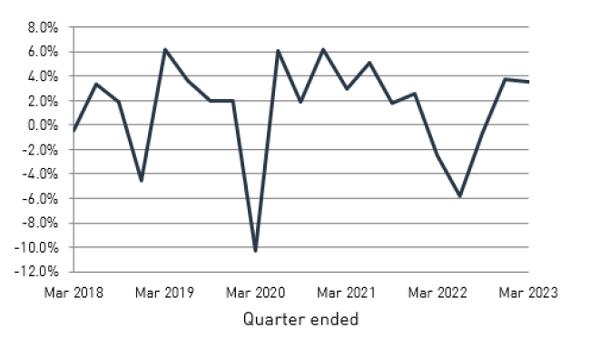
As our superannuation balances grow larger, it makes more sense than ever to keep track of the many rules changes that have recently happened or are coming up soon.

Australians are investing more in super – almost $151 billion dollars in the year ending March 2023, an increase of 11.3 per cent.i

Those extra contributions, plus the rebound in the financial markets, have resulted in super assets of around $3.5 trillion.ii

And it is being put to good use. We took out lump sum payments totalling $53.5 billion dollars during the 12 months and pension payments of $42.3 billion.iii

Quarterly rate of return

Source: APRA Quarterly superannuation performance statistics highlights, March 2023

To keep your super on track for a comfortable retirement, check out these latest changes in case they affect you.

Super bonus for workers

For employees, the new financial year kicks off with an increase in the Superannuation Guarantee paid by employers. It is now 11 per cent of eligible wages.

This rate will increase by 0.5 per cent each year until it reaches 12 per cent in 2025.iv

The Australian Tax Office will also be cracking down on employers who don’t pay on time or at all. From 1 July 2026, super must be paid at the same time as wages rather than at the end of each quarter.

The recent Federal Budget also provided funds to help the ATO enforce super payments and recover unpaid amounts.

Minimum pension drawdown increased

A COVID-19 measure to reduce the minimum drawdown required on super pensions will end on 1 July 2023.

Investors receiving super pensions and annuities must withdraw a minimum amount each year. The federal government reduced this amount by 50 per cent over the last four financial years to help those wanting to protect their capital as the markets recovered from the chaos of the pandemic.

You can find out more by visiting the ATO’s minimum pension standards.

Transfer balance cap to be lifted

The maximum amount of capital that can be transferred to your super pension will increase to $1.9 million from 1 July 2023.v

The transfer balance cap limits the total amount of super that can be transferred into a tax-free pension account. This is a lifetime limit.

The cap is indexed and began at $1.6 million when it was introduced in 2017. Increases in the cap are tied to CPI movements.

You can see your transfer balance account and cap information in your online ATO account.

Extra tax for large balances

Investors with super balances of $3 million or more will lose the benefit of super tax breaks on earnings. From 1 July 2025, taxes on future earnings will be 30 per cent instead of 15 per cent although they will continue to benefit from more generous tax breaks on earnings from the funds below the $3 million threshold.

This change is expected to apply to around 80,000 people.

Other recent changes

A number of changes announced in both Federal Budgets last year have also been slowly introduced over the past 12 months.

In one major change, the minimum age was lowered for those able to invest some of the proceeds of the sale of their homes into super, known as a ‘downsizer contribution’.

From 1 January 2023, if you are aged 55 or older, you can now contribute to your super up to $300,000 (or $600,000 for a couple) from the sale of their home.

The home must be in Australia and owned by you for at least 10 years.

In another residential property initiative, a scheme that allows investors to use their super fund to save for their first home has been expanded.

The First Home Super Saver Scheme was last year increased from $30,000 to $50,000.

The Scheme allows you to make contributions into your super then apply to release them when you want to purchase your first home, provided you meet the eligibility requirements.

Another significant reform for many has been the removal of the work test for those under 75, who can now make or receive personal super contributions and salary sacrificed contributions. (Although the ATO notes that you may still need to meet the work test to claim a personal super contribution deduction.)

Previously if you were under 75, you could only make or receive voluntary contributions to super if you worked at least 40 hours over a 30-day period.

A further change introduced last year was the removal of the $450 per month threshold for super contributions.

Employers must now pay the super guarantee to all employees regardless of their earnings however, employees who are under 18 still need to work more than 30 hours in a week to be eligible.

While caps have been lifted and programs expanded, at least one scheme has not changed. The Low Income Super Tax Offset (LISTO) threshold remains at $37,000. LISTO is a government payment to super funds of up to $500 to help low-income earners save for retirement.

If you earn $37,000 or less a year you may be eligible a LISTO payment. You don’t need to do anything other than to ensure your super fund has your tax file number.

Finally, a project that may pay off down the track, the Federal Budget included continued funding for a superannuation consumer advocate to help improve investors’ outcomes.

Expert advice is important to help navigate these changes over the coming year. Call us for more information.

i, ii, iii https://www.apra.gov.au/news-and-publications/apra-releases-superannuation-statistics-for-march-2023

iv https://www.ato.gov.au/Business/Small-business-newsroom/Lodging-and-paying/The-super-guarantee-rate-is-increasing/

v https://www.ato.gov.au/Individuals/Super/Withdrawing-and-using-your-super/Transfer-balance-cap/

Important: This provides general information and hasn’t taken your circumstances into account. It’s important to consider your particular circumstances before deciding what’s right for you. Although the information is from sources considered reliable, we do not guarantee that it is accurate or complete. You should not rely upon it and should seek qualified advice before making any investment decision. Except where liability under any statute cannot be excluded, we do not accept any liability (whether under contract, tort or otherwise) for any resulting loss or damage of the reader or any other person.

Any information provided by the author detailed above is separate and external to our business and our Licensee. Neither our business nor our Licensee takes any responsibility for any action or any service provided by the author. Any links have been provided with permission for information purposes only and will take you to external websites, which are not connected to our company in any way. Note: Our company does not endorse and is not responsible for the accuracy of the contents/information contained within the linked site(s) accessible from this page.

The start of a new financial year is the perfect time to get your financial affairs in order. Whether it’s tidying up your paperwork, assessing your portfolio or dealing with outstanding issues, there are plenty of practical actions you can take.

Here are some strategies for starting the new financial year on the right foot.

Tidy up your paperwork

Dealing with the paperwork is the task most of us love to hate. But taking a day to trawl through the ‘To Do’ pile and the growing mountain of filing could be a good investment in yourself. What’s more, you might identify some savings.

Set your budget

A lot can happen in a year, so it makes sense to review your budget to ensure it still works towards your goals in the new year. This will help you track your changing expenses and ensure you’re not overspending. And if you haven’t got a working budget, now’s a great time to start. There are plenty of budgeting apps and tools available online that can help you get started.

Assess your portfolio

Another important step to take as you start the new financial year is to assess your investment portfolio.

Some important questions include:

  • Why did you start investing and have your circumstances changed? For example, you may have started investing to receive a better return than your term deposits but now that term deposits rates have increased and share markets are challenged, should you revisit that goal?

  • What is the investment performance? Is it in line with your expectation and the benchmark?

  • Should you consider diversifying into different asset classes?

  • Is dividend reinvestment the best option for you or should you take the dividend income into cash?

  • Is your risk appetite still the same, or should you be aggressive or more conservative?

Check your insurance

Now is a good time to examine your insurances closely and to consider whether they match your needs and risks. It is also a good reminder to take note of policy renewal dates so that you can shop around to make sure you get the best price.

Understand Federal Budget changes

Keeping up to date with the commentary about Federal Budget initiatives may be useful.

The measures aimed at easing the cost of living will provide a boost to some. They include energy bill relief for concession card holders and energy saving incentives. Meanwhile those with chronic health conditions will benefit from a number of changes announced in the budget.

The Budget also included support for families with cheaper childcare and a more flexible Paid Parental Leave scheme, and incentives for some types of new home building projects.

Review your superannuation

A review – at least annually – of your super account is vital to make sure that:

  • Your investments and risk strategy are still right for you

  • The fees are reasonable

  • Any insurance policies held in your super account are appropriate

  • Your employer contributions are being made

  • Your death benefit nomination is relevant

  • You don’t have multiple accounts incurring unnecessary fees

You might also consider a salary sacrifice strategy, where you ask your employer to make extra super contributions from your pre-tax salary. These additional contributions are taxed at 15 per cent within the super fund, plus an additional 15% if Division 293 tax applies to you (income over $250,000).

Remember, you could top up your super balance at the end of each financial year using either concessional contributions (from your pre-tax income) or non-concessional contributions (after-tax income). Don’t forget the caps on payments, which are $27,500 for concessional contributions and $110,000 for non-concessional.

It is a good idea to get some expert advice regarding your super contributions, we can assist with the best ways to manage your contributions.

So, set yourself up for a fresh start to the year with some simple strategies to help you achieve your financial goals.

Important: This provides general information and hasn’t taken your circumstances into account. It’s important to consider your particular circumstances before deciding what’s right for you. Although the information is from sources considered reliable, we do not guarantee that it is accurate or complete. You should not rely upon it and should seek qualified advice before making any investment decision. Except where liability under any statute cannot be excluded, we do not accept any liability (whether under contract, tort or otherwise) for any resulting loss or damage of the reader or any other person.

Any information provided by the author detailed above is separate and external to our business and our Licensee. Neither our business nor our Licensee takes any responsibility for any action or any service provided by the author. Any links have been provided with permission for information purposes only and will take you to external websites, which are not connected to our company in any way. Note: Our company does not endorse and is not responsible for the accuracy of the contents/information contained within the linked site(s) accessible from this page.