Many Australians now technically qualify to be certified as a sophisticated investor, but what are the benefits and risks?

Sophisticated is a word that can have a wide range of connotations.

In the subjective sense it may be used to describe people considered to be well educated, knowledgeable and experienced.

But there is an entirely different and specific meaning of ‘being sophisticated’ when it comes to investing.

Among these is one legal definition enshrined within the Corporations Act 2001, under which certain eligible investors can be certified by a qualifying accountant as being ‘sophisticated investors’ for the purposes of investing in certain securities based on their gross income or net assets.

To be able to pass this particular ‘sophisticated investor’ test, individuals must either be able to prove to their accountant that they have earned at least $250,000 in pre-tax income in each of the two previous financial years or that they have net assets of $2.5 million (which can include the family home).

Many households now potentially qualify

When the test levels were first introduced in 2002 typical household income and assets levels were lower than they are today.

A large number of Australian households now potentially qualify to pass this particular sophisticated investor test based purely on the value of their family home and other assets. For the purposes of this calculation it is also permissible for individuals to include net assets or gross income from any companies they control.

There are separate but broadly aligned tests of financial sophistication applicable in other contexts that are expected to come under scrutiny in the near future. 

A Treasury review into managed investment schemes is currently considering various reform options, focusing among other things on whether the thresholds that determine whether an investor is a retail client or wholesale client for the purposes of the Corporations Act remain appropriate.

Chapter 7 of the Corporations Act, which regulates offers of investments in managed investment schemes, sets out criteria for obtaining an accountant’s certificate that are aligned with those described above. 

The proposed Treasury review follows a number of significant scheme failures since the regulatory framework for managed investment schemes was first introduced more than 20 years ago.

What are the advantages of being a sophisticated investor?

There are reasons why it may be desirable to be certified by an eligible accountant as being a sophisticated investor.

For example, some investment offers are only open to investors who hold this certification (or who qualify to participate in the offer on the basis that they a pass different onerous test set out in the Corporations Act). These investment offers may involve complex financial products or securities, or may involve a relatively high level of risk.

Sophisticated investors with enough capital can potentially gain direct access to a wider range of financial products than general retail investors, such as in cases where the product issuer has decided to issue its product to a certain category of investor only. 

These investments could involve specific bond issues, venture capital deals, investments in hedge funds, private capital raisings by companies seeking to list on the stock market, mezzanine finance for property developments, or other complex financial products.

Sometimes, these types of investments require a substantial minimum amount to be invested which may be in the order of hundreds of thousands of dollars or even more.

What are the risks of being a sophisticated investor?

Being certified as a sophisticated investor can open up new investment opportunities.

But it’s important to understand that being certified as a sophisticated investor may also come with heightened risk.

That is, sophisticated investors are unable to benefit from the same legal protections that the Corporations Act otherwise requires issuers of financial products to make available to investors.

In practical terms, that means sophisticated investors can legally be offered access to wholesale investments without the product issuer being under any obligation to prepare and provide to them with a regulated disclosure document.

There is also no legal requirement for sophisticated investors to be provided with a prospectus, a Target Market Determination document or, where the investor has received tailored personal financial advice, a formal Statement of Advice.

The rationale for this lower level of investor protection has been summarised by the Australian Securities & Investments Commission which reports that certified sophisticated investors “are more likely to be able to evaluate offers of securities and some financial products (such as interests in managed investment schemes) without needing the protections of a regulated disclosure document.”

They’re also considered to be sufficiently skilled to understand the value of investment products or services and the risks associated with investing.

It’s also important to understand that recourse to the Australian Financial Complaints Authority is provided on a discretionary basis to sophisticated investors and varies depending on the specific circumstances.

If you’d like support in setting and achieving your investment goals give us a call, we’re here to help.

Source: Vanguard May 2023

Important information and general advice warning

Vanguard Investments Australia Ltd (ABN 72 072 881 086 / AFS Licence 227263) is the product issuer and the Operator of Vanguard Personal Investor. We have not taken your objectives, financial situation or needs into account when preparing this article so it may not be applicable to the particular situation you are considering. You should consider your objectives, financial situation or needs, and the disclosure documents for any financial product we make available before making any investment decision. Before you make any financial decision regarding Vanguard products, you should seek professional advice from a suitably qualified adviser. A copy of the Target Market Determinations (TMD) for Vanguard’s financial products can be obtained at vanguard.com.au free of charge and include a description of who the financial product is appropriate for. You should refer to the TMD before making any investment decisions. You can access our IDPS Guide, PDSs, Prospectus and TMDs at vanguard.com.au or by calling 1300 655 101. Past performance information is given for illustrative purposes only and should not be relied upon as, and is not, an indication of future performance. This article was prepared in good faith and we accept no liability for any errors or omissions.


Before you retire

If you’re planning to retire, you need to consider:

  • your age including if you have reached your preservation age

  • when you can access your super

  • how much tax you will pay on amounts you receive

  • if good leaver conditions apply if you are part of an Employee Share Scheme

  • if the retirement capital gains tax concession applies, if you sell your small business.

Special rules apply if you receive an employment termination payment, genuine redundancy payment or payments from an approved early retirement scheme.

If you’re leaving your job for other reasons, such as termination, change of industry or leaving Australia the tax on payments you receive may be different.

Payments leading into retirement

If you receive a lump sum payments from your employer for unused annual or long service leave, you may pay tax on it at a lower rate than your other income. Your employer will report any lump sum payments at either ‘Lump sum A’ or ‘Lump sum B’ on your income statement or payment summary. You will need these details when you prepare your tax return.

redundancy payment is a payment made to you when you are dismissed. This usually occurs because the job you have been doing has been abolished. Payments under redundancy are tax-free to a limit depending on the number of years you worked for that employer.

Your employer may offer staff an early retirement scheme to encourage certain groups of employees to retire early or resign. You may pay less tax on payments you receive under an early retirement scheme.

After you retire

Once you retire, you can access a number of tax offsets, such as:

  • Seniors and pensioners tax offset

  • Superannuation income stream tax offset

If you have income from an Australian superannuation income stream, you may be able to claim a tax offset if you’re:

  • receiving a disability superannuation benefit

  • receiving a death benefit income stream

  • 60 or over.

Employee share schemes

If you are a member of an employee share scheme (ESS), you need to consider the ‘good leaver’ conditions. Good leaver conditions in an ESS may allow employees to retain ESS interests if they cease employment to retire from the workforce permanently during the forfeiture period.

Whether ESS interests acquired under an ESS with good leaver conditions are at a real risk of forfeiture will depend on the facts and circumstances. This includes how the ESS operates and the employee’s personal circumstances.

CGT retirement exemption for small business

If you are selling your small business assets, the capital gains tax retirement concession may apply. The retirement concession can exempt a capital gain on a business asset, up to a lifetime retirement exemption limit of $500,000. This concession allows you to provide for your retirement.

If you choose the retirement exemption, there is no requirement to terminate any activity or cease business.

If you are under 55 years old just before you choose to use the retirement exemption, you must make a personal contribution equal to the exempt amount to a complying superannuation fund or a retirement savings account.

Source: ato.gov.au
Reproduced with the permission of the Australian Tax Office. This article was originally published on https://www.ato.gov.au/Individuals/Jobs-and-employment-types/Working-as-an-employee/Leaving-the-workforce/Planning-to-retire/
.

Important:
This provides general information and hasn’t taken your circumstances into account.  It’s important to consider your particular circumstances before deciding what’s right for you. Although the information is from sources considered reliable, we do not guarantee that it is accurate or complete. You should not rely upon it and should seek qualified advice before making any investment decision. Except where liability under any statute cannot be excluded, we do not accept any liability (whether under contract, tort or otherwise) for any resulting loss or damage of the reader or any other person. 

Any information provided by the author detailed above is separate and external to our business and our Licensee. Neither our business nor our Licensee takes any responsibility for any action or any service provided by the author. Any links have been provided with permission for information purposes only and will take you to external websites, which are not connected to our company in any way. Note: Our company does not endorse and is not responsible for the accuracy of the contents/information contained within the linked site(s) accessible from this page.

How much tax you pay on your super contributions and withdrawals depends on:

  • your total super amount

  • your age

  • the type of contribution or withdrawal you make

If you inherit someone’s super after they die, the person’s super fund pays you a super death benefit. You may have to pay tax on some of this benefit.

Because everyone’s situation is different, it’s always best to get advice about tax matters. Contact the Australian Taxation Office (ATO) or us.

How super contributions are taxed

Money paid into your super account by your employer is taxed at 15%. So are salary-sacrificed contributions, also known as concessional contributions.

There are some exceptions to this rule:

  • If you earn $37,000 or less, the tax is paid back into your super account through the low-income super tax offset (LISTO).

  • If your income and super contributions combined are more than $250,000, you pay Division 293 tax, an extra 15%.

If you make contributions from your after-tax income — known as non-concessional contributions — you don’t pay any contributions tax.

See tax on contributions on the ATO website for more information about how much tax you’ll pay on super contributions.

To avoid paying extra tax on your super, make sure you give your super fund your Tax File Number.

How super investment earnings are taxed

Earnings on investments within your super fund are taxed at 15%. This includes interest and dividends less any tax deductions or credits.

How super withdrawals are taxed

The amount of tax you pay depends on whether you withdraw your super as:

  • a super income stream, or

  • a lump sum

Everyone’s financial situation is unique, especially when it comes to tax. Make an informed decision. We recommend you speak to us to get financial advice before you decide to withdraw your super.

Super income stream

A super income stream is when you withdraw your money as small regular payments over a long period of time.

If you’re aged 60 or over, this income is usually tax-free.

If you’re under 60, you may pay tax on your super income stream.

Lump sum withdrawals

If you’re aged 60 or over and withdraw a lump sum:

  • You don’t pay any tax when you withdraw from a taxed super fund.

  • You may pay tax if you withdraw from an untaxed super fund, such as a public sector fund.

If you’re under age 60 and withdraw a lump sum:

  • You don’t pay tax if you withdraw up to the ‘low rate threshold’, currently $230,000.

  • If you withdraw an amount above the low rate threshold, you pay 17% tax (including the Medicare levy) or your marginal tax rate, whichever is lower.

If you have not yet reached your preservation age:

  • You pay 22% (including the Medicare levy) or your marginal tax rate, whichever is lower.

See the super lump sum tax table on the ATO website for more detailed information.

When someone dies

When someone dies, their super is usually paid to their beneficiary. This is called a super death benefit.

If you’re a beneficiary, the amount of tax you pay on a death benefit depends on:

  • the tax-free and taxable components of the super

  • whether you’re a dependent for tax purposes

  • whether you take the benefit as an income stream or a lump sum

See super death benefits on the ATO website for detailed information or contact us today.

Source:
Reproduced with the permission of ASIC’s MoneySmart Team. This article was originally published at https://moneysmart.gov.au/how-super-works/tax-and-super

Important note: This provides general information and hasn’t taken your circumstances into account.  It’s important to consider your particular circumstances before deciding what’s right for you. Although the information is from sources considered reliable, we do not guarantee that it is accurate or complete. You should not rely upon it and should seek qualified advice before making any investment decision. Except where liability under any statute cannot be excluded, we do not accept any liability (whether under contract, tort or otherwise) for any resulting loss or damage of the reader or any other person.  Past performance is not a reliable guide to future returns.

Important
Any information provided by the author detailed above is separate and external to our business and our Licensee. Neither our business nor our Licensee takes any responsibility for any action or any service provided by the author. Any links have been provided with permission for information purposes only and will take you to external websites, which are not connected to our company in any way. Note: Our company does not endorse and is not responsible for the accuracy of the contents/information contained within the linked site(s) accessible from this page.

The rising cost of living is grabbing all the attention right now as people struggle to pay the increasing prices. But in the meantime, our collective wealth has been growing steadily and is being transferred to the next generation at increasing rates.

In fact, the value of inheritances as well as gifts to family and friends has doubled over the past two decades.i

A 2021 Productivity Commission report found that $120 billion was passed on in 2018 and that amount is expected to grow fourfold between now and 2050. In 2018, the value of the average inheritance was $125,000 while gifts averaged $8000 each.

So, there is a lot at stake and it means that estate planning – a strategy for dealing with your assets after you die – is vital to help fulfil your wishes and protect the interests of the people you care about.

One powerful tool in planning your estate is a testamentary trust, which only comes into effect after your death. It operates in a similar way to a discretionary family trust and your Will acts as the trust deed, providing instructions for the trust.

It allows you to control the distribution of your assets and provides a way of managing any tax implications for your beneficiaries. Testamentary trusts are often used to protect assets from unforeseen circumstances such as lawsuits, creditors and divorces and they can help to preserve a family’s wealth.

A testamentary trust can be useful for those with blended family relationships and children with complex needs. For example, a child with a disability who is unable to manage their own investments can be supported by the use of a trust. Testamentary trusts may also help to provide some certainty for parents that their young children will be provided for. They are also often used by philanthropists as a way of providing a legacy for a cause they support.

Choosing a trustee

If you are setting up a testamentary trust, you will need to appoint one or more trustees who will manage administration and distributions.

The trustee could be a family member (who may also be a beneficiary) or the role could be handed to an independent person or organisation.

Trustees should understand the tax situation of each of the beneficiaries to ensure that the timing and amount of distributions don’t inadvertently cause difficulties for them. Trustees must also lodge a tax return every year and maintain trust accounts and records.

As the ATO points out, for the trust to operate effectively, a high level of co-operation between family members may be important so that tax, financial and other information is shared.

The pros and cons

Whether or not you should set up a testamentary trust in your will depends on your own circumstances.

The positives include:

  • The ability to control the distribution of income

  • The possibility of some tax advantages for your beneficiaries

  • A level of protection for your assets from lawsuits, family breakdowns and business difficulties

  • A way of keep a family’s wealth intact into the future

  • Support for vulnerable beneficiaries such as those with special needs or lacking financial experience and minors

  • Can be used by anyone with assets to distribute, whatever the size of their estate

On the other hand, there are a number of considerations to be aware of such as:

  • The complex paperwork and reporting required

  • The cost to establish the trust and keep it running

  • The possibility of disputes among beneficiaries or with the trustee over the future of the trust, distributions, and its administration

Testamentary trusts are a valuable strategy to help ensure your wishes are followed. They can shape your legacy, provide fairly for your loved ones and protect assets.

Call us if you would like to know more about establishing a testamentary trust and to see whether it is suitable for you.

i https://apo.org.au/node/315436


Important: This provides general information and hasn’t taken your circumstances into account. It’s important to consider your particular circumstances before deciding what’s right for you. Although the information is from sources considered reliable, we do not guarantee that it is accurate or complete. You should not rely upon it and should seek qualified advice before making any investment decision. Except where liability under any statute cannot be excluded, we do not accept any liability (whether under contract, tort or otherwise) for any resulting loss or damage of the reader or any other person.

Any information provided by the author detailed above is separate and external to our business and our Licensee. Neither our business nor our Licensee takes any responsibility for any action or any service provided by the author. Any links have been provided with permission for information purposes only and will take you to external websites, which are not connected to our company in any way. Note: Our company does not endorse and is not responsible for the accuracy of the contents/information contained within the linked site(s) accessible from this page.

There’s a common misperception that in order to start investing, you need a large initial sum and lots of time. Here’s why that’s a myth.

Investing can seem like a daunting task, particularly for those who think they lack the time and resources to start.

A study has found that many Australian investors think they don’t have enough money to start investing because they believe they need between $1,000 and $10,000.

This common misconception is important to dispel because it can hold some people back from investing in their future. While investing may have once been the domain of professionals or wealthy individuals, the introduction of indexing and exchange traded funds (ETFs), as well as advancements in technology, has meant investing is now more accessible than ever.

Myth: You need a large initial sum to make investing worthwhile

Gone are the days where investors are required to have a large sum to be able to start investing. There are investment options that may allow you to make one-off investments from just $500, and even lower regular investment amounts.

While it’s essential to keep an eye on costs so they don’t eat away at your returns, investing a large sum to begin with does not necessarily make investing more worthwhile. The key to building wealth is instead consistent, regular investing of any sum. It not only makes investing less daunting, but it also means investors can harness the power of dollar-cost averaging, which lowers the average cost of investing over time. Remember also that the earlier you start, the more time your investments (no matter how big or small) have to compound – a powerful multiplier.

Myth: You must spend a lot of time researching and picking “winners”

Investing your hard-earned money shouldn’t be compared to an activity like gambling. The truth is, investing the right way should actually be a little less flashy. Once you’ve put your investment strategy into place, there shouldn’t be a lot of day-to-day activity. You should just need to check in periodically and make any adjustments needed to keep your plan on track.

Time spent researching stocks, making frequent trades, and trying to time the market rarely has the return on investment some might expect. In fact, the odds are against you when it comes to market-timing. Author Dr. H. Nejat Seyhun determined that an investor’s odds of perfectly timing the market just 50 percent of the time were 0.5 raised to the 816th power. In other words, virtually zero.

While timing the market doesn’t produce returns, time in the market is essential.

Myth: You must always keep up with market news

Market events, like a company announcing earnings or paying dividends, have little to no effect on long-term investment goals, so they shouldn’t affect your investment strategy. Your investment selection and portfolio strategy should be made based on your life, risk tolerance and investment goals, not on what’s happening in the markets day to day.

Familiarising yourself with some investing basics can help put market events into perspective and may make you feel more comfortable as an investor. Keep in mind that there can be a lot of market commentary and not acting on all market news doesn’t mean your returns will suffer. Instead of trying to adapt to what’s happening in the market at any given time, ask yourself, “What mix of investments am I comfortable having, given the time I have to reach my goal?” 

Talk to us if you have any questions regarding any of the information outlined above.

Source: Vanguard May 2023

Reproduced with permission of Vanguard Investments Australia Ltd

Vanguard Investments Australia Ltd (ABN 72 072 881 086 / AFS Licence 227263) is the product issuer. We have not taken yours and your clients’ circumstances into account when preparing this material so it may not be applicable to the particular situation you are considering. You should consider your circumstances and our Product Disclosure Statement (PDS) or Prospectus before making any investment decision. You can access our PDS or Prospectus online or by calling us. This material was prepared in good faith and we accept no liability for any errors or omissions. Past performance is not an indication of future performance.

© 2022 Vanguard Investments Australia Ltd. All rights reserved.

Important:
Any information provided by the author detailed above is separate and external to our business and our Licensee. Neither our business nor our Licensee takes any responsibility for any action or any service provided by the author. Any links have been provided with permission for information purposes only and will take you to external websites, which are not connected to our company in any way. Note: Our company does not endorse and is not responsible for the accuracy of the contents/information contained within the linked site(s) accessible from this page.

We’re serving up the truth about some common scam myths that you might have heard, especially around tax time.

Myth 1: Only older people get scammed

  • Busted! Last year people aged 25 to 34 lost the most to tax scams, followed by those aged 18 to 24. Tax scams target everyone. If you get a phone call from the ATO and it doesn’t sound right, hang up and phone us to double-check.

Myth 2: Scams are easy to spot

  • No, they’re not! Scams aren’t always full of typos and bad grammar. Tech advancements mean scams, including tax and super scams, are hard to identify. Whenever you get an SMS or email, stop and think before you click a link.

Myth 3: Tax scams only happen at tax time

  • Wrong. While you might be focused on getting ready to lodge your tax return, scammers work hard all year round. We see different types of tax and super scams throughout the year.

Be a ‘scambassador’ and talk to your colleagues about tax and super scams you’ve heard about. Sharing this information could help them the next time they get a suspicious phone call or email.

Source: ato.gov.au July 2022
Reproduced with the permission of the Australian Tax Office. This article was originally published on https://www.ato.gov.au/Newsroom/smallbusiness/General/Busted!-Scam-myths/

Important:
This provides general information and hasn’t taken your circumstances into account.  It’s important to consider your particular circumstances before deciding what’s right for you. Although the information is from sources considered reliable, we do not guarantee that it is accurate or complete. You should not rely upon it and should seek qualified advice before making any investment decision. Except where liability under any statute cannot be excluded, we do not accept any liability (whether under contract, tort or otherwise) for any resulting loss or damage of the reader or any other person. 

Any information provided by the author detailed above is separate and external to our business and our Licensee. Neither our business nor our Licensee takes any responsibility for any action or any service provided by the author. Any links have been provided with permission for information purposes only and will take you to external websites, which are not connected to our company in any way. Note: Our company does not endorse and is not responsible for the accuracy of the contents/information contained within the linked site(s) accessible from this page.

Quarterly Property Update

Interest rates have been the hot topic of conversation among homebuyers for a year now. In May 2022 the RBA made its first tactical move, raising the official rate for the first time since November 2010. And it’s all we’ve seemed to hear about since – only the RBA’s traditional January holiday and a pause in April gave us any rate relief. The May increase of 0.25% surprised some pundits who thought the wave was over.

As a result, home values slipped across the country for the best part of 2022, only beginning to rebound modestly in recent months. Some industry experts believe the worst of the rates hikes could be behind us, while others are taking a ‘wait and see’ approach. CoreLogic’s Tim Lawless recently said May’s move is “likely to be the last in what has been the most rapid rate hiking cycle on record”. 

Capital city uplift

Figures released by CoreLogic at the start of May showed the second monthly rise in national housing values with each of the four largest capitals recording a lift over the quarter. After falling -9.1% between May 2022 and February 2023, have Australian housing values finally bottomed out? “Our anticipation is the market will continue to level out on the expectation that interest rates have peaked and the imbalance between housing demand and supply will persist for some time yet,” Mr Lawless wrote in the latest Home Value Index (HVI), citing the significant lift in overseas migration will likely put further strain on availability.

Eleanor Creagh, senior economic at PropTrack, said interest rates cannot solely be held responsible for market sentiment. “This stabilisation in the housing market has occurred despite further rate rises. It appears the impact of interest rate rises is being counterbalanced by stronger housing demand and tight supply conditions,” she said in response to the May rate rise. “The surprise increase in interest rates is unlikely to outweigh these factors, though may dampen confidence in the nascent recovery and in the near-term impact the pace of monthly price increases.”

Ultimately, housing prices are on a knife’s edge while larger economic factors continue to fluctuate. “The path for home prices in the months ahead will be influenced by many factors, including the strength in housing demand, the level of supply hitting the market, as well as the trajectory of interest rates,” Ms Creagh added.

Dwelling values over the quarter

CoreLogic’s national HVI increased by half a percent in April, following a 0.6% lift in March to be 1% higher over the quarter. The combined capital values have improved by 1.4% over the past three months while the combined regions are still sitting in negative territory with a -0.1% move during the same time period. 

All signs are pointing to the fact the housing market has moved through an inflection point according to Mr Lawless. “Not only are we seeing housing values stabilising or rising across most areas of the country, a number of other indicators are confirming the positive shift. Auction clearance rates are holding slightly above the long run average, sentiment has lifted, and home sales are trending around the previous five-year average,” said Mr Lawless. 

Sydney

Sydney is by far leading the positive turn in housing conditions, albeit coming from the deepest price slump. While the median dwelling value in the Harbour City is up 3% for the quarter, it’s still -13.8% down since its January 2022 peak – the greatest peak to trough change in the country. Investors could take note that Sydney’s current gross rental yield sits at 3.2%.

Melbourne

Home to the mildest pandemic cycle in the country, the heavily locked down city experienced a 10.7% increase during that time. After the Victorian capital’s housing values peaked in February 2022, the market fell -9.6% to hit its trough by February this year. Now in recovery, Melbourne values have crept up a modest 0.3% this quarter. In Melbourne, the gross rental yield is currently 3.4%.

Brisbane

After going through one of the most impressive Covid booms in the country as values soared an incredible 41.8%, Brisbane’s peak arrived in June 2022. The bottom of the local market came in February this year with a -11% cyclical fall, but values have since corrected 0.4%, 0.1% over the quarter. For the Queensland capital, gross rental yields are sitting at 4.4%.

Canberra

Home values skyrocketed 38.8% during the post-pandemic run with a peak arriving in Canberra by June last year. The city has since seen values come off -9.5%, -0.1% this quarter and is now in its “cyclical trough” accord to CoreLogic data. Australia’s capital has a current gross rental yield of 4.1%.

Perth

The West Australian capital saw dwelling values jump by 24.5% during the recent boom. The peak to trough (July 2022 to February 2023) fall in Perth was only mild with a -0.9% change and since then values are already up by 1.1%, 1% in the last quarter. Home to the second highest rental yield in the country (only behind Darwin’s at 6.4%), Perth’s is sitting at 4.9%.

Note: all figures in the city snapshots are sourced from: CoreLogic’s national Home Value Index (May 2023)

Important: This provides general information and hasn’t taken your circumstances into account.  It’s important to consider your particular circumstances before deciding what’s right for you. Although the information is from sources considered reliable, we do not guarantee that it is accurate or complete. You should not rely upon it and should seek qualified advice before making any investment decision. Except where liability under any statute cannot be excluded, we do not accept any liability (whether under contract, tort or otherwise) for any resulting loss or damage of the reader or any other person. 

Any information provided by the author detailed above is separate and external to our business and our Licensee. Neither our business nor our Licensee takes any responsibility for any action or any service provided by the author. Any links have been provided with permission for information purposes only and will take you to external websites, which are not connected to our company in any way. Note: Our company does not endorse and is not responsible for the accuracy of the contents/information contained within the linked site(s) accessible from this page.

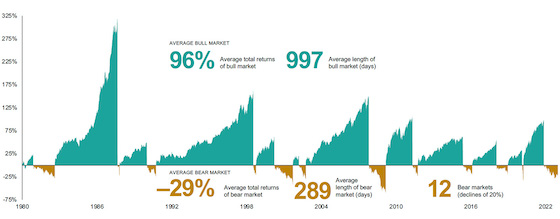
Bull market surges have been longer and stronger than the bear markets that preceded them.

Bear markets occur when a share market falls by 20 per cent or more from its most recent trading high.

Volatile economic and investment conditions caused the United States share market to fall into bear market territory in 2022. Fortunately, for most Australian investors, our broad share market managed to stay of the bear woods even though it did record an overall annual loss.

Since the start of this year the US share market has regained much of the ground it lost in 2022.

And the chart below gives a good perspective on the length of bear markets over time versus bull markets – the term used to describe when markets are rising over a prolonged period.

Bear market facts

While bear markets can be daunting, on average they have lasted much shorter than bull markets and have had far less of an effect on long-term performance.

Bear markets are challenging, but bull markets have been longer and stronger


Note: Although the downturns that began in August 1987 (related to Black Monday) and February 2020 (related to the start of the COVID-19 pandemic) don’t meet a widely accepted definition of a bear market because they lasted less than two months, we are counting them as bear markets and including them in our analysis because of their historic nature.

Past performance is no guarantee of future returns. The performance of an index is not an exact representation of any particular investment, as you cannot invest directly in an index.

Sources: Vanguard calculations, as of December 31, 2022, using the MSCI World Index from January 1, 1980, through December 3, 1987, and the MSCI ACWI thereafter. Indexed to 100 as of December 31, 1979.

From January 1, 1980, through December 31, 2022, the average length of a bull market has been nearly four times that of a bear market.

Similarly, the depth of losses from a bear market has paled in comparison with the magnitude of bull-market gains.

That’s one reason for sticking to a well-thought-out investment plan: Losses from a bear market have typically given way to longer and stronger gains.

It’s worth noting that although the downturns that began in August 1987 (related to Black Monday) and February 2020 (related to the start of the COVID-19 pandemic) don’t meet a widely accepted definition of a bear market because they lasted less than two months, we are counting them as bear markets and including them in our analysis because of their historic nature and the magnitudes of their declines.

Important information and general advice warning

Vanguard Investments Australia Ltd (ABN 72 072 881 086 / AFS Licence 227263) is the product issuer and the Operator of Vanguard Personal Investor and the issuer of the Vanguard® Australian ETFs. We have not taken your objectives, financial situation or needs into account when preparing the above article so it may not be applicable to the particular situation you are considering. You should consider your objectives, financial situation or needs, and the disclosure documents for any relevant Vanguard product, before making any investment decision. Before you make any financial decision regarding Vanguard investment products, you should seek professional advice from a suitably qualified adviser. A copy of the Target Market Determinations (TMD) for Vanguard’s financial products can be obtained at vanguard.com.au free of charge and include a description of who the financial product is appropriate for. You should refer to the relevant TMD before making any investment decisions. You can access our IDPS Guide, PDSs Prospectus and TMD at vanguard.com.au or by calling 1300 655 101. Vanguard ETFs will only be issued to Authorised Participants. That is, persons who have entered into an Authorised Participant Agreement with Vanguard (“Eligible Investors”). Retail investors can transact in Vanguard ETFs through Vanguard Personal Investor, a stockbroker or financial adviser on the secondary market. Retail investors can only use the Prospectus or PDS for informational purposes. Past performance information is given for illustrative purposes only and should not be relied upon as, and is not, an indication of future performance. This article was prepared in good faith and we accept no liability for any errors or omissions.

© 2023 Vanguard Investments Australia Ltd. All rights reserved.

Many of us have dreamed of owning a holiday home, creating an escape from the hustle and bustle of city life. Holiday homes are great for bringing family and friends together and making memories. Whether it’s a beach house or a place in the bush, it’s a place to unwind and relax. It can also be used to generate income as a short-term rental property when you’re not using it.  

If this is on your bucket list, then here are some things you need to keep in mind.

Lead with your head

Firstly, plan how you’re going to use the property and finance it. For example, if you want somewhere to escape to every weekend, can you realistically afford to buy somewhere a few hours away and keep it just for family and friends? Would you consider buying with other family members? Or would you prefer to rent it out to cover costs, and how many weeks rental would you need to rent it to become profitable?

Most holiday homes charge peak rental for school holidays, the summer break or the snow season – times when you probably want to stay there yourself. So, be honest about the trade-offs you’re willing to make.

If you would need to let your property at least part of the time, then location is key. The home will need to be easy to maintain as well as have the amenities and aesthetics that paying guests want. Including things like a BBQ, pool, ceiling fans or heating and comfortable furnishings. All of these can bump up what a rent-worthy property costs to set up and the time you need to commit to it. It’s a good idea to check out other rentals in your preferred areas to see what successful holiday lets offer and what fees they charge.

Holiday home finance is different

Lenders and the ATO view a holiday home as an investment property – whether or not you rent it out. Lenders want a bigger deposit and higher interest rate than for an owner-occupied property. While you may be able to use the equity you have in your main home for the deposit, lenders still want to see that you can service the loan. Some take proven short-term rental income from the property into account. Otherwise, they only accept long-term lease rental projections. We can review your circumstances and prepare an investment plan to help identify properties that may have a greater chance of being approved by lenders.

You can get an idea of what properties earn on sites such as Airbnb’s AirDNA.i

While it’s true short-term holiday lets could earn much higher rents, the income may not be year-round, even though the property’s ongoing expenses and upkeep are. These include extras like specialised landlord insurance, property listing website costs, regular maintenance, cleaning, utilities and the replacement of household items such as towels and kitchen items. You’ll also need to consider the current council rules for short-term lets. In some areas there are restrictions such as the number of weeks a property can be let. These rules can change and it’s the landlord’s responsibility to stay up-to-date.

Tax implications

The good news is that you can claim property-related costs as a tax deduction. If you’re only renting for part of the year, then the deductions are for the rentable period only. And, if you’re thinking of buying the property through your Self-Managed Super Fund, remember that it can only be used for maximum income generation and not family use. It’s a good idea to check with the ATO website or your accountant about the tax rules around rental income and any capital gains you’d have to pay if you sell.ii

While a holiday home can become your own piece of paradise and create many happy memories, organising how to finance it takes preparation.

Please get in touch if you’d like to chat through your options so we can start getting things organised for a successful completion on your dream holiday home.

i https://www.airdna.co/

ii https://www.ato.gov.au/Individuals/Investments-and-assets/Residential-rental-properties/rental-expenses-to-claim/

Important: This provides general information and hasn’t taken your circumstances into account. It’s important to consider your particular circumstances before deciding what’s right for you. Although the information is from sources considered reliable, we do not guarantee that it is accurate or complete. You should not rely upon it and should seek qualified advice before making any investment decision. Except where liability under any statute cannot be excluded, we do not accept any liability (whether under contract, tort or otherwise) for any resulting loss or damage of the reader or any other person.

Any information provided by the author detailed above is separate and external to our business and our Licensee. Neither our business nor our Licensee takes any responsibility for any action or any service provided by the author. Any links have been provided with permission for information purposes only and will take you to external websites, which are not connected to our company in any way. Note: Our company does not endorse and is not responsible for the accuracy of the contents/information contained within the linked site(s) accessible from this page.

It’s challenging to get a foot on the property ladder and coming up with a large enough deposit can seem like an impossible task at times. One way of increasing your savings is to boost the amount of money you have coming in.

When it comes to boosting your income, every little bit helps, so let’s look at some of the ways you can top up your savings.

Increase your earning power

The first step is to look at what you are currently earning and see if there is the potential to earn more by working overtime or by increasing your contribution or responsibilities.

Is it time to ask for a raise? With wage growth stagnating, it’s important to present a compelling argument for a salary increase. It’s not just about summoning the courage to have ‘the talk’ with your boss – you need to maximise your chances of receiving that increase. Think about how you can demonstrate where you have added value, taken on more in your role, or achieved cost or efficiency savings for the company. It might even be an idea to consider doing further study and developing additional skills that could see you increase your earning capacity.

Change jobs

The employment market has swung in favour of job seekers of late so it can be a good time to see what else is on offer as a way of increasing your income. In fact, data shows workers who move jobs received pay rises of between 8 per cent and 10 per cent, while research out of the Reserve Bank of Australia suggests a more modest 5 per cent pay rise for switching jobs is in the normal range.i

On a cautionary note – consider your overall career objectives and don’t just jump ship for more money. You don’t want to move to a higher paying job to find that it makes you miserable.

Sell or rent things you don’t need

We all have stuff lying around that we don’t need that can generate extra income and ‘one man’s trash is another man’s treasure’. Sites that are good for selling items online include Facebook marketplace, Gumtree and Ebay and you may also want to consider second hand markets in your local area or having a garage sale. Make sure you do your research and know what things are worth as you don’t want to give away a sought-after collectable for a song when it’s worth a bomb!

It’s also possible to get income from renting out your stuff you are not using. Do you have tools in the garage that someone would pay to access? Or camping equipment that others would want to use for their get-away? Australian company Releaseit provides a renting platform where you can list your items and accept booking requests from members of the public.

Take on a side hustle

A side hustle does not have to be a second job. Think about what skills you have that may be marketable. For example, are you a whizz with words? If so, you could earn some money writing cover letters and CV’s for job applicants. If you are a gardening green thumb you might be able to help others with their garden design and plant selection. Or if you are creative, selling your work on a platform like Etsy can be financially worthwhile. Even just sharing your opinion can earn you money as participating in paid market research can earn up to $100-$150 per session.ii

Boosting your income is a great way to reach your property goals faster than focusing solely on saving but saving is still an important part of getting your deposit together. Paying any extra income into a dedicated account can make sure you don’t touch it.

It’s also helpful to have a firm figure in mind to be aiming for to ensure you stay on track.

i https://www.afr.com/policy/economy/want-a-pay-rise-then-you-should-switch-jobs-20220330-p5a9ds

ii https://researchconnections.com.au/

Important: This provides general information and hasn’t taken your circumstances into account. It’s important to consider your particular circumstances before deciding what’s right for you. Although the information is from sources considered reliable, we do not guarantee that it is accurate or complete. You should not rely upon it and should seek qualified advice before making any investment decision. Except where liability under any statute cannot be excluded, we do not accept any liability (whether under contract, tort or otherwise) for any resulting loss or damage of the reader or any other person.

Any information provided by the author detailed above is separate and external to our business and our Licensee. Neither our business nor our Licensee takes any responsibility for any action or any service provided by the author. Any links have been provided with permission for information purposes only and will take you to external websites, which are not connected to our company in any way. Note: Our company does not endorse and is not responsible for the accuracy of the contents/information contained within the linked site(s) accessible from this page.