
Step one: what are your financial pain points?

When you start making plans, chances are you’ll both come across financial pain points. In other words, the areas that need some attention and possible alterations. These might include:

  • post-wedding or honeymoon debts

  • different earning capacities

  • different savings goals

  • different spending habits

  • disagreements you’ve had in the past

  • different ideas about couples bank accounts.

While it’s normal to have pain points like these, it’s important to recognise them for what they are and work on solutions.

Step two: separate individual goals from couple goals

While you’ll both have personal savings goals, it’s a good idea to talk about what these are and why they’re important to you.

This will help you work on them, without compromising the goals you have as a couple. Examples of couple goals include:

  • buying a home together

  • renovating your home

  • buying an investment property

  • travelling or moving overseas.

Step three: create an action plan

With a better grip on your financial pain points and the goals you both want to achieve, it will be easier to start making practical plans.

Just like working with wedding planning list, setting out a clear timeline can help you visualise your goals, and importantly, make sure you’re staying realistic about how and when you’ll achieve them.

It could be worth talking to us. We can help you set up the timelines and look at ways of boosting your goals.

Keeping motivated is important, but this often takes incentive. You could set up a separate bank account, that has good interest rates and bonuses. You might also want to consider a term deposit. These savings products offer fixed, competitive interest rates and you can choose a term to suit your needs.

You may also consider whether you want a joint account when opening a new savings account as a couple.

When you hit your milestones, there’s no harm in rewarding yourself. A nice dinner or weekend away can remind you that your couple goals are worth achieving.

Using an online budget planner will help you find out where you can save money, as well as how much. MoneySmart’s savings goals calculator is also a great tool to keep you on track.

Step four: get things moving

You may have already opened up a savings account, but have you thought about applying for a personal loan?

With the right repayment plan in place, personal loans can help you achieve those bigger financial goals, such as paying for the costs of starting a family, moving overseas, or even paying off the engagement ring.

If you’re looking at property instead, it’s best to start the conversation with your lender soon, so you can figure out how much you can afford and where you want to live.

When you apply for a home loan, you’ll want to be prepared. Banks and lenders take into consideration a lot of factors before they decide to approve applications. But the more organised you are, the easier it will be to get things moving.

For more budgeting tips, call us today.

Source: NAB

Reproduced with permission of National Australia Bank (‘NAB’). This article was originally published at https://business.nab.com.au/

National Australia Bank Limited. ABN 12 004 044 937 AFSL and Australian Credit Licence 230686. The information contained in this article is intended to be of a general nature only. Any advice contained in this article has been prepared without taking into account your objectives, financial situation or needs. Before acting on any advice on this website, NAB recommends that you consider whether it is appropriate for your circumstances.

© 2023 National Australia Bank Limited (“NAB”). All rights reserved.

Important:
Any information provided by the author detailed above is separate and external to our business and our Licensee. Neither our business nor our Licensee takes any responsibility for any action or any service provided by the author. Any links have been provided with permission for information purposes only and will take you to external websites, which are not connected to our company in any way. Note: Our company does not endorse and is not responsible for the accuracy of the contents/information contained within the linked site(s) accessible from this page.


It has been a wild ride for the Australian dollar since the Covid-19 pandemic struck and that could mean good news or bad news for your investment portfolio.

In March 2020 the Aussie dipped below US58 cents for the first time in a decade. Since then, a high of just over US77 cents in 2021 has been followed by a rollercoaster ride, mostly downhill.

In October 2022 the dollar plummeted to US61.9 cents, bounced its way back up to US71.3 cents in February this year but by mid-August it had slipped to a nine-month low at under US64 cents.i

Many analysts agree that further falls are on the cards with some even predicting the dollar could fall to as low as US40 cents within five years.ii

What’s driving the dollar?

Given any currency’s susceptibility to changing economic conditions both at home and overseas, the Aussie has had quite a bit to deal with lately.

Rising interest rates can boost the Australian dollar by making us more attractive for foreign investors, providing our rates are rising ahead of the US and others.

If foreign investors buy more Australian assets because they can get a bigger return on their investment, more money flows into Australia which increases demand for Australian dollars. And if investors hold more Australian assets than overseas ones, less money leaves the country, decreasing supply. So, increased demand and decreased supply see the Australian dollar rise.

While the Reserve Bank of Australia (RBA) has increased rates by 4 per cent in Australia since May last year as it battles to get inflation under control, rates have also been rising in the US.

The US Federal Reserve has undertaken its most aggressive rate-rising cycle in 40 years with rates now at a 22-year high and signs of further increases likely. This has put pressure on the Australian dollar, narrowing the difference between the US and Australian rates, meaning foreign investors will look for better returns elsewhere.

Changing economic conditions

The value of the Australian dollar is also affected by changes in economic conditions as well as rises and falls in other financial markets. For example, in August news that the unemployment rate had increased slightly and an easing in wage price growth led to speculation that the RBA would put a hold on rates, putting a dampener on the Aussie.

Also affecting the dollar was a decline in US share markets in August, confirming the typical pattern of falls in the Australian dollar when prices in equity markets drop.

Meanwhile, the performance of China’s economy plays a significant part in Australian dollar movements. China is currently battling soaring unemployment, particularly among young people, falling land prices and a housing crisis, among other ills.

As Australia’s largest trading partner, both in terms of imports and exports, any slowdown in China means lower sales of our commodities and other goods and services and less investment in property and business.iii

How the dollar affects us

There are advantages and disadvantages of a falling Australian dollar. On the plus side, our exports will be more competitive because our customers will pay less for our goods and services compared with those produced overseas. Conversely, imported goods will be relatively more expensive.

There could also be an increase in tourism – the cost of travel in Australia will be cheaper for those coming from overseas. Unfortunately, those planning an overseas trip will need to find a significantly greater pile of Australian dollars to pay for airfares, accommodation and shopping.

For investors, it is a useful exercise to review the currency’s effect on your portfolio.

For example, if you’re invested in Australian companies that rely on overseas earnings, look at how they handle their exposure to the currency risk. A lower dollar is good news for those with overseas operations and those that export goods. On the other hand, those that need to buy in components or products from overseas may suffer.

In any case, have a chat to us to look at the best way forward in these uncertain times.

i https://tradingeconomics.com/australia/currency
ii https://www.news.com.au/finance/markets/australian-dollar/aussie-dollar-in-free-fall-amid-bloodbath/news-story/929165d65db4dc7d8a97bc7b27b5ab0d
iii https://www.aph.gov.au/about_parliament/parliamentary_departments/parliamentary_library/

Important: This provides general information and hasn’t taken your circumstances into account. It’s important to consider your particular circumstances before deciding what’s right for you. Although the information is from sources considered reliable, we do not guarantee that it is accurate or complete. You should not rely upon it and should seek qualified advice before making any investment decision. Except where liability under any statute cannot be excluded, we do not accept any liability (whether under contract, tort or otherwise) for any resulting loss or damage of the reader or any other person.

Any information provided by the author detailed above is separate and external to our business and our Licensee. Neither our business nor our Licensee takes any responsibility for any action or any service provided by the author. Any links have been provided with permission for information purposes only and will take you to external websites, which are not connected to our company in any way. Note: Our company does not endorse and is not responsible for the accuracy of the contents/information contained within the linked site(s) accessible from this page.

One of the biggest challenges first home buyers face at present is saving for a decent deposit. While there are definitely some advantages to buying as a couple compared to on your own, pooling your savings for a deposit can put a strain on even the most solid relationship.

So here are some tips to help you into your own home, while keeping the harmony in your relationship.

Working together on the three ‘C’s’

Getting a deposit together is all about saving as much as possible, keeping in mind that you will most likely be earning different amounts and have distinct approaches to managing your money. Focussing on the three c’s, communication, compromise and setting common goals, can help you maintain a healthy and happy relationship while you are saving for your own home.

Communication

The key is to keep talking. Communication is critical but it’s also important to know the type of conversations you need to have about money and your goals for home ownership, can bring up strong emotions. It’s Ok to call time out if it’s getting heated and pick up the chat another day when you are both feeling calmer.

Then make sure you come together regularly to look at and discuss how your finances are going.

Compromise

It can be hard to reach agreement about your plans to achieve your goal, a little give and take can make things easier. You can start by understanding where the other person is coming from. ‘Money values’ are often hard to shift and formed in childhood, so a little empathy can go a long way.

If one person is a spender and the other a saver, find ways you can both compromise to avoid friction in your relationship. The saver in the relationship may need to relax the reins a little from time to time to have some fun, and the spender may need to make some sacrifices to achieve your common goal of owning your own home.

Common goals

Keep in mind what you are doing this for – keep the focus on your final goal of picking up your keys and walking together through the door of your own home. While that’s the ultimate goal you share, there are other considerations you need to make sure you are on the same page about.

Thinking about what you are both looking for in a property, what areas you are interested in buying in and what you are likely to have to spend, will help you decide your budget for your purchase and how much you’ll need to save for a deposit. Another consideration is how much lenders will let you borrow and that’s where we come in.

In terms of how much you need as a deposit, most borrowers try to save 20% of the property purchase price to avoid paying lender’s mortgage insurance. For example, if you wanted to buy a $750,000 property, you’d need to come up with $150,000 to complete the required deposit.

Another aspect to consider is your timeframe for coming up with the deposit. While it’s understandable you are impatient to buy as soon as possible, it’s important to be realistic about how long it will take you to save the required amount.

Knowledge is power

Having a clear understanding of your financial situation will help you work out what is achievable. This is a time for you both to put all of your cards on the table. It’s important that both of you know your outgoings and where your money is being spent to help you cut costs or find ways you could earn a little more to help with your deposit. It’s also important to reduce existing debt and also look at your respective credit scores to see if anything can be done to improve them.

Think about the best way to structure your financials. While it’s usual that managing the household finances and paying bills will fall largely to one person in the relationship, it is important that both parties are involved in the planning and setting up of accounts and setting up budgets for savings targets.

Your also need to consider what government grants might be available to you and the best loan structure for your needs. Contact us today to discuss how we can help with the finance side of things.

And remember – you’re in this together, and together you’ve got this! 

Important: This provides general information and hasn’t taken your circumstances into account. It’s important to consider your particular circumstances before deciding what’s right for you. Although the information is from sources considered reliable, we do not guarantee that it is accurate or complete. You should not rely upon it and should seek qualified advice before making any investment decision. Except where liability under any statute cannot be excluded, we do not accept any liability (whether under contract, tort or otherwise) for any resulting loss or damage of the reader or any other person.

Any information provided by the author detailed above is separate and external to our business and our Licensee. Neither our business nor our Licensee takes any responsibility for any action or any service provided by the author. Any links have been provided with permission for information purposes only and will take you to external websites, which are not connected to our company in any way. Note: Our company does not endorse and is not responsible for the accuracy of the contents/information contained within the linked site(s) accessible from this page.

Key points:

  • The Intergenerational Report 2023 released by Treasury gave Australians insight into the national economy from 2023 until 2062 – 2063

  • The care and support sector and its workforce were projected to double over the next 40 years

  • The paid workforce participation rate was expected to dip from 66.6 percent to 63.8 percent, due to the population continuing to age

The national economy is expected to feel the effects of Australia’s ageing population by the year 2063, according to a newly published Report by the Federal Treasury.

  • The number of Australians aged 65 and over will more than double by 2063

  • The number of people aged 85 and over will more than triple

  • The number of centenarians is expected to increase six-fold

Although the average life expectancy age is projected to increase in Australia, the rate of increase will grow at a slower rate than in previous years. Life expectancies at birth were 81.3 years for men and 85.2 years for women in the 2022 – 23 period and are expected to be 87.0 years for men and 89.5 years for women by 2062 – 63. Modern medicine and technology will see men live 24.7 years longer after turning 65 and women are tipped to live for a further 26.2 years after making it to 65.

Additionally, the 2020 to 2021 period saw the lowest population growth rate in Australia, breaking a 100-year record, with 0.1 percent growth due to the COVID-19 pandemic. 

The Intergeneration Report reflected the increasing demand for aged care and support as a result of an older population, living longer with reduced national paid employment participation.

Council on the Ageing Australia, the peak advocacy group for older Australians, expressed that the Government needed to include people from every generation in planning for the future. Patricia Sparrow, chief executive officer of COTA Australia, said “[…] we have to value and harness the wisdom and experience” that comes from living older, healthier lives.

“There are legitimate discussions to be had around housing, health and other issues but we won’t get a better deal for all Australians by excluding older people from the economy and the community,” Ms Sparrow said. 

“This presents us with a policy design challenge to ensure we harness older people to support the growth and improvements of our nation.

“Older Australians are a resource with valuable expertise and expertise that can and should be shared. Without harnessing that we’re robbing every generation.”

The Report predicted the care sector would account for approximately 15 percent of the nation’s gross domestic product, commonly referred to as GDP, by 2062 – ‘63 — an increase of seven percent from the eight percent GDP in 2023.

The Report noted that future increases to productivity, especially in the services sector, would be crucial to strong economic growth over the coming years. Something which Ms Sparrow said is possible through rethinking the role of older people in the workforce.

“Older people can and do continue to contribute to the economy. However, ageism keeps older people who want to work out of our workforce. Addressing ageism will assist older Australians [to] make the meaningful contribution they want to.”

Visit the Federal Treasury Intergenerational Report 2023 report in full online and let us know your thoughts on the economic impact of ageing. Will you be working in 2062 – 2063? If so, the editorial team at Talking Aged Care will continue to be your source of news for the next forty years.

Source:
This article was originally published on https://www.agedcareguide.com.au/talking-aged-care/how-an-ageing-population-permanently-changed-the-australian-economy
. Reproduced with permission of DPS Publishing.

Important:
This provides general information and hasn’t taken your circumstances into account.  It’s important to consider your particular circumstances before deciding what’s right for you. Although the information is from sources considered reliable, we do not guarantee that it is accurate or complete. You should not rely upon it and should seek qualified advice before making any investment decision. Except where liability under any statute cannot be excluded, we do not accept any liability (whether under contract, tort or otherwise) for any resulting loss or damage of the reader or any other person. 

Any information provided by the author detailed above is separate and external to our business. Our business does not take any responsibility for any action or any service provided by the author. Any links have been provided with permission for information purposes only and will take you to external websites, which are not connected to our company in any way. Note: Our company does not endorse and is not responsible for the accuracy of the contents/information contained within the linked site(s) accessible from this page.
Iron ore has been the backbone of the Australian economy and many investment portfolios for much of the 21st century. Export of the commodity saw Australia evade recession both in the wake of the Global Financial Crisis back in 2008 and the Covid epidemic.

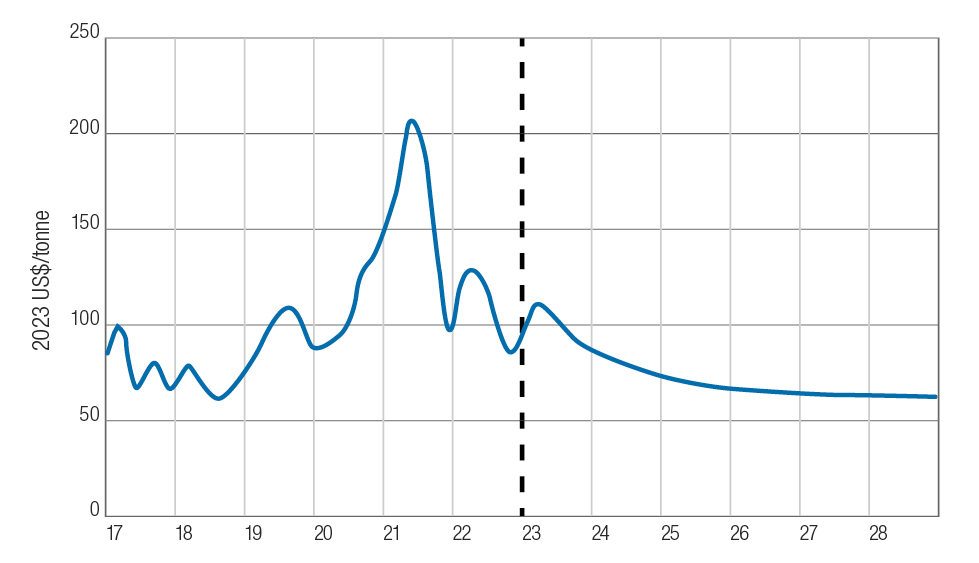
In 2021, resources accounted for 68 per cent of Australia’s export revenue. This was the year that iron ore prices peaked at almost $US230 a tonne.i

Large quantities of iron ore were discovered in Australia as far back as 1822 in Tasmania. However, its growth as an export icon really took off with the first shipment of iron ore from the Pilbara in Western Australia in 1966.

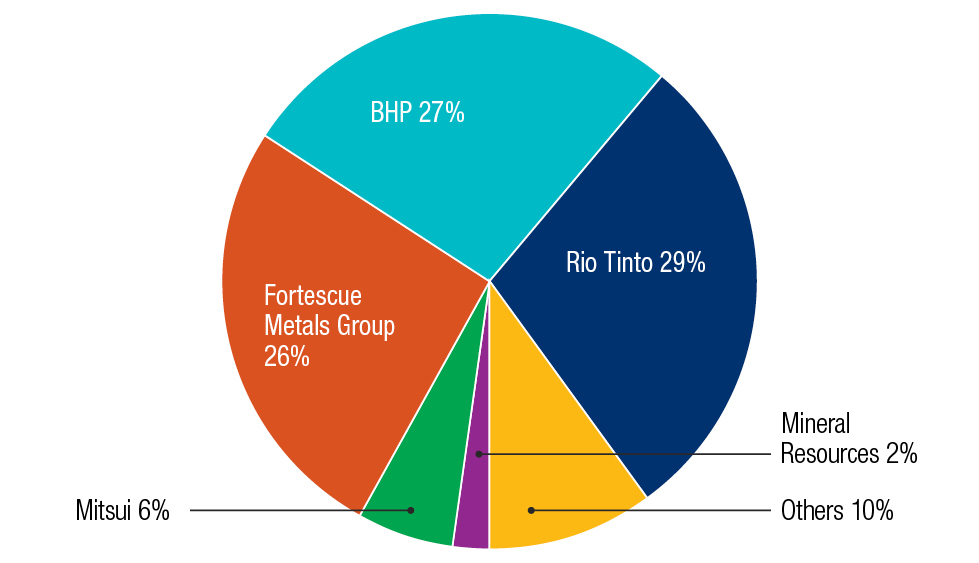
Today there are three major companies that mine iron ore in Australia – BHP, Rio Tinto and Fortescue Minerals. Considered blue chip stocks, they are often favourites with investors and their share price performance is linked to iron ore prices. Together, these miners are responsible for 76 per cent of production in Western Australia and contribute to 38 per cent of global production.ii

Share of iron ore production by company, 2021

Source: GlobalData’s Australia Iron Ore Mining to 2026 report

Iron ore’s importance worldwide stems from its use in steel, a key material used in infrastructure, housing and manufacturing equipment globally. Manufacturing includes such things as cars, ships, trains, trucks and pipelines. Iron ore is also used in cast iron and stainless steel which in turn have many applications.

China’s role

The main recipient of Australia’s iron ore is China. In 2022 China bought 1.1 million tonnes of iron ore, 65 per cent of which came from Australia.iii

The driving force powering this demand was the urbanisation and industrialisation of China. China actually produces more iron ore than Australia but it is at a much lower grade.

No wonder, Australia has been riding on iron ore’s back.

While demand is still high in China, Covid put a dampener on its economic growth when the country basically shut down for an extended period. Its strict measures did not start to roll back until December 2022 and investors began to worry.

While economic activity is slowly resuming, it has reduced significantly from its heady days. As a result, demand for iron ore has also fallen.

This has seen the price of iron ore drop to around the $US100 a tonne mark from its $US230 million peak in 2021.

Although China’s economy is not performing as energetically as it did a decade ago, Premier Li recently told the World Economic Forum that it was rolling out more measures to boost domestic demand.iv

This has triggered some optimism among market watchers, although there are still bears around who are more circumspect.

Global demand

It is not only in China where demand for iron ore is falling. The rest of the world is wrestling with recession and that too has put a dampener on the market.

Added to this slowdown in demand is the move to increase supply. The major Australian producers and Brazil’s Vale Mining have all got new projects and expansions on the horizon.v

Luckily, iron ore is relatively cheap to mine in Australia, costing Rio Tinto and BHP $US30 a tonne to produce, which means they are somewhat sheltered from price fluctuations. While Rio Tinto and BHP can remain profitable with prices dropping as low as $US60, lower prices will have a flow on effect, impacting superannuation balances, investor returns and the broader economy.vi

Iron ore price outlook, quarterly

Source: Bloomberg (2023), Department of Industry, Science and Resources (2023)

Impact on the economy

Unfortunately, lower profits mean the Australian Tax Office will also receive significantly lower revenue and that in turn will impact on the Australian economy.

While profits are still boosting the government’s coffers, the outlook is less bright.

Tax revenue from iron ore has made a significant contribution to the robustness of the Australian economy and has been a key reason for the recent return to surplus in the federal budget after 15 years of deficits.

In fact, the federal government is expecting the surplus in 2022-23 to be a whopping $19 billion, significantly higher than the $4.2 million original forecast in the May Budget. Not all that growth is attributed to strong commodity prices, but they have certainly played a part.vii

Nevertheless, the domestic economy is still expected to slow as high inflation and global challenges make their mark.

Budget papers estimate that a $US10 per tonne increase in the Commonwealth’s assumed price for iron ore exports is expected to result in an increase in tax receipts of around $500 million in both 2023-24 and 2024-25.viii

But the federal government is still cautious about the economic outlook for Australia and are forecasting a return to a budget deficit and the possibility of a recession as the move to higher interest rates puts brakes on the economy.

Aside from economic performance, any reduction in revenue for the mining companies will also translate into lower dividends and lower price growth for investors.

But despite some bearish sentiment in the market including the growing number of institutional and individual investors steering clear of mining stocks over ethical and environmental concerns, there is no denying that iron ore is still a big money spinner.

If you would like to discuss options for investment in the current economic climate, then give us a call.

i https://minerals.org.au/resources/record-high-for-resources-export-revenue/
ii https://www.mining-technology.com/data-insights/iron-ore-in-australia-2
iii https://edition.cnn.com/2023/05/05/economy/australia-china-exports-record-intl-hnk
iv https://www.reuters.com/world/asia-pacific/chinas-growth-be-higher-q2-projected-hit-annual-5-target-premier-li-2023-06-27/
v https://www.mining.com/iron-ore-price-expected-to-ease-over-next-5-years-on-slower-demand-growth-and-more-supply/
vi https://www.abc.net.au/news/2023-05-30/australian-iron-ore-boom-ending-after-china-rift/102408002
vii https://www.theguardian.com/business/2023/jun/30/australia-budget-surplus-swells-to-19bn-due-to-surging-tax-revenue
viii https://www.watoday.com.au/politics/western-australia/how-wa-s-resource-riches-helped-deliver-the-first-budget-surplus-in-15-years-20230509-p5d725.html

Important: This provides general information and hasn’t taken your circumstances into account. It’s important to consider your particular circumstances before deciding what’s right for you. Although the information is from sources considered reliable, we do not guarantee that it is accurate or complete. You should not rely upon it and should seek qualified advice before making any investment decision. Except where liability under any statute cannot be excluded, we do not accept any liability (whether under contract, tort or otherwise) for any resulting loss or damage of the reader or any other person.

Any information provided by the author detailed above is separate and external to our business and our Licensee. Neither our business nor our Licensee takes any responsibility for any action or any service provided by the author. Any links have been provided with permission for information purposes only and will take you to external websites, which are not connected to our company in any way. Note: Our company does not endorse and is not responsible for the accuracy of the contents/information contained within the linked site(s) accessible from this page.
If you find a transaction in your account that you don’t recognise, it could be unauthorised or mistaken.

If you think something is wrong, contact your bank as soon as possible.

Signs of unauthorised and mistaken transactions

An unauthorised transaction is when someone transfers money from your account without your permission.

mistaken transaction is when when you pay the wrong person or company by using the wrong bank details.

When you check your accounts, look for payments or withdrawals you don’t recognise, such as:

  • a payment to a person or company you don’t know

  • a cash withdrawal from a place you’ve never been

  • a transaction on a date when you didn’t use your account

  • a payment made twice

When you check transactions, keep in mind:

  • Transactions can take days to show up in your account. If you buy something on a weekend, the transaction might appear the next week.

  • The name of the shop or restaurant might not match the name on your bank statement. Check the business and trading names online.

How to get your money back

If you find something wrong, contact your bank as soon as possible.

The sooner you contact your bank, the more likely you are to get your money back — and if the transaction is unauthorised, the sooner the bank can stop any further transactions.

When you report a mistaken or unauthorised transaction, make sure the bank gives you a reference number. This will help if you to need to contact them again.

If an unauthorised or mistaken transaction occurs on your personal account, and your bank has signed up  to ASIC’s ePayments code, they have to take steps to help you.

Mistaken transactions

You are likely to get your money back if it is still in the recipient’s account and if you report it to your bank:

  • within 10 business days

  • after 10 business days — but it will take longer to get your money back

  • after seven months — if the recipient agrees to the refund

Unauthorised transactions

You are more likely to get your money back if:

  • a forged, expired, blocked or cancelled card was used

  • a bank employee or a seller made the transaction fraudulently

  • the transaction took place before you received your card, PIN or password

  • a seller incorrectly debited your account more than once

  • the transaction took place after you told your bank that your card was lost or stolen

  • the transaction took place after you told your bank that someone else may know your PIN or password

  • it’s clear that you haven’t contributed to the loss

You are less likely to get your money back if you:

  • acted fraudulently

  • didn’t keep your PIN or password secret

  • unreasonably delayed telling your bank that your card was lost or stolen

  • unreasonably delayed telling your bank that someone else may know your PIN or password

  • accidentally left your card in an ATM

Protect yourself

Check your bank statements regularly, and get familiar with the different types of transactions in your account. This can make it easier to spot a mistake.

Source:
Reproduced with the permission of ASIC’s MoneySmart Team. This article was originally published at https://moneysmart.gov.au/banking/unauthorised-and-mistaken-transactions

Important note: This provides general information and hasn’t taken your circumstances into account.  It’s important to consider your particular circumstances before deciding what’s right for you. Although the information is from sources considered reliable, we do not guarantee that it is accurate or complete. You should not rely upon it and should seek qualified advice before making any investment decision. Except where liability under any statute cannot be excluded, we do not accept any liability (whether under contract, tort or otherwise) for any resulting loss or damage of the reader or any other person.  Past performance is not a reliable guide to future returns.

Important
Any information provided by the author detailed above is separate and external to our business and our Licensee. Neither our business nor our Licensee takes any responsibility for any action or any service provided by the author. Any links have been provided with permission for information purposes only and will take you to external websites, which are not connected to our company in any way. Note: Our company does not endorse and is not responsible for the accuracy of the contents/information contained within the linked site(s) accessible from this page.

Preparing to retire is emotional and practical. Making a retirement plan can help you manage your finances, and cope better as your life and priorities change.

Make a retirement plan

Your retirement plan can be simple or detailed. Include:

  • Timing — when you want to retire. This could change, but it’s good to have a starting point.

  • Lifestyle and priorities — prioritise what matters most. For example, social activities and staying active, continuing or changing work, where you will live.

  • Income and living costs — estimate your daily living costs. Do a budget to prioritise your spending. Work out how much income you’ll have, and from where.

  • Plan for the future — if you can, boost your retirement income by contributing more to your super. Decide how to pay off your mortgage or other debts, and build a savings buffer. Check you have an up-to-date will and powers of attorney.

Think about when you want to retire

There’s no set age you need to be to retire. It will depend on your health, work options, finances and personal situation.

Are you retiring in ten years, two to five years, or next year? If you have a partner, when will they retire? Knowing how much time you have helps you make a retirement plan.

Talk about your retirement priorities with a partner, colleague or friend. If you need professional advice to plan for retirement, speak to us.

Consider your lifestyle and priorities

Set your priorities

Think about what your lifestyle will look and feel like. What are the things that matter most?

Consider:

  • your living costs

  • social life and recreation

  • staying active and healthy

  • volunteering or community participation

  • planning for changing health needs or aged care

  • supporting your family, children or grandchildren (if any)

Keep working, reduce hours or retrain

Continuing to earn an income, even part-time, can help your retirement savings last longer. If you want to keep working, options include:

  • Job Switch — explore options to retrain or seek part-time work

  • Transition to retirement — if you’ve reached your preservation age, you can use some of, and keep contributing to, your super while working

  • Work Bonus — if you get the Age Pension, you can earn up to $300 per fortnight from work before your pension payment reduces

Plan where you will live

If you own your home:

  • If you still have a mortgage, you could use some of your super (when available) to pay it off.

  • Consider downsizing to free up money. You could pay off your mortgage, support your lifestyle, or relocate to be closer to family or services. Before going ahead, check the tax impact and whether it will affect your government benefits.

If you’re renting:

  • You may be eligible for an extra payment if you rent and get payments from Centrelink, like the Age Pension. To find out more, see rent assistance on the Services Australia website.

Work out your income and living costs

How much money you’ll need for living costs in retirement depends on your lifestyle priorities and what you can afford.

For most people, your retirement income will be a combination of superannuation and the Age Pension. If you don’t have much super, you may be more reliant on the pension. If you do have super, think about how and when to withdraw it. You may also have some savings or investments.

Work out your living costs

Consider:

  • Housing — rent or mortgage, rates, home and contents insurance, maintenance

  • Utilities — electricity, gas, water, phone, internet, streaming services

  • Food — fresh food, groceries, takeaway, dining out

  • Clothing and household goods — clothing, personal care, furniture, household appliances

  • Health and leisure — health insurance, health care, social activities, fitness, holidays, gifts

  • Transport — car registration, insurance and running costs, public transport

As a rule of thumb, try allowing for two thirds of your current living costs. This is a useful guide, that assumes reduced costs for work and that you’ve paid off your mortgage.

Your spending may be higher when you first retire. For example, if you plan to travel or update your home. You may also need to allow more for health care as you get older.

Get your super income

You can get your super when you retire and reach your ‘preservation age’. That is between 55 and 60, depending on when you were born.

When you are eligible to withdraw your super, your main options are:

  • an account-based pension

  • an annuity

  • a lump sum

  • or a combination of these

You could also consider a transition to retirement strategy. You can use some of, and keep contributing to, your super while working.

Contact your super fund to discuss your options.

Claim government benefits

From age 67 (or earlier, if born before 1957), you may be eligible for government benefits such as:

  • Age Pension

  • Pensioner concessions

  • Health care benefits

  • Tax offsets

For questions about government benefits, call Centrelink’s older Australians line on 132 300. Ask to speak to a Financial Information Service (FIS) officer (for free). The helpline is open Monday to Friday, 8:00am to 5:00pm.

Add in savings and investments

If you have money in savings, this could top up your retirement income.

If you have investments like shares or investment property, think about whether to keep or sell. Check the costs, tax impact and whether it will affect your government benefits.

Plan for the future

Grow your income

If you can, consider contributing more to your super. 

Save for an emergency

Save an emergency fund to give yourself a safety net for unexpected bills like repairs or medical costs.

Pay off debt

If you have a mortgage or other debts, consider how best to pay them off. For tips on how to do this, see get debt under control.

Make an estate plan

Decide what you want done with your assets when you die. Check you have an up-to-date will and powers of attorney, and a nominated beneficiary for your super.

Get help if you need it

  • To get advice about your super income options, contact us or talk to your super fund.

  • For questions about government benefits or retirement, call Centrelink’s older Australians line on 132 300. Ask to speak to a Financial Information Service (FIS) officer (for free). The helpline is open Monday to Friday, 8:00am to 5:00pm.

  • To get professional advice on planning for retirement, speak with us.

  • For help with tax matters, contact a tax professional.

Source:
Reproduced with the permission of ASIC’s MoneySmart Team. This article was originally published at https://moneysmart.gov.au/retirement-income/prepare-to-retire

Important note: This provides general information and hasn’t taken your circumstances into account.  It’s important to consider your particular circumstances before deciding what’s right for you. Although the information is from sources considered reliable, we do not guarantee that it is accurate or complete. You should not rely upon it and should seek qualified advice before making any investment decision. Except where liability under any statute cannot be excluded, we do not accept any liability (whether under contract, tort or otherwise) for any resulting loss or damage of the reader or any other person.  Past performance is not a reliable guide to future returns.

Important
Any information provided by the author detailed above is separate and external to our business and our Licensee. Neither our business nor our Licensee takes any responsibility for any action or any service provided by the author. Any links have been provided with permission for information purposes only and will take you to external websites, which are not connected to our company in any way. Note: Our company does not endorse and is not responsible for the accuracy of the contents/information contained within the linked site(s) accessible from this page.
1. Try a working bee

What better excuse to have a barbecue than with a working bee? Get family, friends, neighbours and co-workers together to turn mundane jobs into an afternoon of fun (and toil). Get them painting bedrooms, polishing decks or hammering shelves—while you repay them with a drink and a BBQ.

2. Check out display homes

It’s one thing having an idea in your head—it’s quite another when you see it in front of you. A little known fact about display homes is that when they’re sold, so is the furniture. That’s right—premium furniture and accessories sold at heavily reduced prices. Don’t forget to leave your email address with the builders so you don’t miss their sales.

3. Check out the flash new buildings in town

Most of these establishments hire architects and interior decorators which are beyond the budgets of most of us. But scribbling down a few ideas from a new restaurant or bar is free.

4. Barter at garage sales

It’s amazing what people get rid off. Items are a fraction of the retail cost, people are desperate to sell and haggling is expected. Find sales through your local newspaper, or keep an eye out for posters stuck on lamp posts around your neighbourhood.

5. Visit trade fairs

Trade fairs take place all over Australia at different times of the year. Sellers showcase their goods and buyers get the chance to buy stuff at cost price. Be mindful that some fairs require you to have a business registration, or work in that particular trade.

6. Hire a handy-person

They’re inexpensive, experienced and perfect for all manner of odd jobs. Especially the one’s you’ve been putting off because you don’t have the time or skills to complete them. Get your handyperson to build a shed, mount a shelf, or paint a room perhaps.

7. Choose the right season of the year

When travelling, saving money means avoiding peak seasons like Christmas, Easter and school holidays and the same rules apply for renovations. For instance, if you’re planning to install air conditioning, do it in winter when demand is low.

8. Buy from alternative markets

Do flea markets, trash and treasure and car boot sales sound familiar? They’re like garage sales, but on a mighty scale. People gather in large halls or vacant outdoor areas to sell their unwanted goods. Most items are second hand, some even faulty (be careful), but they’re super cheap.

9. Get help from family, friends and online marketplaces

You can ask your family and friends to lend you their time to complete renovation jobs. They may even have equipment you can use instead of having to buy it brand new. If you have to buy, you can look for cheaper options like buying things second-hand.

10. Wait for hard collections

Twice a year some local councils invite residents to throw out large items that can’t be accepted in weekly collections. People ditch all sorts of stuff like mattresses, beds, wood, white goods and appliances. Before you start lugging an oversized piece of wood over your shoulder, just remember to ask permission from the owner (and don’t pick up anything that has a council sticker on it).

11. Buy from a tip

We don’t want you to scavenge through the trash — but instead visit the tip’s shop-front. Some pretty cool stuff gets reused and sold there. You’ll find recycled household material and plants, which means your landscaping might cost you a few gold coins instead of a few hundred bucks.

Source: NAB

Reproduced with permission of National Australia Bank (‘NAB’). This article was originally published at https://business.nab.com.au/

National Australia Bank Limited. ABN 12 004 044 937 AFSL and Australian Credit Licence 230686. The information contained in this article is intended to be of a general nature only. Any advice contained in this article has been prepared without taking into account your objectives, financial situation or needs. Before acting on any advice on this website, NAB recommends that you consider whether it is appropriate for your circumstances.

© 2022 National Australia Bank Limited (“NAB”). All rights reserved.

Important:
Any information provided by the author detailed above is separate and external to our business and our Licensee. Neither our business nor our Licensee takes any responsibility for any action or any service provided by the author. Any links have been provided with permission for information purposes only and will take you to external websites, which are not connected to our company in any way. Note: Our company does not endorse and is not responsible for the accuracy of the contents/information contained within the linked site(s) accessible from this page.

What is the First Home Owner Grant?

The FHOG was introduced by the Federal Government in 2000 to assist first home buyers with purchasing a home. Since then, the rules around it have repeatedly changed.

While the FHOG is a national scheme, it’s funded by the states and territories—and administered by each of them individually. So each state or territory tweaks its own FHOG rules pretty much every year.

We’ll look at some general principles of the FHOG, the intention behind it and then look at the eligibility rules. We’ll also show you where to find more information depending on the state or territory you live in.

What you need to know about the First Home Owner Grant

Introduced to offset the effect of GST on house ownership, the FHOG has evolved into an economic stimulus tool. It generally changes to reflect housing affordability, and can change quickly and often.

How much is the First Home Owner Grant?

The Federal Government has a portal to the relevant FHOG page where you can find out how much the FHOG is in each state and territory. You can find out for example, how much the home buyers grant is in WA, Victoria and Queensland, as well as the other states and territories.

The FHOG has undergone changes over the years and varies a great deal from state to territory to state. This home buyer grant is now aimed squarely at new builds. The FHOG can be worth between $10,000 and $15,000 in most cases.

Who gets the FHOG?

Again, each state and territory has its own rules, but the following conditions generally apply:

  • it’s only available to first home buyers. You – and your spouse or partner – can’t have owned property before

  • you can only receive the grant once

  • you must be an Australian citizen or permanent resident (may vary by state or territory)

  • you must be a ‘natural’ person (in other words, a real human, not a company or a trust)

  • you must live in the house for at least six months once it’s built

  • most states and territories have a minimum age requirement (usually 18)

  • maximum purchase price is between $575,000 and $750,000 (depending on state or territory)

  • in almost every instance, the property must be either new or ‘substantially renovated’ (i.e. much more than just a new kitchen).

Check to see if you’re eligible.

Do concessions apply?

You’ll need to check the rules for your state or territory, but you could be eligible for:

  • discounts on stamp duty – some states and territories can waive or discount stamp duty up to some property price limits

  • regional property concessions – you may be eligible for a larger grant if buying or building in regional areas, or even a larger discount on stamp duty

  • the Home Guarantee Scheme*.

* Formerly First Home Loan Deposit Scheme

When will the grant be paid?

Once again, each state and territory has their own rules so you’ll need to check out the sites above. But generally, the grants are paid out under these conditions:

  • established home: payment will be made on settlement

  • contract to build: grant paid to the builder with the first progress payment

  • new home: payment at settlement

  • purchase off the plan: payment at settlement.

We know that the home loan process can be daunting. When the time comes, don’t feel like you have to do it on your own – call us. 

How do I apply for the FHOG?

To apply for the FHOG, you can:

  • lodge the application yourself through your state or territory authority

  • ask your home loan provider to lodge the application for you.

Source: NAB

Reproduced with permission of National Australia Bank (‘NAB’). This article was originally published at https://www.nab.com.au/personal/life-moments/home-property/buy-first-home/first-home-owner-grant

National Australia Bank Limited. ABN 12 004 044 937 AFSL and Australian Credit Licence 230686. The information contained in this article is intended to be of a general nature only. Any advice contained in this article has been prepared without taking into account your objectives, financial situation or needs. Before acting on any advice on this website, NAB recommends that you consider whether it is appropriate for your circumstances.

© 2023 National Australia Bank Limited (“”NAB””). All rights reserved.

Important:

Any information provided by the author detailed above is separate and external to our business and our Licensee. Neither our business nor our Licensee takes any responsibility for any action or any service provided by the author. Any links have been provided with permission for information purposes only and will take you to external websites, which are not connected to our company in any way. Note: Our company does not endorse and is not responsible for the accuracy of the contents/information contained within the linked site(s) accessible from this page.”

If you are saving for a long-term goal, it can feel like you have to miss out on things such as travel to keep your savings on track. That’s not necessarily the case, it is possible to have a fantastic holiday without breaking the bank or derailing your savings plans.

Let’s face it, cost of living pressures are being felt everywhere in our day-to-day budgets but even more so when it comes to things like flights and accommodation. While airfares have fallen from the historic highs experienced in early 2023, they are still pretty pricy, and with booming demand for accommodation, comes equally high prices.

If you want to get away for a holiday but don’t want to break the budget, here are some ideas to help you keep costs down when you travel.

Plan ahead for the best deals

While it’s lovely to head out of town on a whim, being spontaneous can be expensive. The sweet spot for international travel according to Skyscanner’s data is 22 weeks in advance but be aware that it varies from city to city. For domestic travel it’s also best to be prepared as the best bargains can be had 21 weeks in advance.i

Flights are often more expensive around school holidays and different destinations are pricy for both flights and accommodation during their peak travel times. For example, fares to Bali skyrocket during winter when Australians want to escape to tropical paradise, but if you head to Bali during the wet season from October to March you may be able to access to great deals, if you don’t mind a bit of rain.

Keeping accommodation costs down

Once you’ve got flights sorted it’s time to think about accommodation and if you think booking a place to stay for a holiday has gone up over the past few years – you would be correct! Airbnb has released figures showing the cost of short-term stays has gone up 35% in the past three years.ii

To keep costs down you might want to consider housesitting – either informally through friends or family, or through online services that enable hosts and guests to make arrangements. Aussie House Sitters claim to be “the largest, most trusted house-sitting website in Australia.”

Volunteering in Australia or abroad also provides access to free accommodation, and the joy of knowing you are helping a worthwhile cause. Free Volunteering is one of several sites that offer opportunities ranging from teaching English overseas, to helping out at a hobby farm or hostel in exchange for free board.

You might also consider a working holiday, with jobs ranging from picking fruit in Cairns or serving tables in Bondi to earn money while enjoying a bit of a change of scenery. Check out Working Holiday Jobs.

Hit the road for a budget holiday

You could also avoid airfares and accommodation altogether and head out on the road to explore your own backyard. Camping can be an inexpensive way to see the country and while the cost of all the equipment you need may be intimidating, embrace the sharing economy and check out sites where you can borrow a range of stuff from tents to stoves, or ask friends if you can borrow their gear.

Getting away in a campervan has never been more popular, but when customers only want a one-way rental, it provides opportunities for bargain hunters as rental firms will offer discounts for vans to be relocated from city to city. If it works in with your itinerary it can be an affordable way to get from “A” to “B”.

Finally, it’s easy to get carried away when you are on holiday and break the budget, so it’s a good idea to not only plan your break and develop a budget you are comfortable with but also check in from time to time during the trip, to see whether you need to tighten the belt a little or can afford to lash out on that great restaurant you just spotted.

With a bit of planning, you can come back with incredible memories AND a healthy bank balance!

i https://www.skyscanner.com.au/bttb/best-time-to-book-au
ii https://www.marketwatch.com/story/airbnb-executives-want-average-prices-to-come-down-after-years-of-increases-62079068