Check the income to declare, when to report a loss, and deductions you can claim for managed investment trusts.

Types of managed investment trusts

Managed investment trusts include:

  • cash management trusts

  • money market trusts

  • mortgage trusts

  • unit trusts

  • managed funds, such as a property trust, share trust, equity trust, growth trust, imputation trust or balanced trust.

Trust income and credits

You must show any income or credits you receive from any trust investment product on your tax return. Your distribution advice or statement from the trust will show the information you need to complete your tax return, including:

  • income and capital gains from a trust, including a managed fund

  • capital gain or loss when you dispose of your managed investment trust units

  • your share of a national rental affordability scheme tax offset.

You can also claim credits for tax:

  • paid on or withheld from trust income

  • withheld from fund payments from a managed investment trust

  • withheld from trust income subject to foreign resident withholding

  • withheld from trust income subject to non-resident withholding tax, if you were in fact a resident.

Trust losses

If a trust makes an overall loss in an income year, the loss is retained in the trust – there is no amount of net income available for distribution.

However, in some cases you are required to report a loss on your tax return. This happens if you are eligible to use the averaging provisions available to primary producers and the trust has made a loss from its primary production activities but has an overall net income amount, part or all of which it distributes to you.

Your distribution advice or statement from the trust will separately identify your share of any primary production loss (which is needed for averaging purposes) and your share of other income.

For information on Trust loss provisions, see Trust loss provisions.

Trust income deductions

Tax deductions for managed investment trusts can include:

  • management fees

  • specialist journals

  • interest on money you borrowed to invest.

If you made a prepayment of $1,000 or more in relation to your managed investment, there are special rules which may affect the amount you can deduct.

You can’t claim a deduction for:

  • expenses incurred in deriving exempt income or non-assessable non-exempt income – such as expenses incurred in deriving distributions on which family trust distribution tax or trustee beneficiary non-disclosure tax has been paid

  • amounts the trust has already claimed or that only the trust can claim, – such as expenditure on landcare operations or water facilities.

Capital gains from a trust

Distributions from trusts can include different types of amounts. The following two are relevant for capital gains tax (CGT) purposes:

Non-assessable payments mostly affect the cost base of units in a unit trust (including managed funds) but can in some cases create a capital gain.

The trustee should advise you whether the CGT discount, the small business 50% active asset reduction, or both, have been taken into account in working out the trust’s net capital gain.

Speak to us or your tax agent if you have any questions regarding this topic.

Source: ato.gov.au
Reproduced with the permission of the Australian Tax Office. This article was originally published on https://www.ato.gov.au/Individuals/Investments-and-assets/Managed-investment-trusts/.

Important:
This provides general information and hasn’t taken your circumstances into account.  It’s important to consider your particular circumstances before deciding what’s right for you. Although the information is from sources considered reliable, we do not guarantee that it is accurate or complete. You should not rely upon it and should seek qualified advice before making any investment decision. Except where liability under any statute cannot be excluded, we do not accept any liability (whether under contract, tort or otherwise) for any resulting loss or damage of the reader or any other person. 

Any information provided by the author detailed above is separate and external to our business and our Licensee. Neither our business nor our Licensee takes any responsibility for any action or any service provided by the author. Any links have been provided with permission for information purposes only and will take you to external websites, which are not connected to our company in any way. Note: Our company does not endorse and is not responsible for the accuracy of the contents/information contained within the linked site(s) accessible from this page.

If you’re age 60 or over, own your home and need to access money, releasing equity from your home may be an option.

There is risk involved and a long-term financial impact. Get independent financial or legal advice before you go ahead.

How home equity release works

‘Equity’ is the value of your home, less any money you owe on it (on your mortgage).

‘Home equity release’ lets you access some of your equity, while you continue to live in your home. For example, you may want money for home modifications, medical expenses or to help with living costs.

Ways to access equity in your home include:

  • reverse mortgage

  • home sale proceeds sharing (home reversion)

  • equity release agreement

  • the Government’s Home Equity Access Scheme (formerly the Pension Loans Scheme)

The amount of money you can get depends on:

  • your age

  • the value of your home

  • the type of equity release

Your decision could affect your partner, family and anyone you live with. So take your time to talk it through, get independent advice and make sure you understand what you’re signing up for.

Get independent advice

Before making the decision to apply for any home equity release, consider how it will affect:

  • your eligibility for the Age Pension

  • your ability to afford aged care

  • your ability to pay for future living expenses, medical bills and home maintenance

  • what you leave for others when you die

  • if someone lives with you, whether they will be able to stay in your home when you move out or die

If you are borrowing to invest, it puts your whole home at risk — not just the portion you are investing.

Talk to someone qualified and independent who can help you make an informed decision:

  • Get independent advice from a financial adviser – we can help, or legal professional.

  • Ask the Services Australia Financial Information Service how it will affect your pension or government benefits.

Reverse mortgage

A reverse mortgage allows you to borrow money using the equity in your home as security.

If you’re age 60, the most you can borrow is likely to be 15–20% of the value of your home. As a guide, add 1% for each year over 60. So, at 65, the most you can borrow will be about 20–25%. The minimum you can borrow varies, but is typically about $10,000.

Depending on your age and lender policy, you can take the amount you borrow as a:

  • regular income stream

  • line of credit

  • lump sum, or

  • combination of these

How a reverse mortgage works

You stay in your home and don’t have to make repayments while living there. Interest charged on the loans compounds over time, so it gets bigger and adds to the amount you borrow. The interest rate is likely to be higher than on a standard home loan.

You repay the loan in full, including interest and fees, when:

  • you sell your home

  • you move out of your home, or

  • your deceased estate sells your home

You may be able to make voluntary repayments earlier, if you wish. You may also be able to protect a portion of your home equity from being eroded by the loan. For example, to ensure you have enough money left to pay for aged care.

What a reverse mortgage costs

The cost of the loan depends on:

  • how much you borrow

  • how you take the amount you borrow (for example, a lump sum will cost more due to compounding interest)

  • the interest rate and fees (for example, loan establishment, ongoing fees, valuation)

  • how long you have the loan

Over time, your debt will grow and your equity will decrease (see the case study below).

Your lender or broker must go through reverse mortgage projections with you, showing the impact on your home equity over time. Get a copy of this to take away, and discuss it with your adviser. Ask questions if there’s anything you’re not sure about.

Negative equity protection

Reverse mortgages taken out from 18 September 2012 have negative equity protection. This means you can’t end up owing the lender more than your home is worth (market value or equity).

If you took out a reverse mortgage before this date, check your contract. If it doesn’t include negative equity protection, talk to your lender or get independent advice on what to do.

Home sale proceeds sharing (home reversion)

‘Home sale proceeds sharing’ (or home reversion) allows you to sell a proportion (a ‘share’ or ‘transfer’) of the future value of your home while you live there. You get a lump sum, and keep the remaining proportion of your home equity.

How home sale proceeds sharing works

The provider pays you a reduced (‘discounted’) amount for the share you sell. How much you get for the share depends on your age.

Terms and conditions vary. The provider may offer a ‘rebate’ feature. This means you (or your estate) get some money back if you sell your home (or die) earlier than expected. The amount you get back depends on when you sell your home and how much you got for your sold share. You may also have the option to buy back the sold share later, if you wish.

For example, suppose your home is currently worth $500,000 and you sell a 20% share of the future value. Depending on your age, the provider may offer you $37,000 to $78,000 to buy that share today. When you sell your home, the provider receives their share of the proceeds. Say in 20 years time you sell your home for $800,000. The provider gets 20% of the sale price ($160,000), minus any rebate (if applicable).

What home sale proceeds sharing costs

It’s not a loan, so you don’t pay interest. You pay a fee for the transaction and to get your home valued (as a guide, around $2,000). You may also have to pay other property transaction costs.

Home sale proceeds sharing costs you the difference between:

  • what you get for the share of your home you sell now, and

  • what it’s worth in the future (minus any early sale rebate)

The more your home goes up in value, the more the provider will receive when you sell it.

Get the provider to go through projections with you, showing the impact over time. Get a copy of this to take away, and discuss it with your adviser. Ask questions if there’s anything you’re not sure about.

Equity release agreement

An equity release agreement allows you to sell a portion of the value of your home. You get a lump sum or instalment payments in return. You live in your home and pay fees for the portion you’ve sold. A bit like paying rent on it. Your proportion of equity reduces over time, to cover the fees you pay.

How an equity release agreement works

One option is for one or more investors to buy portions of your home’s equity through a property investment fund. You pay fees which are periodically deducted from the remaining equity in your home. The investor’s share of your home’s equity goes up over time, and yours goes down.

For example, suppose your home is currently worth $500,000. You sell 20% of your home’s equity in return for a lump sum of $100,000. The fee charged by the fund may vary, depending on your circumstances and the agreement. If the fund charges an initial fee of $30,000, it may take $130,000 of your equity to cover both the lump sum and periodic fee.

Additional amounts of equity are deducted each time the periodic fee falls due (such as every 5 years). The fee is a set percentage of the fund’s equity in your home. So, as the fund’s share of equity increases, the fee goes up.

When the equity release agreement ends, and your home is sold, the fund gets their share of the proceeds. That is, the proportion of your home’s equity they have accrued. You or your deceased estate get the remainder of the proceeds, if any.

The proportion of home equity you keep will reduce over time, and could even go down to zero.

 Check your agreement to see what happens if your equity goes down to zero. Make sure you can continue living in your home, until sold by you or your deceased estate.

What an equity release agreement costs

It’s not a loan, so you don’t pay interest. Instead, you pay fees such as:

  • an application fee

  • periodic service fees, potentially deducted in advance from your home’s equity

  • a fee to end the agreement

Get the fund to go through projections with you, showing the impact on your home equity over time. Get a copy of this to take away, and discuss it with your adviser. Ask questions if there’s anything you’re not sure about.

Home Equity Access Scheme

The Home Equity Access Scheme (formerly the Pension Loans Scheme) is provided by Services Australia and the Department of Veterans’ Affairs. It lets eligible older Australians get a voluntary non-taxable fortnightly loan from the Government. You and your partner can use the loan to supplement your retirement income.

How the Home Equity Access Scheme works

The loan is secured against real estate you, or your partner, own in Australia. You can choose how much you offer as security.

You can choose the amount you get paid fortnightly. Your combined pension and loan payments cannot exceed 1.5 times the maximum fortnightly pension rate.

From 1 July 2022, you can get an advance payment of your loan (that is, a lump sum). This is in addition to, or instead of, your fortnightly loan payments. Taking up this option may reduce the fortnightly loan payment you get for the next year (26 fortnights).

There is a maximum amount of loan you can borrow over time. This is based on your (or your partner’s) age and how much you offer as security for the loan.

What a Home Equity Access Scheme loan costs

You must repay the loan and all costs and accrued interest to the Government. You can make repayments or stop your loan payments at any time.

All loans have a negative equity guarantee. This means you won’t repay more than your home is worth (equity). Exceptions may apply.

For more information about the Home Equity Access Scheme, visit Services Australia or the Department of Veterans’ Affairs.

Consider other options

If you need money, other options to consider include:

  • Government benefits — Check if you’re eligible for the Age Pension or government benefits.

  • No interest loan — Lets you borrow a small amount of money quickly for essential goods or car repairs. There are no fees.

  • Downsizing — If you’re thinking about selling your home and downsizing, consider the cost of buying and selling. Check if it affects your government benefits.

If you’re considering any of these options, contact us today for more information. 

Source:
Reproduced with the permission of ASIC’s MoneySmart Team. This article was originally published at https://moneysmart.gov.au/retirement-income/reverse-mortgage-and-home-equity-release

Important note: This provides general information and hasn’t taken your circumstances into account.  It’s important to consider your particular circumstances before deciding what’s right for you. Although the information is from sources considered reliable, we do not guarantee that it is accurate or complete. You should not rely upon it and should seek qualified advice before making any investment decision. Except where liability under any statute cannot be excluded, we do not accept any liability (whether under contract, tort or otherwise) for any resulting loss or damage of the reader or any other person.  Past performance is not a reliable guide to future returns.

Important
Any information provided by the author detailed above is separate and external to our business and our Licensee. Neither our business nor our Licensee takes any responsibility for any action or any service provided by the author. Any links have been provided with permission for information purposes only and will take you to external websites, which are not connected to our company in any way. Note: Our company does not endorse and is not responsible for the accuracy of the contents/information contained within the linked site(s) accessible from this page.


Life is pretty frantic, and it is common to feel like it’s a struggle to keep up the pace. In fact, feeling exhausted is so common that it has its own acronym, TATT, which stands for “tired all the time”.

While it’s somewhat comforting to know you’re not alone, it’s certainly not a nice feeling, so let’s look at some of the best ways to get some bounce back into your step.

Watch what you take on

One of the first and most obvious things is to look at your busy lifestyle and see if something has to give.

Don’t be afraid to decline invitations if you are feeling overcommitted, in particular say no to the things that are a drain on you physically or emotionally. No one can be busy 100% of the time and it’s important to ensure you have a little downtime to just do sweet nothing – even if you need to schedule it into your calendar!

As you manage your time think about what is most important to you and prioritise things that make you happy and give you energy.

Catching some zzzz’s

Of course, the most powerful downtime, is getting a good night’s sleep. If you are not a great sleeper making some small tweaks to your evening routine can help. Anything you can do to wind down, be it having a hot bath or reading a book, is great for getting in the right zone for a restful night’s sleep.

Avoiding screen time for an hour or two before bed is beneficial as the blue light from laptops and phones is known to trick your brain into thinking it’s still daytime. This reduces hormones like melatonin, which help you relax and get deep sleep.

And while caffeine may be your friend if you are feeling a little lacklustre, it’s not ideal to have caffeine after 3-4pm if you want to have a good night’s sleep.

Stress less to recharge your batteries

Winding down can be easier said than done, however – often we don’t even realise how stressed we are until it gets to a point where it creates a problem for us.

Being in a constantly anxious state is draining. Our body is sending messages to put us on high alert – the fight or flight response – which is fine for short periods of time, but when it’s constant our batteries get drained pretty quickly.

Simple practices like deep breathing and progressive muscle relaxation can be very effective in reducing stress and improving energy and don’t have to take a lot of time or effort.

The right fuel for sustained energy

No amount of relaxation or rest is going to help, if we are not giving our bodies the best fuel for energy. We can’t expect to perform at our peak if we are running on fumes, which is where a balanced diet and hydration are key. Sugar in particular, is a culprit in giving you a burst of energy and then a crash, so instead of reaching for that chocolate bar mid-afternoon, try a handful of nuts or a banana for an energy boost.

Another easy tweak is to make sure you are drinking enough water. Just putting a jug in easy reach on your desk can be enough to have you humming along through the day.

Get your body moving for an energy boost

The last thing you probably feel like doing if you feel exhausted is to pop on your running shoes or go out for a brisk walk, but getting your blood pumping and your heart beating fast is a great way to shake off the cobwebs and boost your energy. It’s important to listen to your body and pace yourself but expanding energy is a great way to create more energy!

Life is to be lived and making some tweaks to your lifestyle and routine might just help you get that boost you need to enjoy life to the fullest.

Note: It’s important to also consider that chronic tiredness can have a medical cause, so be sure and see your doctor if you have any concerns about your overall health.

Important: This provides general information and hasn’t taken your circumstances into account. It’s important to consider your particular circumstances before deciding what’s right for you. Although the information is from sources considered reliable, we do not guarantee that it is accurate or complete. You should not rely upon it and should seek qualified advice before making any investment decision. Except where liability under any statute cannot be excluded, we do not accept any liability (whether under contract, tort or otherwise) for any resulting loss or damage of the reader or any other person.

Any information provided by the author detailed above is separate and external to our business and our Licensee. Neither our business nor our Licensee takes any responsibility for any action or any service provided by the author. Any links have been provided with permission for information purposes only and will take you to external websites, which are not connected to our company in any way. Note: Our company does not endorse and is not responsible for the accuracy of the contents/information contained within the linked site(s) accessible from this page.

Why invest in property?

What makes this such a popular option? You can earn rental income plus benefit from capital growth.

What’s different for investors vs. homeowners?

Stamp duty

If you’re an investor you’ll also pay stamp duty, which varies, depending on your state. This is based on your property’s purchase price and is often higher for an investment property than if you’re buying a house to live in. This stamp duty calculator will give you a quick estimate for the amount you’ll pay. For the exact amount you should speak with your State Revenue Office.

Lenders Mortgage Insurance and loan establishment fees

Like taking out a home mortgage, if you can cover 20% of your investment property you may avoid paying Lenders Mortgage Insurance. If not, you’ll have to factor in this cost as well as any loan establishment fees. Speak to us to understand lending and Lenders Mortgage Insurance for the property you have in mind.

Building and landlord insurance

When you’re investing your savings and time into a property, insurance isn’t something you should skimp on. Building insurance will cover you for unforeseen damage like fire or flooding. If you buy a unit, building insurance will be paid from strata levies.

Land tax

Unlike your home, when buying a property as an investment you’ll be liable for land tax, an annual tax that varies from state to state. Your land is assessed every year to work out the tax amount you’ll pay and if you’re liable for paying it.

More details can be found on your State Revenue Office’s website.

Council rates and utilities

As the owner you’ll need to cover the council rates for the property – which vary according to local authority property codes. Under standard residential tenancy agreements, the landlord must pay for:

  • installation for initial connection to an electricity, water, gas service

  • electricity and gas if the premises are not separately metered

  • a water service

  • sewerage services.

Body corporate fees

If you buy a townhouse, unit or flat, you’ll need to factor in body corporate fees. They would be the same as if you were living in the property. These fees are usually paid quarterly and cover maintenance of common areas as well as building insurance. The fees will depend on the condition of the property, its features and the area.

Maintenance and repairs

As the owner you’ll need to pay for any repairs and/or maintenance costs for the property. These costs can be partly tax deductable, however improvements or renovations to the property are not deductable.

Management fees

Managing an investment property can be time consuming. If you manage the property yourself you’ll be responsible for showing the property to tenants, inspections, collecting rent and organising repairs. You should consider whether this is the best use of your time. The other option is you can engage an expert to manage your property. In this case, you’ll need to pay their fees, which are tax deductable.

Mortgage repayments

If you’re relying on rent to cover your investment property’s mortgage payments and other expenses, you might find this income isn’t always enough and will need to cover the gap yourself.

There may also be times where you don’t have a tenant. To avoid having your investment property vacant, there are a few simple things you can do.

Find out about the vacancy rate in the neighbourhood. A high vacancy rate may indicate a less desirable area. This may make it harder to rent the property and may make it more difficult to sell in the future.

Look for properties with features that will appeal to as many as people as possible, such as a second bathroom, lock up garage or somewhere close to shops, schools and transport.

If you’re looking to invest in property, talk to us about getting finance. 

Source: NAB

Reproduced with permission of National Australia Bank (‘NAB’). This article was originally published at https://www.nab.com.au/personal/life-moments/home-property/invest-property/costs

National Australia Bank Limited. ABN 12 004 044 937 AFSL and Australian Credit Licence 230686. The information contained in this article is intended to be of a general nature only. Any advice contained in this article has been prepared without taking into account your objectives, financial situation or needs. Before acting on any advice on this website, NAB recommends that you consider whether it is appropriate for your circumstances.

© 2023 National Australia Bank Limited (“NAB”). All rights reserved.

Important:
Any information provided by the author detailed above is separate and external to our business and our Licensee. Neither our business nor our Licensee takes any responsibility for any action or any service provided by the author. Any links have been provided with permission for information purposes only and will take you to external websites, which are not connected to our company in any way. Note: Our company does not endorse and is not responsible for the accuracy of the contents/information contained within the linked site(s) accessible from this page.

Monitor how your shares are performing compared to similar companies or the market overall.

Stay up-to-date with company, economic and market changes. This gives you a better chance of acting quickly to take advantage of opportunities or to avoid losses.

Set alerts to track share performance

Economic and market changes can impact a company’s earnings. Share prices can change as new information is released to the market.

It pays to check the price of your shares regularly. How well your portfolio performs depends on selling decisions as much as buying decisions.

Stay up-to-date by subscribing to alerts from:

  • ASIC — Set up a free company alert to get an email every time a company lodges information. This includes takeovers, buybacks and floats.

  • ASX — Check the prices section of the Australian Securities Exchange (ASX) website for company information and announcements.

  • Business and finance media — Set online alerts for coverage of company activities.

  • Company websites — Set up watchlists to monitor the performance of shares you hold or are interested in.

Tracking your shares closely also helps you avoid investment scams or company director fraud.

Read annual reports and company updates

Shareholders receive annual reports or company updates. These are useful sources of information about company performance.

Pay particular attention to announcements about takeovers or changes of strategy, as these could impact share price.

Consider takeover bids carefully

In a takeover, one company makes an offer to take control of another company. They try to buy enough shares to run meetings and decide who gets elected as directors.

If you own shares in the target company, the takeover company could offer you cash, shares or a combination of these.

The offer could be a takeover bid, a scheme of arrangement or a backdoor listing (reverse takeover).

Takeover bid

Once the bid is announced, you get a written offer to buy your shares within two months. You will receive a:

  • bidder’s statement — who the bidder is, what it does, what it will do if the takeover is successful, how much it is offering for your shares

  • target company’s statement — usually recommends whether to accept or reject the offer, and why

Wait until you’ve received both statements, review them, then decide whether to accept or decline the offer.

If you accept, you sell your shares directly to the bidder and do not pay a brokerage fee. You get the cash and/or shares within 21 days of bid closure.

If you decline, you generally do not have to sell your shares to the bidder. But if the bidder gets 90% or more of the company, it could compulsorily acquire them under bid terms.

Scheme of arrangement

Within a few months of the announcement, you will receive a scheme booklet from the company you hold shares in. It will include:

  • who is acquiring your shares, and how much you will get

  • if offering shares in the company buying your shares, what both companies will look like when merged

The booklet may also include an independent expert report, giving an unbiased assessment of the offer. This explains the pros and cons, whether the scheme is ‘fair and reasonable’, and what are the implications if the scheme goes ahead or not.

Review the scheme booklet, and consider if it’s in your best interests. Then decide whether to vote for or against. You can vote in person at the scheme meeting or send in your proxy form.

You get to vote on the offer, and the company acquires your shares if shareholders accept the scheme. The scheme goes through an approval process before you get the cash and/or shares.

Backdoor listing

In a backdoor listing (reverse takeover), a listed company acquires an unlisted company in exchange for cash and/or shares. The listed company may have few assets or be no longer viable.

The takeover allows the unlisted company to become listed without an initial public offering (IPO). The listed company can re-emerge as a new business and work towards creating value for shareholders.

A backdoor listing may take longer and cost more than an IPO, and be more difficult to understand. Share trading is suspended while the process takes place. Some shareholders may not be able to sell shares within 12 to 24 months of the takeover.

As a shareholder in the unlisted company, you get cash and/or shares in the listed company in exchange for your shares.

As a shareholder in the listed company, you may benefit from an increase in value of your shares. Or your interest in the company could be diluted as more shares are issued.

Get advice if you need it

If there’s anything you’re unsure about or don’t understand in the takeover offer, talk to us before you decide.

Track your dividends

Share dividends are distributed to shareholders from company profits, usually twice a year. The size of the dividend depends on how the company performs. Sometimes you don’t receive any dividends.

Some types of companies pay more dividends than others. For example, financial companies typically pay more than mining companies.

Keep a record of transactions

Hang on to your transaction statements. Like any income, you need to include dividends on your tax return. You can also find details of dividends per share on the company website or the ASX.

Claim franking credits

A ‘franking credit’ is your share of the tax a company has paid on profits you receive as a dividend. This is also known as an imputation credit. It means you get a credit on your tax return. 

Reinvest what you can afford

A company may offer you more shares instead of a cash dividend, sometimes at a discounted price. This is known as a dividend reinvestment plan, and still counts as income on your tax return.

Before you take up the offer, think about what you want from your shares. Do you want regular income or capital growth? Consider using your dividends to invest in different shares or other assets to diversify and spread your investment risk.

Keep your holding statements

When you buy or sell shares in a company, you will receive a holding statement. Keep these as proof of ownership and for tax purposes. You need this paperwork to work out capital gains tax.

Keep records for your tax return

Records to keep for your tax return include:

  • records of sales and purchases

  • dividend statements

  • any dividends that have been reinvested

  • participation in a bonus share scheme

Declare your tax file number to your broker or share registry. Then dividends and distributions will prefill on your tax return.

Identify red flags

If you’re concerned about any of your investments, speak to us or try these company safety checks on ASIC Connect:

  • search in ‘organisation and business names’ for company names and documents lodged

  • search in ‘banned and disqualified’ to check for names of disqualified directors

  • use an ASIC-approved information broker to find information about directors, company officers and share capital

Or check the list of companies you should not deal with.

Talk to us if you need professional advice.

Source:
Reproduced with the permission of ASIC’s MoneySmart Team. This article was originally published at https://moneysmart.gov.au/shares/keeping-track-of-your-shares

Important note: This provides general information and hasn’t taken your circumstances into account.  It’s important to consider your particular circumstances before deciding what’s right for you. Although the information is from sources considered reliable, we do not guarantee that it is accurate or complete. You should not rely upon it and should seek qualified advice before making any investment decision. Except where liability under any statute cannot be excluded, we do not accept any liability (whether under contract, tort or otherwise) for any resulting loss or damage of the reader or any other person.  Past performance is not a reliable guide to future returns.

Important
Any information provided by the author detailed above is separate and external to our business and our Licensee. Neither our business nor our Licensee takes any responsibility for any action or any service provided by the author. Any links have been provided with permission for information purposes only and will take you to external websites, which are not connected to our company in any way. Note: Our company does not endorse and is not responsible for the accuracy of the contents/information contained within the linked site(s) accessible from this page.

From Proverbs to John Lennon, many people have said it – and the last nine months have been a reminder of its truth: life happens when you are making other plans. While investors were worrying about the recession that sharply rising interest rates would surely lead to, fretting about the cost of living and waiting for unemployment to rise and earnings to drop, the stock market was quietly building a powerful rally.

After the trauma of 2022 when shares and bonds both fell in tandem, leaving nowhere for investors to hide, it was inevitable that the priority for many would be capital preservation and income generation not growth. But while everyone was seeking out safe money market funds or clipping the coupon on bonds offering a decent yield for the first time in years, the stock market has been on a tear.

Between the market’s most recent peak at the start of 2022 and its low point in the middle of October last year, the MSCI World Index fell by 27pc. To regain its previous high, it needed to bounce back by 37pc. So far it is up by 29pc. It has, therefore, clawed back almost four fifths of its earlier fall. If this had been no more than a bear market rally, it would most likely have run out of steam after regaining half its losses. It is starting to feel like a proper bull market.

But it is a bull market that no-one has noticed. It has crept up on the rails, out of sight. Last month, the S&P 500 rose by 3.1pc, while the Nasdaq added 4pc. It was the fifth month on the trot that the US stock market had risen – a run it had not achieved since the post-vaccine surge in 2021.

One of the reasons this secret rally has passed many investors by is that it has been achieved on the back of the performances of just a handful of shares. The Magnificent Seven tech giants have done all the heavy lifting while everything else has bumbled along worrying about the future. In the first five months of 2023, an equal weighted version of the S&P 500 fell by 1pc while the market leaders soared.

But since the beginning of June, the rally has broadened out as investors have gained confidence that this is the real McCoy. In the last two months, that equal weighted version of the US benchmark has risen by more than 10pc. US small caps have outperformed the S&P 500 in recent weeks. Meanwhile, the rest of the world is catching up too. Over the last month, the best performing investments have included Chinese and UK shares, which had been left out of the rally so far in 2023.

All of this has happened despite a catalogue of things to worry about. The war has ground on. China’s economy has resolutely refused to bounce back after Covid restrictions were lifted. Cracks are showing in the UK housing market. This week Fitch questioned the US’s creditworthiness. Most importantly, interest rates have continued to rise as central banks err on the side of caution.

It might seem strange that markets have shrugged this off. In fact, it is normal. Typically markets move a good six to nine months before the real economy. So, what are they telling us now?

First, that the economy is holding up a lot better in the face of the last 18 months’ interest rate assault than anyone had the right to expect. Tomorrow’s non-farm payroll employment data will most likely show that America is still creating jobs. Unemployment remains historically low. Consumers, protected by long-term fixed mortgages and with secure jobs, continue to spend. The soft landing – falling inflation, no recession – that felt at times like so much wishful thinking, looks more and more likely.

From an investment perspective, the key is how that benign economic backdrop feeds through into corporate earnings. With half of America’s leading companies having reported their second quarter profits, about 80pc of them have beaten expectations. It means that a shallow decline in earnings for 2023 as a whole, after good growth in 2021 and 2022 and ahead of a decent recovery next year, looks plausible. That really would be the very definition of a soft landing.

The next important question is whether, after the strong rally of the last nine months, investors are paying a fair price for the growth in prospect. Since the October low, the multiple of expected earnings at which the US stock market is priced has risen from 15 to 20. That is quite a vote of confidence in the future and cannot be expected to go much further in the absence of evidence that the earnings recession is coming to an end.

This is a dangerous moment for investors. The bull market which has crept up on us, hidden in full view, is now out in the open. People like me are writing about it. Investors are looking at their pension statements and extrapolating their gains. The baton is about to be handed on from a market re-rating to actual delivery of earnings growth. It could happen smoothly. But we should expect a wobble or two along the way.

The biggest risk for investors is that just as they were more interested in grabbing 3-4pc from a super-safe money market fund six months ago they now start to chase the 10-20pc that they hope the stock market can continue to provide. Being slightly late is why most investors’ achieved returns are lower than the headline market data suggest they should be. As John Lennon almost said: ‘man proposes but God disposes’.

Source:
Reproduced with permission of Fidelity Australia. This article was originally published at https://www.fidelity.com.au/insights/investment-articles/life-happens-when-youre-making-other-plans/

This document has been prepared without taking into account your objectives, financial situation or needs. You should consider these matters before acting on the information. You should also consider the relevant Product Disclosure Statements (“PDS”) for any Fidelity Australia product mentioned in this document before making any decision about whether to acquire the product. The PDS can be obtained by contacting Fidelity Australia on 1800 119 270 or by downloading it from our website at www.fidelity.com.au. This document may include general commentary on market activity, sector trends or other broad-based economic or political conditions that should not be taken as investment advice. Information stated herein about specific securities is subject to change. Any reference to specific securities should not be taken as a recommendation to buy, sell or hold these securities. While the information contained in this document has been prepared with reasonable care, no responsibility or liability is accepted for any errors or omissions or misstatements however caused. This document is intended as general information only. The document may not be reproduced or transmitted without prior written permission of Fidelity Australia. The issuer of Fidelity Australia’s managed investment schemes is FIL Responsible Entity (Australia) Limited ABN 33 148 059 009. Reference to ($) are in Australian dollars unless stated otherwise.
© 2023. FIL Responsible Entity (Australia) Limited.

Important:
This provides general information and hasn’t taken your circumstances into account. It’s important to consider your particular circumstances before deciding what’s right for you. Any information provided by the author detailed above is separate and external to our business and our Licensee. Neither our business nor our Licensee takes any responsibility for any action or any service provided by the author. Any links have been provided with permission for information purposes only and will take you to external websites, which are not connected to our company in any way. Note: Our company does not endorse and is not responsible for the accuracy of the contents/information contained within the linked site(s) accessible from this page.

Lenders use your credit score (or credit rating) to decide whether to give you credit or lend you money. Knowing this can help you negotiate better deals, or understand why a lender rejected you.

Your credit score is based on personal and financial information about you that’s kept in your credit report.

You can access your credit score and credit report for free.

If you want to fix something in your credit report, see credit repair.

If you’ve been affected by the recent Optus and Medibank data breaches, the Office of the Australian Information Commissioner has information on how to respond to a data breach.

You can request a temporary ban on your credit report, to ensure no unauthorised loans or credit applications are made.

If your bills or loan repayments are getting out of control, talk to your lender or service provider. Taking action straight away can stop a small problem from becoming a big one. That’s better for you and your credit rating. To get back on track, see financial hardship.

Get your credit score and report for free

If you’ve ever applied for credit or a loan, there will be a credit report about you.

You have a right to get a copy of your credit report for free every 3 months. It’s worth getting a copy at least once a year.

Your credit report also includes a credit rating. This is the ‘band’ your credit score sits in (for example, low, fair, good, very good, excellent).

Credit report

Usually, you can access your report online within a day or two. Or you could have to wait up to 10 days to get your report by email or mail.

Contact these credit reporting agencies for your free credit report:

Different agencies can hold different information. So you may have a credit report with more than one agency.

Credit score

Some credit reporting agencies may provide your credit score for free. Check with them directly (see above).

Or you can get your credit score for free from an online credit score provider. This usually only takes a few minutes.

Credit score providers use data from one or more credit reporting agencies to work out your score. To find a provider, visit know your credit score on the CreditSmart website.

Typically, you agree to their privacy policy when you sign up. That lets them use your personal information for marketing. But you can opt out of this after you sign up.

Avoid any provider that asks you to pay or give them your credit card details.

How your credit score is calculated

Your credit score is calculated based on what’s in your credit report. For example:

  • the amount of money you’ve borrowed

  • the number of credit applications you’ve made

  • whether you pay on time

Depending on the credit reporting agency, your score will be between zero and either 1,000 or 1,200.

A higher score means the lender will consider you less risky. This could mean getting a better deal and saving money.

A lower score will affect your ability to get a loan or credit. See how to improve your credit score.

What’s in a credit report

Your credit report is a record of your credit history. It includes things like your credit rating, the credit products you hold, and your repayment history.

Credit providers look at your credit history to decide whether to give you credit or lend you money.

Your credit report includes the following information.

Personal information

Personal details to identify you. Like your name, gender, date of birth, driver’s licence number, employer, current and previous address.

Credit rating

The ‘band’ your credit score sits in (for example, low, fair, good, very good, excellent). Your report may also include your credit score (not all credit reporting agencies do this).

Credit products

For each credit product you’ve held in the last two years:

  • type of credit product (such as credit card, store card, home loan, personal loan, business loan)

  • credit provider

  • credit limit

  • opening and closing dates of the account

  • joint applicant’s name, if any

Repayment history

For each credit product you’ve held in the last two years:

  • repayment amount

  • when payments were due

  • how often you paid and if you paid by the due date

  • missed payments (not made within 14 days of the due date), and if and when you made them

Things can happen that affect your ability to make your repayments. For example, a natural disaster, illness, job loss or relationship breakdown.

If this happens, you can ask your lender or provider for a ‘financial hardship arrangement’. This may be temporary, like deferring a payment, or permanent, like varying a loan. To find out how to do this, see financial hardship.

A hardship arrangement helps to protect your credit rating. Lenders like to see that you’ve made a plan to get back on track.

A hardship arrangement for a credit product, like a loan or credit card, can appear on your credit report. Your credit report will only show the months the arrangement is in place. Or, if the arrangement is permanent, the month the loan is varied. No other details are included, and the listing is deleted after 12 months.

An arrangement with a buy now pay later, phone, internet or utility provider won’t appear on your credit report.

Defaults on utility bills, credit cards and loans

Your service provider may report your non-payment of a debt (called a ‘default’) to a credit reporting agency. They must notify you before they do so.

This may include defaults on your utility and phone bills.

A service provider can report a default if:

  • the amount owed is $150 or more, and

  • your service provider can’t contact you (called a clearout), and

  • 60 days or more have passed since the due date, and

  • the service provider has asked you to pay the debt either by phone or in writing

A default stays on your credit report for:

  • five years

  • seven years in the case of a clearout

If you pay the debt, your credit report will still list the default, but it will also show that you’ve paid it.

Credit applications

If you’ve applied for credit before:

  • number of applications you’ve made

  • total amount of credit you’ve borrowed

  • any loans you’ve guaranteed

Bankruptcy and debt agreements

Any bankruptcies or debt agreements, court judgments, or personal insolvency agreements in your name.

Credit report requests

Any requests for your credit report that have been made by credit providers.

Fix mistakes in your credit report

When you get your credit report, check that:

  • all the loans and debts listed are yours

  • details such as your name and date of birth are correct

If something is wrong or out of date, contact the credit reporting agency and ask them to fix it. This is a free service.

Some companies may try to charge you to get all negative information removed from your credit report. The only thing they can ask the credit reporting agency to remove is wrong information. And you can do that yourself for free — see credit repair.

If there are loans or debts in your report that you know nothing about, it could mean someone has stolen your identity. See identity theft for what to do.

Source:
Reproduced with the permission of ASIC’s MoneySmart Team. This article was originally published at https://moneysmart.gov.au/managing-debt/credit-scores-and-credit-reports

Important note: This provides general information and hasn’t taken your circumstances into account.  It’s important to consider your particular circumstances before deciding what’s right for you. Although the information is from sources considered reliable, we do not guarantee that it is accurate or complete. You should not rely upon it and should seek qualified advice before making any investment decision. Except where liability under any statute cannot be excluded, we do not accept any liability (whether under contract, tort or otherwise) for any resulting loss or damage of the reader or any other person.  Past performance is not a reliable guide to future returns.

Important
Any information provided by the author detailed above is separate and external to our business and our Licensee. Neither our business nor our Licensee takes any responsibility for any action or any service provided by the author. Any links have been provided with permission for information purposes only and will take you to external websites, which are not connected to our company in any way. Note: Our company does not endorse and is not responsible for the accuracy of the contents/information contained within the linked site(s) accessible from this page.

What is a salary sacrifice arrangement?

Salary sacrifice is an agreement with your employer to contribute a certain amount of your pre-tax salary or potential bonus into your super. The aim is to potentially reduce your tax and boost your super balance at the same time.

The word sacrifice doesn’t really make this strategy sound appealing, but it has some great potential benefits.

How salary sacrifice works – bringing your taxable income down 

Instead of being taxed at your marginal tax rate of up to 47 per cent including Medicare Levy, these payments are generally taxed at the concessional rate of up to 15 per cent. 

If you’re a high income earner, with combined income and concessional super contributions of more than $250,000, your concessional contributions above the $250,000 will be taxed at an additional rate of 15 per cent (30 per cent in total). However, this is still lower than the top marginal tax rate of 47 per cent (including Medicare Levy).

Salary-sacrificed super contributions are part of your concessional (or before-tax) contributions for the financial year. The concessional contributions cap includes mandatory contributions made by your employer and is $27,500 per year, regardless of your age.

The Government’s MoneySmart website has a great super contributions optimiser calculator. It can give you an idea of how salary sacrificing can affect your super and take home pay.

If you like the idea of salary sacrifice, discuss it with your employer and see if you can make an arrangement with them. You should also seek advice from a tax agent or speak to your financial adviser to determine if this strategy suits your financial situation.

Personal deductible contributions

Similar to salary sacrifice arrangement, you can make personal contributions to super and claim a tax deduction for these contributions. By making a personal super contribution and claiming it as a tax deduction, you’ll reduce your taxable income and invest more in super.

The contribution will generally be taxed in the fund at the concessional rate of up to 15 per cent. This is instead of your marginal tax rate which could be up to 47 per cent including Medicare Levy.

An additional 15 per cent tax applies to concessional super contributions if your combined income and concessional contributions exceed $250,000. Depending on your circumstances, this strategy could result in a tax saving of up to 32 per cent and enable you to increase your super.

We recommend you contact us to discuss whether salary sacrifice or personal contributions would work for you.

Contributing some of your pre-tax salary into super could help you to reduce your tax and invest more for your retirement.

Let’s say you have an income of $60,000 and you chose to salary sacrifice $10,000 over the course of the year. Your taxable income would drop to $50,000. This means you’d pay less in tax. 

Salary sacrifice isn’t for everyone though. It is more effective if you earn over $37,000 and it’s important to remember not to go over the $27,500 before-tax contributions limits otherwise you could be paying extra tax.

You’ll need to remember the new cap for super contributions which from July 1 2023, for before-tax contributions, is $27,500 for everyone, regardless of your age. There are tax penalties if you go over this cap. Remember, compulsory employer contributions are included in your concessional contributions cap.

Get set for the future 

Setting up salary sacrifice is normally a straightforward process. If your employer agrees, you’ll need to arrange with them to have some of your pre-tax income paid straight into your super fund. You can access these funds when you reach your preservation age.

The benefits of contributing extra to your super from your pre-tax pay include easier budgeting. The money is not paid into your bank account, so you’re less likely to miss it. Also, you can receive a capped tax rate of 15 per cent or 30 per cent on the ‘sacrificed’ income.

An additional 15 per cent tax applies to concessional super contributions if your combined income and concessional contributions exceed $250,000.

If you’re serious about getting your super up to speed, then salary sacrifice could be helpful. It’s an effective strategy to maximise your super contributions and lower your taxable income at the same time. Your take-home pay could cover today, your sacrificed salary could help fund tomorrow.

To size-up your savings and set up salary sacrifice, contact your employer. You should also seek advice from us first or tax professional.

Source: NAB

Reproduced with permission of National Australia Bank (‘NAB’). This article was originally published at https://www.nab.com.au/personal/life-moments/work/plan-retirement/salary-sacrifice

National Australia Bank Limited. ABN 12 004 044 937 AFSL and Australian Credit Licence 230686. The information contained in this article is intended to be of a general nature only. Any advice contained in this article has been prepared without taking into account your objectives, financial situation or needs. Before acting on any advice on this website, NAB recommends that you consider whether it is appropriate for your circumstances.

© 2023 National Australia Bank Limited (“NAB”). All rights reserved.

Important:
Any information provided by the author detailed above is separate and external to our business and our Licensee. Neither our business nor our Licensee takes any responsibility for any action or any service provided by the author. Any links have been provided with permission for information purposes only and will take you to external websites, which are not connected to our company in any way. Note: Our company does not endorse and is not responsible for the accuracy of the contents/information contained within the linked site(s) accessible from this page.

Rising levels of debt and finding ways to manage it is a concern for many of our clients. For some, it’s aiming to improve their credit score when applying for a mortgage or government home ownership scheme. For others, it’s being able to cover rising mortgage repayments or unexpected expenses.

Fortunately, there are a number of ways to manage debt, including debt consolidation and accessing home equity. Here are some things you need to consider when making a debt management plan that’s right for you.

Work out your debt management plan

It can be confronting seeing your financial situation laid bare, but it’s impossible to create a workable debt management strategy if you aren’t clear on your total debts and expenses. That means making a list of your debts, their current interest rates as well as your income and valuables. And don’t forget, lenders will want to see at least 6 months’ worth of recent bank statements anyway.

Once you have a full picture of your finances, you can begin to look at your debt repayment options. Part of that plan may mean prioritising which debts to pay off first, switching to a cheaper or drawn down mortgage and combining your debts into one consolidation loan that reduces the interest and fees you’re paying. It may also mean cutting back on non-essential spending.

What are the benefits of consolidating your debts?

Debt consolidation involves combining several debts including any personal loans, credit cards and your home loan, into one loan. It can make your repayments simpler to keep track of, with a single reoccurring repayment, rather than multiple payments with different interest rates to stay on top of.

Consolidating multiple debts into one loan also provides a timeline of when you can be debt-free and can give you greater control of your budget, by reducing costs such as a lower total interest rate and fewer fees.

If you’re concerned about how your debts are impacting your credit score, consolidating into one loan may be beneficial. While it may initially lower your credit score, over time it will likely improve as it’ll be easier for you to manage your repayments.

However, debt consolidation is not appropriate in all circumstances, so it’s important to consider whether it’s for you.

Considerations when considering debt consolidation

While streamlining your debts can sound like a no brainer, there are some risks and considerations before undertaking the process, largely will you be financially better off?

Initially there may be upfront costs such as balance transfer fees, closing costs and new loan fees and long term you may end up paying more interest overall. When you consolidate your debts into one loan and extend the length your loan to reduce your monthly repayments, you will end up paying more interest and spend more over the lifespan of the loan.

Debt consolidation and your credit score

If you already own property, remortgaging to a lower interest rate is something to look into. After all, even on today’s interest rates, your mortgage is lower than your credit card or personal loan repayments.

You have probably seen your equity rise over recent years, so freeing up that money via a draw down facility can look like a no-brainer. However, lenders don’t see things that simply. Lenders have to decide if you can manage the larger loan and like to see proof that you are managing your money well. They give just as much weight – maybe even more – to your credit score when deciding if you are suitable candidate.

Your credit score takes into account the amount of debt you already have and if you are struggling with existing repayments. It’s a good idea to assess your credit score before applying for a new loan to consolidate your debts and risking getting your loan rejected, as that lowers your rating.

We’re always happy to help you assess whether you are a strong candidate for a new home loan to assist you in taking control of your future. Simply give us a call to get started.

Important: This provides general information and hasn’t taken your circumstances into account. It’s important to consider your particular circumstances before deciding what’s right for you. Although the information is from sources considered reliable, we do not guarantee that it is accurate or complete. You should not rely upon it and should seek qualified advice before making any investment decision. Except where liability under any statute cannot be excluded, we do not accept any liability (whether under contract, tort or otherwise) for any resulting loss or damage of the reader or any other person.

Any information provided by the author detailed above is separate and external to our business and our Licensee. Neither our business nor our Licensee takes any responsibility for any action or any service provided by the author. Any links have been provided with permission for information purposes only and will take you to external websites, which are not connected to our company in any way. Note: Our company does not endorse and is not responsible for the accuracy of the contents/information contained within the linked site(s) accessible from this page.

Your superannuation investment grows through:

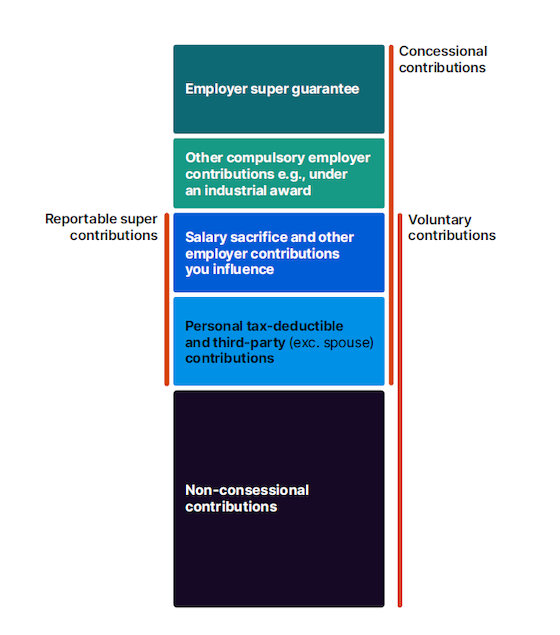
Your pre-tax income contributions (other than super guarantee) are your reportable super contributions, which:

  • appear on your online income statement or payment summary at the end of the income year

  • are not included in your assessable income, but are taken into account in income tests for some benefits, concessions and obligations administered by the ATO and Centrelink.

Caps apply to the amounts that can be contributed to your super each financial year. If you go over these caps, you may have to pay extra tax.

While there are restrictions on contributions, and your total super balance affects how the super rules apply to you, there is no limit on the total amount you can hold in accumulation phase in one or more super funds.

Main categories of superannuation contributions

Use ATO online services to find out how much super you have based on what super funds report to the ATO or contact us and we can help.

Log in to ATO online services

If you don’t have a myGov account, create one and link it to the ATO.

You can also use ATO online services to consolidate your super accounts and find any accounts you’ve lost touch with, including unclaimed super that has been transferred to us.

To help compare options and choose a super fund that meets your needs you can:

Or you can choose to speak to us. We can help when it comes to working out strategies to grow your super.

Source: ato.gov.au
Reproduced with the permission of the Australian Tax Office. This article was originally published on https://www.ato.gov.au/individuals/super/growing-and-keeping-track-of-your-super/growing-your-super/
.

Important:
This provides general information and hasn’t taken your circumstances into account.  It’s important to consider your particular circumstances before deciding what’s right for you. Although the information is from sources considered reliable, we do not guarantee that it is accurate or complete. You should not rely upon it and should seek qualified advice before making any investment decision. Except where liability under any statute cannot be excluded, we do not accept any liability (whether under contract, tort or otherwise) for any resulting loss or damage of the reader or any other person. 

Any information provided by the author detailed above is separate and external to our business and our Licensee. Neither our business nor our Licensee takes any responsibility for any action or any service provided by the author. Any links have been provided with permission for information purposes only and will take you to external websites, which are not connected to our company in any way. Note: Our company does not endorse and is not responsible for the accuracy of the contents/information contained within the linked site(s) accessible from this page.