
The conventional wisdom that retirees should abandon growth assets at 65 is outdated and potentially dangerous. It’s important to understand that retirement isn’t the finish line, it’s a marathon that often runs three decades.

Staying partially in growth assets in retirement can help sustain wealth. The real question isn’t whether to include growth assets, it’s how much to include.

Maintaining some growth assets in retirement

Australian Bureau of Statistics data shows the average intended retirement age is 65.6 years1, while ATO data reveals average super balances of around $430,000 for those aged 65-692. With potential retirements lasting 25-30 years, abandoning growth entirely means your purchasing power erodes relentlessly as inflation compounds.

In general, it is advantageous for retirees to maintain around 20-40% in equities to help combat inflation and provide capital growth. This isn’t about chasing aggressive returns; it’s about preserving real wealth.

Practical allocation strategies:

  • Age-based rules of thumb: The “100 minus your age” formula suggests a 65-year-old holds 35% in growth assets, gradually reducing to 20% by 80.
  • Objective-based: If your super and Age Pension comfortably cover fixed expenses, you can afford higher growth exposure in discretionary funds.
  • Time-horizon approach: Money needed within 5 years stays defensive; funds not required for 10+ years can remain growth-oriented.

Individual circumstances vary enormously depending on risk tolerance, total assets, and other income sources like the Age Pension.

What is sequencing risk?

Here’s where retirement investing gets genuinely dangerous and where many completely miss the threat until it’s too late.

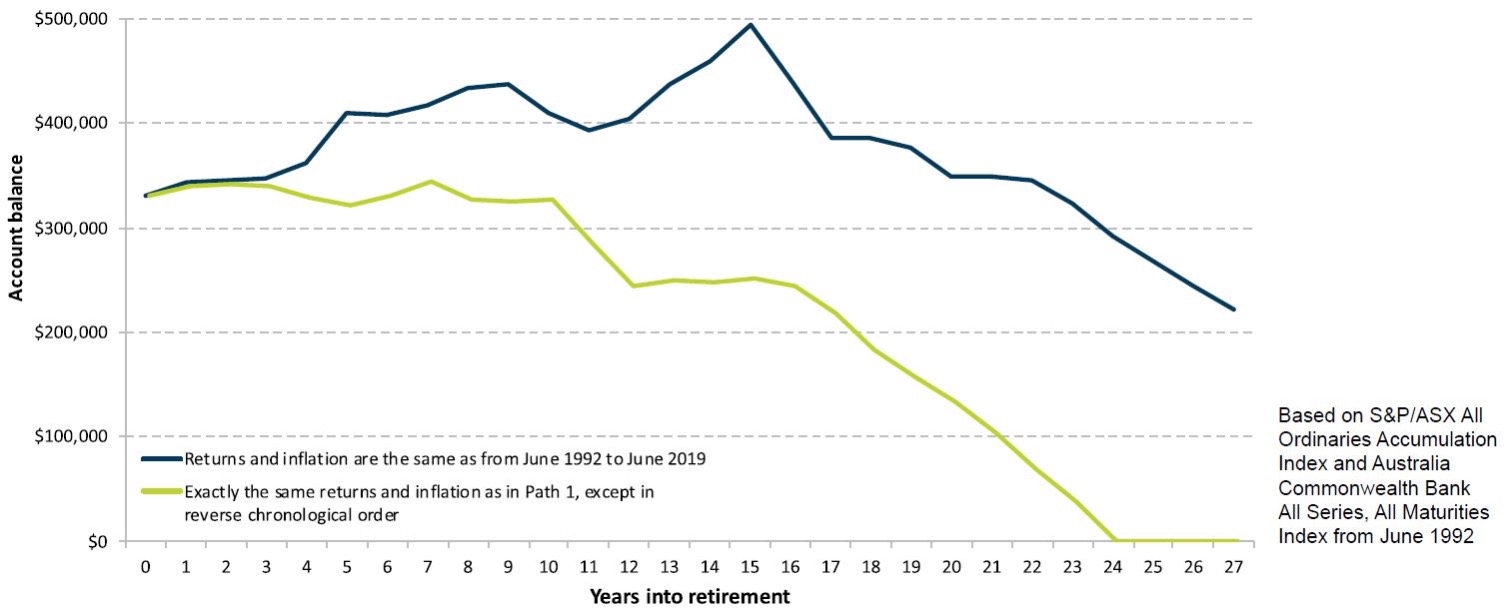
Sequencing risk is the risk that the order and timing of your investment returns are unfavourable, resulting in less money for retirement3. The retirement risk zone, the five years either side of retirement, is when sequencing risk matters most. A 37% market crash in year one of retirement (like 2008’s Global Financial Crisis) forces you to sell assets at depressed prices to meet minimum pension drawdowns, locking in losses permanently. The table below from Challenger shows the difference in impact if the same rates of market returns and inflation from June 1992 to June 2019 are sequenced in reverse chronological order. This reverse chronological sequence delivers wildly different outcomes.
Mitigating sequencing risk:

  • Use an income ‘bucketing’ strategy. In very simple terms, this means having enough cash set aside so you can recover from a large fall in the share market before you continue to withdraw income. Keep 2-3 years of living expenses in cash to avoid selling growth assets during market downturns.
  • Flexible withdrawals: Research shows flexible spending strategies, such as reducing withdrawals in down years, can significantly improve portfolio longevity compared to fixed dollar amounts4.
  • Partial annuities: Allocating 20-30% to lifetime income products eliminates sequence risk for that portion, guaranteeing baseline income regardless of market timing

Building a sustainable drawdown strategy

The famous “4% rule”, where you withdraw 4% of your balance in year one, then adjust annually for inflation, originated from US research in the 1990s. But 2026 isn’t 1994, and Australia isn’t America.

Morningstar’s 2025 retirement research suggests 3.9% is the highest safe starting withdrawal rate for new retirees seeking consistent inflation-adjusted spending, assuming a 90% probability of funds lasting 30 years5. That’s down from the traditional 4% because of current bond yields, equity valuations, and inflation expectations. However, the same research suggests retirees willing to tolerate spending fluctuations can start with withdrawal rates approaching 6%, significantly higher than the rigid 3.9% base case.

Australian-specific considerations:

Government-mandated minimum drawdown rates for 2025-26 range from 4% for ages 65-74, up to 14% for those 95+6. Crucially, you must withdraw these minimums from your super pension, but you don’t have to spend them. Unspent amounts can be kept in non-super accounts as emergency buffers or discretionary investment capital.

Building your drawdown framework:

  • Layer your income: Age Pension (if eligible) covers essentials, super pension provides lifestyle income, investment accounts fund discretionary spending.
  • Adjust annually: Review withdrawal amounts each January based on portfolio performance, spending needs, and health changes.
  • Separate essential from discretionary: If travel costs can be deferred during bear markets, you’ve dramatically reduced sequence risk.
  • Consider bucketing: Year 1-3 expenses in cash, years 4-10 in bonds/conservative assets, 10+ years in growth investments.

Your next move

Pull out your super statement and calculate: what percentage of your balance are you withdrawing annually? Does your portfolio allocation match your actual time horizon? Have you stress-tested what happens if markets drop 30% in your first retirement year?

If your current withdrawal rate exceeds your portfolio’s likely real returns, you’re in capital depletion mode, acceptable if intentional, dangerous if accidental.

The difference between thriving financially through a 30-year retirement versus anxiously watching your balance dwindle comes down to one strategic decision at 65: accepting that retirement is too long to abandon growth entirely, while respecting that sequence matters more than average returns.

The information contained in this article is general information only. It is not intended to be a recommendation, offer, advice or invitation to purchase, sell or otherwise deal in securities or other investments. Before making any decision in respect to a financial product, you should seek advice from an appropriately qualified professional.  We believe that the information contained in this document is accurate. However, we are not specifically licensed to provide tax or legal advice and any information that may relate to you should be confirmed with your tax or legal adviser.

1 Retirement and Retirement Intentions, Australia | Australian Bureau of Statistics

2 Average super balances reach record highs says ASFA – Financial Newswire

3 Sequencing risk explained

4 Can you manage sequencing risk in retirement?

5 What’s a Safe Retirement Withdrawal Rate for 2026? | Morningstar

6 Income stream (pension) rules and payments | Australian Taxation Office

Divorce is one of life’s most disorienting experiences. Even when it’s the right decision, the financial fallout can feel overwhelming.

In 2024, almost 50,000 divorces were granted in Australia,1 and for many, the hardest part isn’t the legal process. It’s figuring out what comes next. A clear financial plan can help you recover and start over smarter.

Asset division: know the rules before you sign anything

Under the Family Law Act 1975 (Cth)2, the Federal Circuit and Family Court of Australia divides the total asset pool, including property, investments, debts and superannuation, on a “just and equitable” basis.

Key points for action:

  • Time limits are strict: married couples must commence property settlement proceedings within 12 months of a divorce order becoming final; de facto couples have 2 years from the date of separation.3 Missing these windows means applying to the court for special leave, which is not guaranteed.
  • Full financial disclosure is now a statutory duty codified directly into the Family Law Act from 10 June 2025.4 Failure to disclose could result in contempt of court, adverse cost orders, or an unfavourable property outcome.
  • Get independent legal and financial advice before signing, especially where a business, investment property or defined benefit super fund is involved.

Protecting yourself now: the immediate financial to-do list

There are practical steps you need to take before you start to think about rebuilding. Many people focus on the headline settlement and overlook the practical steps they should take to protect themselves right now.

  • Open individual bank accounts in your own name for salary and day-to-day transactions.
  • Cancel joint credit cards and remove your name from shared debts or utilities you’re no longer responsible for, as you remain legally liable until you do so.
  • Update your superannuation beneficiary nominations immediately. Old binding nominations may still legally direct your super to a former partner.
  • Review all joint insurance policies (home, car, life). Separation can alter or void cover without either party realising until it’s too late.

Rebuilding credit and savings: slow and steady wins

Once the settlement dust settles, the rebuilding phase can begin by taking steps to establish your new financial household.

  • Check your credit report via a free provider such as Equifax or illion. Dispute any joint debts incorrectly listed solely in your name.
  • Build a new budget based using tools such as ASIC’s MoneySmart budget planner5.
  • Prioritise a modest emergency fund (3 months of living expenses) before aggressively investing. Stability comes before growth.
  • If you receive a lump sum from the settlement, resist the urge to invest everything at once. A staged approach with a clear strategy can help reduce costly emotional decision-making.
  • Consider whether you qualify for government support, such as Family Tax Benefit, Child Care Subsidy or the Single Income Family Supplement, if children or dependents are involved.

Super splitting explained: don’t leave retirement money on the table

Superannuation is often a couple’s second-largest asset after the family home, yet it’s the most commonly overlooked in settlements. Under the Family Law Act6, super is treated as property and can be split by agreement or court order for both married and de facto couples (including same-sex couples). The Family Law (Superannuation) Regulations 20257 govern how super interests are valued and divided.

  • You are entitled to request details of your former partner’s super fund(s) directly. If details remain unclear, the Family Court can obtain super information from the ATO.8
  • Splits are formalised via a Superannuation Agreement or Consent Orders. Both parties must receive independent legal advice when using a formal Superannuation Agreement.
  • The super fund trustee must be given at least 28 days’ written notice of any proposed splitting order before it is filed with the court.9
  • Super interests of generally $5,000 or less cannot be split. Defined benefit funds and SMSFs require specialist valuation.
  • Splitting super does not create immediate cash; the amount remains preserved under superannuation law until the receiving party meets a condition of release.
  • Consider the long-term retirement impact of any split. A staged financial modelling conversation with your adviser before finalising any agreement can make a significant difference to your retirement outcome.

Your next step

Financial recovery after separation is not a straight line, but it is entirely achievable. The key is not to navigate it alone.

A coordinated approach between your financial adviser and your family lawyer, early in the process, can prevent costly mistakes and save significant money. If you’re going through a separation or simply want to understand your options before one arises, reach out. This is exactly what we’re here for.

The information contained in this article is general information only. It is not intended to be a recommendation, offer, advice or invitation to purchase, sell or otherwise deal in securities or other investments. Before making any decision in respect to a financial product, you should seek advice from an appropriately qualified professional.  We believe that the information contained in this document is accurate. However, we are not specifically licensed to provide tax or legal advice and any information that may relate to you should be confirmed with your tax or legal adviser.

1 https://www.abs.gov.au/statistics/people/people-and-communities/marriages-and-divorces-australia/latest-release
2 Family Law Act 1975 – Federal Register of Legislation
3 https://www.legislation.gov.au/current/C2024C00340
4 https://www.ag.gov.au/families-and-marriage/publications/family-law-property-changes-10-june-2025-fact-sheet-separating-couples
5 https://moneysmart.gov.au/budgeting/budget-planner
6 Family Law Act 1975 – Federal Register of Legislation
7 Valuing superannuation interests – defined benefit interests | Attorney-General’s Department
8 Family law and superannuation | Federal Circuit and Family Court of Australia
9 https://www.ag.gov.au/families-and-marriage/families/superannuation-splitting

Libet Casino, a rising star in the online gaming world, distinguishes itself with a robust promotional framework designed to attract and retain players. The platform offers a myriad of bonuses and incentives that enhance the gaming experience and maintain player loyalty. Understanding the promotional offerings at libet casino is crucial for anyone looking to make the most of their online gambling journey.

Understanding the Bonus Ecosystem

Libet Casino has developed a comprehensive bonus system that includes welcome offers, ongoing promotions, and a loyalty program that rewards frequent players. New players are greeted with generous welcome bonuses that can significantly boost their initial gaming balance. These promotions often come with terms and conditions that players should familiarize themselves with to ensure a rewarding experience.

Regular promotions are another highlight, featuring limited-time offers that provide extra incentives, such as free spins or deposit bonuses. Maintaining a dynamic promotional calendar ensures that players always have something new to look forward to, which enhances the overall engagement on the platform.

Types of Bonuses Available

  • Welcome Bonuses for new players
  • Reload Bonuses for existing players
  • Cashback Offers to mitigate losses
  • Free Spins on selected games
  • Loyalty Rewards for frequent players

The welcome bonus typically matches the initial deposit and may include free spins. Reload bonuses encourage players to deposit further, while cashback offers provide a safety net for those experiencing a losing streak. Free spins can be used on specific slots, adding an exciting dimension to the gameplay.

Wagering Requirements Explained

While the bonuses available at Libet Casino are appealing, it is important to understand the wagering requirements attached to them. These requirements dictate how many times a player must wager the bonus amount before cashing out winnings. For example, a 30x wagering requirement on a €100 bonus means players must place bets totaling €3,000 before they can withdraw funds.

Transparency is a key feature of Libet Casino’s promotions, with clear terms outlined on the site. Players are encouraged to review these terms to align their gaming strategies accordingly. Understanding the conditions ensures that players can capitalize on the bonuses effectively.

Player Support and Engagement

Libet Casino not only offers attractive promotions but also emphasizes player support through various channels. Live chat, email, and a comprehensive help center are available to assist players with any queries regarding promotions or account issues. This level of support fosters a reliable environment for players, enhancing their overall satisfaction.

The combination of an engaging promotional program and strong player support makes Libet Casino a compelling choice for both newcomers and seasoned players alike.

Bonus Type Wagering Requirement Validity Period
Welcome Bonus 30x 30 days
Reload Bonus 25x 14 days
Free Spins No Wagering 7 days

FAQ About Promotions at Libet Casino

What bonuses are available for new players at Libet Casino?
New players can enjoy a substantial welcome bonus, typically including match bonuses and free spins.

Are there ongoing promotions for existing players?
Yes, Libet Casino offers reload bonuses, cashback offers, and regular promotions to keep players engaged.

What should players know about wagering requirements?
Wagering requirements specify how many times players must bet the bonus amount before they can withdraw any winnings.

Richy Fish Casino, an emerging player in the online gaming industry, is committed to navigating fair gaming practices and ensuring a safe environment for its users. This platform not only guarantees a diverse gaming catalog but also adheres to strict regulatory standards, making it a reliable choice for players seeking integrity and excitement in their gaming experience. The casino aims to provide transparency and fairness, essential aspects of its operation that differentiate it from many competitors. richy fish casino

Ensuring Fairness and Security

Richy Fish Casino places a strong emphasis on fair gaming practices and player security. The platform operates under a reputable gaming license, ensuring compliance with regulatory standards that prioritize user protection. Advanced encryption technologies safeguard sensitive data, instilling player confidence in the safety of their personal and financial information.

Moreover, the casino employs random number generators (RNGs) to guarantee the unpredictability of game outcomes. This technological approach is a cornerstone of fair play, ensuring that all players have an equal chance of winning. Through regular audits by independent testing agencies, Richy Fish Casino demonstrates its commitment to upholding industry standards.

Diverse Gaming Portfolio

The gaming catalog at Richy Fish Casino is expansive, featuring a wide range of options that cater to various player preferences. From classic table games to a plethora of slot machines, the platform provides entertainment from top-tier providers known for their innovation and quality.

  • Table Games: Blackjack, Roulette, Baccarat
  • Slot Machines: Video slots, Progressive jackpots
  • Live Casino: Real-time gaming with professional dealers
  • Specialty Games: Keno, Bingo, Scratch Cards

This breadth of offerings ensures that players can find something that suits their interests, accommodating both casual gamers and high rollers alike.

Bonuses and Promotions

Richy Fish Casino enhances its appeal through a robust bonus structure designed to reward both new and loyal players. The welcome package includes a generous match bonus on the first deposit, encouraging newcomers to explore the platform. Regular promotions and loyalty rewards further enhance the player experience, promoting engagement and retention.

Below is a summary of the key bonus offerings:

Bonus Type Details Wagering Requirements
Welcome Bonus 100% match up to £200 30x
Free Spins Up to 50 spins on selected slots 25x
Loyalty Program Earn points for every bet N/A

Player Support and Experience

Richy Fish Casino prioritizes exceptional player support, offering multiple channels for assistance, including live chat, email, and a comprehensive FAQ section. The support team is available 24/7, ensuring that players receive timely help with any inquiries or issues.

Additionally, the platform is designed with user experience in mind, featuring an intuitive layout and seamless navigation. This focus on usability helps players easily find their favorite games and access essential information quickly.

FAQ

Is Richy Fish Casino a safe platform?
Yes, it operates under a reputable license and employs advanced encryption technologies.
What types of games are available?
The casino offers a variety of games, including slots, table games, and live dealer options.
Are there bonuses for new players?
Yes, new players can benefit from a welcome bonus and additional promotions.

Ocean Breeze Casino has recently introduced a variety of exciting new features that set it apart in the competitive online gaming market. As an innovative platform, it aims to enhance the overall user experience while providing players with more options and greater rewards. For more details, visit https://oceanbreezecasinos.net.

Expanded Game Library

One of the standout updates at Ocean Breeze Casino is its expanded game library. Players can now enjoy a wider selection of games, including classic slots, video slots, table games, and live dealer options from top developers such as NetEnt, Microgaming, and Evolution Gaming. The introduction of new titles on a regular basis ensures that players always have fresh content to explore.

The growth of the game library includes various themes and mechanics, catering to both casual players and gaming enthusiasts. Popular game categories such as progressive jackpots and high-stakes tables are now more easily accessible, enhancing the overall gaming experience.

Enhanced Bonus Program

The casino has also revamped its bonus program, offering lucrative welcome bonuses, ongoing promotions, and a robust loyalty scheme. New players will find a generous welcome package that boosts their initial deposits significantly, while existing players can take advantage of regular cashback offers and daily promotions.

  • Welcome bonus: up to 200% on first deposit
  • Weekly cashback: 10% on losses
  • Loyalty points redeemable for cash and prizes

This enriched bonus structure not only attracts new players but also rewards loyal customers, making Ocean Breeze Casino an appealing choice for various types of gamblers.

Mobile Experience and Usability Improvements

Recognizing the increasing trend of mobile gaming, Ocean Breeze Casino has optimized its platform for mobile devices. The mobile interface is sleek, user-friendly, and fully functional, allowing players to enjoy their favorite games on the go without any compromise in quality. Additionally, the casino has introduced a dedicated mobile app, enhancing accessibility and convenience.

Navigation has also been streamlined, with categories clearly defined and games easily searchable. This focus on usability ensures that even new players can swiftly find their desired games without frustration.

Player Support and Safety Measures

Ocean Breeze Casino prioritizes player safety and satisfaction, incorporating comprehensive support channels and advanced security measures. The platform uses state-of-the-art encryption to protect user data, and it holds an official gaming license that reinforces its credibility.

Players can access customer support via live chat, email, and phone, ensuring that their concerns are addressed promptly. The casino also promotes responsible gaming practices, providing tools to help players manage their gambling habits effectively.

Feature Description Benefit
Game Variety Expanded selection of games Catering to diverse player preferences
Bonus Offers Revamped loyalty program Attracting new players and retaining existing ones
Mobile Platform Optimized for mobile usage Convenient play anywhere, anytime

FAQ

What types of games are available at Ocean Breeze Casino?
Players can find a variety of games including slots, table games, and live dealer options from renowned providers.

Are there bonuses for new players?
Yes, Ocean Breeze Casino offers a generous welcome bonus that significantly boosts new players’ first deposits.

How can I access customer support?
Customer support can be reached via live chat, email, and phone for any player inquiries.

The Blood Moon Casino stands out in the competitive landscape of online gaming, offering a unique blend of entertainment and opportunities for players. This platform is designed for those seeking an immersive experience with a diverse array of games, a user-friendly interface, and a commitment to safety and security.

Gaming Catalog Overview

At Blood Moon Casino, players will find an extensive gaming library, featuring a variety of options from renowned software providers. The platform includes classic slots, modern video slots, table games, and live dealer offerings. Players can explore:

  • Hundreds of slot titles with different themes
  • Popular table games like blackjack, roulette, and poker
  • Live casino games for a more engaging experience
  • A selection of progressive jackpots

The variety ensures that every player finds something that appeals to their gaming style, whether they are casual players or high rollers looking for excitement.

Trust and Security

Safety is a priority at Blood Moon Casino. The platform is licensed and regulated, ensuring fair play and player protection. Advanced encryption technology secures players’ personal and financial information, making transactions safe. Additionally, the casino promotes responsible gaming, providing tools to help players manage their gaming activities.

Bonus Ecosystem

Blood Moon Casino offers an attractive bonus system to welcome new players and reward loyalty. The platform provides:

Bonus Type Details Wagering Requirement
Welcome Bonus 100% match on first deposit 30x
Free Spins 50 free spins on selected slots 20x
Loyalty Rewards Points for playing, redeemable for bonuses N/A

These bonuses enhance the overall gaming experience, providing added value and encouraging players to return regularly.

Player Support Services

The support team at Blood Moon Casino is readily available to assist players with any inquiries or issues. Players can contact support via live chat, email, or phone. This accessibility ensures a smooth experience for all users, enhancing player satisfaction and trust in the platform.

FAQ

What games are available at Blood Moon Casino?
Players can enjoy a wide range of slots, table games, and live dealer options across various categories.

How secure is my information at Blood Moon Casino?
The platform employs advanced encryption technology to safeguard personal and financial data.

What types of bonuses can I expect?
Blood Moon Casino offers a welcome bonus, free spins, and loyalty rewards to enhance gameplay.

The dream versus the plan

Australians are starting side hustles at a remarkable pace, and plenty are quietly outgrowing their day jobs. But enthusiasm alone doesn’t pay the bills. The leap from side income to full-time business is one of the most consequential financial decisions you’ll make, and the difference between freedom and financial stress often comes down to timing and preparation.

Signs your business is genuinely ready

Before numbers, look at patterns. Your side hustle is signalling readiness when:

  • Revenue is consistent, not just impressive. A few big months are not sufficient. You want at least 12 months of stable or growing income that reliably covers your target salary.
  • You have a client base, not just clients. Repeat customers and referrals are the hallmarks of a sustainable business; one-off work is a freelance gig.
  • You’re turning away work. If your day job is costing you business opportunities, the market has already decided for you.
  • You’ve crossed, or are approaching, $75,000 in annual turnover. At this point, GST registration becomes mandatory within 21 days, a clear signal that you’re operating at a genuine business scale1.

Financial benchmarks to hit first

Passion is the ignition, but these are the fuel:

  • Replace 100–120% of your current take-home pay. Not gross salary, take-home. Factor in the tax you’ll need to pay, including quarterly PAYG instalments and GST obligations if applicable.
  • Build a personal emergency buffer of 6-12 months’ expenses. As a recommended baseline, your income stability and personal circumstances determine where in that range you sit.
  • Separate business and personal finances completely. A dedicated business account, accounting software, and a registered accountant are recommended before you go full-time. Treating these as foundational steps ensures you have the necessary “ducks in a row” to manage risks and focus on growth rather than administrative chaos.
  • Understand your new tax and cashflow reality. Australia’s 2025–26 marginal personal tax rates run from 16% to 45% once the tax-free threshold is reached. As a sole trader, your entire net profit is taxable income. A tax planning conversation before you resign is worth every dollar.

Risk mitigation: protect the leap

  • Don’t cancel your income protection insurance. It’s a good idea to review and upgrade it. Self-employed Australians have no sick leave safety net; income protection is the substitute.
  • Consider your super. Your employer’s 12% Superannuation Guarantee contributions disappear the moment you resign. Build voluntary super contributions into your business budget from day one to avoid a painful retirement shortfall later.
  • Set a hard go/no-go date. Give yourself a specific timeline (typically 6–12 months) to hit your benchmarks. Open-ended “someday” plans rarely become reality.

The businesses most likely to succeed aren’t necessarily the most inspired; they’re the ones that planned the leap before they took it.

The information contained in this article is general information only. It is not intended to be a recommendation, offer, advice or invitation to purchase, sell or otherwise deal in securities or other investments. Before making any decision in respect to a financial product, you should seek advice from an appropriately qualified professional.  We believe that the information contained in this document is accurate. However, we are not specifically licensed to provide tax or legal advice and any information that may relate to you should be confirmed with your tax or legal adviser.

1 Registering for GST | Australian Taxation Office

Here’s a truth most Australian 30-somethings discover too late, the super contributions you make this decade will outperform those you make in your 40s and 50s, even if you contribute less.

Why? Because time is your secret weapon, and compound returns are doing the heavy lifting.

The power of early contributions

Think of your super like a snowball rolling down a mountain. When you’re 30, that snowball has 35 years to gather momentum before you reach retirement. Every dollar you contribute today earns returns, and those returns earn returns, creating an exponential growth pattern known as compounding that can transform modest contributions into substantial wealth over time.

Salary sacrifice vs after-tax contributions

Your 30s present a strategic fork in the road. Should you salary sacrifice (concessional contributions) or boost your after-tax (non-concessional) contributions? For most Australians, salary sacrifice is the winner.

This is because salary sacrifice contributions are taxed at just 15% inside super, compared to your marginal tax rate, which could be 32% (including Medicare levy) or higher. For example, if you’re earning $90,000, every $1,000 you salary sacrifice saves you $170 in tax.

If you are a high-income earner, additional tax of 15% may be applied to your concessional contributions, making the tax rate for these contributions 30%. However, being a high-income earner, your marginal tax rate is expected to be 47%, including the Medicare levy. This means making concessional contributions may still be tax effective.

For the 2025-26 Financial Year, the concessional contribution cap is $30,000, including your employer’s 12% Superannuation Guarantee contributions. On a $90,000 salary, with your employer contributing $10,800, you have $19,200 in available concessional contributions cap space.

  • Salary sacrifice advantage: Tax-effective, reduces taxable income, ideal for most working Australians.
  • After-tax contributions: Useful when you’ve maxed out concessional caps or have a low income (potentially attracting government co-contributions)1.
  • The sweet spot: For those with super balances under $500,000, you can carry forward unused concessional caps from the previous five years, a golden opportunity to catch up2.

Choosing the right investment option

Your 30s afford you the luxury of time to recover from market volatility, making this the prime decade to embrace growth-focused investments.

Many default ‘lifecycle’ superannuation options invest heavily in higher growth assets when you’re under 50, gradually shifting to conservative investments as retirement approaches. This autopilot approach may not work for everyone, so it pays to understand your options.

For 30-somethings, consider whether you are invested in:

  • Growth or High Growth options: Typically 70-100% in shares and property, potentially targeting higher long-term returns.
  • Balanced options: A middle ground with 60-80% growth assets if volatility concerns you.
  • Lifecycle strategies: Automatically adjusts your risk profile as you age, set and forget.

Performance matters enormously over decades. A fund delivering 7% annually versus 5% can mean a difference of hundreds of thousands of dollars at retirement. You can compare your fund’s long-term returns (10+ years) and fees using tools like the government’s YourSuper3 comparison tool.

Your next move

This decade is your super sweet spot.

Log into your fund, check your current investment option, calculate your available contribution cap, and consider even a modest salary sacrifice increase.

A 30-year-old adding $50 per week to their super could see that translate to an extra $100,000-plus at retirement. That’s not sacrifice; that’s strategic wealth building.

The information contained in this article is general information only. It is not intended to be a recommendation, offer, advice or invitation to purchase, sell or otherwise deal in securities or other investments. Before making any decision in respect to a financial product, you should seek advice from an appropriately qualified professional.  We believe that the information contained in this document is accurate. However, we are not specifically licensed to provide tax or legal advice and any information that may relate to you should be confirmed with your tax or legal adviser.

1 Government co-contribution: up to $500 per year if you earn $62,488 or less and make after-tax contributions (2025-26)

2 https://www.ato.gov.au/tax-rates-and-codes/key-superannuation-rates-and-thresholds/contributions-caps

3 https://www.ato.gov.au/calculators-and-tools/super-yoursuper-comparison-tool

Ten years ago, neighbours Phil and Ann were both 55 and eyeing retirement. Phil built a portfolio of high-yielding mining stocks paying 8% dividends, generating immediate cash flow. Ann chose steadily growing companies like Woolworths and Telstra, accepting a modest 4% yield. Ten years later, Phil’s income barely budged while costs climbed 30%. Ann’s growing dividends now exceed Phil’s, and her portfolio value has doubled.

Same starting point, different strategies, profoundly different outcomes. Dividend investing isn’t just about collecting passive income; it’s about choosing the right type of income for your timeline and goals.

High-yield vs dividend growth strategies

In late 2025, the ASX200 dividend yield sat at 3.3%, one per cent below its 10-year average of 4.3%1, making strategic selection more critical than ever.

Research shows that simple high-yield strategies have consistently underperformed the market on a long-term view2. Why? Because companies offering sky-high yields (often 7-10%) frequently do so because their growth has stalled. These companies believe the most efficient use of capital is returning it to investors rather than reinvesting for expansion3. That 9% yield may look attractive, but if the dividend stays flat while inflation runs at 3% annually, you’re losing purchasing power every year.

Dividend growth investing flips this equation. Companies like Australian energy company, APA Group, have increased dividends annually for 20 consecutive years, including through the Global Financial Crisis and COVID. A $100,000 investment in APA in 2012 initially yielded 5.3%, generating $5,300 income that year. By 2025, that same investment generated $11,200 annually, an 11.2% yield on the original capital, while average market yields remained around 5-6%4. The share price appreciation mirrored the income growth, delivering superior total returns.

Creating a dividend portfolio

Building a sustainable income portfolio requires more discipline than simply buying the highest yields you can find. Franked dividends are generally better for most investors in Australia because they include tax credits (franking credits) that reduce your personal tax on the dividend, sometimes even resulting in a cash refund if you’re in a low tax bracket, effectively giving you more after-tax income.

  • Start with quality and diversification: For example, spread holdings across market sectors to reduce concentration risk and exposure to different economic drivers. High current yields are typically found in utilities, real estate, energy, and financial services sectors.
  • Assess sustainability before yield: Companies with payout ratios below 80% and strong free cash flow generation typically offer more sustainable dividends than those stretching to maintain high payouts5. A 10% yield means nothing if the dividend gets slashed next year.
  • Consider your timeline and strategy:
    • 10+ year horizon (Growth approach): Weight toward dividend growth companies with 3-5% starting yields that compound over decades.
    • 5-10 year horizon (Balanced approach): Combining moderate yields (4-6%) with some growth potential.
    • Immediate income needs (High-yield approach): Higher yields (6-8%) from established, defensive companies with visible cash flows.

Your next move

Don’t chase yield blindly. Are your dividends growing faster than inflation or simply generating income that loses purchasing power annually?

The difference between retiring comfortably and struggling financially often comes down to whether you prioritised yield growth alongside current income.

The information contained in this article is general information only. It is not intended to be a recommendation, offer, advice or invitation to purchase, sell or otherwise deal in securities or other investments. Before making any decision in respect to a financial product, you should seek advice from an appropriately qualified professional.  We believe that the information contained in this document is accurate. However, we are not specifically licensed to provide tax or legal advice and any information that may relate to you should be confirmed with your tax or legal adviser.

1 https://www.morningstar.com.au/stocks/navigating-asx-dividend-landscape-2026
2 4 picks for sustainable and growing dividends
3 4 picks for sustainable and growing dividends
4 https://www.morningstar.com.au/stocks/navigating-asx-dividend-landscape-2026
5 4 picks for sustainable and growing dividends

More Australians qualify for the pension than you’d think

Here’s a number that surprises most retirees: you don’t need to be asset-poor to receive the Age Pension. A single homeowner can hold up to $722,000 in assessable assets and still receive a part pension; for a homeowner couple, that threshold rises to $1,085,0001. Even a modest part-pension unlocks access to the Pensioner Concession Card, worth thousands of dollars annually in healthcare, rates, and utility discounts alone. Understanding how the system works is the first step to ensuring you receive every dollar you’re entitled to.

The two tests: assets and income

Centrelink applies two means tests simultaneously, and your payment is determined by whichever produces the lower result.

  • Assets test. To qualify for the full Age Pension, a single homeowner’s assessable assets must be below $321,500; for a homeowner couple, the threshold totals $481,5002. The taper rate is steep: for every $1,000 in assessable assets above the lower threshold, your pension is reduced by $3 per fortnight. Your family home is usually exempt; however, your super (once you reach Age Pension age), investment accounts, vehicles, and even household contents are all assessed.
  • Income test. Singles can earn up to $218 per fortnight before their pension reduces; for couples, the combined income is $380 per fortnight3. Above these thresholds, the pension reduces by 50 cents for every dollar earned by singles, and 25 cents per dollar for each member of a couple. Critically, Centrelink uses deeming to calculate income from financial assets, applying 1.25% on the first $64,200 for singles ($106,600 for couples) and 3.25% on amounts above that, regardless of what those assets actually earn4.
  • Work Bonus — you can earn up to $300 per fortnight from employment or self-employment without it affecting your pension, with unused amounts accruing in a Work Bonus balance of up to $11,800.

Gifting rules: generous intentions, strict limits

Transferring assets to family is a natural retirement impulse; however, Centrelink has clear rules around this. You can gift up to $10,000 in a financial year and a maximum of $30,000 over a rolling five-year period without penalty5. Anything above these limits is treated as a “deprived asset” and counted as if you still own it for five years from the date of the gift, assessed under both the assets and income tests.

The planning opportunity here is real, but timing matters. Gifting can begin before you reach Age Pension age at 67, the five-year clock starts from the date of the gift, not the date you claim. A gift made at 64 will clear Centrelink’s books by the time you turn 69. Strategic, early gifting within the allowable limits is a legitimate and effective tool, but only if it’s planned, not improvised.

Restructuring assets for a better outcome

This is where real value is unlocked, and where the difference between a well-advised and an unadvised retiree can be measured in tens of thousands of dollars over a retirement:

  • Invest in your home. Renovations, upgrades, or paying down a mortgage all convert assessable assets into an exempt one. Every dollar shifted into your principal residence reduces your assessable asset base.
  • Funeral bonds and prepaid funerals. Funeral bonds are exempt from the assets test up to $15,750 per person6. Alternatively, a prepaid funeral plan with a valid contract is fully exempt with no upper cap, making it the more powerful option for many retirees.
  • Correct asset valuations. Centrelink requires second-hand value, not replacement or insurance value. A fair estimate for home contents is typically $10,000 for couples and $5,000 for singles.
  • Special Disability Trusts. Eligible family members can contribute up to $500,000 into a Special Disability Trust for a family member with severe disability without triggering gifting rules, with assets inside exempt from the assets test up to $832,7507.

Where a financial adviser adds value

The Age Pension system is simultaneously one of Australia’s most valuable retirement entitlements and one of its most complex. The rules interact in ways that reward careful planning and punish guesswork.

  • Modelling both tests together. An adviser can model your numbers through both the assets and income tests simultaneously, identify which test is constraining your entitlement, and build a restructuring strategy that addresses the right lever. Most retirees have no idea which test is limiting them.
  • Pre-retirement restructuring. The five-year gifting clock, asset restructuring, and super drawdown sequencing all need to be set in motion before you reach 67, not after. An adviser can assist in coordinating these timelines to ensure strategies are in place when they count.
  • Deeming versus actual returns. With deeming rates currently set at 1.25% and 3.25%8 and quality defensive assets earning more, an adviser can help structure your investment portfolio to increase your actual income while reducing deemed income, keeping you on the right side of the income test.
  • Ongoing review. Thresholds are indexed in March, July, and September each year, and your personal asset values change constantly. Careful restructuring of assets can provide a welcome boost to your Age Pension rate; however, it’s important to look at the bigger picture. The more work your pension does, the less you’ll need to draw from your retirement savings. An adviser monitors this continuously, not just at the point of claiming.

The Age Pension should not be an afterthought. For many Australians, it is a meaningful and growing component of retirement income. The question is whether you have a plan to claim your full entitlement or are simply hoping for the best.

These figures are current as at 21 March 2026.

The information contained in this article is general information only. It is not intended to be a recommendation, offer, advice or invitation to purchase, sell or otherwise deal in securities or other investments. Before making any decision in respect to a financial product, you should seek advice from an appropriately qualified professional.  We believe that the information contained in this document is accurate. However, we are not specifically licensed to provide tax or legal advice and any information that may relate to you should be confirmed with your tax or legal adviser.

1 Assets test for Age Pension – Age Pension – Services Australia
2 Assets test for Age Pension – Age Pension – Services Australia
3 Income test for Age Pension – Age Pension – Services Australia
4 Deeming – Age Pension – Services Australia
5 Gifting – Age Pension – Services Australia
6 Funeral bonds and prepaid funerals – Age Pension – Services Australia7 Benefits of Special Disability Trusts – Special Disability Trusts – Services Australia
8 Deeming – Age Pension – Services Australia